

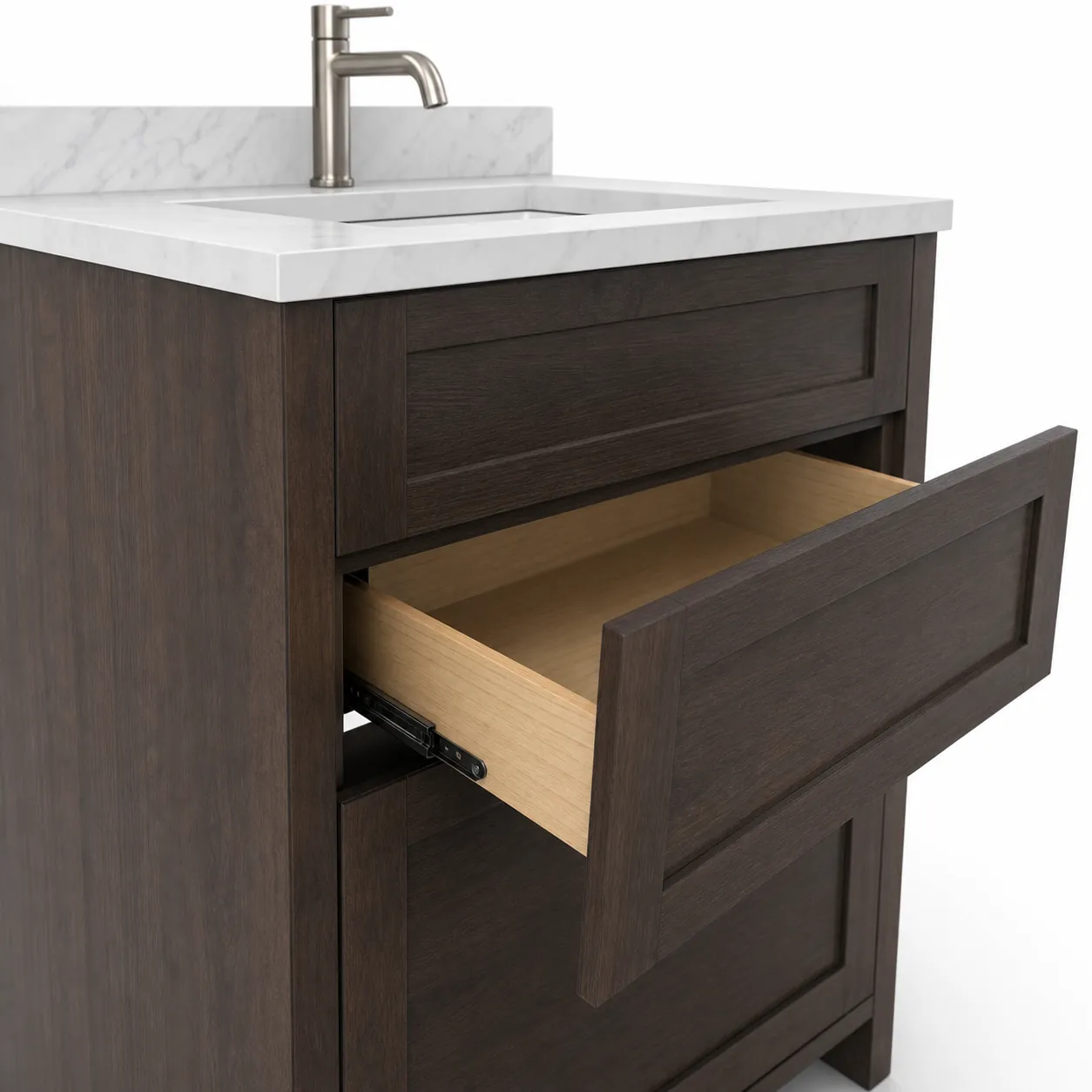
regional hardware specification is the first checkpoint buyers should lock before they approve a supplier, budget, or production slot. Day 1, the purchase order lands. Day 14, the pre-production sample ships. By Day 45, the container arrives at port — and within 72 hours of uncrating, a project manager in Atlanta catches the first failure: drawer slides rated for residential use got installed into a high-traffic commercial vanity. The spec sheet said 75 lb dynamic load. The ADA compliance review required 100 lb. A $50,000 order just became a change-order negotiation that pushes the project completion date back by six weeks. This isn’t a material defect. It’s a regional hardware specification failure, and it happens when the approved sample passes visual inspection but no one validates the functional rating against the destination market’s operational reality.
Most procurement checklists treat hardware as a binary checkbox — does it open and close? That standard collapses the moment you ship the same hinge to Lagos and London. A soft-close clip-on tested in a Munich showroom won’t survive 18 months in coastal Mombasa without a zinc-plating layer thick enough to block salt-laden humidity. The core mistake isn’t buying cheap components. The mistake is buying components that were never qualified for the specific thermal, mechanical, and chemical stress of the end-user location. Fix that at the sample approval stage, and the quality tolerance on the mass production run tightens automatically.
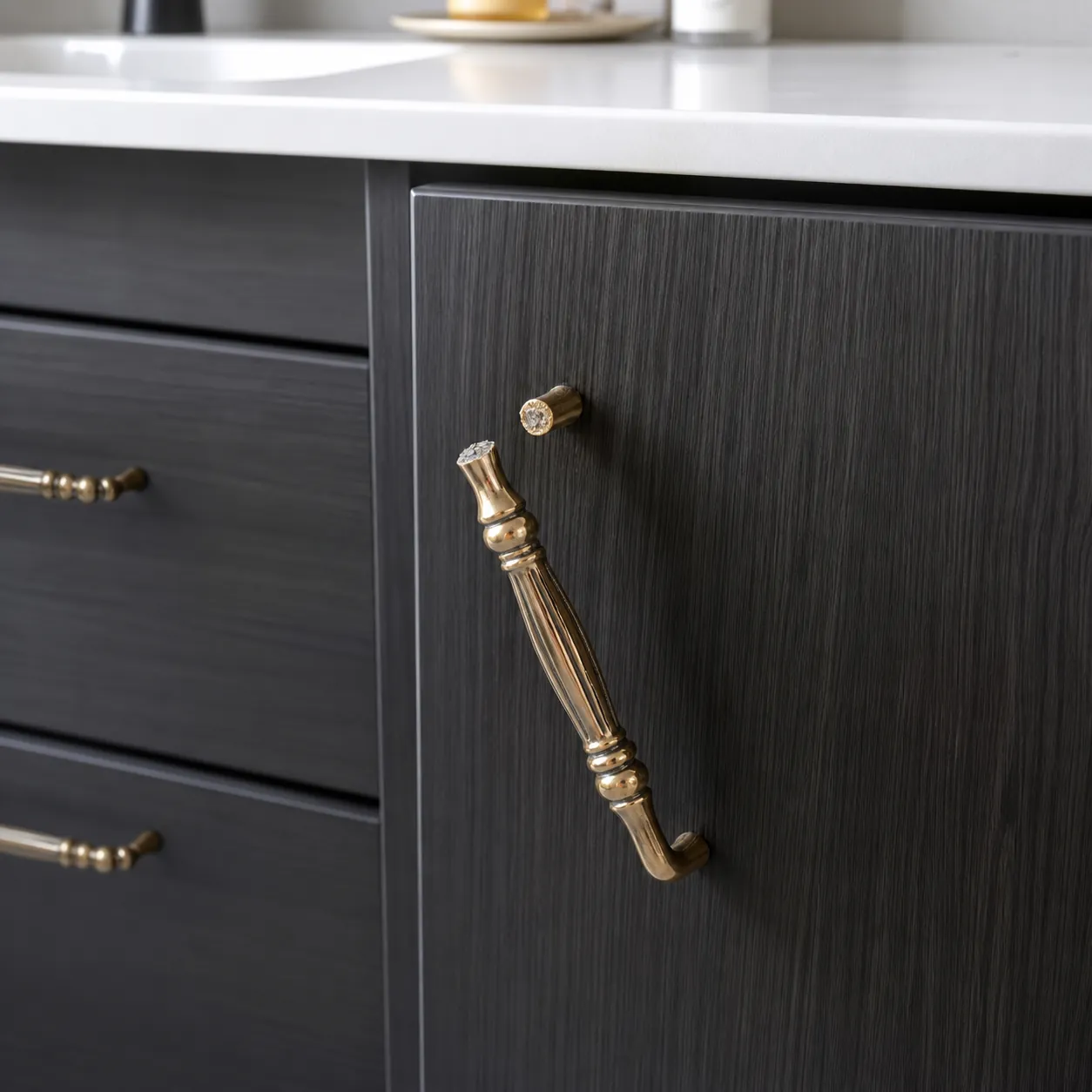
Mapping Hardware Requirements to Global Markets
Hardware specs that work in Chicago fail in Mombasa within a year.
Most vanity hardware catalogs list the same hinge for every market. That approach costs importers real money. A distributor in Nigeria traced 20% of warranty claims back to untreated hinge corrosion—standard zinc-plated slides had rusted through in under two wet seasons. The hardware wasn’t defective, just specified for a different climate.
North America: ADA Compliance and Heavy‑Duty Load
In the U.S. and Canada, accessibility rules define the hardware spec. ADA standards limit the force required to open a drawer to 5 pounds of pull force. A 100-pound dynamic-rated slide, pre-loaded and tested with a full extension load, keeps the opening effort below that threshold. Slides rated for 75 pounds routinely fail this test when the drawer is loaded with toiletries. For project procurement managers, the spec sheet must show the dynamic load rating—not just the static number—to satisfy the accessibility consultant.
-
-
- Critical Spec: Full-extension slides with 100 lb dynamic rating, soft-close mechanism, and drawer front reinforcement to handle 400 lb static load for accessible vanities.
- Common Failure: Substituting 75 lb slides to cut cost leads to binding and ADA non-compliance during final inspection, triggering re-specification and 4–6 week delays.
-
Europe: Corrosion Resistance and Quiet Operation Norms
European projects prioritize quiet operation and long-term corrosion resistance. EN 15330 and similar standards expect hinges and slides to endure humid bathroom environments without surface degradation. While many Chinese manufacturers default to zinc plating, European buyers increasingly demand electro-galvanized steel or 304-grade stainless hardware. The noise requirement is equally strict: soft-close slides must operate below 45 decibels to meet hospitality specs in markets like Germany and Switzerland.
-
-
- Material Requirement: Electro-galvanized steel or 304 stainless for hinges; nylon-encapsulated ball bearings in slides to reduce friction noise.
- Testing Protocol: 48-hour neutral salt spray test (ISO 9227) is a baseline; some buyers request 72-hour for coastal installations.
-
Tropical Climates: Anti‑Rust Coatings and Ventilation
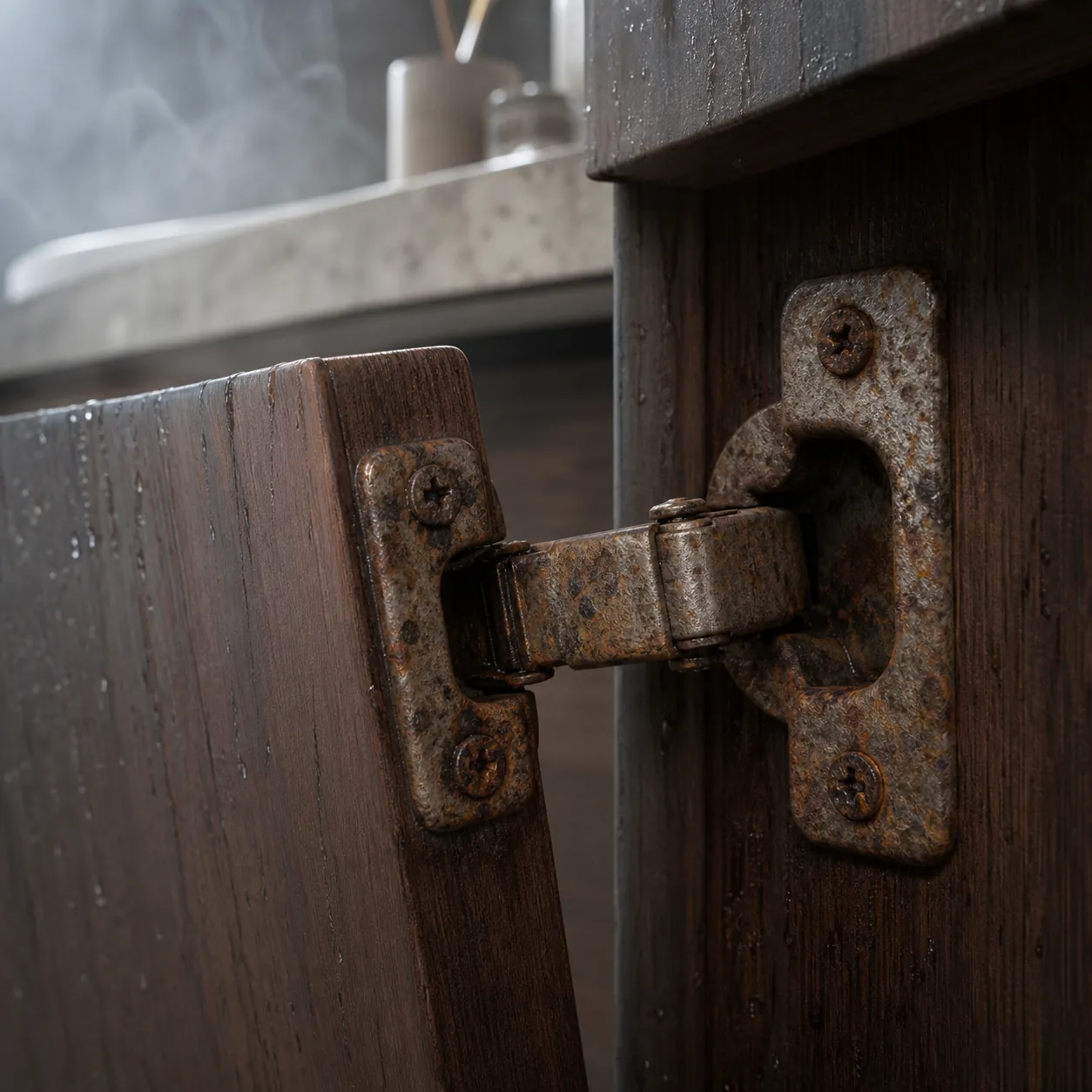
High-humidity markets—West Africa, Southeast Asia, coastal South America—demand hardware that ignores moisture. Untreated zinc-plated hinges routinely corrode within 18 months, generating warranty claims above 20% according to distributor feedback. Focuscabinet’s region-ready hardware for these zones undergoes 96-hour salt spray testing and uses electro-galvanized steel with an additional anti-rust passivation layer. Beyond the metal itself, cabinet design matters: ventilation slots behind drawer boxes and open-back vanity frames prevent moisture from sitting inside the casework.
-
- Coating Spec: Electro-galvanized steel with trivalent chromium passivation, tested to 96 hours salt spray per ASTM B117 without red rust.
- Design Adaptation: Ventilation cutouts and moisture-resistant backing boards reduce internal humidity, prolonging hardware life.
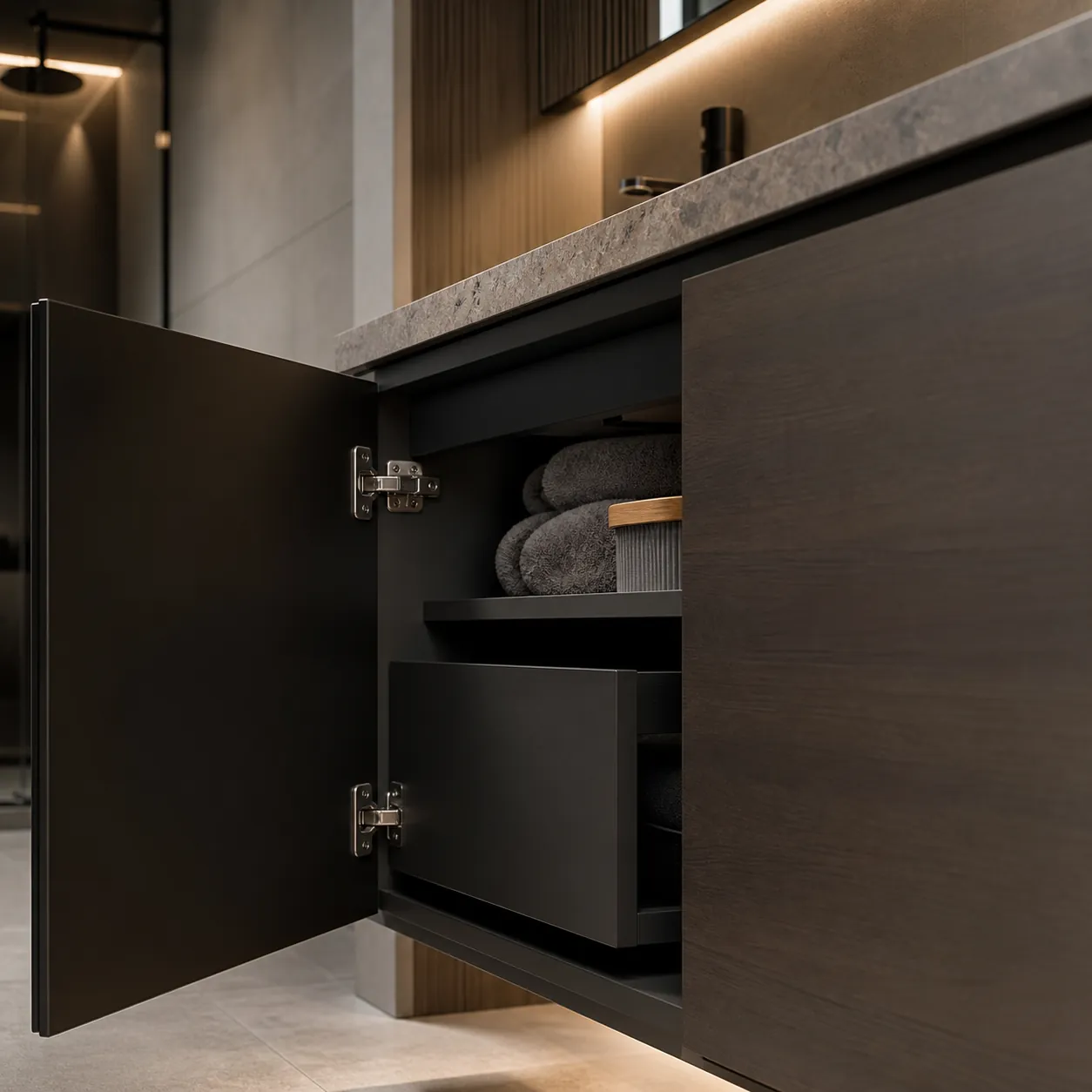
Hinge and Slide Specifications that Satisfy Multiple Regions
A universal base is not one hinge for every market.
Most global specifiers believe a single heavy-duty hinge solves regional compliance. That decision has killed more project margins than freight surcharges. The reason is mechanical. A hinge that meets ADA opening force requirements in North America does not automatically survive a 96-hour salt spray test for Accra or Lagos. The market-specific risk gets baked into the hardware long before the container ships.
What the Universal Base Actually Standardizes
The universal base standardizes mounting hole positions, cup diameter, and screw spacing. Tooling stays identical across all regions. What changes is the material grade and surface treatment. For North American projects, the slide carriage is pre-loaded to a 100 lb dynamic rating—enough to satisfy ADA force requirements without triggering a re-specification from the project engineer. For European orders, the same base geometry pairs with a nickel-plated damped mechanism to meet quiet-operation norms in multi-family residential buildings.
Regional Kit Logic: Three Swap Points
-
- Coating chemistry: Electro-galvanized steel for tropical markets, zinc-nickel alloy for European humidity cycles, and standard zinc for temperate dry climates. Each kit targets a specific corrosion resistance threshold without over-engineering the cost.
- Spring force calibration: North American kits require a lower opening force to comply with ADA. European kits prioritize controlled soft-close dampening. Swapping the spring mechanism on the same base plate adjusts compliance without retooling the cabinet frame.
- Slide load rating: General-use slides rate at 75 lb. North American upgrade kits push to 100 lb dynamic. This single swap prevents the project engineer from flagging an under-rated drawer slide during submittal review—a delay that typically costs two weeks in the construction schedule.
African distributors report warranty claim rates approaching 20% on untreated hinge corrosion. The failure mode is predictable: standard zinc plating pits within months in high-humidity coastal bathrooms. Focuscabinet’s Africa-ready kit swaps in electro-galvanized steel and passes 96-hour salt spray testing before shipment. That is not a theoretical upgrade. It is a direct response to the most common field failure in tropical markets.
The Procurement Logic: One Part Number, Three Kits
A procurement manager managing a multi-site hotel project across Dubai, London, and Miami does not need three separate hardware part numbers. One universal base part number with three regional upgrade kits reduces ordering complexity. The warehouse stocks one mounting template. The installer uses one jig. The only variable is the sealed kit box pulled from inventory per destination. When a project spec changes region mid-cycle—and it will—the hardware adaptation does not require a new sample approval round. This is the operational detail that separates projects that ship on time from those that do not.
| Hardware Component | Base Specification | Regional Requirement | Testing & Validation | Focuscabinet Advantage |
|---|---|---|---|---|
| Drawer Slides | Full-extension, soft-close mechanism | North America: ADA ≤5 lbf door pull, heavy-duty load capacity | 100 lb dynamic load rating, 50,000+ cycle endurance test | Pre-loaded slides prevent re-specification and ensure ADA compliance |
| Cabinet Hinges | 110° opening angle, nickel-plated steel | Europe: Quiet-close, high corrosion resistance; Africa/Tropics: 96h salt spray | 96-hour salt spray test, electro-galvanized steel coating | Electro-galvanized steel hinges reduce warranty claims from 20%; optional damped closure |
Focuscabinet’s Region‑Ready Hardware Testing Protocol
Skip the lab report — check the four tests that stop warranty claims before they start.
Most hardware spec sheets read the same way: zinc alloy, soft-close, 35 mm cup. That data tells you nothing about whether the hinge will seize up in a Lagos bathroom after six months of humidity, or whether the drawer slide will pass a commercial inspection in Toronto. Real differentiation happens at the testing bench, not on the product label.
Mechanical: Load Rating That Survives the ADA Inspector
The mechanical pillar measures cycle endurance and dynamic load. For North American projects, slides must operate smoothly under a 100 lb dynamic rating — the threshold that keeps opening force below 5 pounds to satisfy ADA requirements. A standard residential slide rated at 75 lb dynamic can fail a compliance walk-through and trigger a costly re-specification mid-project. Focuscabinet’s testing benches run full extension cycles with weighted drawers until failure, logging the exact cycle count when side play exceeds 3 mm.
European markets care less about brute load and more about consistent performance after years of daily use. The same soft-close mechanism that feels precise on day one must still dampen reliably after 80,000 cycles. That number doesn’t appear on most data sheets. Ask for it.
Chemical: Corrosion Resistance by Climate Zone
This is where untreated hardware fails fastest. Distributors serving West African and Southeast Asian markets consistently report warranty claim rates above 20% when standard zinc-plated hinges ship into coastal humidity without additional protection. Focuscabinet’s Africa-ready hardware uses electro-galvanized steel and undergoes 96-hour salt spray testing to simulate years of exposure in a condensed window. Standard hardware from catalogs often stops at 24 or 48 hours — not enough for tropical project cycles.
European bathroom hardware norms add another layer: EN 1670 corrosion resistance classes. Hinges and slides targeting EU hospitality projects should hit at least grade 3 (indoor, frequent condensation). For coastal installations in the Mediterranean, grade 4 becomes the sensible floor. Request the certification grade, not just a “corrosion resistant” checkbox.
Thermal & Aesthetic: The Second-Shift Tests
-
- Thermal stability: Hardware mounted on cabinetry that ships through uninsulated containers can face internal temperatures from -10°C to 60°C. Thermal cycling tests check whether soft-close fluids thicken in cold or thin out in heat. A damper that works in Changge at 20°C might lag in a Minnesota winter delivery. Focuscabinet’s protocol runs temperature ramps while measuring closure force.
- Aesthetic consistency: Finish uniformity matters more to project procurement managers than to one-off buyers. Across a 200-unit hotel order, even slight color variation in brushed nickel or matte black handles triggers rejection. The aesthetic pillar uses controlled lighting and colorimeters to verify batch-to-batch consistency before hardware leaves the 10,000m² facility.
A universal hinge base makes regional adaptation simpler. Focuscabinet’s approach starts with a common cup-and-arm platform, then swaps the surface treatment and damping fluid based on destination. That keeps lead times shorter and minimum order quantities lower when you need to run one SKU across three climate zones with different chemical demands.
The cost of skipping these four pillars shows up 12 to 18 months after installation, when the first corrosion spots appear on hinge barrels or a drawer fails the ADA force test. By then, the procurement file is closed, the contractor has been paid, and the warranty clock is ticking backward toward your margin.

Conclusion
Specifying vanity hardware by region isn’t a compliance checkbox—it’s the line between a project that stays in budget and one absorbing a 20% warranty hit from corroded hinges or sagging drawers. The 90% you have now covers load ratings, coating chemistry, and regional norms. The final 10% is what separates professionals from amateurs: knowing that a universal hardware base with region‑specific upgrade kits eliminates guesswork and long‑term cost exposure, because the hardware is already pre‑qualified for the climate and code it will actually face.
-
- ADA compliant vanity drawer slides need a 100 lb dynamic load rating to prevent re‑specifications on North American projects.
- Tropical climate hinges demand 96‑hour salt spray testing and electro‑galvanized steel to slash corrosion‑linked warranty claims.
- A universal hinge base with regional upgrade kits simplifies inventory while locking in local code and climate compliance.
- Four‑pillar testing—mechanical, chemical, thermal, aesthetic—catches failures that single‑factor specs miss.
When you’re locking down hardware for a commercial bathroom project, pull up your supplier’s testing reports and match them to the benchmarks from this guide. Look for salt spray duration, dynamic load numbers, and upgrade kit availability that mirror the region you’re shipping to. If you’d rather source hardware that already clears these hurdles, visit Focuscabinet’s product page to see vanities and basins engineered with region‑ready hardware—so you don’t have to rebuild a compliant spec from scratch.
Frequently Asked Questions
Do drawer slides need different ratings for North America vs Europe?
Yes, North America typically demands 100-lb dynamic load rating for ADA compliance, while Europe prioritizes soft-close mechanisms under its quiet operation norms. The slide mechanism must meet the local standard first. Confirm the test certificate before finalizing the spec.
What hinge finish prevents rust in tropical coastal bathrooms?
A 48-hour NSS salt spray rating on stainless steel or a multi-layer electroplated finish resists rust in high-salinity coastal air. Coatings matter more than base metal. Ask the supplier for the specific anti-corrosion test report.
Can one hinge work for all export regions?
A universal base hinge is possible, but each region needs upgrade kits—like heavy-duty springs for North America or soft-close dampers for Europe. The core cup size and mounting pattern remain common. Match the kit to the destination before sampling.
How do you test hardware for bathroom humidity conditions?
A four-pillar protocol checks mechanical cycle life, chemical salt-spray resistance, thermal cycling from -10°C to 50°C, and aesthetic surface integrity. Real-world performance beats generic lab passes. Request the thermal-conditioning report for your target climate zone.





0 Comments