

Most vanity finish defects are decided before a cabinet ever reaches final inspection. Dust lands in a wet film as visible specks, unstable airflow leaves orange peel, and excess moisture in a panel kills adhesion weeks after the container leaves port. Reworking a finished vanity costs multiples of what the same care costs at the spray booth. This guide gives quality managers a walkthrough method for a paint line: what to ask about airflow, filtration, and drying, and what to verify on site, using one factory as a running example, Main Focus Cabinet (MFBATH), a vanity manufacturer in Changge, Henan, China.
You need no airflow instruments for this check; most answers come from your eyes and a few direct questions, and the article is organized so you can copy each question into an audit template. Six checkpoints follow: booth engineering, temperature and humidity, work discipline, finish systems, and the acceptance language that lands in your purchase contract, each usable in person or over video.
Key Takeaways
- Finish defects are environmental before they are cosmetic: dust, orange peel, and adhesion failures trace back to the spray booth, so qualify the booth before you negotiate the price.
- Positive pressure, working exhaust, and maintained filtration are the non-negotiable basics; three questions and a handful of visual checks at the booth door reveal most of the story.
- Temperature, humidity, and a clean, undisturbed flash-off zone protect gloss and adhesion more than any fix applied later to a finished door.
- Entry discipline and housekeeping cost little and decide dust levels: shoe change at the door, sanding separated from spraying, tools off the floor, and a drying zone nobody walks through.
- Photograph the booth, keep batch inspection records, and write finish acceptance criteria (gloss, color difference, dust density) into the contract, then verify the first container with third-party inspection.
Table of Contents
- Why Dust Is the First Enemy of a Vanity Finish
- Booth Design: Positive Pressure, Airflow and Filtration
- Temperature, Humidity and Flash-Off Control
- Discipline That Can’t Be Bought: Entry Control and Housekeeping
- Finish Systems Buyers Encounter: PU, UV and Water-Based
- What a Buyer Should Verify on Site and in the Contract
- Frequently Asked Questions
- The Bottom Line
Why Dust Is the First Enemy of a Vanity Finish
A dust speck is a particle that landed in a wet film and stayed: one grain of sawdust, one sleeve fiber, one flake from a ceiling light, and the door carries a permanent bump. The bump reads clearly on dark, high-gloss surfaces, the finishes most popular on modern vanity doors, and it stands out before a customer touches the cabinet. Matte and light finishes hide these defects; gloss reveals them. So the finish doubles as a quality report on the booth that produced it, readable without a single instrument.
Orange peel tells a different part of the story. The textured, dimpled surface appears when paint is applied unevenly, when the spray pattern or air pressure at the gun is unstable, or when overspray drifts back onto film that has already started to tack. It is not batch luck; it is the airflow signature of a booth whose pressure, exhaust, or technique is drifting. Where gloss defects are about particles, orange peel is about the air itself, and both are visible on a walkthrough long before your container is.
Adhesion failures are the slowest defect to appear and the most expensive to answer. If the surface was oily, dusty, or still damp when the base coat went on, the top film can look perfect at the factory and lift months later in a humid bathroom that runs hot one day and cold the next. Humidity is a curing variable as well: high moisture in the air or in the panel slows solvent release and weakens the bond between film and substrate. This is why the finish conversation starts before the booth, with board moisture and surface condition.
Finish quality, unlike electronics, is inspectable at the source: defects are visible while the cabinet is still on the line. A thirty-minute walkthrough of the paint department tells you whether dust, airflow, and moisture are controlled or whether your container will become the inspection station. The sections that follow say exactly what to look at in those thirty minutes.
Booth Design: Positive Pressure, Airflow and Filtration
A spray booth is a simple machine and a strict one. It pushes filtered air into the room under positive pressure, so the inside stays slightly above the pressure of the surrounding shop and outside air cannot seep in through door gaps and wall joints. It moves that air past the work to an exhaust point, carrying overspray with it. And it filters what comes in, so the air that reaches a freshly coated door is as clean as the plant can make it. Overspray is then captured by a water curtain or by dry filter packs between the booth and the exhaust fan, which keeps paint from building up in ducts or drifting back into the finishing hall.
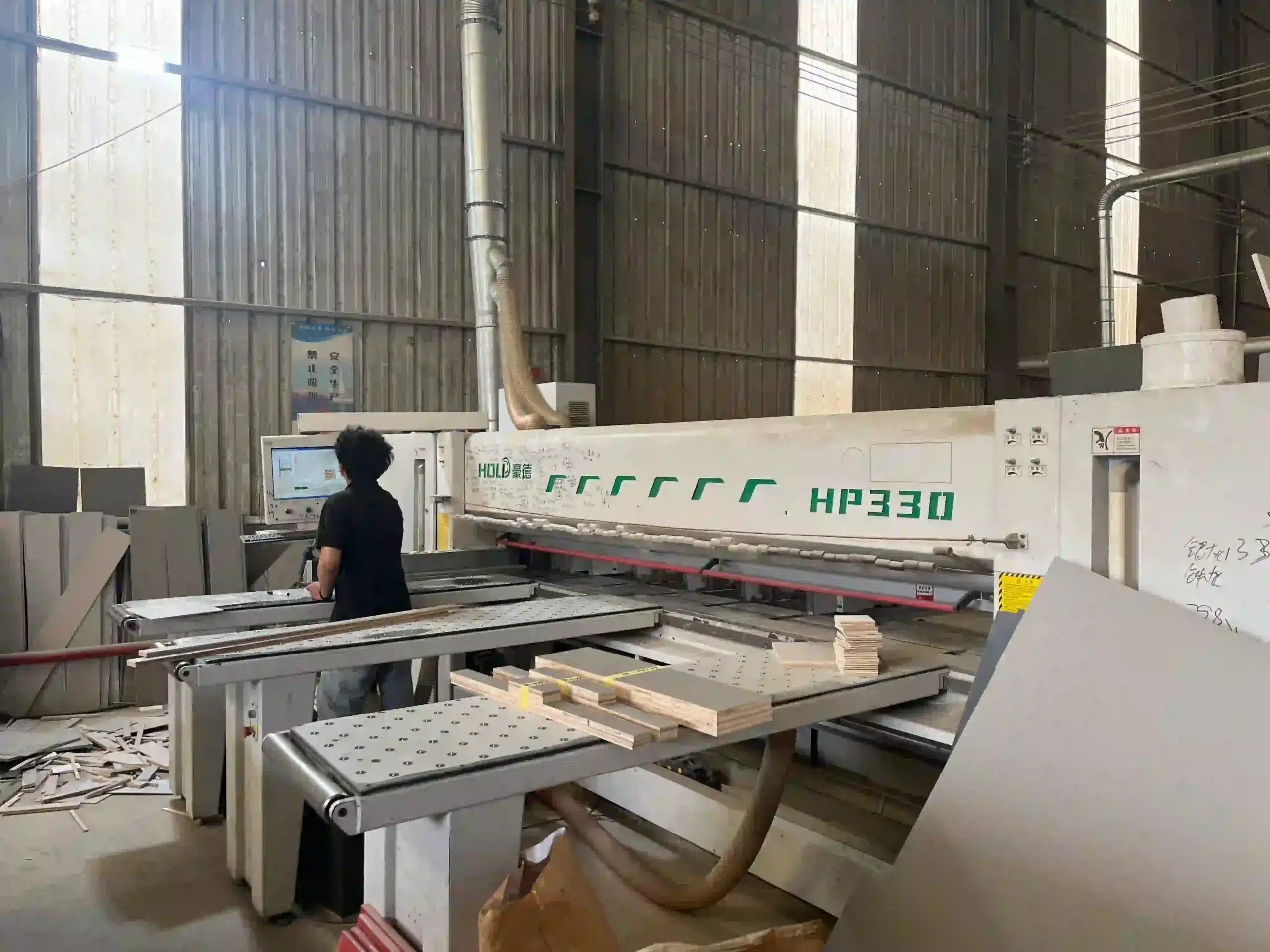
Ventilation here is regulated, not optional. In the United States, the OSHA standards for spray finishing operations specify the exhaust and fire-safety practices of a compliant booth, which gives importers a framework for what a serious factory should answer. A plant that cannot explain how its booth keeps pressure, exhaust, and filtration in balance is running on luck.
Three questions narrow the picture faster than an instrument. First, is the booth door open? An open door gives the pressure away, and shop air full of sanding dust and machining residue drafts straight into the painting envelope. Second, is the floor wet or dusty? Water on a booth floor feeds humidity into every film around it, and dust on the floor gets picked up by airflow and by boots. Third, when were the ceiling panels and filters last replaced? Look for a date on the filter frame or in the maintenance log; media that looks clogged or brown is past its life.
A structured walkthrough fills roughly the same time as a sales tour and returns more signal. The table below condenses the observation points, what a passing booth shows you, and why each point decides the finish.
| What You Check | What a Passing Booth Shows | Why It Decides the Finish |
|---|---|---|
| Booth door and entry | Door sealed, gasket intact, no gap open to the outside yard | A sealed envelope lets the fan keep the booth under positive pressure |
| Supply air filters | Filter panels at the intake, clean enough to read the date on, no gaps around the frames | Clean supply air is the only way to keep particles out of a wet film |
| Exhaust and overspray handling | Air visibly moving toward the exhaust, water curtain or dry filter packs, no fog hanging in the air | Working exhaust removes overspray before it settles into fresh film |
| Floor condition | Dry, swept, taped joints, no sawdust trail from the machining hall | Foot traffic and dust drag reinject the particles the filters just removed |
| Ceiling and lamps | Lights sealed, ceiling free of flakes, no hoses or cables hanging above the work | Anything overhead sheds dust directly into the spray path |
| Pressure readout, if fitted | A gauge showing the booth above room pressure, checked at shift start and logged | Turns pressure from a claim into a value someone records every day |
Use the table as a checklist, not as a script. The passing-booth column describes the norm; a booth that fails three or more rows is producing the defects you will spend months explaining to your customers, while a booth that answers every row easily is telling you something about the surrounding plant as well. The discipline that keeps a booth clean rarely stops at the booth door.
Temperature, Humidity and Flash-Off Control
Temperature and humidity set the pace of a finish. Solvent must leave the film at the right speed: too slow, and the film sags or fails to level; too fast, and the top dries before it flows out, leaving roughness and uneven gloss. The classic tools are a thermohygrometer at the booth and a plant rule: crews do not spray when the room drifts outside the range a given system needs. No moment is more sensitive to a skipped rule than a door moving from the spray station to the rack.
That rack area matters enough to earn its own name: the flash-off zone, a dry, dust-free space where coated parts stand between coats and after the final coat, letting solvents leave in a controlled way before the next stage. It is where hardness and adhesion actually develop, which is why it must stay clean, ventilated, and out of the foot-traffic path. A passing plant treats the zone like part of the booth; a failing one treats it like storage.
Multi-coat systems make the environment the product. MFBATH’s solid wood line applies a multilayer polyurethane (PU) waterproof coating in exactly this kind of staged environment; each layer has to level, flash, and dry cleanly before the next one goes on, which is why the factory lists 20 standard finishes across oak, walnut, maple, and ash instead of treating the finish as an afterthought. Board moisture belongs to the same equation: water that a plant fails to dry out of the raw panel will escape through the coating later. Our wood moisture control article covers how incoming boards are dried and measured before they ever reach the booth.
Solvent management closes the loop. During application and drying, volatile organic compounds leave the film, and a booth that extracts them protects the coating and the workers who apply it. MFBATH offers low-VOC finish options and documents E1, CARB Phase 2, and TSCA Title VI formaldehyde compliance on its boards, so the VOC story is answerable in writing. For the health side, the EPA publishes a reference on VOCs and indoor air quality.
Discipline That Can’t Be Bought: Entry Control and Housekeeping
Expensive machines do not keep dust out of a booth; habits do. The cheap controls decide the outcome: workwear and shoe covers at the entry, hair and forearms covered, materials brought in through a pass-through, and sanding separated from spraying so the two operations never share air. These controls take seconds to spot on a walkthrough, cost the factory almost nothing, and say more when absent than any certificate.
Housekeeping is the same story in a quieter key: tools on wall boards instead of benches, rags in labeled bins, dust lines swept before they migrate, cleaning supplies visible near the booths, a shift routine that ends with a wipe-down. None of this shows up in a certificate; it shows up in whether the finishing hall reads as a machine shop or a laboratory. The flash-off zone is the honest test: if people walk through it on the way to the warehouse, your doors collect the dust they carry.
Discipline also has a paper half. A factory that can show how the finish step is checked, and on what evidence, has turned habit into process. A surface check sits inside MFBATH’s five-point inspection on every cabinet, so a defect must get past the same eyes that already approved your reference sample, and those eyes answer to a documented system: ISO 9001 and ISO 14001, held since 2017 and confirmed current in 2025. Our production line inspection guide walks the five checkpoints in the order a cabinet meets them.
Then ask the shift leader when the booth was last deep-cleaned, and watch whether the answer arrives with a date or with a shrug. Ask whether cleaning is written into the shift schedule and who signs it off. The answers tell you whether the plant polices its own air or whether the question will be answered for the first time by an inspector standing at your container.
Finish Quality Starts on the Line
Browse this product, solution, or service page to explore relevant offerings.

Finish Systems Buyers Encounter: PU, UV and Water-Based
Three finish families dominate bathroom vanity production, and each changes how a booth must run. Multilayer polyurethane (PU) systems build several coats of a durable resin film, favored for water resistance and everyday wear, which is why they anchor solid wood lines. Ultraviolet (UV) curing finishes dry with UV light on a line, shortening the spaces between coats and suiting high-volume industrial finishing. Water-based finishes carry low solvent loads and are easier on plant air, but they demand a different application window, because flow, humidity tolerance, and drying all shift with the resin.
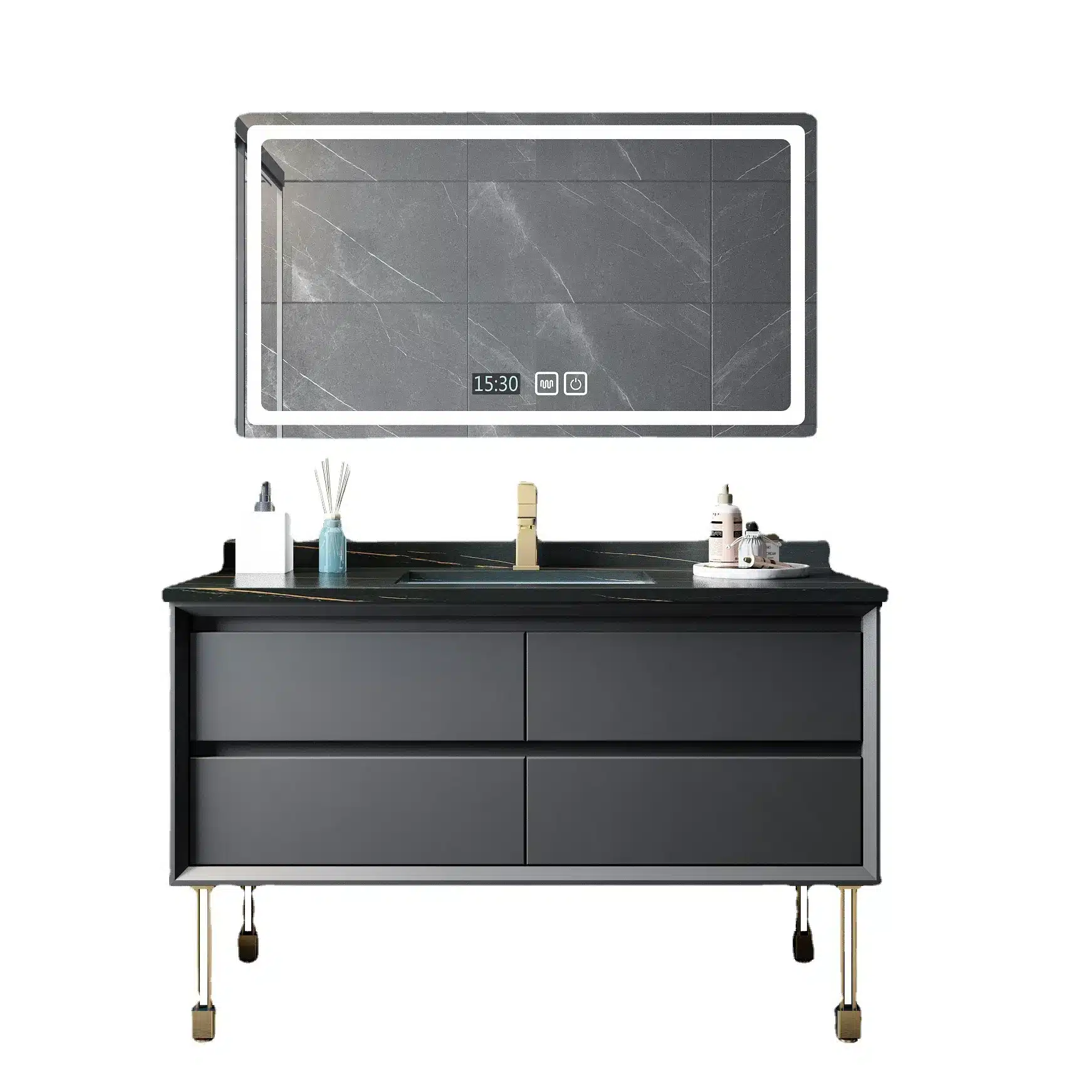
The system a factory can run is a constraint, not a preference. Applying multilayer PU well requires the staged flash-off and drying discipline described earlier; running a UV line requires the capital and floor space for a curing tunnel; switching to water-based changes temperature, humidity, and decontamination routines. So a question about which system a plant uses is really a question about whether booth, environment, and coating were designed together.
MFBATH runs PU, UV, and water-based backgrounds across its lines. The solid wood range carries the multilayer PU waterproof coating in 20 standard finishes over oak, walnut, maple, and ash; the plywood line offers 15 standard finishes inside a finish library exceeding 1,000 options; and the PVC line is 100 percent waterproof by material, with a gloss door that shows every particle, making its booth the strictest inspection of the three. For the trade-offs between the families, our PU, UV, and water-based finishes compared article lines them up side by side.
Coatings also end somewhere, and that somewhere is usually the first place a cabinet fails. The seam where edge banding meets the door face, or where a sealed joint meets coated wood, is the hot spot: any gap in the film gives moisture a route into the substrate, and the finish can look perfect while the edge wicks water. Serious lines treat the edge as part of the coating system rather than as an afterthought; MFBATH’s waterproof edge sealing guide explains why the seam decides service life more often than the face does.
Why Coating Count Starts With the Substrate
No booth and no finish system can rescue a board that went into the line wet, oily, or rough. Coating count starts with the substrate: the moisture reading recorded at incoming goods, the sanding pass that opens the pores, the primer that seals the surface. Buyers who compare coatings without asking about substrate preparation are comparing the last step of a process whose earlier steps they have not seen. Ask for the moisture and sanding records next to the coating data; the two read as one story.
What a Buyer Should Verify on Site and in the Contract
Verification splits cleanly into evidence you can collect on a visit and evidence you can collect from a desk. On site, you want the spray booth on video or in dated photos, the batch inspection records from a recent production run, and a holding of approved finish samples to compare against the goods later. Off site, the same files reach you by email or video call, which matters when a finish question arrives between visits instead of during one.
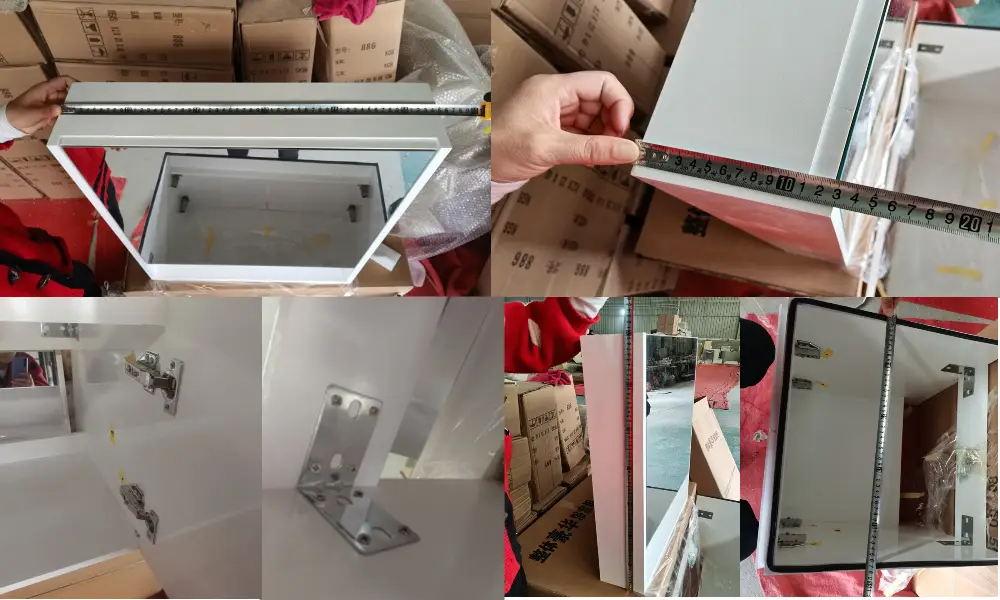
Third-party inspection converts your checklist into someone else’s signed report. Firms such as SGS and TÜV will inspect the finish against your reference sample and issue their own finding, but only if the arrangement is made before the production window closes. MFBATH supports third-party inspection and factory audits when arranged in advance, and the inspection company, not the factory, writes the conclusion. On a first container, that signed report is worth more than a phone call after the goods land.
Then move the checklist into the contract. Write the finish acceptance criteria as clauses, not adjectives: gloss level against the approved sample, color difference tolerance across and between batches, and the particle density standard for the front-visible areas of the cabinet. The thresholds are whatever both sides agree on; the point is to document the reference before production instead of arguing after the container clears customs. A clause requiring every piece to match the approved sample closes the loopholes that a vague “factory finish” leaves open. Once an acceptance standard is in place, the surrounding terms follow a known shape: MFBATH’s full-container orders carry a two-year whole-cabinet warranty, and its minimum order quantity (MOQ) is 15 sets per model, color, and size. To see the sizes, materials, and finishes such a line can deliver, browse the full product range.
Run the same checklist when the factory introduces itself, because answers that are cheap when a plant is showing off get expensive when it is hiding. A 95-employee plant with monthly capacity of 5,000 sets, as MFBATH operates, produces booth photos, batch records, and inspection dates from memory; a plant that routes every finish question to the sales office is answering with its organization chart instead of its line. More finish-focused factory evaluations live in our manufacturing excellence guides.
Frequently Asked Questions
Can a dusty finish be saved with sanding and polishing?
Sometimes, and it is never cheap. A single dust speck can be leveled and glossed again, but the work consumes labor, risks burn-through on edges and raised panels, and on dark or high-gloss surfaces polishing tends to leave a slightly different sheen around the repair, which some inspectors reject anyway. Repairs also tell you nothing about the next batch. Fixing specks at a finished-goods bench is what a factory does after the booth has already failed; the question a buyer should be asking is why the specks were there at all.
Which is more environmentally friendly, UV or water-based finish?
Both can be defensible, and neither settles the question on its own. Ultraviolet (UV) curing dries with UV light and produces very little solvent evaporation, but it requires a curing line and the energy that line consumes. Water-based finishes carry low solvent content and are easier on shop air, yet they are sensitive to humidity and temperature during application. MFBATH offers low-VOC finish options, and with a minimum order quantity (MOQ) of 15 sets per model, color, and size, a custom finish system can be trialed in a small run instead of being locked in for a full production year.
Do I have to visit the spray booth in person?
No, and you should still see it. A remote check works well when it is requested in advance: a dated video of the booth running, close-up photos of filters and gauges, and images of the inspection tools and reference samples used at the finish station. Combine that with a third-party inspection by a firm such as SGS or TÜV, arranged before the production window, and most of what an in-person visit would catch is covered. The in-person visit then becomes optional, welcome but no longer the only way to see the line.
Why is a multilayer PU coating waterproof?
Because it is a film built in layers, and layers close the routes water takes. Each polyurethane coat levels over the one below it, and the sequence of base, build coats, and top forms a continuous surface instead of a single thin hope. Waterproofing also depends on what the coating meets at the edges: MFBATH pairs the multilayer PU film with sealed edges and water-resistant board options, including BWR (boiling-water-resistant) and marine-grade plywood, and the PVC line is 100 percent waterproof by material. The coating works the face; the edge seal and the board work the rest.
The Bottom Line
The finish your customer opens the box to see was mostly decided in the air of a spray booth months earlier. Walk the paint department with this article’s checklist, ask for the booth, the filters, the flash-off zone, the inspection records, and the acceptance clauses in writing, and you convert finish quality from a hope into a specification. When any piece of it fails to add up, reject the plant quietly and early, because a booth that cannot keep dust out of a wet film will not keep it out of your container.




0 Comments