

Vanity factory wood moisture control decides whether a bathroom cabinet stays square in humid Miami or dry Denver. Wood never stops trading moisture with the air around it, and a factory that ignores that fact ships drawers that stick, doors that gap, and finishes that crack. Importers rarely see the drying room on a factory tour; they meet the consequences months later in a container. This guide explains how a vanity factory controls wood moisture from board to carton, and what to verify before you order.
Main Focus Cabinet (MFBATH), a bathroom vanity factory in Changge, Henan, China, founded in 2015, runs 10,000 square meters with 95 employees and a monthly capacity of 5,000 sets. Every product passes 5 quality checks, and moisture readings sit inside that sequence. Samples ship free within 10 working days, bulk runs take 20–30 days, and third-party inspection works with advance notice.
Key Takeaways
- Wood moisture content is measured as a percentage of dry weight, and furniture-grade boards are commonly dried to a single-digit to low-teens percent range depending on the destination climate.
- MFBATH runs 5 quality checks on every product, with moisture meter readings taken at set points instead of once at the end.
- The factory holds ISO 9001 and ISO 14001, certified in 2017 with validity confirmed in 2025, plus CE and UL for applicable lines.
- Samples ship free within 10 working days, bulk production runs 20–30 days, and the MOQ is 15 sets per model, color, and size.
- MFBATH reports a return rate below 1% under a 2-year full-cabinet warranty, so moisture defects show up in a factory-wide metric.
- Third-party inspection with SGS or TÜV runs with advance notice, which makes it a scheduled step rather than an afterthought.
Table of Contents
- Why Moisture Control Sits at the Start of the Line
- Drying to a Target Range
- Meter Checks on the Production Line
- Board Choice as Moisture Strategy
- What Importers Should Audit on a Factory Visit
- Moisture Failure Signs in Finished Vanities
- Frequently Asked Questions
- The Bottom Line
Why Moisture Control Sits at the Start of the Line
Vanity factory wood moisture control starts at the board yard, not the paint booth. A panel cut at one moisture level moves by a measurable amount when summer humidity arrives, and that movement shows up as twisted doors and drawers that bind. The drying room, the moisture meter, and the storage rack decide the outcome before a single panel becomes a cabinet. Everything after that is finishing work on top of a decision already made.
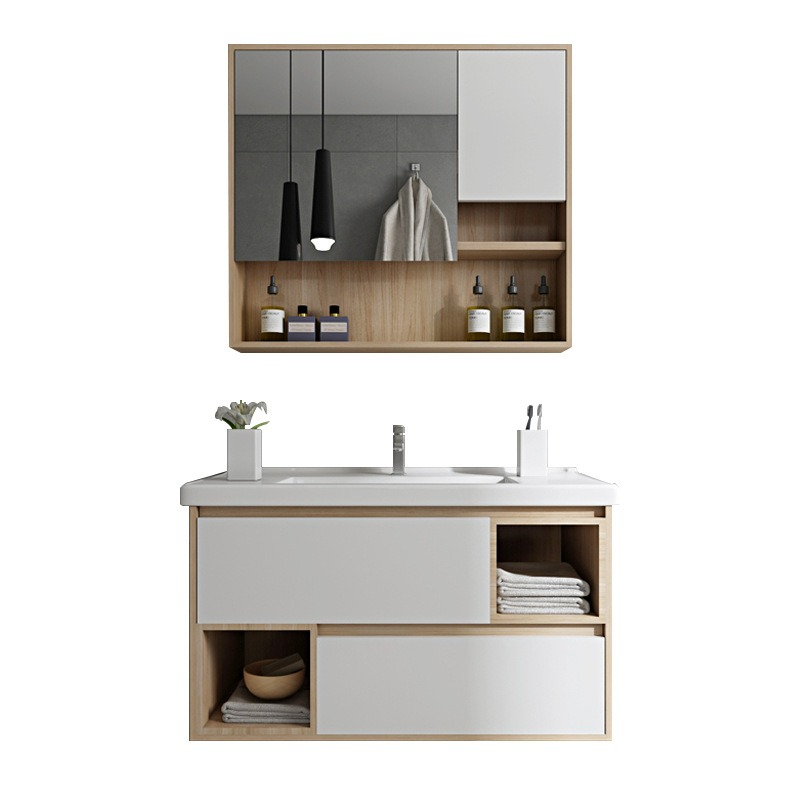
Wood swells when it gains moisture and shrinks when it loses it, and the change is rarely even across a panel. Warping, twisting, and cupping come from uneven movement; glue lines fail when the two faces of a joint pull in different directions. A factory that manages moisture keeps those forces small enough that hinges, slides, and seams stay where they were installed.
The seasonal path matters as much as the numbers. A cabinet that leaves the factory in winter and lands in a humid port in summer crosses two climates before it is installed, and each crossing changes the panel. Most of that movement happens in the first year, which is why the geometry you measure at the sample stage is not the geometry your customer lives with.
Volume makes moisture control a process problem. MFBATH has run its factory in Changge, Henan since 2015 with 95 employees and a monthly capacity of 5,000 sets, and at that scale one operator’s good judgment is not a control. The factory sets a repeatable sequence — dry, measure, store, cut, check — so the 5 quality checks on every product start from boards that entered the line in a known state. Repeatability is the whole argument for moving moisture work upstream.
Drying to a Target Range
The core of vanity factory wood moisture control is drying stock to a target range before it meets the cutter. Kiln drying pushes heated air through stacked boards on a controlled schedule, which is faster and more uniform than leaving lumber to dry in open sheds. Air drying costs less energy but follows the weather, leaving wider swings between winter and summer lots. Most furniture-grade mills use kilns for the final stage of drying no matter how the board started.
The target comes from the concept of equilibrium moisture content (EMC). A board rests at the moisture level where it neither gains nor loses water to the surrounding air, and that level shifts with temperature and relative humidity. A cabinet bound for coastal Florida equilibrates at a higher level than one headed to inland Colorado, so the drying target should match where the cabinet will live, not where the mill sits.
Species change the picture too. Oak, walnut, maple, and ash differ in density and in how fast they exchange moisture, so one kiln schedule across all of them would leave some boards over-dried and others under-dried. A factory that sorts stock by species and history before drying gets a tighter distribution at the end of the schedule.
Conditioning closes the gap between the kiln and the destination climate. Dried boards are stored and slowly brought toward the climate they will face, which lowers the shock when the finished cabinet leaves the factory. A factory that skips conditioning saves days at the front of the schedule and spends them later in claims.
What the numbers mean
Wood moisture content is expressed as a percentage of the wood’s dry weight, a convention the APA – The Engineered Wood Association documents in its plywood engineering publications. Furniture-grade wood is commonly dried to a single-digit to low-teens percent range, with the exact target set by regional climate — roughly 6 to 12 percent covers most indoor markets. Treat any single number a factory quotes as a starting point, and ask which climate it was chosen for.
The same number reads differently at different points in the line. A freshly kiln-dried board, a panel after cutting, and a finished cabinet face different exposure, so one reading at one station teaches less than a trend across stations. What matters is that readings stay inside the target band from board to carton.
How drying failures show up
Under-dried wood fails in the cabinet, not at the mill. Drawer sides that still hold excess moisture shrink after assembly, which loosens joints and changes the fit of the drawer in its runner. Glue joints fail when the two faces move at different rates, and delamination at panel edges is the usual report when the bond gives up.
Over-dried wood is the quieter failure. A board dried too hard becomes brittle, and it swells quickly when it reaches a humid warehouse, pushing doors out of square and stressing hinge plates. The damage shows up in the destination country weeks after the container closes, which is why the drying record matters more than the final inspection photo.
Meter Checks on the Production Line
Meter checks turn vanity factory wood moisture control from a drying-room topic into a line discipline. Pin meters drive two needles into the wood and read electrical resistance between them; pinless meters read the surface from a sensor plate and leave no marks. Pinless units speed up checks on finished faces, while pin meters reach deeper into thicker stock, and many factories keep both.
Placement matters as much as the meter. MFBATH reads incoming boards before cutting, panels again after cutting, and cores before lamination, so a reading that drifts out of range stops work at the station where it appears. Those readings fold into the 5 quality checks that every product passes before packing, which gives importers a written trail instead of a verbal one.
Check frequency follows risk. Boards from a supplier who dried them last season get read on every batch; boards from the same mill, same week, and same moisture history get spot-read. The meter itself needs calibration against known standards, and a factory that cannot show a calibration record cannot show a trustworthy reading.
The payoff shows up in the finished product. The vanity product range built on that discipline includes plywood, solid wood, and PVC constructions, and each one inherits the moisture state of the boards that entered the line. A drawer that glides on day one and still glides on day 400 is the visible result of meter discipline.
Board Choice as Moisture Strategy
Board choice is the second half of vanity factory wood moisture control, because some constructions tolerate humidity better than others. MFBATH builds from three families — plywood, solid wood, and PVC — and each behaves differently when moisture moves. None of the three removes the need for drying and meter checks, but each one changes the margin those checks need to provide.

Plywood layers cross their grain, which spreads moisture movement across directions and keeps panels flatter than solid boards. Standard plywood suits dry bathrooms; boil-water-resistant (BWR) and marine grades use waterproof glues for wet zones. The BWR vs. marine grade plywood guide walks through which grade fits which market.
Solid wood brings grain and weight to the bathroom, and MFBATH seals it with a multi-layer polyurethane (PU) waterproof coating that slows moisture exchange at the surface. Oak, walnut, maple, and ash come from sustainable sources, with FSC-certified wood available as an option. The solid wood waterproof coating guide explains how the coating layers work together.
PVC takes the moisture variable off the table. It is 100% waterproof, does not absorb water, and does not warp, so the cabinet keeps its geometry in any humidity. The PVC board grades guide covers the construction details importers should check before choosing it.
All three families ship under the same emission discipline: E1 at or below 0.1 ppm, CARB Phase 2, and TSCA Title VI where the board type requires it. Emission levels and moisture behavior are separate questions, and the sample stage is where both get answered. Ask for the emission certificate and the drying record on the same sheet.
| Material | Moisture Behavior | Typical Role |
|---|---|---|
| Standard plywood | Cross-laminated layers spread movement and limit cupping; the glue line sets the limit | Carcasses and doors for dry-to-normal bathrooms |
| BWR and marine plywood | Waterproof glue lines hold panels flat in wet zones | Cabinets under sinks and in commercial washrooms |
| Solid wood | Gains and loses moisture with climate; surface sealing slows the exchange | Visible frames and doors on natural-finish vanities |
| PVC | 100% waterproof; absorbs no water; does not warp | High-humidity bathrooms, rentals, and hospitality projects |
Moisture-Controlled Cabinets, Batch After Batch
Browse this product, solution, or service page to explore relevant offerings.

What Importers Should Audit on a Factory Visit
Vanity factory wood moisture control is verifiable on a walking tour, and a checklist keeps the visit honest. Importers who ask for documents before they ask for samples get a different quality of answer. Start with drying records, then watch the meters work, then look at storage.
Seven items cover the moisture side of a factory audit:
- Drying records: batch logs showing kiln or air-drying schedules for the boards in current production
- Meter calibration: calibration certificates and a live reading on a known board
- Storage conditions: covered, elevated racks that keep boards and panels off damp floors
- Glue application: spread rates and press times for plywood and edge banding
- Finished-goods storage: cabinets wrapped and stored away from warehouse humidity
- QC photo evidence: dated photos from the 5 checks per product
- Third-party inspection: SGS or TÜV visits arranged with advance notice
Each item connects to a written record. MFBATH holds ISO 9001 and ISO 14001, certified in 2017 with validity confirmed in 2025, plus CE and UL for applicable lines. The ISO 9001 factory audit guide shows how those certificates translate into evidence you can inspect.
A factory that treats the meter as a prop fails the audit fast. Ask to see the readings logged during the current run, not the ones from last month, and ask what action a reading outside the target range triggers. The inline vs. final inspection guide explains why a check at the end of the line cannot fix a board that entered it wet.
Schedule the third-party visit the same way you schedule production. SGS or TÜV inspection runs with advance notice, so book the slot when the line starts rather than when the container is nearly full. The moisture items on the audit list then get checked twice: once by your eyes and once by the inspector’s.
Moisture Failure Signs in Finished Vanities
Moisture damage has a signature, and it appears in four places on a finished vanity. Drawer binding comes first: a drawer that glides in the showroom and sticks in the field points to side panels that moved. Door gaps follow, with the gap widening at the top and closing at the bottom on the hinge side. Delamination shows as layers separating at panel edges, and finish cracking runs along joints where the substrate shifted under the coating.
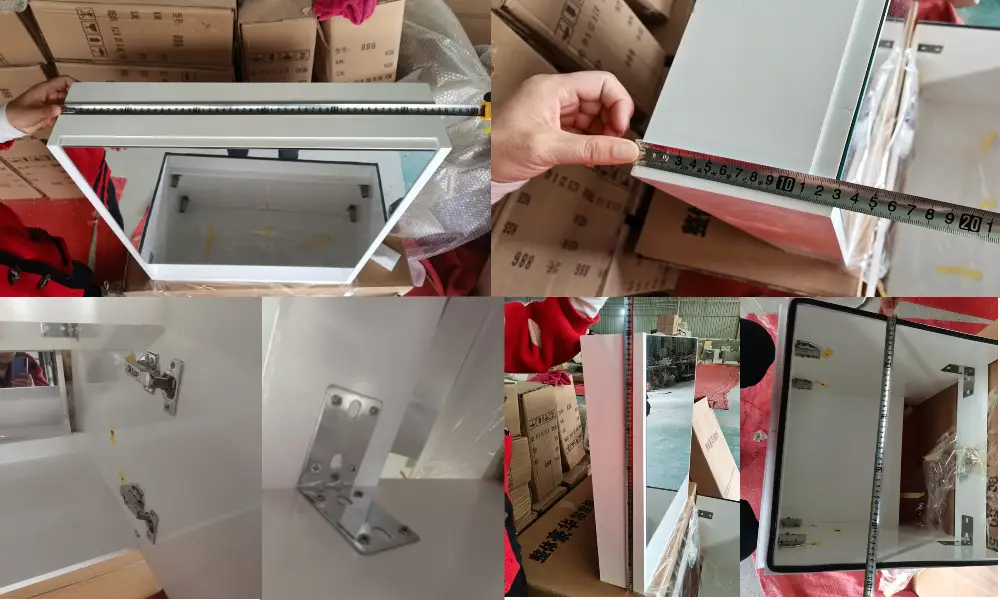
Hardware makes the symptoms visible early. Drawer slides and hinges run on tight tolerances, and manufacturers like Blum engineer hardware for panels that move within expected limits. When a panel moves beyond those limits, the slide binds and the hinge plate pulls. The hardware did not fail; the panel did.
The sample stage is where these signs should be photographed, not the arrival stage. MFBATH ships samples free within 10 working days, so an importer can run the sample through a humidity test at home before committing to bulk. Photograph the drawer sides, the door edges, and the panel corners, and keep the images with the sample record.
A few field checks tell you whether the signs are moisture or assembly. Measure door gaps at top and bottom, run the drawers through full travel, and check panel edges for separation. Any of the four signs on a fresh sample is a reason to ask the factory for the moisture record before you approve.
Frequently Asked Questions
What moisture range should a vanity factory dry its wood to?
Industry convention puts furniture-grade wood in a single-digit to low-teens percent range, with the exact target set by the destination climate. The APA – The Engineered Wood Association publishes plywood moisture guidance you can compare against a factory’s drying records. Ask which target the factory used and why it fits your market.
Where does MFBATH check moisture during production?
Incoming boards are read before cutting, panels again after cutting, and cores before lamination, all inside the 5 quality checks that every product passes. Pin and pinless meters are both in use, and calibration records are kept for each unit. The readings log to the same file as the QC photos, so an importer can review the full trail.
What should an importer do when a finished vanity shows moisture damage?
Photograph the affected areas with the carton number in frame, then send the images and order details to the factory in writing. MFBATH covers cabinets with a 2-year full-cabinet warranty and reports a return rate below 1%, so a documented claim has a defined path. Keep the moisture record from your factory audit with the claim file.
The Bottom Line
Vanity factory wood moisture control separates cabinets that hold their geometry for years from cabinets that fight their own hardware after a season. Drying to a target range, reading boards at set points on the line, and choosing the right board family are the three controls that matter. MFBATH runs those controls across a 5,000-set monthly capacity with a return rate below 1%, and its free samples within 10 working days give importers a way to verify them before bulk production starts.




0 Comments