

Key Takeaways
- A bathroom vanity production line inspection walks nine checkpoints from board receiving to carton sealing, and every one can be verified by video or by a third-party auditor.
- MFBATH, a vanity factory founded in 2015 in Changge, Henan, runs a 10,000 ㎡ plant with 95 employees and monthly capacity of 5,000 sets; every product passes 5-stage QC.
- Board compliance is checkable at the workstation: E1 emissions at or below 0.1 ppm, CARB Phase 2, and TSCA Title VI, with FSC certification available on request.
- Timing sets the value: samples leave in 10 working days, bulk production runs 20–30 days, and a mid-run walkthrough catches drift while correction is still cheap.
- Remote inspection works when structured: dated photos at set points, a live video walk, a written QC report with photo and video evidence, and an independent firm such as SGS or TÜV booked ahead.
- Use MFBATH’s published terms as your baseline — MOQ 15 sets with mixed loading, a 2-year whole-cabinet warranty, and a return rate under 1% — when you compare any factory’s inspection claims.
Table of Contents
- What a Production Line Inspection Is
- The 9 Checkpoints on a Vanity Production Line
- Line Inspection Timing: In-Line vs Final
- How to Run One Remotely
- Frequently Asked Questions
- The Bottom Line
What a Production Line Inspection Is
You approve a factory from brochures and video calls, and the money risk starts the day the deposit clears. A production line inspection moves the verification onto the floor. You watch boards become panels, panels become cabinets, and cabinets become cartons. The point is not to catch one bad hinge. It is to see whether a process that makes 5,000 sets a month can hold your specification from shift to shift.

An inspection is a structured walk, not a tour. The observer moves through workstations in the order goods move: receiving, cutting, edge banding, assembly, hardware, finishing, and packing. At each stop you check the method, not just the output. Look at how panels are stored, what the banding press is set to, and whether the quality control (QC) gate has documents. That is the difference between a visit and an inspection.
The scale you are inspecting is defined by published numbers. MFBATH was founded in 2015 in Changge, Henan, with a 10,000 ㎡ facility, 95 employees, and monthly capacity of 5,000 sets. The plant holds ISO 9001 and ISO 14001 certificates dated 2017, with validity confirmed in 2025, plus CE and UL marks for export models. The ISO 9000 family of standards defines how such management systems are built and audited. Quality management here is a paper trail you can pull at each station, not an abstract promise.
Some buyers treat inspection as the supplier’s job and pay only for a final check. That view is comfortable and expensive. A final check can reject a bad container, but it cannot reclaim the 20–30 days lost to rework and the shipping slot you gave up. The buyers who sleep well on this side of the ocean are the ones who own a process, not a moment. The quality management literature frames inspection as one control loop inside a larger system, which is the right way to read this checklist.
In-Line Inspection vs. Pre-Shipment Inspection
The two checks answer different questions. A pre-shipment inspection (PSI) answers whether the finished container is ready to sail. An in-line inspection answers whether the rest of the batch will come out the same as the samples you approved. The consequence of skipping the in-line pass shows up in rework. A hinge pattern installed wrong on day three can repeat across the whole run of a 20–30 day production cycle.
The 9 Checkpoints on a Vanity Production Line
Nine checkpoints cover everything that decides whether a vanity survives shipping and years of bathroom use. They group into five zones: quality system, materials, processing, hardware, and QC gates. Use the list below as your walking order and the summary table as your scoring sheet. Each checkpoint names what to look at and what counts as a pass.
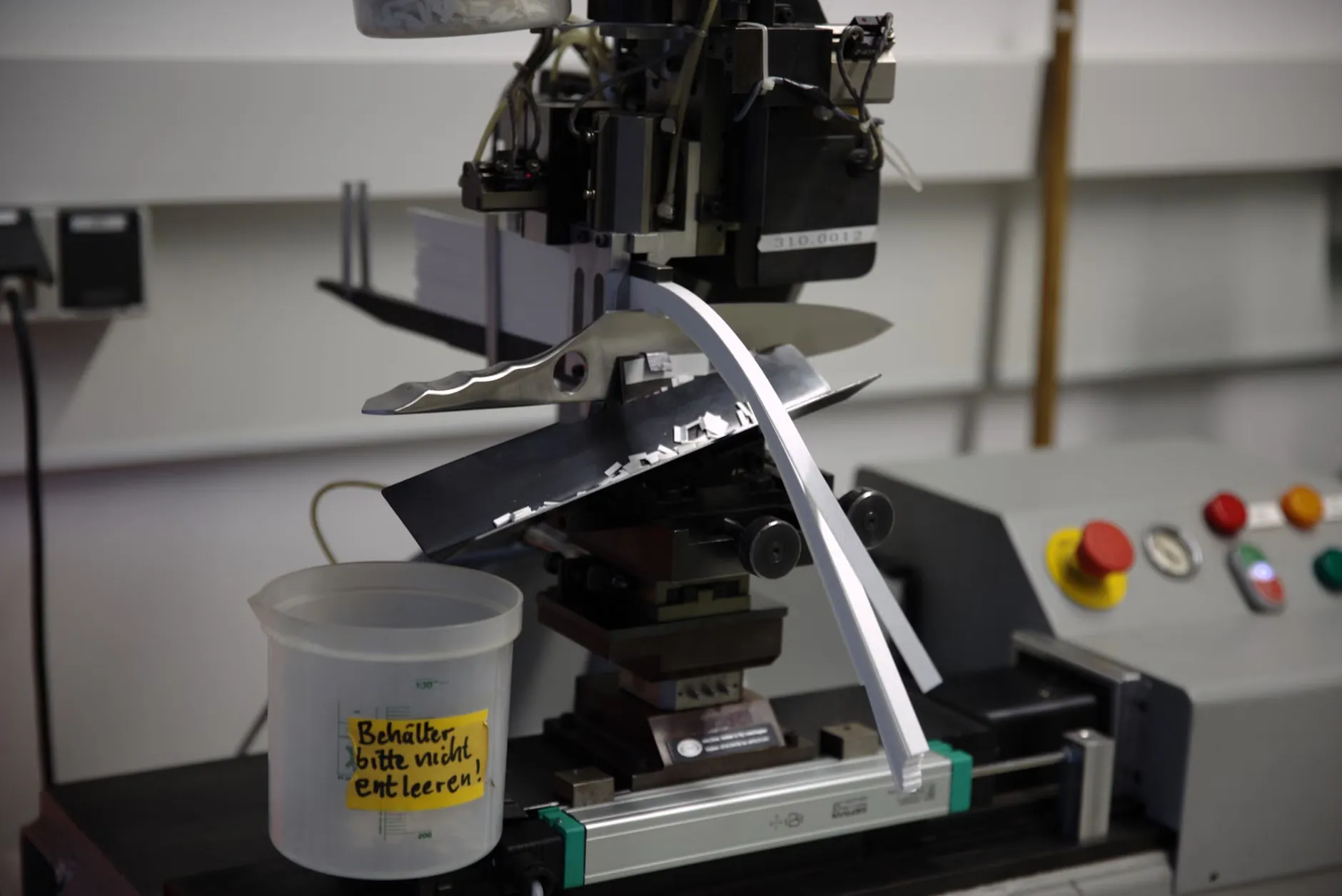
- Quality management system and certificates. Pull the current ISO 9001 and ISO 14001 certificates, the CE and UL documentation, and the audit dates. A valid ISO 9001 certificate is dated, names the issuing body, and is current; MFBATH’s is dated 2017 with validity confirmed in 2025. The ISO 9001 page at iso.org and our ISO 9001 factory audit verification guide show exactly what to accept.
- Board materials and emission compliance. Ask for the test report of the batch on the line, not a generic certificate from last year. E1 means formaldehyde emission at or below 0.1 ppm. CARB Phase 2 (California Air Resources Board) and TSCA Title VI (Toxic Substances Control Act) set the US market standard. FSC-certified boards are available on request when your project needs chain-of-custody documentation.
- Moisture control. Bathroom cabinets live where humidity swings, so the boards should be handled accordingly. Check that panels are stored off the floor, under cover, and that exposed edges are sealed before assembly. Ask for the moisture content reading at the cutting station and compare it with the range in your purchase order. A line that ignores moisture will send warped doors into your container.
- Cutting and edge banding. Watch the banding station actually run: adhesive temperature, band width, and corner treatment. Then pull a panel from the line and inspect the corners with your own eyes. Banding that is flush, sealed at corners, and without lift passes. Banding that peels at the corner will do the same in a humid bathroom.
- Hardware installation. Hinges, drawer slides, and soft-close mechanisms take dozens of open-close cycles every day. The industry-standard durability test for cabinet hinges is 100,000 cycles, a benchmark any factory can name. Ask how the factory selects and verifies hardware, and read our 100,000-cycle hinge test article for what that number means in practice.
- Countertops and stone. Sintered stone should measure 7–8 on the Mohs scale and tolerate heat up to 300°C, which is why it survives curling irons better than laminate. Check the slab thickness, the cut edges, and the sink cutout support. Stone that is under-supported will crack at its weakest point, usually after installation.
- Finishing and low-VOC coatings. Verify the coating inventory at the finish line and the low-VOC labels on the containers. Run your eyes across doors and drawer fronts for even coverage and surface defects. A finish line that skips steps will show it in the corners first.
- Packaging and carton protection. Look at carton grade, corner guards, foam, and whether hardware ships in labeled bags. A vanity that passed every QC gate can still arrive damaged when the packing station is sloppy. Packaging is the last checkpoint before the container door closes, and it takes minutes to inspect.
- The 5-stage QC gates. Every product at MFBATH passes five checks before release, and each gate keeps a record with the inspector’s name. Ask for today’s gate records at three different points in the shift, not just the stack handed to you at the office door. Signed records for all five checks on every carton are the pass condition.
Run the checkpoints in order and you will notice something. The inspection is mostly paperwork and observation, not laboratory equipment. That is why a structured checklist works remotely as well as on-site. The summary table below turns the nine checkpoints into a scoring sheet you can fill in on one page.
| Checkpoint | What to Check | Pass Indicator |
|---|---|---|
| Quality System | Current ISO 9001 and ISO 14001 certificates, CE/UL documents, audit dates. | Certificates dated and valid; ISO 9001 validity confirmed in 2025. |
| Board Materials | Batch test report for E1, CARB Phase 2, TSCA Title VI; FSC documents if specified. | E1 at or below 0.1 ppm; certificates match the batch on the line. |
| Moisture Control | Board storage, edge sealing, moisture readings at the cutting station. | Reading inside the PO range; boards dry, covered, and off the floor. |
| Cutting and Edge Banding | Banding press settings, corner sealing, adhesion on panels pulled from the line. | Flush corners and no lift on samples; adhesive set at the specified temperature. |
| Hardware | Hinge and slide brand, soft-close function, cycle rating of chosen hardware. | Hardware meets the 100,000-cycle industry-standard test. |
| Countertop Stone | Slab thickness, cut edges, sink cutout support underneath. | Sintered stone at Mohs 7–8, heat rated to 300°C, supported at cutouts. |
| Finishing | Coating inventory, low-VOC labels, door and drawer front surfaces. | Even coverage with no surface defects; low-VOC finish confirmed on containers. |
| Packaging | Carton grade, corner guards, foam, labeled hardware bags. | Cartons sized and braced for container loading; hardware bagged and labeled. |
| 5-Stage QC Gates | Gate records at three different points in the shift, with inspector names. | Signed records for all five checks on every product released. |
A bathroom vanity production line inspection that ends at the office door is a sales call, not an inspection. Follow the nine checkpoints onto the floor, pull the records yourself, and compare what you see with the factory’s published data. Score every checkpoint pass or fail with evidence attached. A factory that cannot show gate records for any of the five QC stages is a different conversation. The manufacturing excellence archive collects the factory-side guides that go with this checklist, so file your scores next to the reference material.
Inspect With a Factory That Publishes Its Numbers
Browse the product range behind the inspection checklist, including PVC, plywood, solid wood, and sintered stone vanities.

Line Inspection Timing: In-Line vs Final
The calendar decides what an inspection can prove. A final inspection on loading day confirms the container you shipped; it cannot fix a hinge pattern already repeated across the batch. An in-line inspection around the midpoint of a 20–30 day production run catches process drift while correction is still cheap. That is the core argument for walking the line at all.
MFBATH’s published numbers give you the windows. Samples are ready within 10 working days. After sample approval and a signed purchase order, bulk production runs 20–30 days, with loading at Qingdao under FOB (free on board) terms. Plan the in-line visit roughly halfway through the run and the final inspection in the last days before loading.
When to Walk the Line
For a first order, walk the line twice. The first visit lands mid-production, after the initial cut and banding of your model. The second visit lands at the final inspection stage, where you or your third party checks the packed batch. The deeper comparison of in-line vs final inspection for vanity orders explains which checkpoints only make sense mid-production.
If you cannot travel, run the mid-run check by live video and keep the third-party visit for the final stage. Book both in the same email, because a factory that fills its calendar is a factory that ships on time. The schedule you agree in writing is the schedule the QC department treats as real.
How Often to Inspect
For repeat orders with a factory that has shipped clean containers, one final inspection may be enough. For a new factory, add the mid-run visit and a weekly photo report between visits. A factory that schedules your only visit on the same day as loading is selling you a tour, not an inspection. Frequency is a risk decision; write it into the purchase order before production starts.
How to Run One Remotely
A remote bathroom vanity production line inspection runs on three channels: live video, dated photos, and an independent report. Each channel covers a weakness of the others. Video shows motion and condition; photos give you a timestamped record; a third-party report gives you a signature. Run all three and the distance stops being an excuse.

Video Walkthroughs and Photo Protocols
Give the factory a shot list before the call: the receiving area, the cutting station, the banding press, a hinge install, and the QC gate records. Require dated photos with timestamps and cross-check them against the production schedule in your PO. A photo of yesterday’s gate records is stronger evidence than a live shot of a clean office. The protocol matters more than the camera quality.
Third-Party Inspection: Book SGS or TÜV Early
Independent inspection firms close the trust gap. MFBATH supports third-party factory audits and product inspections by firms such as SGS and TÜV when they are arranged in advance. Book before production starts; a request made in the last week often collides with packing schedules. An inspection you cannot schedule is a risk you carry all the way to the port.
QC Reports with Photos and Videos
The written record is the deliverable of any inspection. MFBATH provides an internal QC report with photo and video support for every order, and every product passes 5-stage QC before release. The QC report checklist article lists the fields you should demand in yours. The published track record — a 2-year whole-cabinet warranty, a return rate under 1%, and 1000+ dealers in 20+ countries — is what the report should line up with.
Watch for red flags a remote run catches quickly. Gate records whose dates do not match the production schedule. Photos that show a different workstation layout than the video. A factory that offers a beautiful office tour but stalls on the shot list. Each one is a reason to escalate to a third-party audit before the balance moves.
Frequently Asked Questions
Can I trust a remote bathroom vanity production line inspection?
Yes, when it is structured. Use the same nine checkpoints, require dated photos and a live video walk, and add a third-party firm such as SGS or TÜV where the order value justifies it. Ask for signed 5-stage QC gate records and compare the results with the factory’s published numbers. That combination covers most of what an on-site visit would catch.
How far in advance should I book third-party inspection?
Book before production starts, not before loading. MFBATH supports SGS, TÜV, and similar firms with advance scheduling, so your agent can confirm a slot while the order is still being planned. A booking made in the final week often collides with packing. The result is a container that sails without the check you paid for.
What documents should an inspection produce?
A written report per checkpoint with pass or fail, dated photos, video segments, and signed gate records. Keep the report format in the purchase order so the factory knows what to prepare. Use our QC report checklist as the template; a report you cannot compare against the PO is a photo album, not evidence.
The Bottom Line
A bathroom vanity production line inspection is a repeatable checklist, not a gesture of trust. Nine checkpoints, structured timing inside a 20–30 day run, and signed evidence make the difference. That combination turns a factory visit into data you can file with the PO. Start with the nine checkpoints, book a mid-run walkthrough, and ask for today’s QC gate records before your deposit clears. MFBATH publishes its production baseline — 5,000 sets monthly, 5-stage QC, and a 2-year warranty — on its home page, so you can compare claims against facts.




0 Comments