

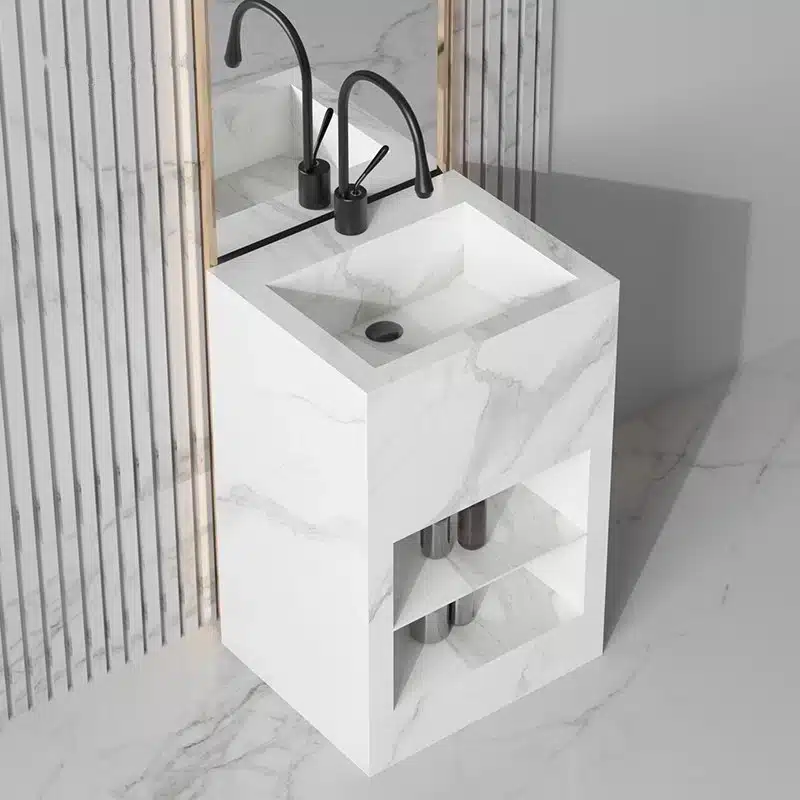
The countertop on a bathroom vanity takes more abuse than most buyers expect. A wide top loaded with an undermount basin, stone, and daily use can develop a slight dip in the middle or hairline cracks around the sink cutout, and thin edges chip on the job site before the cabinet even reaches the showroom. That is the practical side of the vanity top thickness 12mm vs 15mm question every importer faces when specifying a new line. Choose the wrong thickness and you carry the cost in freight, field callbacks, and warranty claims.
This guide breaks down what thickness actually changes on a sintered stone countertop, how it interacts with the material itself, and what to write into your purchase order. The sourcing context comes from the production line at Main Focus Cabinet (MFBATH), a bathroom vanity manufacturer in Changge, Henan, China, founded in 2015, which produces both 12mm and 15mm tops for the North American market.
Key Takeaways
Here is what the vanity top thickness 12mm vs 15mm decision actually changes, in numbers you can carry into a sourcing conversation:
- Sintered stone tops are formed from natural minerals with no resin, reach Mohs hardness 7-8, and resist heat up to 300°C, so a 12mm top behaves very differently from a resin board of the same nominal thickness.
- Standard vanity widths run 24–60 inches and depths run 18–24 inches; span length, not style, usually decides whether a model needs 15mm.
- MOQ (minimum order quantity) is 15 sets per model, color, and size, custom sizes start from 15 sets per size, and mixed loading is allowed in a single shipment.
- Every product passes 5 inspection checks, and free samples ship within 10 working days so you can verify thickness before the bulk run.
- Bulk production takes 20–30 days, and total lead time to the US, Canada, and Mexico is 4–6 weeks.
- MFBATH backs its cabinets with a 2-year full-cabinet warranty and holds a return rate below 1%, so a thickness mistake shows up directly in your cost structure.
Table of Contents
Use these links to jump to the section you need before you draft the next purchase order:
- Why Top Thickness Matters for Vanity Countertops
- 12mm vs 15mm: What the Difference Actually Changes
- How Top Thickness Interacts with Material Choice
- What to Specify in Your Purchase Order
- Frequently Asked Questions
- The Bottom Line
Why Top Thickness Matters for Vanity Countertops
Thickness is the quiet spec on a countertop drawing. Color and texture get all the attention, but the number that controls how the top behaves in the field is the millimeter reading, and that reading rarely gets discussed until something flexes or chips. For a factory like MFBATH, which cuts tops across the full standard width range, the 12mm vs 15mm decision is a load-and-span calculation before it is a price line. This section covers the four ways thickness shows up after the container leaves the port.
Sag and deflection risk on wide spans
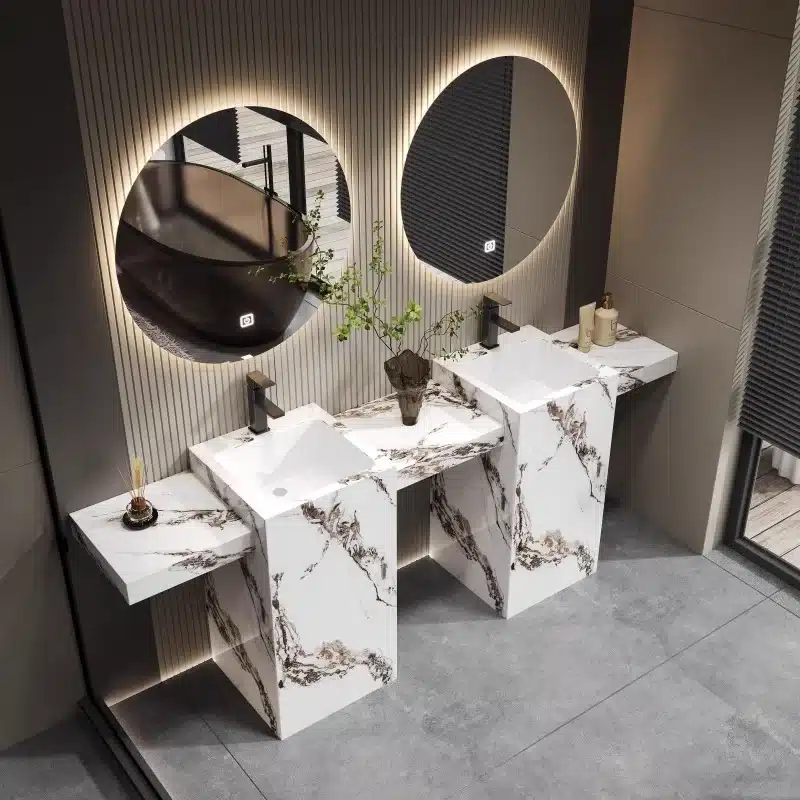
Deflection is the first thing to watch. A countertop span behaves like a beam: the longer the unsupported length, the more the middle wants to drop under load, and an undermount basin cutout removes material exactly where the top is weakest. In the standard width range of 24–60 inches, the short side of that range is rarely a problem, while the long side is where thin tops begin to show a visible dip over time. Thickness adds stiffness without changing the footprint, which is why wide vanities are the first place buyers move up from 12mm. A distributor can absorb one bad color story; a recurring sag story is harder to explain to a dealer network.
Edge chip resistance on the job site
Chips cost money before the cabinet earns it. Tops get handled at the port, in the container, and on the install crew, and a thin edge has less material behind it when it meets a cart, a corner, or a dropped fitting. A thicker top takes the same bumps with a wider margin, which matters for distributors who move hundreds of units a season and cannot inspect every carton. Fewer chipped edges also means fewer claims against the 2-year full-cabinet warranty, and every claim you avoid keeps your return rate math healthy.
Installation tolerance
Installers work with floors that are not perfectly level and walls that are not perfectly square. A stiffer top sits more predictably during shimming and leveling, and it is less likely to rock on a low cabinet or bind against a basin gasket. The tolerance that 15mm buys makes the install itself shorter, and a shorter install means a shorter list of field callbacks for the dealer who sold the unit. For job-site labor that bills by the hour, a top that seats cleanly on the first try is worth the extra material on the wide models.
How the standard size range comes into play
MFBATH builds vanities in standard widths of 24–60 inches and depths of 18–24 inches, with custom sizes available from 15 sets per size. That range is exactly why thickness cannot be one blanket answer: a 24-inch powder room top and a 60-inch master bath top do not share the same load path, and the 18–24 inch depth controls how far the front edge cantilevers over the cabinet. Match thickness to the widest product in your lineup, not the average one, and you will have one less variable to defend when a claim lands.
If you are still mapping the rest of the sourcing questions for your lineup, the product knowledge library collects the related guides in one place.
12mm vs 15mm: What the Difference Actually Changes
Once you accept that thickness matters, the next question is what the two numbers actually buy you. On paper, 12mm and 15mm look close; on a loaded vanity, the difference shows up in stiffness, freight, and the edge profiles your customers can choose. Here is the honest version of the vanity top thickness 12mm vs 15mm trade-off, as it plays out on the production line and in the container, so you can price and plan with both numbers on the table.
Stiffness difference in practice
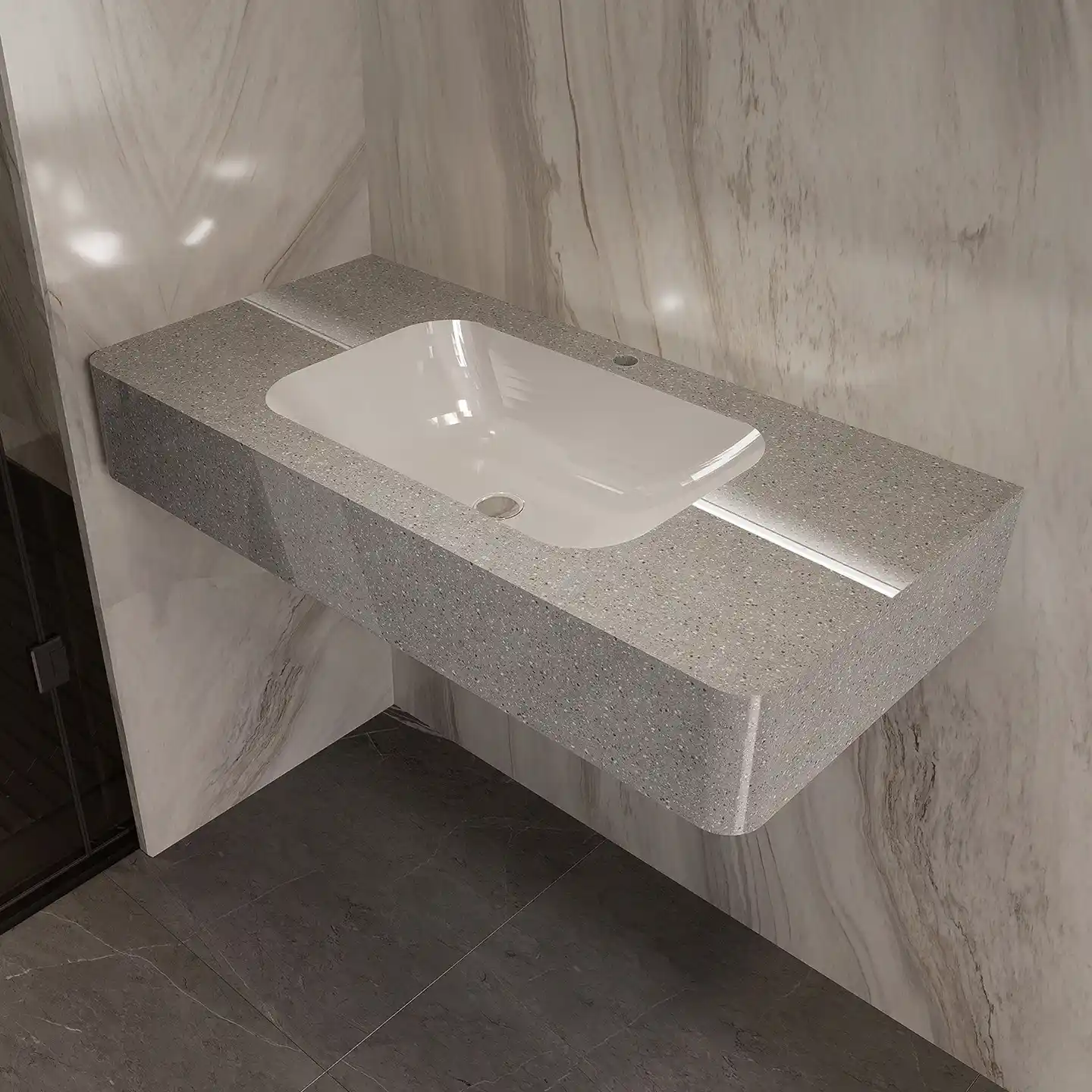
Bending resistance does not grow in a straight line with thickness. A modest jump in millimeters changes how a slab flexes far more than the added material suggests, because resistance to bending depends on the depth of the section, not just its weight. In practice, that means a 15mm top holds its line across a wide span and around an undermount cutout, while 12mm stays fully serviceable on compact models with proper support. The right call is driven by the span, not by a one-size rule, and the two options can coexist in one order without conflict.
Weight and freight impact
Every millimeter of material is weight in the container. Heavier tops mean higher freight cost per unit, and that line lands on your landed cost before the product ever sells. The counterweight is durability: fewer cracked arrivals usually offset part of the freight difference on wide models. This is also where mixed loading earns its keep, because you can run 12mm on compact models and 15mm on wide models in the same container and pay freight only on what you actually ship. When you quote a container price to your own customers, that mix is the lever that keeps the wide models affordable.
Machining and edge treatment
The edge is where a top is actually finished. Deeper profiles such as a full bullnose or a pronounced bevel need material behind them, and a thicker slab gives the machine room to cut a profile that stays proportional on a large vanity. Machining time also rises with thickness, which is one reason suppliers quote the two options differently in the first place, and it is why the purchase order should name the profile instead of leaving it implied. The same rule runs through the basin area: a cutout in a thicker top keeps a cleaner edge around the faucet deck and the bowl opening.
The table below lines up the two options the way a sourcing sheet should: side by side, without decoration.
| Attribute | 12mm Top | 15mm Top |
|---|---|---|
| Stiffness | Adequate for compact spans; flexes more on wide runs | Noticeably stiffer across wide spans and around cutouts |
| Weight | Lighter; lower freight cost per unit | Heavier; build the extra freight into landed cost |
| Edge options | Simpler profiles: eased edge, small bevel | Deeper profiles: bullnose, pronounced bevel |
| Sag on wide spans | Holds on compact models with proper support | Safer on wide models and undermount basins |
| Cost position | Lower material and machining cost | Higher material and machining cost; quote both at MOQ |
| Best use case | Guest baths, powder rooms, compact models | Master baths, hotels, wide and high-use models |
Read the table as a starting point, not a verdict. The same factory can build both, and MFBATH’s mixed loading policy means the thickness can follow the model instead of forcing one answer across the whole container.
Specify the Right Top Thickness
Browse this product, solution, or service page to explore relevant offerings.
How Top Thickness Interacts with Material Choice
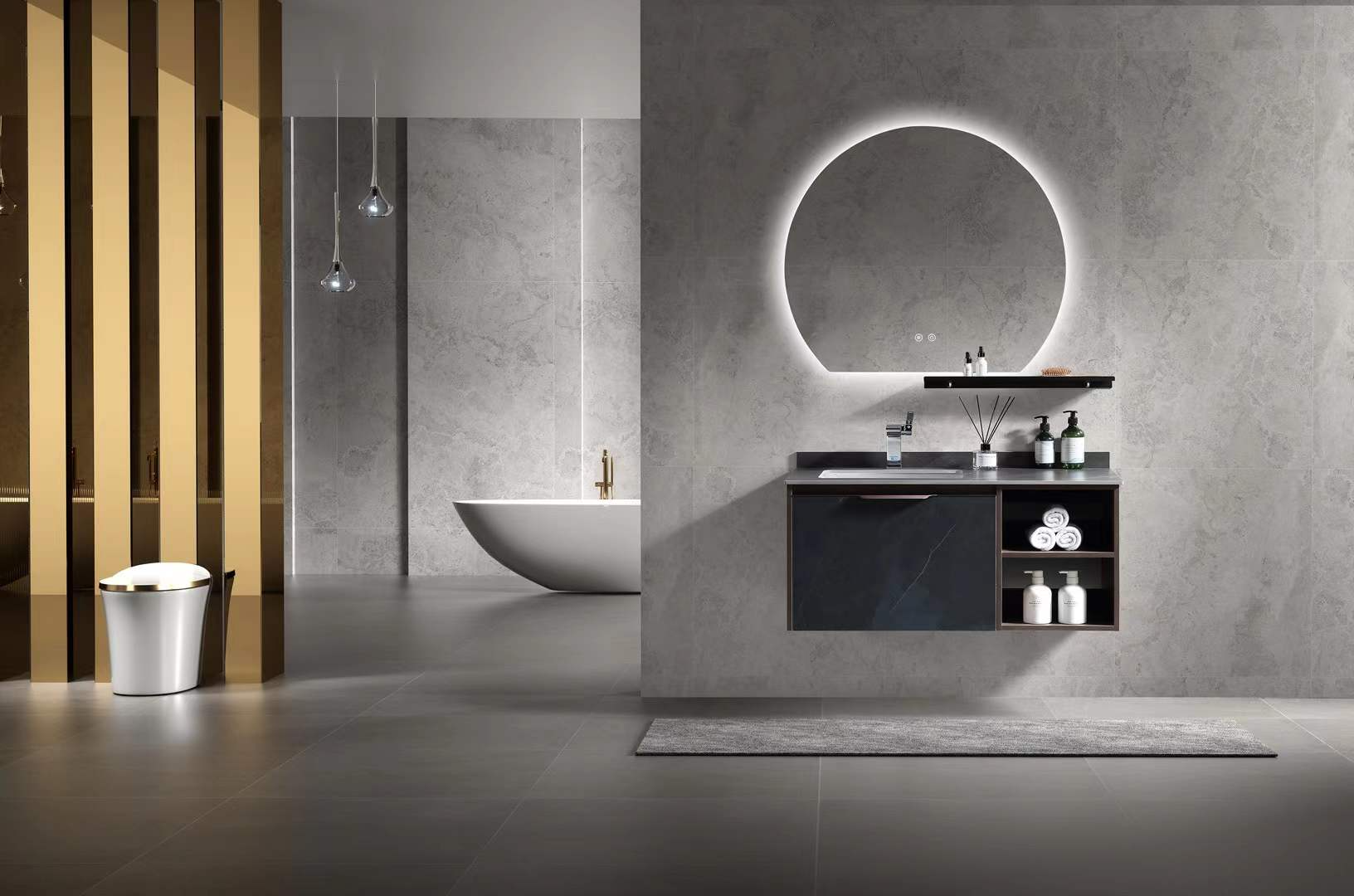
Thickness never acts alone. The same 12mm reading means different things in different materials, which is why the vanity top thickness 12mm vs 15mm question only makes sense once the material is locked in. MFBATH builds countertops in sintered stone with marble and granite textures, and ceramic basins are also customizable on request, so the thickness decision sits inside a larger material decision.
Sintered stone starts as natural minerals — quartz, feldspar, and silica — fused at high temperature and pressure with no resin in the mix. That structure delivers a Mohs hardness of 7-8, heat resistance to 300°C, non-porous stain resistance, UV fade resistance, and an antibacterial surface. Because the material is mineral through and through, a thin sintered stone top keeps more stiffness than a resin-heavy board of the same nominal thickness, which shifts the safe minimum thickness downward for a given span.
If you are still choosing between material families, the sintered stone vs quartz comparison walks through how the two behave on a countertop and where each one earns its cost.
Why material density changes the safe minimum thickness
Density does the work that thickness appears to do. A resin-based engineered board flexes more under the same load because its binder is softer and creeps under constant pressure, so it needs more millimeters to reach the stiffness of a dense mineral top. Ceramic behaves differently again: it is fired and rigid, which is why the ceramic basin option pairs naturally with sintered stone tops in the same cabinet. The practical rule for a sourcing sheet is to specify material grade and thickness together, because changing one changes what the other can safely be.
Market direction also leans on the choice. The sintered stone vanity trends guide covers large-format tops and veining patterns, and both of those lean toward the stiffer 15mm build on bigger vanities.
The performance facts do not stay on the datasheet. A top that resists heat to 300°C shrugs off curling irons and dropped styling tools in a hotel bathroom, and a non-porous surface keeps coffee and dye stains from becoming a retail return. Those behaviors are identical in 12mm and 15mm, which is why the thickness debate should stay about mechanics and freight, not about whether the material is durable enough. Your customers will test the stain story in week one; the thickness story only shows up over years.
If your market demands materials with tighter environmental credentials, ISO 14001 materials are available on request. The same production line that handles your standard run can switch the material source for the order, which matters when you quote large hotel or multifamily projects with their own material requirements.
What to Specify in Your Purchase Order
The difference between a smooth container and a dispute starts on the PO. Once you have settled the vanity top thickness 12mm vs 15mm choice for each model, the rest is a matter of writing it down so the factory and the buyer read the same sheet. Here is the checklist that MFBATH’s sourcing customers actually use when they order.
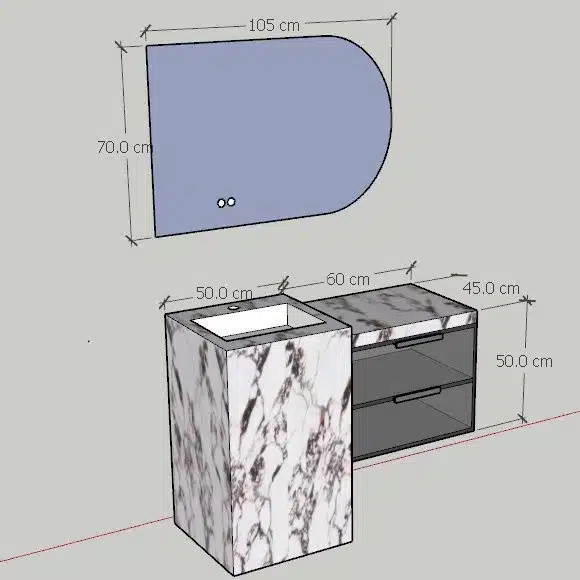
Six lines belong on every order:
- Exact mm thickness — write 12mm or 15mm per model, never a vague “standard”.
- Material grade — sintered stone with the marble or granite texture you approved, or ISO 14001 material where the project requires it.
- Edge profile — the profile name and radius, such as eased, bevel, or bullnose.
- Sink mounting type — top-mount, undermount, or the integrated ceramic basin option.
- Thickness tolerance — a written tolerance in millimeters, confirmed against the approved sample.
- Sample sign-off — the free sample number referenced on the PO as the quality reference for the bulk run.
Custom sizing follows the same discipline. MFBATH accepts custom sizes from 15 sets per size, and the MOQ of 15 sets per model, color, and size keeps small trials affordable while still allowing you to test the market. The 40,000+ customization combinations, including countertop materials and Pantone color matching, mean the thickness spec does not force you into a catalog color or texture.
The MOQ structure also protects your container economics. With mixed loading allowed, a single shipment can carry 12mm tops for compact models, 15mm tops for wide models, and multiple Pantone-matched colors, so the thickness decision can follow the model instead of the freight lane.
Cabinet emissions matter for the same reason thickness does: they end up as a liability on the sales floor. The casework meets E1 ≤0.1ppm, CARB Phase 2, and TSCA Title VI limits with low-VOC finishes, and you can verify what those labels require by reading the EPA formaldehyde guidance and the CARB composite wood products program. For North American retail and multifamily work, those two references cover most of the compliance questions buyers raise.
Quality control is where the thickness spec gets verified. Every product passes 5 inspection checks, third-party inspection by SGS or TÜV is available with advance arrangement, and the free sample — delivered within 10 working days — is your chance to measure the top yourself before the bulk run starts. Bulk production runs 20–30 days, and total lead time to the US, Canada, and Mexico is 4–6 weeks, so the sample window and the production window both fit inside a normal buying cycle.
The commercial terms keep the risk where it belongs. Payment is a 30% deposit to order, with the balance due within one week of the draft bill of lading, shipped FOB (free on board) Qingdao Port. MFBATH operates a 2-year full-cabinet warranty with a return rate below 1%, and the factory is ISO 9001 certified, with the quality system obtained in 2017 and confirmed valid in 2025.
If your lineup includes decorative surfaces, the terrazzo vanity tops guide covers a second material family with its own thickness logic.
To see the models that take these specs, review the bathroom vanity product lines page and match each thickness to the spans in your plan.
Frequently Asked Questions
The four questions below come up in almost every thickness conversation with sourcing customers, with straight answers you can reuse in your own sales materials.
Is 12mm thick enough for a sintered stone vanity top?
Yes for most residential and mid-size commercial spans under roughly 48 inches, with proper support; 15mm adds stiffness for wider spans, undermount sinks, and heavy daily use in hotels.
Does a thicker top change the price meaningfully?
Yes, because material volume and machining time rise; thickness is one of the first variables suppliers quote on, so get both options priced at MOQ 15 sets per model, color, and size before deciding.
Can I mix 12mm and 15mm tops in one order?
Yes. MFBATH allows mixed loading and custom sizes from 15 sets per size, so you can run 12mm on compact models and 15mm on wide or undermount models in a single shipment.
What should the factory provide to verify thickness?
A sample cut or drawing with dimension notes, plus photos from the 5 inspection checks per product; ask for thickness tolerance in writing and verify it on the free sample (10 working days).
The Bottom Line
Span and use decide the vanity top thickness 12mm vs 15mm call, and the numbers are simple: compact models in the 24–60 inch standard range run fine on 12mm, while wide models, undermount basins, and hotel-duty use justify 15mm. Write the thickness, material grade, edge profile, sink mounting, and tolerance into your purchase order, and verify them on the free sample before the bulk run. MFBATH ships both options with mixed loading at a MOQ of 15 sets, so your lineup does not have to compromise on a single thickness.




0 Comments