
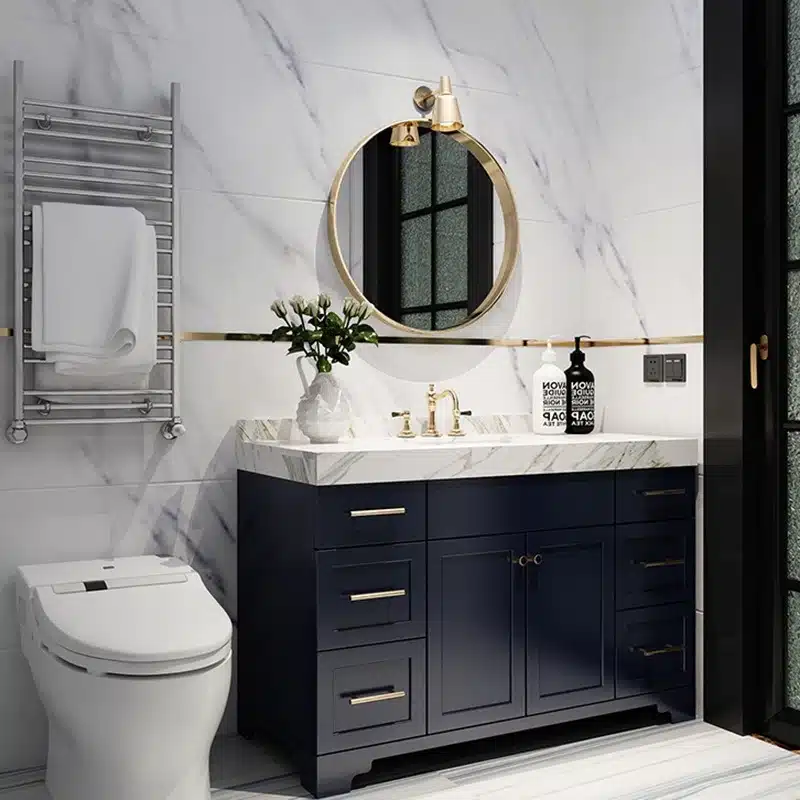
A bathroom catalog is a collection of promises. A vanity on a showroom floor is proof of delivery. Dealers and builders who stage real product close more conversations, because buyers can open a soft-close drawer, run a hand across the finish, and see exactly what they are paying for. A factory sample program is the bridge between a catalog and a sale: the manufacturer ships coordinated sample sets, you stage them, and the display does the selling. This article explains why a vanity showroom sample program pays for itself, what a sample set should contain, how the Main Focus Cabinet (MFBATH) factory program works from request to delivery, how to evaluate samples against production, and how to budget and rotate display inventory without committing a full container to every SKU.
Why Display Programs Matter for Vanity Dealers
A buyer who walks into a showroom with a phone full of screenshots is already most of the way to a decision. What settles it is usually the display: the drawer that closes itself, the finish that looks better under real lighting than it did on screen, the mirror that makes the whole vignette feel finished. Dealers who keep at least one complete vanity set staged per style family give their sales floor a closer, and that closer works on every visitor, not just the ones who ask questions.
Model home programs work the same way, one step earlier. Builders stage model homes to sell lots and floor plans, and the bathroom is where many buyers make their upgrade decisions. A coordinated vanity-and-mirror set tells the story of a finished bathroom; a lone cabinet leaves the story half-told. When the builder specs the displayed product for the actual home, the dealer who owns the display owns the order — and the repeat orders that follow in the same development.
Full sets also change the math on margin. A vanity alone is a cabinet; a vanity, mirror, and basin together are a bathroom statement. Dealers earn across the coordinated set rather than a single SKU, and the mirror in particular is a high-ticket add-on that rarely sells on its own from a flat spec sheet. The display creates the context that makes the add-on sale natural instead of forced.
The entry cost is deliberately low. Factory sample programs exist so dealers can build display floors without pre-buying production volume, and Main Focus Cabinet supports 1,000+ dealers across 20+ countries with a dealer support program built around showroom displays and samples. Because samples are free and the buyer only covers shipping, the real cost of a display is freight, not inventory — which makes the program accessible to a dealer with one small showroom, not just a distributor with a warehouse.
The same discipline carries into commercial work. Hotel and multi-family specifiers want to see physical references before they commit, and the commercial and hospitality project guides cover that buying pattern in depth. A dealer who can stage a sample set for a project buyer is a dealer who can quote the project.
What a Coordinated Sample Set Should Contain
A sample set is not a single cabinet. It is a coordinated bathroom story: vanity, mirror, and basin designed to be specified together. When the factory coordinates the set, the dealer gets one shipment, one finish match, and one spec sheet — and the customer gets a display that reads as a finished bathroom, not a cabinet with questions around it.
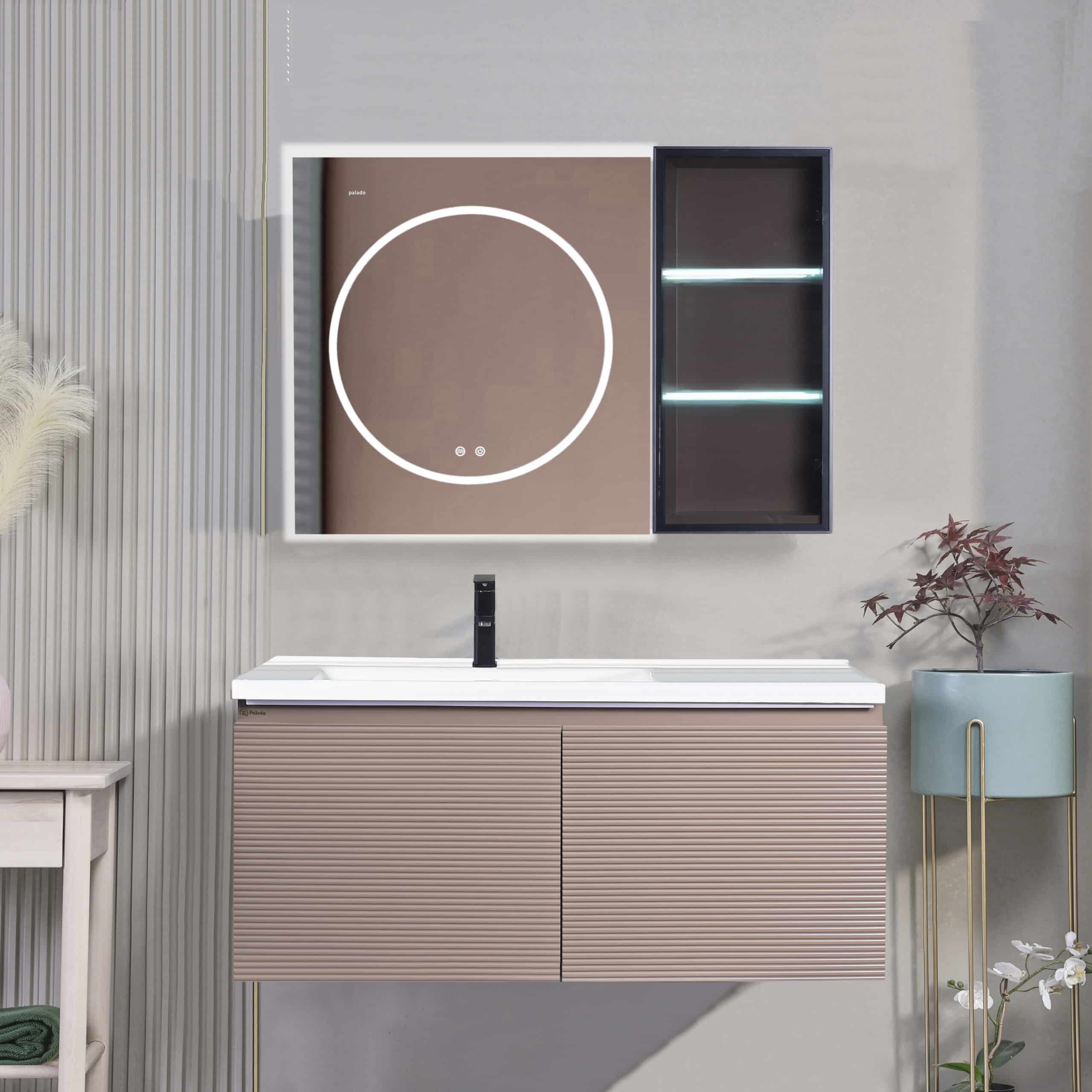
Start with the vanity, and choose the material family that matches your market. PVC vanities are 100% waterproof, easy to clean, and scratch-resistant, in widths from 24 to 60 inches and depths from 18 to 24 inches, with 1,000+ standard finishes — the workhorse for volume programs. Plywood vanities come in standard, BWR (boil-water-resistant), and marine-grade panels, with E1, CARB Phase 2, and FSC options. Solid wood vanities in oak, walnut, maple, or ash carry a multi-layer polyurethane waterproof coating, range from 24 to 60 inches wide, and offer 20 standard finishes for the higher-end display.
The mirror completes the vignette. Classic round and rectangular mirrors run from 24×36 inches to 48×72 inches, with an optional anti-fog coating for humid markets; smart LED mirrors with adjustable brightness and color temperature give the display a premium tier and a story to tell the upgrade buyer.
The basin or top is the piece that makes the set feel intentional. Ceramic, resin, and sintered stone basins are all available, and sintered stone tops bring Mohs 7–8 hardness, 300°C heat resistance, non-porous stain resistance, UV-stable color, and antibacterial surfaces to the display. Hardware closes the set: soft-close hinges and drawer slides on every door, plus branded hardware for white-label and private-label programs, with logo print or laser engraving.
Match the set to the region you sell into. North America style families and Europe style families read differently on a sales floor, and buyers who recognize their own aesthetic in a display trust it faster. If your market runs toward clean, floating silhouettes, stage the sintered stone floating vanities, available from 600 to 1800 mm in single and double basin layouts, with floor-mounted versions from 800 to 2000 mm for larger bathrooms. If your buyers are volume-driven, the PVC family with its 1,000+ standard finishes gives you a display that matches almost any spec sheet a builder brings in. The point of a coordinated set is that every component supports the same story — pick the story your market already wants to hear.
Plan the shipment as three boxes: one for the vanity, one for the mirror, one for the basin or top. Three boxes per set protect the finishes during ocean freight and simplify staging — open three boxes, place the set, and the display is live. The logic also keeps damage claims clean: a cracked mirror is one box to replace, not a reason to return the whole set.
Finally, think in mixed containers, not full-container-per-SKU. Production MOQs are per model, color, and size, but mixed container loading means a dealer can combine a few units of several SKUs in a single shipment — several style families on your floor from one container, and display inventory that does not force you to commit a container to a single design. The full range of vanity product lines is worth reviewing before you choose the families you will stage.
Here is a quick reference for what a coordinated sample set covers:
| Component | What to specify | Factory options |
|---|---|---|
| Vanity | Width, depth, material, finish | PVC 24–60 in; plywood standard/BWR/marine-grade; solid wood oak/walnut/maple/ash |
| Mirror | Shape, size, features | Classic round/rectangular 24×36 to 48×72 in; anti-fog; smart LED |
| Basin / top | Material, single or double basin | Ceramic, resin, or sintered stone; sintered stone tops 600–2000 mm |
| Hardware | Hinge and slide spec, branding | Soft-close; white label/private label; logo print or laser engraving |
| Packaging | Labeling and display condition | Custom packaging for dealer programs |
How the Factory Sample Program Works
Main Focus Cabinet (MFBATH) is a bathroom cabinet manufacturer in Changge, Henan, China, founded in 2015, running a 10,000 m² factory with 95 employees and a monthly production capacity of 5,000 sets. The sample program is the front door to that factory, and it is structured so a dealer can test the relationship on a small scale before committing to volume.
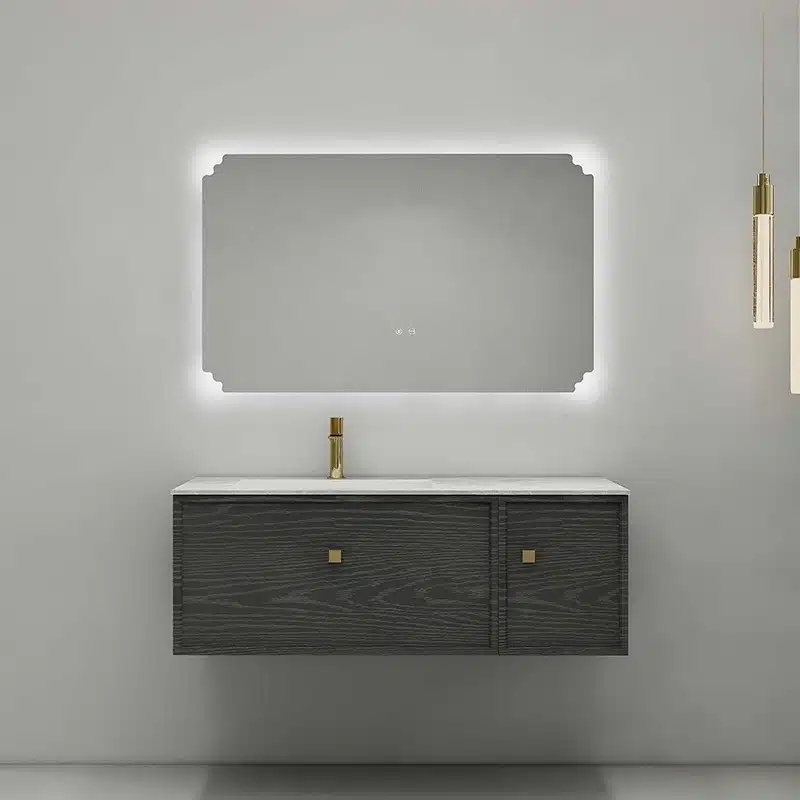
Samples are free; the buyer covers shipping. Sample production takes 10 working days, and once the sample is approved, bulk production runs 20–30 days. Those two numbers set the expectation for the whole program: a dealer can hold a physical sample in about two weeks, and a production order is on the water within a month of approval.
The minimum order quantity (MOQ) for production is 15 units per model, per color, per size. That granularity matters for display programs because it lets a dealer order a small number of any given configuration — enough to stage, not enough to warehouse. Custom plywood colors move on a higher floor of 50+ units, so budget plywood color-matching into a larger order rather than a display order.
Customization is where a dealer program turns into a brand program. The factory supports 40,000+ custom combinations, spanning Pantone color matching, eco-friendly materials, ceramic, resin, and sintered stone basins, branded hardware, white label and private label programs, logo printing and laser engraving, and custom packaging. The 100+ page 2025 catalog is free, and it is the fastest way to shortlist the models you want to see in person.
Quality control is built into the flow. Every product passes five inspection checks, and third-party inspection by SGS or TÜV can be arranged before shipment, so the display set you receive sits at the same quality bar as the bulk order. The factory backs the whole cabinet with a 2-year warranty, and the return rate sits under 1% — figures worth asking any supplier for before you commit a display to their product.
On compliance, the basics are in place: ISO 9001 and ISO 14001 certified since 2017, with certifications confirmed current in 2025; CE and UL markings held on relevant products; and CSA, NOM, and ADA requirements designed into the product lines for North American markets.
Ordering a sample set, step by step
- Request the free 100+ page 2025 catalog and shortlist two or three models per style family you want on your floor.
- Confirm finishes, mirror size, and basin type with your factory contact so the set arrives coordinated.
- The factory confirms sample production at 10 working days and quotes shipping; you pay the freight.
- Inspect the set when it arrives against the golden sample approval process — dimensions, finish, hardware, and packaging.
- Approve the sample and place the production order at the 15-unit-per-model/color/size MOQ, with mixed container loading if you are staging several families.
Vanity Sample Sets for Showroom and Dealer Programs
Browse this product, solution, or service page to explore relevant offerings.
Sample Evaluation and Color Consistency
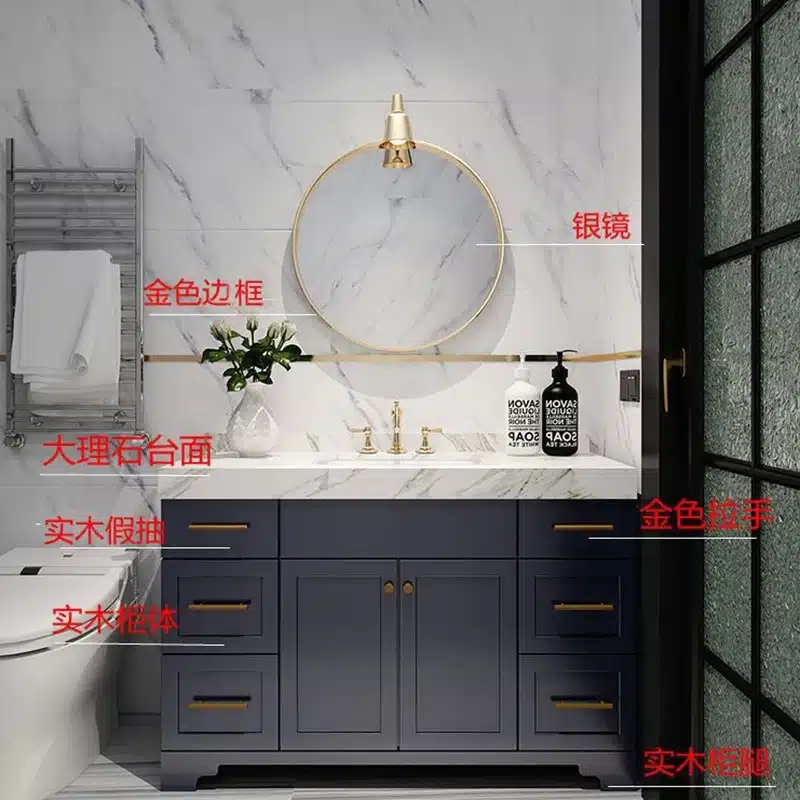
The approved sample is the contract for production. Keep it, label it, and treat it as the reference for every subsequent check — the factory will hold its own golden sample, but your copy is the one that settles disputes before they start. The bathroom vanity sample checklist walks through the full inspection, and it is worth running on every set, not just the first one.
Color is the most common point of drift, and it is also the most controllable. Start with a Pantone reference when you order a custom finish, so the target color is an objective number rather than a description. Evaluate the finished sample in a D65 light booth, the standard light source for color matching, and compare against your reference — the vanity sample color accuracy guide covers the booth setup and Delta-E tolerances in practical terms.
Then check the finish in the light it will actually live under. Showroom lighting, model home windows, and hotel bathrooms all read color differently, and a finish that looks right in the booth can look flat on the floor. Stage the sample in your actual display location before you sign off.
For wood-based sets, confirm the material story as well as the color. Plywood panels are available in standard, BWR, and marine-grade constructions, and the APA grade guides are a useful reference for what each level means in the panel itself. If your program markets certified wood, FSC-certified options are available, and the FSC site explains what the certification actually covers so you can describe it accurately to buyers.
Document the set the day it arrives. Photograph the finish in booth light and in the display location, record the model and finish codes from the carton labels, and file the photos with the order paperwork. Six months later, when you reorder the same family, those records are what tell you whether the new shipment matches the set on your floor. The factory’s own golden sample process is only half the system; the dealer’s archive is the other half.
Compliance is part of the evaluation, not an afterthought. E1 emissions at or below 0.1 ppm, CARB Phase 2, TSCA Title VI, and low-VOC finishes are the baseline for North American programs, and products are designed to meet Americans with Disabilities Act (ADA) guidelines for commercial installs — the ADA regulations are the text to check against when a project spec calls for accessible clearances.
Once the set passes, the program moves from evaluation to rotation: deciding what stays on the floor, when it changes, and how the next shipment is funded.
Rotation Calendar, Budget, and Logistics
A display is inventory, not decor, and inventory needs a calendar. Set a rotation rhythm — many dealers refresh in the spring and again in the fall, and time the refresh to what buyers will ask for next. Displays run six to twelve months ahead of the market, which means the sets you stage now should preview the styles buyers will request in 2027; the 2026 bathroom vanity trends guide is a practical source for the color and texture direction to test on your floor.
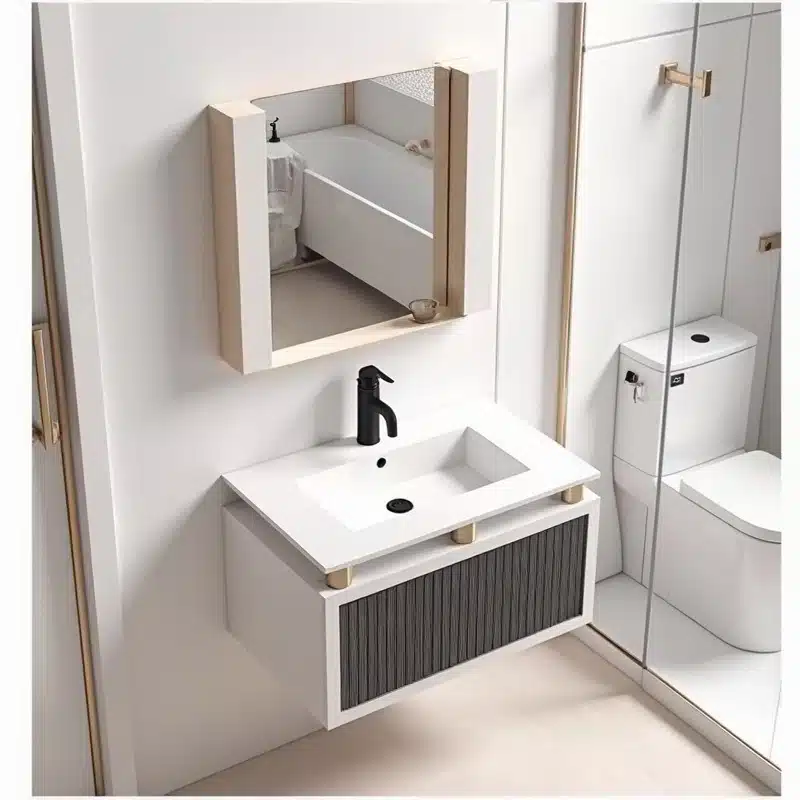
Keep the stocking strategy simple: one set per style family on the floor, a shortlist of three to five families, and reorders at the 15-unit MOQ per model, color, and size. Use mixed container loading on every refresh shipment so each container updates several families instead of duplicating one. The families that draw traffic stay; the ones that gather dust rotate out at the next order.
A workable cadence runs two refreshes a year. Stage the spring refresh in January so the floor is live for the spring buying season, and stage the fall refresh in July or August so it lands before the fall model-home push. Because bulk production takes 20–30 days and total delivery runs 4–6 weeks, each refresh has to be ordered roughly two months ahead of its staging date. Put those dates on the calendar when you approve the first sample set, and the program runs itself from there — the sample order, the display set, the production order, and the next refresh all become scheduled steps instead of emergencies.
The budget side of the program is predictable. Orders run on a 30% deposit, with the balance due within one week of the draft bill of lading (draft BL). Pricing is quoted free on board (FOB) Qingdao Port, which means the dealer controls freight from the port forward and can compare carriers directly. Production runs 20–30 days, and total delivery to the US, Canada, and Mexico runs 4–6 weeks — long enough to plan around, short enough to schedule a refresh with confidence. When you need a single set faster, air freight for sample shipments keeps the display program moving between container orders.
Frequently Asked Questions
How much does a vanity sample set cost?
Samples are free from Main Focus Cabinet; the buyer covers shipping. Sample production takes 10 working days, and bulk production runs 20–30 days once the sample is approved. The cost of a display program is therefore freight plus the deposit on the first production order — not a per-sample price. Ask for the free 100+ page catalog first to shortlist models before you pay any freight.
What is the MOQ after sample approval?
The minimum order quantity is 15 units per model, per color, per size. Because the MOQ is granular, a dealer can order a small run of each configuration needed for the floor. Mixed container loading lets you combine several SKUs in one shipment, so a single container can stock several style families at once. Custom plywood colors start at 50+ units.
How long does delivery take to the United States?
Production takes 20–30 days, and total delivery to the US, Canada, and Mexico runs 4–6 weeks. Terms are free on board (FOB) Qingdao Port, with a 30% deposit and the balance due within one week of the draft bill of lading. Sample shipments move faster — about 10 working days of production before they ship.
The Bottom Line
A showroom or model home program is how a dealer makes a catalog real: free samples, 10-working-day sample production, a 15-unit-per-model/color/size MOQ, and mixed containers that put several style families on the floor from one shipment. Budget on a 30% deposit, FOB Qingdao Port, and 4–6 weeks to the US, Canada, or Mexico, and rotate on a calendar so the floor always previews what buyers will ask for next. Start with the catalog, stage one coordinated set, and let the display sell.




0 Comments