


Custom branded vanity hardware is any hinge, handle, knob, slide, or nameplate that carries your mark instead of a generic finish. Walk into a hotel bathroom and your hand finds the vanity first: the handle is the first touch point, and the first thing a guest registers. Branded hardware turns that touch point into a brand statement — your logo on the handle, the hinge, the nameplate, even the box it ships in. For most importers this used to mean long waits and heavy minimums. The 15-unit MOQ changed that.
Main Focus Cabinet (MFBATH), a bathroom vanity manufacturer in Changge, Henan, has supplied 1000+ dealer accounts across 20+ countries since 2015. Branded hardware is not a side service here. It sits inside the same ordering system as the cabinets, with logo engraving or printing starting at 15 units per model, per color, per size. That threshold puts a private-label program within reach of a first trial order.
This guide covers the full path: which parts can carry your logo, how hinges and drawer slides fit into the 15-unit minimum, and what to verify before approval. The sample and production timeline runs through the same sections. If you are a brand owner, white-label buyer, or hotel group sourcing vanities under your own name, use this as your project roadmap.
Key takeaways
- Logo engraving or printing starts at 15 units per model, per color, per size — the same threshold for solid wood vanities, sintered stone basins, and mirrors.
- Brandable parts include handles, knobs, hinges, drawer slides, nameplates, and panel surfaces.
- Samples take 10 working days; bulk production runs 20–30 days, with 4–6 weeks total delivery to the US, Canada, and Mexico.
- The custom program spans 40,000+ combinations, covering Pantone colors, materials, basins, and branded hardware.
- Custom packaging — gift boxes, outer cartons, instruction manuals — ships with your logo from day one.
- Every product passes 5 inspection points, and third-party inspection (SGS, TÜV) is welcome with advance scheduling.
Table of contents
- Why Branded Hardware Matters in Vanity Programs
- Four Logo Carriers and Their Trade-Offs
- Branding Hinges and Slides at 15-Unit Minimums
- How the 15-Unit MOQ Actually Works
- From Sample Approval to Container Load
- Quality Checks and Testing Before You Approve
- What to Prepare Before You Request a Quote
- Frequently Asked Questions
- The Bottom Line
Why Branded Hardware Matters in Vanity Programs
Your logo on a handle works harder than your logo on an invoice. Guests, residents, and retail buyers see the hardware every time they open a drawer or a door. Engraved or printed branding makes the product identifiable at the point of use, which is where repeat bookings and repurchase decisions actually happen.
For hotel groups, branded hardware is consistency engineering. The same handle, the same finish, the same logo position across every property makes renovation and restock predictable. When a property manager orders a replacement, they order the same SKU, not a close match. That is why a spare parts strategy that drives repeat orders matters: branded parts that stay in production keep the chain uniform and the reorder loop short.
Branding also complicates counterfeiting. A laser-engraved logo is part of the product; stripping it damages the part. Generic ODM supply offers no such protection. With ODM you buy someone else’s design, and your name appears nowhere. With a white-label or private-label program, the cabinet, the hardware, and the packaging all carry your identity. The difference shows up in resale value and channel discipline, not just aesthetics.
Spec’ing custom branded vanity hardware is a supply-chain decision, not a decoration decision. The logo must survive freight, installation, and years of use, and the part must stay reorderable. Buyers who treat hardware branding as an afterthought end up with a handle that looks right in the showroom and wears wrong in the field.
The commercial logic is straightforward. A vanity that carries your mark is harder to swap out at retail, easier to reorder for renovation, and less attractive to a counterfeiter. Hardware is the smallest component of the cabinet and the most visible one, which makes it the natural entry point for branding a line.
Four Logo Carriers and Their Trade-Offs
Before you choose a carrier, decide what the logo must survive. A guest bathroom handle gets opened hundreds of times per year. A hotel vanity door hinge moves on every cleaning cycle. The carrier determines how the mark ages.
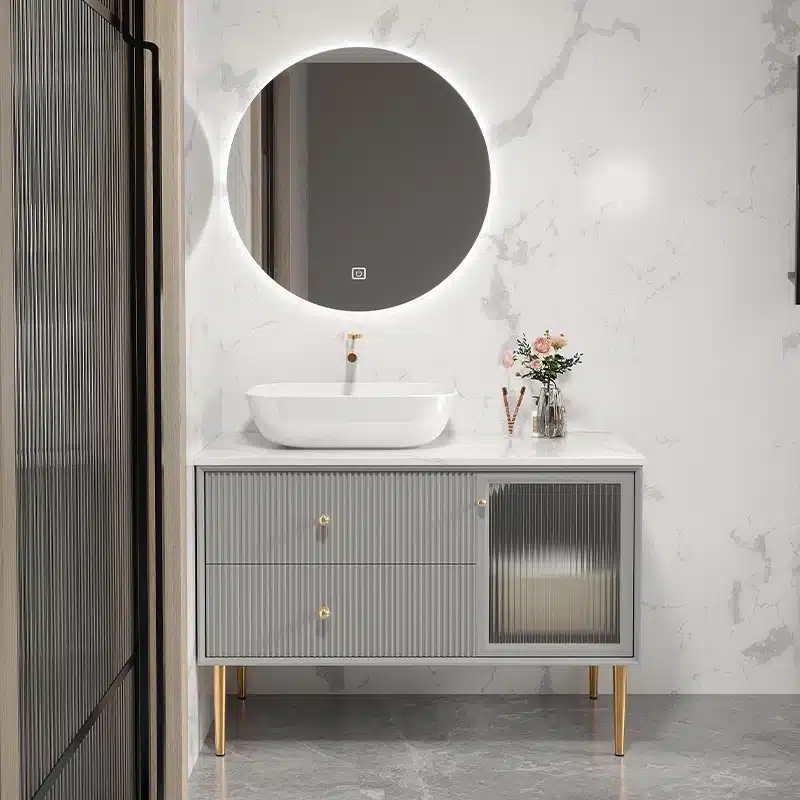
Laser engraving. A logo burned into wood or sintered stone becomes part of the surface. It does not peel, chip, or rub off. On solid wood and sintered stone vanities this reads as a premium, understated signature. Engraving is the stronger choice when you want a mark that cannot be removed without damaging the product.
Pad or UV printing. Full-color logos sit on panels, mirror glass, and metal hardware. Complex marks, gradients, and fine text reproduce cleanly. Print quality depends on the coating underneath, so specify the finish at the same time as the artwork.
Metal nameplates. A small badge screwed or adhered to the door face carries the logo with a dimensional look. Field teams can swap a nameplate without replacing the door or the handle. For hotel chains that rebrand or refresh, this is the replaceable option.
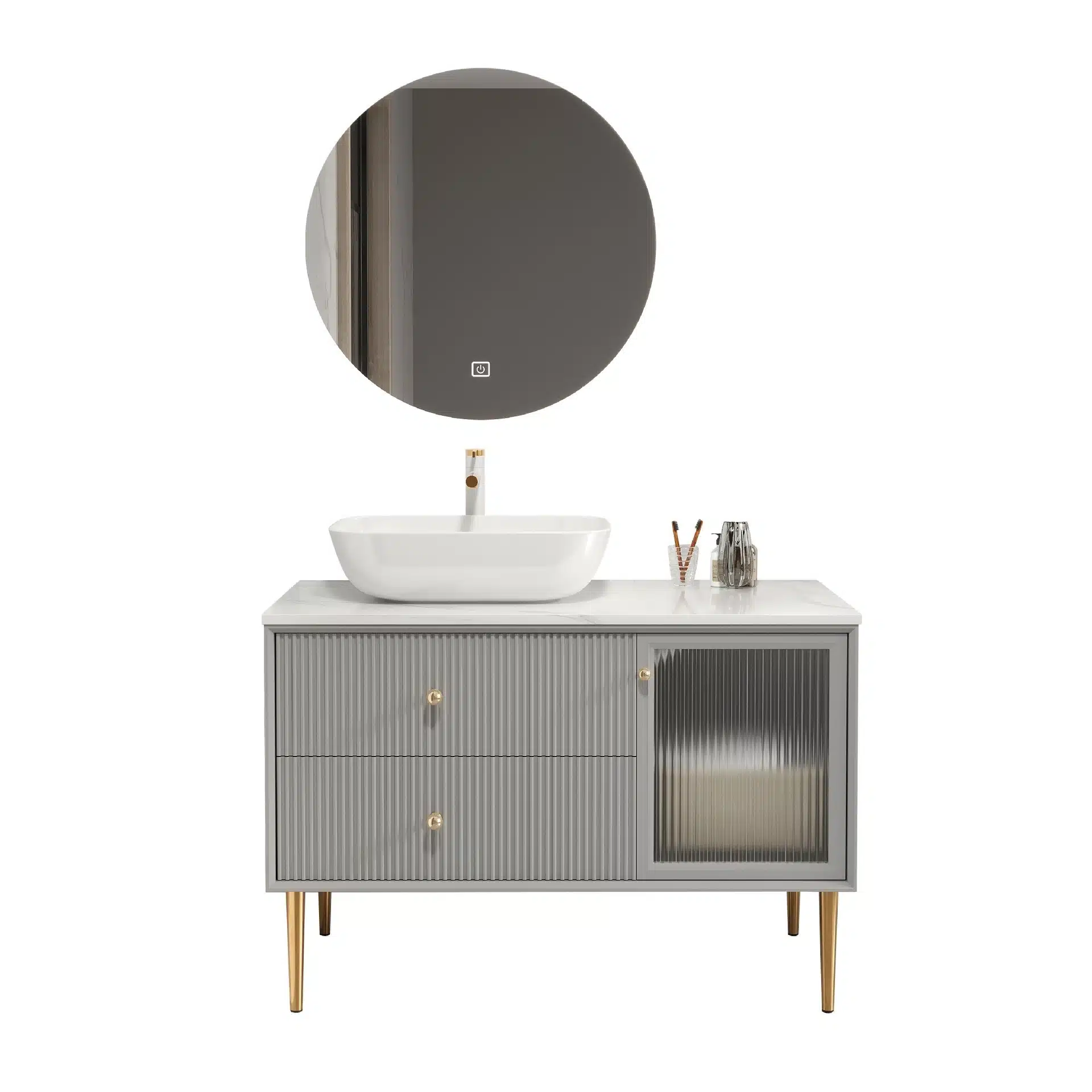
Custom handles and knobs. The handle itself becomes the logo. A die-cast part carries your mark on the touch point guests feel first. This is the maximum-visibility route, and it pairs naturally with custom packaging that shows the same logo on the box.
If one default is needed, engrave the handle or door and print the mirror. Keep a nameplate in the program when you need field-swappable branding.
Material drives the carrier choice. Solid wood and sintered stone accept laser engraving cleanly. PVC and plywood panels take printed logos without surface damage, and mirror glass favors UV inks. When one logo must run across a mixed program, confirm the artwork renders in both methods before you quote. A mark approved in one finish can fail in another.
| Carrier | How It Works | Durability | Minimum Order | Ideal Use |
|---|---|---|---|---|
| Laser engraving | Logo burned into wood or sintered stone surfaces | Permanent; cannot peel or chip | From 15 units | Premium, subtle brand marks |
| Pad or UV printing | Full-color logo on panels, glass, or hardware | Long-lasting under a clearcoat | From 15 units | Complex logos and gradients |
| Metal nameplate | Badge screwed or adhered to the door face | Replaceable in the field | From 15 units | Chains that rebrand or refresh |
| Custom handle or knob | Die-cast part carrying the mark | Matches hardware durability | From 15 units | Maximum brand visibility |
Branding Hinges and Slides at 15-Unit Minimums
Hinges and drawer slides are the workhorses of a branded program, and they are the parts most buyers forget to brand. Custom branded vanity hardware programs work only when moving parts carry the same mark as the handles. The MOQ logic stays the same: 15 units per model, per color, per size covers hinge families and slide runs alongside the cabinet.
Hinge Branding
The visible parts of a hinge are the cup, the arm, and the cover cap. Logo placement options include a stamped mark on the arm and a colored cap that matches your Pantone finish. The structural choice comes first: clip-on versus screw-on hinges change installation speed and field maintenance, so lock that decision before artwork starts.
Slide Branding
Under-mount slides hide most of their length, but the visible front bracket can carry a small mark. Load rating and extension type matter more than logo placement. Under-mount versus side-mount slides differ in load capacity and feel, so pick the slide family for the drawer, not for the logo.
Regional Specifications
Hardware that performs in one market fails in another. Specifying bathroom vanity hardware by region prevents failures: hinge type, finish tolerance, and corrosion resistance vary with climate and code. Fold regional requirements into the same 15-unit order, and one production run covers function and branding together.
Soft-close components deserve the same scrutiny as the logo itself. Our soft-close vanity hardware analysis covers the failures that surface on commercial projects when the mechanism is chosen for price rather than duty cycle. A branded handle on a weak mechanism still fails, and the failure carries your name.
Finish matching matters as much as the mark itself. A Pantone-matched hinge cap against a custom cabinet color closes the visual gap that generic hardware leaves open. For chains running the same model across properties, keep a branded hinge and slide allocation in the spare parts plan. Replacement parts with the same mark hold the renovation standard together.
How the 15-Unit MOQ Actually Works
The MOQ — minimum order quantity — is 15 units per model, per color, per size. For custom branded vanity hardware, that phrasing does the heavy lifting: every combination is its own line. Two Pantone colors mean two 15-unit lines. Two sizes mean each size counts separately.
The color dimension is where budgets slip. A private-label program with 4 colors and 3 sizes creates 12 lines, and each line needs 15 units to start. Plan the color count before you negotiate, because the per-color minimum applies to every SKU in the program.
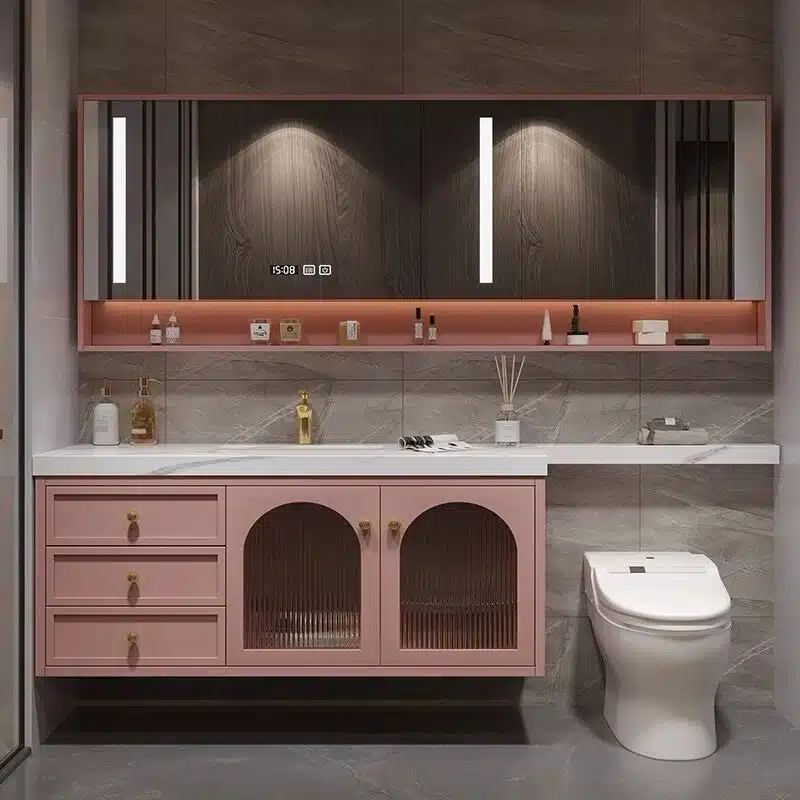
A quick example shows how the minimum scales. Three Pantone colors and two sizes produce six 15-unit lines — 90 units in total — before mixed-container logic combines them with other models. Each added color multiplies the minimum commitment, so lock the palette before you lock the order.
Mixed containers keep the system practical. You can combine different models and sizes in one shipment as long as the total volume reaches the MOQ. A trial container can hold a branded handle line, a standard model, and a sink basin order under one set of documents.
The wider custom program runs through 40,000+ combinations: Pantone colors, eco materials, ceramic, resin, and sintered stone basins, plus branded hardware. White-label service wraps the whole order — logo printing or laser engraving, and custom packaging with gift boxes, outer cartons, and instruction manuals in your language.
White label and private label overlap but are not identical. White label usually means your brand replaces the manufacturer’s brand on a standard product. Private label goes further: your color, your packaging, your hardware, your instruction manual. MFBATH supports both routes, and logo engraving or printing starts at 15 units in either case.
One nuance: plywood cabinet lines with fully custom colors carry a 50+ unit minimum, so if your SKU runs on plywood carcasses, size the first order accordingly. For the math behind SKU planning, the OEM MOQ strategy at 15-unit minimums walks through how the threshold changes your product mix.
Branded Hardware Programs for Private Label Vanities
Browse this product, solution, or service page to explore relevant offerings.
From Sample Approval to Container Load
A branded program follows five steps, and each one has a fixed point of control.
Request samples. Free samples are supported. Send your logo file, Pantone references, and hardware spec; the factory produces a sample with the actual engraving or printing on it.
Approve the sample. Sample lead time is 10 working days. Compare the sample against your artwork on three axes: mark placement, color accuracy, and hardware feel. The sample vs production consistency checklist lists the checks that catch production drift before it costs a container.
Place the production order. Payment terms are 30% deposit to confirm the order, with the balance due within a week after the draft bill of lading. Bulk production runs 20–30 days.
Ship. Goods leave from Qingdao Port on FOB terms. For the US, Canada, and Mexico, total delivery runs 4–6 weeks including logistics, with real-time tracking available. Clients in those markets typically save about 15% on freight versus alternative routing.
Stock and reorder. The branded SKU is now in your catalog. Because the MOQ stays at 15 units per model, per color, per size, a reorder of one color line stays as small as the original trial. That keeps working capital low while the line proves itself in the market.
Two documents protect a branded order at the port. The packing list should name the marked parts so customs and your warehouse can match them to the purchase order. Container photos should show logo placement on a sample unit before loading closes. Both cost nothing and prevent a full container of misprinted branding.
Quality Checks and Testing Before You Approve
Branding changes nothing about QC discipline; it raises the bar. Every product passes 5 inspection points in-house. The factory holds ISO 9001 and ISO 14001 certification, current since 2017 and confirmed in 2025. For independent verification, third-party inspectors such as SGS or TÜV are welcome with advance scheduling, and internal QC reports come with photos and videos.
Material compliance sits beside hardware branding in the approval stack. Solid wood can come from FSC-certified supply chains, and panel products meet E1 limits with CARB Phase 2 and TSCA Title VI options. Low-VOC finishes keep a branded program aligned with green-building specifications.
Hardware Test Awareness
Hardware deserves its own test awareness. A branded hinge that fails in year one damages the brand, not just the door. Our findings in the 100K cycle hardware test in humidity show why cycle counts matter before you brand a hinge. Mechanisms that look identical in a showroom diverge sharply under repeated use in a humid bathroom.
Ask for test evidence on any hinge or slide you plan to brand. A clip-on hinge that passes its cycle test in a dry workshop can behave differently after months of steam and cleaning chemicals. The same discipline applies to soft-close mechanisms, which carry moving parts that wear faster than any logo.
Warranty and Defect Tracking
Cabinets carry a 2-year warranty, and the return rate stays below 1%. Those numbers apply to branded programs exactly as they apply to standard stock. Track defects by hardware part as well as by cabinet model, because a logo handle with a plating issue shows up as a brand complaint, not a cabinet complaint.
What to Prepare Before You Request a Quote
A quote request is only as good as the artwork and spec behind it. Five items cover almost every branded hardware RFQ.
- Vector logo files. Engraving and printing start from vector artwork (AI, SVG, or EPS). Low-resolution JPEGs force redraws and delay the 10-working-day sample clock.
- Pantone references for finishes. The 40,000+ custom combinations include Pantone color matching, so send codes, not descriptions.
- Hardware selection. State hinge type (clip-on or screw-on), slide type (under-mount or side-mount), and finish. List region-specific requirements in the same document.
- Packaging spec. Choose gift box, outer carton, and instruction manual formats. Custom packaging is part of the white-label program, so your logo appears on the box from the first container.
- Compliance targets. For US-bound programs, specify formaldehyde limits: E1, CARB Phase 2, and TSCA Title VI. The EPA’s formaldehyde page explains TSCA Title VI requirements, and the California ARB composite wood products program covers CARB Phase 2. If accessibility matters for US hotel or assisted-living projects, design hardware to meet ADA Standards. For wood sourcing, FSC-certified supply chains are available; FSC explains chain-of-custody certification. CE and UL markings are held on applicable products, and CSA, NOM, and ADA requirements are designed to meet in their relevant markets.
Start with base models before you brand them. The free 2025 product catalog runs 100+ pages and gives your team a shortlist of cabinets, basins, and mirror options to spec against.
Frequently Asked Questions
Can I brand only the hardware and keep the cabinet standard?
Yes. Logo printing or laser engraving starts at 15 units, and branded hardware sits in the same minimum. Keep the cabinet a standard model and you still meet the threshold.
Does the 15-unit MOQ apply per color?
Yes — 15 units per model, per color, per size. Each Pantone color is its own line, and mixed containers let you combine models and sizes to reach the total volume.
How long does a branded sample take?
Samples take 10 working days, and free samples are supported. Send vector artwork and Pantone codes upfront to avoid a redraw cycle.
Can hinges and drawer slides carry my logo?
Yes. Hinge arms, cover caps, and slide brackets can carry your mark under the same 15-unit minimum. Function and test results come before branding.
What packaging options come with a branded program?
Custom packaging includes gift boxes, outer cartons, and instruction manuals, all printed with your logo as part of the white-label service.
The Bottom Line
Branded hardware programs exist so your name shows up where your products show up. Custom branded vanity hardware programs at a 15-unit MOQ per model, color, and size make the entry practical. The timeline — 10 working days for samples, 20–30 days for production, 4–6 weeks to North America — keeps it fast. Pick carriers that survive the room, lock hinge and slide families before artwork, and budget per Pantone color line.
Send your logo files and Pantone references to the MFBATH team for a quote. Ask for the free 100+ page 2025 catalog to shortlist base models while the sample clock runs.





0 Comments