
When you buy vanities for apartments, rental townhomes, or mixed-use buildings, the spec you write decides two numbers you will live with for years: the first cost per unit and the cost of replacing what breaks after tenants move in. Spec too thin and maintenance calls eat the savings; spec too heavy and you pay for durability renters never notice. This guide covers multi family bathroom vanity specs for property managers, developers, and contractors — how to weigh PVC against plywood and solid wood, which sizes and durability details to standardize, what a 2-year warranty and a return rate below 1% are actually worth, and how to order volume without paying a volume premium.
Multi-Family Bathroom Vanity Specs Start with the Use Case
The difference between buying vanities for a hotel and buying for apartments is housekeeping. A hotel room’s vanity is cleaned by staff daily, guests stay a few nights, and damage gets caught within hours. A rental unit is occupied by one household for a year or more, cleaned on a resident’s schedule, and subjected to whatever a tenant’s day involves — wet countertops, spilled toiletries, slammed drawers, and cleaning products that would strip a cheap finish in months. So the first rule of multi-family sourcing is to write the spec around the use case, not around the catalog.
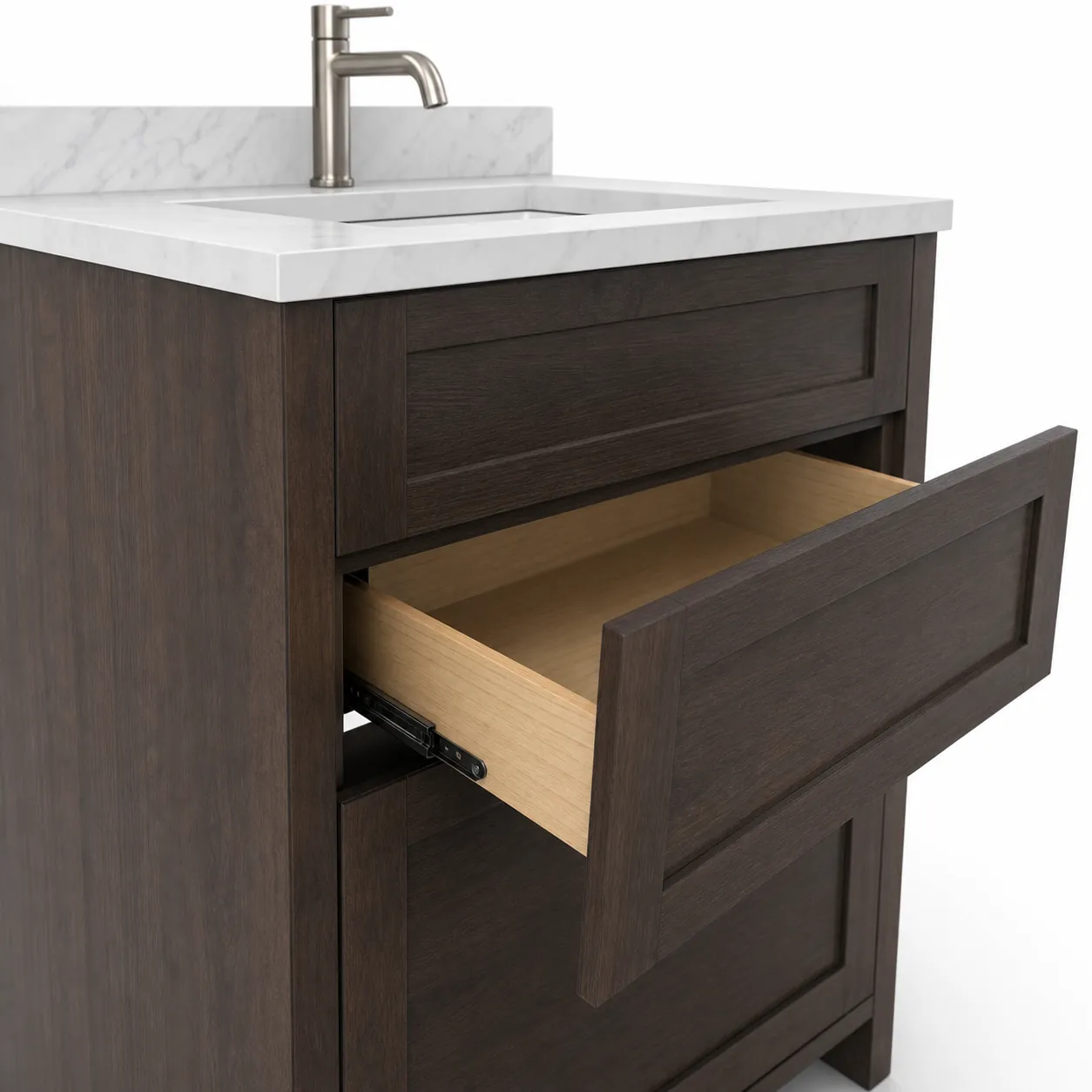
Start by listing the failure modes you have actually seen in your buildings. Water sitting on the cabinet top and wicking into the sides, edge banding lifting after a few wet seasons, hinges and slides wearing out after years of daily use, drawer fronts scuffing, and finishes yellowing or peeling near the sink. Every one of those failures has a spec answer: a waterproof core material, sealed edges, rated hardware, and a finish that tolerates moisture. If your current spec does not address those four points, you are buying furniture, not commercial equipment.
Unit mix matters just as much as material. A building with studios, one-bedrooms, and two-bedroom units needs several vanity sizes in the same finish family, and the more distinct SKUs you create, the more you complicate production, spare-parts inventory, and future phase replacements. That is why standardization is the quiet driver of multi-family economics: fewer sizes, one finish language, and a supplier who can repeat the same cabinet years later when you renovate the next phase. Our vanity guide for apartments walks through how to match unit types to cabinet sizes without multiplying SKUs.
Finally, price the replacement, not just the purchase. Pulling a failed vanity out of an occupied building involves the cabinet cost, freight, a technician’s time, the new unit, and usually a paint or trim repair around the base. The material decision below is really a decision about how often you are willing to repeat that process.
For most buyers, the useful discipline is to separate “base spec” from “upgrade spec” in writing. The base spec covers the majority of units and optimizes first cost; the upgrade spec is reserved for the units where a stronger cabinet pays back — concierge floors, larger family bathrooms, amenity space. That split keeps your average cost down while protecting the visible, high-traffic areas of the property. It also makes supplier negotiations cleaner: you quote one material set for volume and one for the premium tier, and you avoid the trap of applying an amenity-level cabinet to every door. If you have been burned by vague supplier claims before, the multi-family sourcing mistakes article lists the red flags we see most often in this exact buying scenario.
Material Comparison: PVC vs Plywood vs Solid Wood
The core decision in any multi-family spec is the cabinet material, because material drives both water resistance and first cost. Three material families cover almost every rental application — PVC (polyvinyl chloride), plywood in three grades, and solid wood — with a sintered-stone tier for premium amenity space. Each has a clear cost profile and a clear durability profile, and matching the two to your turnover rate and humidity conditions is the whole game.
PVC: the high-turnover workhorse
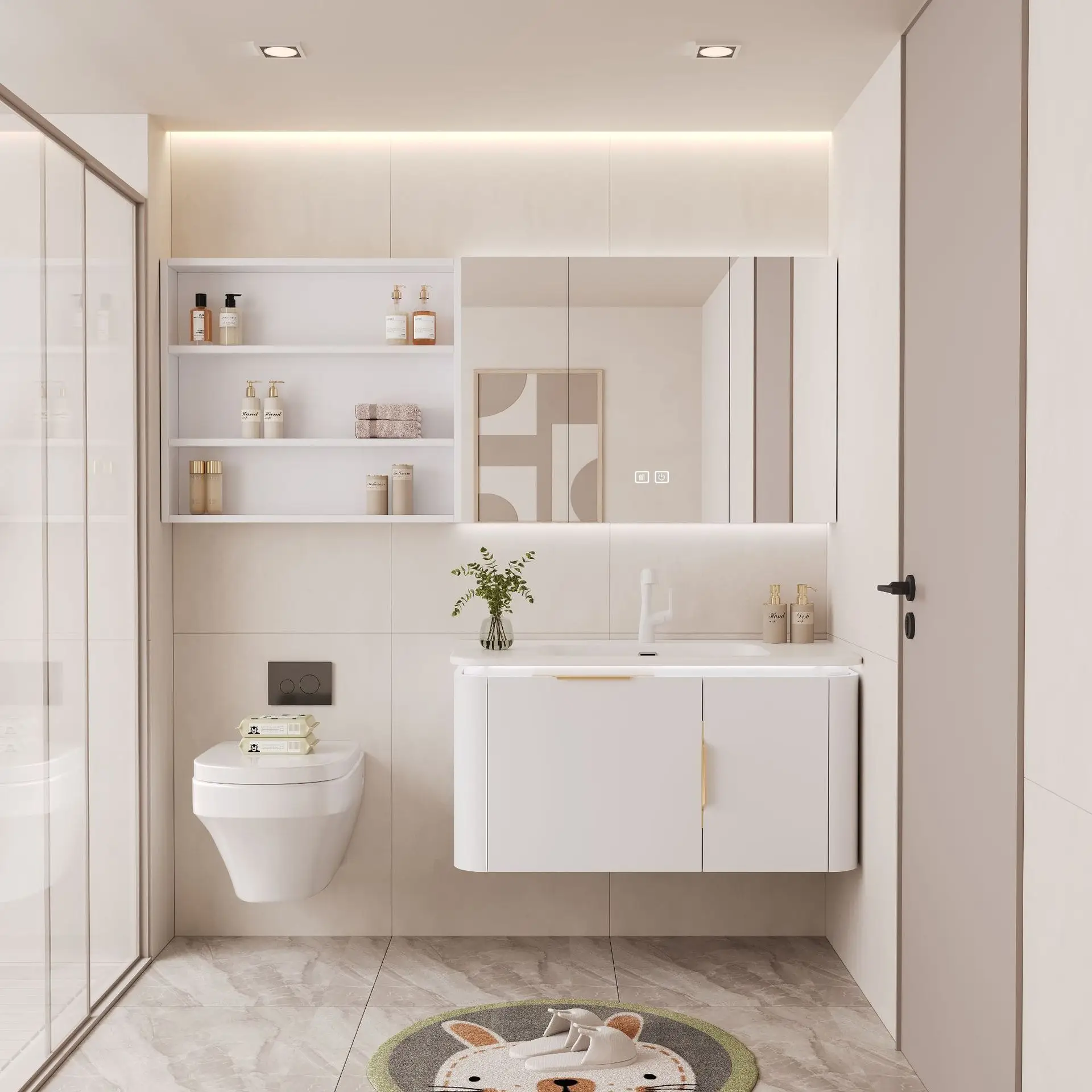
PVC vanities are 100% waterproof — no water absorption and no warping — because the core is a plastic sheet rather than a wood composite. Water can sit on the counter, splash the doors, and soak the cabinet base without swelling the panels. PVC is also easy to clean, scratch-resistant, and cost-effective at first cost, which is why it is the default answer for high-turnover rental units and shared bathrooms. Standard widths run 24–60 in and depths 18–24 in, which covers studios through family bathrooms without custom tooling. The finish story is a practical advantage for multi-family buyers: 1,000+ standard finishes let you match a new phase to a building that was furnished five years earlier, and custom colors start from 15 units per color, so even a small phase can carry your brand palette. The detailed comparison in our PVC vs plywood vanity guide shows where each material is the stronger pick.
Plywood: the balanced middle
Plywood vanities use a multi-layer structure that resists warping, and the panels come with waterproof edge sealing to close off the cut edges where moisture normally enters. Formaldehyde content is low, with E1 (≤0.1 ppm) and CARB Phase 2 compliant panels, and FSC-certified wood is available as an option for projects with procurement requirements around sustainable forestry. Plywood comes in three grades, and the grade choice is where most spec confusion happens:
- Standard plywood — good moisture resistance with sealed edges, suitable for owner-occupied and longer-hold apartments where care levels are higher.
- BWR (boiling water resistant) plywood — glue lines rated for boiling-water exposure, built for humid bathrooms and buildings near coastlines.
- Marine-grade plywood — the highest moisture tolerance of the three, for regions with sustained humidity or aggressive wet-dry cycling.
For a multi-family spec, the practical question is which grade your project’s climate and turnover justify. If you are building in a dry inland market with moderate rents, standard grade is often enough; coastal and high-humidity projects should step up. We break down the differences in our BWR vs marine-grade plywood comparison. Plywood custom colors start from 50+ units per color, a higher threshold than PVC’s 15 because the finishing process is different — plan your palette before you quote.
Solid wood: for the units people judge
Solid wood vanities are built from oak, walnut, maple, and ash from sustainable sources, with FSC certification available. The waterproofing comes from a multi-layer polyurethane (PU) coating applied over the natural wood, and the finish range is 20 standard finishes. Solid wood is the most expensive option per unit and the one tenants are most likely to damage through dents and scratches, so it earns its place in amenity rooms, clubhouses, model units, and concierge-level apartments — not in the volume spec.
Sintered stone: the premium tier
Above the wood families, MFBATH offers sintered stone vanities for higher-end units: floating models from 600–1800 mm and floor-standing models from 800–2000 mm. The material’s selling points are physical: Mohs hardness of 7–8, which shrugs off scratches, and heat resistance to 300°C, so hot appliances and curling irons are not a damage risk. If your project has a dozen units that need to feel premium, spec those separately rather than upgrading the whole building.
| Material | Water resistance | Impact and cleaning behavior | Cost tier | Multi-family bathroom vanity specs fit |
|---|---|---|---|---|
| PVC (polyvinyl chloride) | 100% waterproof; no absorption, no warping | Scratch-resistant, easy to clean | Lowest first cost | High-turnover rental units; standard sizes 24–60 in |
| Standard plywood | Multi-layer core resists warping; waterproof edge sealing | Solid surface; veneer needs reasonable care | Mid first cost | Owner-occupied and longer-hold apartments |
| BWR plywood | Boiling water resistant glue lines | Same plywood strength, higher moisture tolerance | Mid-to-higher first cost | Humid bathrooms, coastal buildings |
| Marine-grade plywood | Highest moisture tolerance of the plywood grades | Stable under repeated wet-dry cycles | Higher first cost | Coastal and humidity-heavy regions |
| Solid wood | Multi-layer PU waterproof coating | Natural hardwood; dents with hard impacts | Highest first cost | Premium amenity, clubhouse, model units |
Read the table as a cost-versus-durability ladder: each step up buys more moisture tolerance and more first cost, and the right rung depends on your turnover rate and climate, not on what looks impressive in a showroom. A common mistake is to spec the whole building at the top of the ladder because a few units justify it. Split the spec, keep the average down, and spend the savings where residents actually see it.
Size Standardization and Durability Details to Write Into the Spec
Once the material is chosen, the next layer of the spec is dimensional and mechanical. PVC vanities standardize at widths of 24–60 in and depths of 18–24 in, which spans the practical range of apartment bathrooms: a 24 in cabinet for a compact powder room, 30–36 in for standard single baths, and 48–60 in for family bathrooms and larger units. Standardizing on that range matters because every non-standard dimension pulls the unit out of the production line’s normal flow and pushes cost up. If your floor plans fit the standard range, say so in the spec and hold the supplier to it.
Finish planning is a second standardization lever. With 1,000+ standard finishes available on PVC, you can usually find a close match to an existing building’s palette without a custom run, which protects you on two fronts: matching a new phase to an old one, and matching a single replacement unit years later. When you do need a custom color — brand colors, a specific wood tone, a design palette — the thresholds are 15 units per color on PVC and 50+ units per color on plywood. Those numbers should be written into your procurement plan, because they decide whether a custom finish is a single-phase cost or a long-term commitment.
Mechanical durability is where rental spec details quietly differentiate suppliers. Soft-close drawers and doors are available and worth specifying for multi-family use: they cut the noise that bothers adjacent units and reduce the slamming that wears out hinges in rental settings. On plywood cabinets, the waterproof edge sealing is the detail that determines whether the cabinet survives years of wet hands and steam — inspect the edges, not just the panel face, when you review samples. On solid wood, the multi-layer PU coating is what makes the cabinet serviceable in a bathroom at all.
Write the durability section of your spec as a checklist, not a paragraph: material grade, width and depth, edge sealing, soft-close hardware, finish family, and custom-color threshold. That format makes supplier quotes comparable, because every vendor has to price the same line items. If you are also responsible for other wet areas in the building, our commercial restroom vanity specifications cover the stricter requirements that public and employee bathrooms demand — a useful reference when a property includes amenity restrooms alongside the residential units.
Durable Multi-Family Vanity Programs for Property Buyers
Browse this product, solution, or service page to explore relevant offerings.
Warranty, QC, and the Real Economics of Replacement
The warranty line in a commercial spec is not a formality — it is your estimate of future replacement cost. MFBATH offers a 2-year warranty on the complete cabinet, and the factory’s return rate sits below 1%. Put that number in context: on a 500-unit order, below 1% means fewer than five cabinets come back. The warranty matters less as a legal document than as a signal of process discipline, because the processes that produce a sub-1% return rate are exactly the ones that protect you on a 5,000-set-per-month production run.
That discipline is visible in the factory’s quality system. Every cabinet passes a 5-stage QC (quality control) check per unit — not per batch — and third-party inspection is welcome, with firms such as SGS and TÜV able to audit production when arranged in advance. For a buyer who cannot stand on the factory floor every week, an independent inspection clause is the most cost-effective insurance in the contract: it converts a supplier’s claim into a verifiable process. The factory has also met ISO 9001 (International Organization for Standardization) quality management and ISO 14001 environmental management requirements since 2017, which gives you a stable baseline to audit against when comparing manufacturers.
Formaldehyde and emission claims deserve the same verification habit. The panels are E1 grade (≤0.1 ppm) and CARB Phase 2 compliant, and you can cross-check any supplier’s claims against the EPA’s formaldehyde emission standards for composite wood products, which cover the US market for composite panels. Ask the supplier to state the emission class on the quote and support it with test documentation; if a vendor hesitates on that line item, that is a useful signal before you commit volume.
Finally, treat the factory’s operating facts as part of the durability decision, because consistency is a durability attribute. MFBATH has been manufacturing in Changge, Henan, since 2015, employs 95 people, and runs about 5,000 sets per month of capacity. For a multi-family buyer, capacity is not bragging — it is the answer to a specific question: can this factory repeat my spec at the same quality when my next phase orders 300 more units? Our plywood bathroom vanity manufacturer profile shows how to vet a factory on those questions before you sign.
Ordering Multi-Family Volume: MOQ, Mixed Loading, and Delivery
The ordering terms are where a multi-family project either becomes factory-direct or stays stuck at a distributor’s margin. MFBATH’s MOQ (minimum order quantity) is 15 units per model, per color, per size — low enough that a single small phase qualifies, and the real unlock is mixed container loading: you can combine models and sizes in one container once the total reaches the MOQ. In practice that means a 60-unit order can carry 24 in, 30 in, and 48 in cabinets, two finish families, and still ship as one lot. For developers spec’ing mixed floor plans, this removes the classic penalty of buying several sizes in small quantities.
Payment terms are standard trade terms: 30% deposit to start production, with the balance due within one week of the draft BL (bill of lading), shipping FOB (free on board) from Qingdao port. Those terms are worth knowing before you budget, because the deposit protects the production slot while the draft-BL timing means your payment schedule aligns with shipment rather than delivery. Budget the cash flow accordingly and there are no surprises at the finish line.
Timelines matter for construction and renovation calendars. Samples ship free within 10 working days, bulk production takes 20–30 days, and total delivery to the US, Canada, and Mexico runs 4–6 weeks with logistics tracking throughout. For a renovation schedule, that window fits a typical phase plan: order samples while you finalize finishes, lock the bulk order, and land the container before the units are ready for installation. Logistics solutions for US, Canada, and Mexico clients can also save roughly 15% on freight compared with standard routing, which is a real number to ask about when you compare landed costs — freight is frequently the hidden line item that separates one factory quote from another.
The ordering strategy that works for multi-family buyers is phasing, not one giant order. Because the MOQ is 15 units per model/color/size and finishes are repeatable from a 1,000+ finish library, you can spec the base building now, renovate Phase 2 in two years, and reorder the same cabinets without redesigning anything. That continuity is what turns a vanity supplier into a building-standard partner, and it is the same logic that our hotel and multi-family sourcing mistakes guide applies to properties of every size — the mistakes are usually in the ordering terms, not the cabinet.
Frequently Asked Questions
What is the MOQ (minimum order quantity) for multi-family vanity orders?
The MOQ is 15 units per model, color, and size, and mixed container loading is supported — you can combine different models and sizes in one shipment once the total reaches the MOQ, so a 60-unit phase can carry several cabinet widths and finish families in a single container.
How long does a multi-family vanity order take from samples to delivery?
Free samples ship within 10 working days, bulk production takes 20–30 days, and total delivery to the US, Canada, and Mexico runs 4–6 weeks with logistics tracking — which fits a typical renovation phase plan of ordering samples first and locking bulk production while finishes are finalized.
Are PVC vanities durable enough for rental bathrooms?
Yes for high-turnover units: PVC is 100% waterproof with no water absorption or warping, plus scratch resistance and easy cleaning, which suits units that cycle tenants every year or two. For buildings where you want a wood aesthetic with high moisture tolerance, BWR or marine-grade plywood is the alternative to write into the spec.
The Bottom Line
Write multi-family specs around the two costs you control: first cost per unit and replacement frequency. PVC covers high-turnover units at the lowest first cost, BWR or marine-grade plywood covers humid and longer-hold projects, and solid wood belongs in premium amenity space only. Standardize sizes and finishes, put the QC and inspection terms in writing, and order with mixed loading from the 15-unit MOQ with a 4–6 week delivery window. Send MFBATH your unit mix and floor-plan widths, and you will get back a spec sheet you can compare line by line.




0 Comments