
A $50,000 order can go sideways when the pre-production sample and the mass production run don’t match. That is why the smart mirror features checklist has to start with measurable specs, not catalog wording. The gap between a sample that looks great in a showroom and a container of mirrors with dull, uneven lighting is almost always a specification that never made it onto the order sheet.
Color rendering index (CRI) is the first place to push back. Over 40% of smart mirrors sold online have CRI below 85, and that shows up directly in ecommerce reviews as washed-out skin tones and greenish reflections. Focuscabinet standardizes CRI≥95 across its LED mirror line, a spec that matters when a buyer is trying to keep return rates down.
Price per unit matters, but compare FOB pricing only after the electrical and optical specs are locked. A mirror quoted at $45 less per unit might carry an LED strip that drifts color temperature under heat, or a driver with no short-circuit protection. Make the sample approval process include a written quality tolerance around color temperature, CRI, and the IP rating confirmed by a test report.
Anti-fog performance is another place where samples mislead. Chemical coatings survive one steam test in a dry warehouse but fail in a humid bathroom after six weeks of daily showers. Active heated pads are the more reliable route for bulk orders, and if a supplier cannot show a timed de-fog test with a clear start and end point, treat the feature as unverified.
Set the baseline before requesting quotes. For North America and Europe, require UL or CE certification, IP44 as the minimum waterproof rating, and copper-free glass if the mirrors will face coastal humidity. The benchmark to write down: CRI≥95, 4000K default color temperature, active anti-fog, and a documented touch switch durability test. If a factory hesitates on any of those, keep looking.
Why a Detailed Feature Checklist Prevents Costly Mistakes
A written spec sheet is the only thing standing between a sample approval and a container of mismatched mirrors.
A $50,000 order went sideways last year because the pre-production sample matched the showroom model — but the mass production run didn’t. The LED driver was swapped, the copper-free glass turned out to be standard glass, and the touch switch registered every third tap. No written spec sheet existed to hold the factory accountable. A memory of what the sample looked like doesn’t clear customs.
A feature checklist closes the gap between “looks right” and “specified right.” A smart mirror carries seven subsystems that drift between quotes: LED driver, color temperature, CRI, anti-fog method, IP rating, glass grade, and switch type. Each one is a failure point across product lines. A 500-unit bulk order split across SKUs will silently diverge unless the smart bathroom mirror bulk order spec sheet pins every value down.
-
- CRI ≥ 95: Focuscabinet standardizes CRI≥95 across all LED mirrors. Over 40% of smart mirrors sold online fall below CRI 85 — expect color-rendering complaints and returns if this spec is missing from the sheet.
- Touch switch durability: Demand a documented cycle count on the spec sheet, not a marketing claim. A switch that dies after a winter of bathroom humidity becomes a warranty return that eats the margin on the entire order.
- IP rating (IP44 vs IP65): IP44 handles splashes; IP65 survives direct water spray. Choose based on the climate and installation height in your target market, not the supplier’s default configuration.
- Copper-free glass: Copper-free composition should appear on the factory certification, not in a product photo caption. Standard mirrors corrode faster in humid coastal regions.
Matching features to customer expectations is the second half. An ecommerce brand owner doesn’t just sell a mirror — they sell the bathroom aesthetic in the listing photo. When the delivered product renders skin tones grey and lipstick colors wrong, the buyer returns it. The return costs more than the margin. A documented smart mirror features checklist turns that risk into a spec you can verify before committing to a container.
The checklist is also your price anchor. If a factory quotes FOB pricing without a documented spec sheet, you are comparing prices for two different products. Sourcing guides talk about regional reach and logistics, but regional reach means nothing if the mirror that arrives is not the mirror that was approved.
| Feature | Specification | Benefit |
|---|---|---|
| Lighting Quality | CRI ≥95; 3000K/4000K/6000K options | True-color reflection reduces returns by up to 40% |
| Anti-Fog Technology | IP44–IP65 rated heated pad vs chemical coating | Clear mirror in high-humidity bathrooms without smearing |
| Smart Controls | Touch switch ≥50,000 cycle test; motion sensor range up to 3m | Long-lasting electronics cut after-sales failures |
| Safety Certifications | UL/CE certification; copper-free mirror backing | Meets North American & EU import compliance |
| Region-Ready Design | Voltage 110–120V or 220–240V; humidity-adapted sealing | Plug-and-play installation for global e-commerce markets |
| Bulk Consistency | Five-stage QC; batch color tolerance ΔE <1.5 | Uniform appearance across multi-unit orders |
| Warranty & Spare Parts | 2–5 year warranty; 5-year LED driver & switch parts stock | Lower lifetime cost and easier local servicing |
| Packaging Protection | Corner-reinforced cartons + foam inserts; drop-tested | Minimizes damage claims on e-commerce last-mile delivery |
Lighting Quality – Lumens, Color Temperature, CRI
A mirror can be square, beveled, and IP65-rated yet still make customers look sick.
Lumens, color temperature, and CRI are the three numbers that separate a premium smart mirror from a cheap LED board in a frame. Most supplier spec sheets only list “6000K LED” and stop there. That is not enough to compare products, and it is not enough to protect your return rate.
-
- Lumens per mirror size: For a 600×800mm mirror, spec at least 2,000 lumens from the LED strip. At 700×900mm, step up to 2,400–2,800 lumens. A 1,200mm double-door mirror needs 3,500+ lumens for even illumination. Dimming to 10% is a control feature, not a substitute for max output.
- 3000K vs 4000K vs 6000K: 4000K is the safest default for vanity mirrors in North America and Europe because it matches daylight without washing out skin tones. 3000K fits luxury hospitality projects. 6000K sells well in Southeast Asia and parts of the Middle East, but it makes skin look pale. If you want one SKU for multiple regions, make 4000K the stock item and offer 3000K as an optional CCT.
- CRI ≥90 minimum, CRI ≥95 for ecommerce: CRI below 85 shifts how reds and skin tones appear, and that generates “mirror makes me look sick” reviews. Focuscabinet standardizes CRI ≥95 across all LED mirrors because over 40% of smart mirrors sold online land below CRI 85. A CRI ≥95 requirement costs little at production and cuts color-complaint returns significantly.
Put these three specs in writing on every RFQ. Set a quality tolerance of ±5% on lumen output and ±200K on color temperature, and require the CRI value to be stated on the sample approval form. A supplier who cannot quote CRI at the inquiry stage will likely swap LED strips after approval. That is exactly the risk a smart LED mirror CRI 95 checklist is meant to kill.
Anti-Fog Technology – Passive vs Active
A chemical coating fails within a year.
Most anti-fog claims on a spec sheet come down to one of two technologies: a heated pad laminated to the rear of the mirror, or a chemical coating applied to the glass surface. They are not interchangeable, and the choice directly impacts the return rate on every mirror you sell.
A heated pad raises the glass temperature above the dew point of the bathroom, so steam never condenses. A properly designed pad clears a 600 mm mirror in under two minutes and keeps it clear as long as it is switched on. A chemical coating reduces surface tension so water forms a thin film instead of droplets, but that film still distorts the reflection until it evaporates.
-
- Heated pad: Resistive film bonded to the glass. Higher unit cost, but delivers consistent fog-free performance in high-humidity bathrooms. Specify at least 80 W/m² and confirm the pad covers the full mirror surface, not just the center.
- Chemical coating: Cheaper and invisible, but it wears off with cleaning agents, steam, and daily use. For a bulk order, assume the coating will underperform after a year in a typical household bathroom. If a supplier will not put the coating lifespan in writing, treat it as a consumable, not a feature.
- Test routine: Run a 10-minute hot shower in a sealed room with the mirror mounted at vanity height. Clock the time to a fully clear surface, then repeat the cycle 100 times. If the mirror is not clear within 90 seconds after the 100th cycle, the anti-fog system does not meet bulk-order standards.
For coastal and tropical regions, heated pads are the safer call. Chemical coatings degrade faster in salt-laden humid air, and the last thing an ecommerce brand needs is a wave of reviews showing fogged mirrors six months after delivery.
Smart Controls – Touch, Motion, App Integration
Ask for the touch switch test log — an unverified 100,000-cycle claim is marketing, not engineering.
Touch switches are the most common failure point on a smart LED mirror. The glass survives; the controller board behind it doesn’t. In humid bathrooms, PCBs without conformal coating corrode quietly — the switch misses taps around month six, then dies completely. That’s the failure mode behind ‘stopped working after 5 months’ reviews, and it lands on your margin as return shipping.
-
-
- Touch cycle benchmark: Require a documented 50,000-cycle test at 60 taps per minute in a 60°C/90% RH chamber. Cheap capacitive films fail between 10,000 and 20,000 cycles. If the factory can’t show the test log, assume the cycle claim is theoretical.
- Controller protection: Conformal-coated PCB is the difference between a switch that lasts a year and one that lasts three. It’s a fractional cost increase — a vague answer from your supplier means it’s not coated.
-
Motion sensor returns are the second wave, usually reported as ‘the mirror doesn’t turn on.’ The real fault is detection geometry. Most PIR sensors advertise a 2–3 meter range, but a 60° lens in a two-meter-wide bathroom has blind spots. Your customer walks straight at it and nothing happens; they wave sideways and it lights. They read that as a defect.
-
- Detection angle: Spec 120° for compact bathrooms. Anything narrower than 90° creates dead zones in rooms under 2.5 meters wide.
- Battery vs hardwired: Battery-powered sensors deliver 3–6 months in real use. A mirror with a mains connection should use hardwired sensing — it removes a consumable that customers will blame on you.
Two items belong on any smart mirror features checklist before you sign the order: touch controller conformal coating and motion sensor angle. Suppliers who answer with documented specs have run the tests; suppliers who say ‘we’ll check’ have not.
Safety Certifications – UL, CE, IP Rating
Certification is a market-entry gate, not a marketing badge.
The first thing to check on a supplier’s certificate wall is not whether the paper looks official — it’s whether the model number on the certificate matches the model being ordered. A smart mirror headed to the US needs aUL Listedfile number that Amazon and big-box retailers can verify, not a CE declaration from a lab that doesn’t test for US wiring. For Canada, add cUL or CSA. For the EU and UK, CE or UKCA covers low-voltage and EMC requirements. Australia and New Zealand typically require RCM. Many Middle East and Southeast Asia project tenders ask for IEC CB test reports or GCC certification. Ask for the report number and look it up directly.
CE is a self-declaration, not a certificate issued by an authority. A factory can sign off on CE without any independent testing, so it tells you almost nothing about safety design. UL and ETL, on the other hand, involve third-party testing and periodic factory inspections. Those inspections expire. If the supplier’s UL file is outdated, your container can sit at port or get delisted from an ecommerce platform. I have seen 60-day delivery delays because someone accepted a photocopy of an expired cert.
-
- IP44: Splash-proof from all directions. Enough for a mirror mounted above a vanity or basin, which is the standard placement for 90% of bathroom mirrors. It also meets most bathroom zone requirements outside the immediate shower area.
- IP65: Dust-tight and protected against low-pressure water jets. Needed only when the mirror is installed inside a shower enclosure, steam room, or a position that receives direct water spray.
A supplier that quotes IP65 as ‘better’ across the board is usually adding cost, not value. Sealing a touch panel and LED driver to IP65 raises the bill by 8–15% and complicates heat dissipation. For a typical vanity mount, IP44 is the realistic spec. Where importers get burned is when the supplier’s IP44 rating applies only to the LED light bar, not the full mirror assembly. Clarify in writing that the IP rating covers the complete unit, including the touch switch and any integrated outlet.
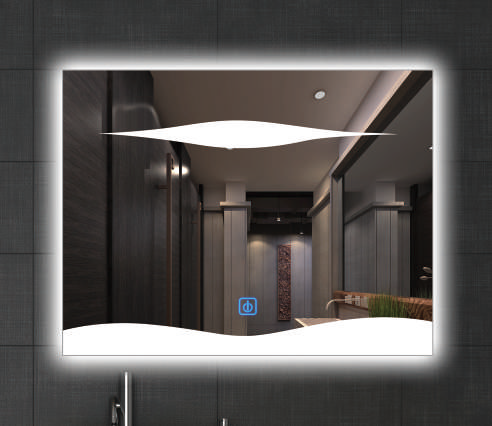
Glass Quality – Copper-Free vs Standard
Copper-free mirrors are not a premium upsell — they are a corrosion issue waiting to happen in coastal or high-humidity markets.
The mirror’s reflective surface is a thin silver layer. In standard mirror production, a copper layer is applied over that silver to protect it before the paint backing goes on. That copper layer is the weak point in a bathroom setting. Moisture penetrates the edges, oxidizes the copper, and produces black spots that creep inward over time. Once oxidation starts, the mirror degrades quickly. For e-commerce sellers, that translates into return requests and negative reviews arriving months after the buyer has already installed the mirror.
Copper-free mirrors replace the copper layer with a lead-free protective coating directly over the silver. That removes the most vulnerable component from the corrosion chain. In high-humidity environments, the practical result is a mirror that resists edge corrosion and black spotting for significantly longer. For distributors serving coastal climates or bathrooms with poor ventilation, this is not an optional upgrade.
-
- Verification method — XRF analysis: Request an XRF (X-ray fluorescence) report from the factory. It shows the composition of the mirror’s coating layers. If copper appears in the backing, it is not a copper-free mirror, regardless of what the brochure says.
- Certification evidence: Ask specifically for the factory’s copper-free mirror certification or third-party test report. A factory that genuinely uses copper-free standard will have documentation on file. Vague claims are a red flag.
- Sample edge test: Cut a small corner from a pre-production sample and expose it to warm, humid conditions (40°C, 90% RH) for 72 hours. Copper-backed mirrors will show early oxidation at the cut edges. Copper-free mirrors stay clear.
For bulk buyers, verification has to happen before the container ships, not after you have 500 mirrors in a warehouse. Add the copper-free specification to your smart bathroom mirror bulk order spec sheet and require the test report at the sample approval stage. If the supplier pushes back on documentation, question why. The material cost difference between copper-free and standard mirror backing is small compared to the financial hit from a defective batch that fails inside the warranty period.
Warranty and After-Sales Support
A 1-year warranty on a smart LED mirror is a red flag.
For a smart mirror, the warranty is not a single promise. It is a set of promises about different components. The industry norm is 2 years on the full mirror, but the component-level breakdown matters more. LEDs themselves can run past 50,000 hours. The driver, the touch switch, and the power supply are the parts that actually fail. Ask for the warranty period on each of those separately.
-
- LED driver (power supply): The most common failure point. A 2-year minimum is standard. Below that, the factory is using an inferior driver. Many B2B suppliers quote 3 years on the driver because the MTBF (mean time before failure) of a quality driver exceeds 30,000 hours.
- Touch switch / motion sensor: These are high-touch, high-moisture components. Demand at least 2 years of coverage. A reputable supplier will have cycle test data — typically 50,000 touch cycles — and should share it upon request. If they cannot produce that report, assume the switch is the weakest link.
- Mirror glass / reflective layer: Copper-free mirrors last longer because they resist edge corrosion. The warranty should match that, typically 3 years. If the reflective layer warranty is only 1 year, the supplier doesn’t trust their own glass coating.
The test is not the warranty document. It is the spare parts pipeline. A 2-year warranty is useless if the replacement driver takes 60 days to arrive. Before signing, ask for a documented spare parts plan. The supplier should be able to state a recommended spare parts ratio — typically 2% to 3% of order quantity for drivers and switches — and a confirmed replacement lead time.
Bulk buyers should also insist on a stock commitment for the product model. If a supplier redesigns a mirror and abandons the old spare parts, you are left with dead inventory in your warehouse. A factory that has been running for a decade, like Focuscabinet, usually carries dedicated spare parts for at least 5 years after a model was last produced. That is the kind of commitment that protects your margin.
Conclusion
Sample approval matters, but mass production is where reputations are made. The mirrors that fail in the field are the ones where nobody verified the CRI, the IP rating, or the touch switch cycle count before the container shipped. Those three specs, documented on paper and tested on a pre-production unit, separate a one-time purchase from a repeatable product line. Focuscabinet builds its smart LED mirrors around that discipline, standardizing CRI≥95 and copper-free glass across the range, so the unit you approve is the unit you reorder. That consistency is why the final 10% of the checklist is worth more than the first 90%.
Take the checklist you used for this article and run it against your current supplier quotes. Where the answers are vague, ask for the test report. Where the reports are missing, treat that as a finding, not an explanation. Browse the Focuscabinet smart LED mirror range to compare documented specs side by side before you commit to the next sample round.
Frequently Asked Questions
What should a smart LED mirror checklist include?
Focus on measurable specs: lumens, color temperature, CRI, anti-fog type, switch durability, IP rating, and warranty terms. These are the specs that determine whether a sample can be repeated across a. Ask the factory to put every item in writing before quoting.
What IP rating is needed for smart bathroom mirrors?
IP44 is the minimum for normal bathroom zones, while IP65 is better for high-humidity or steam-heavy spaces. Your target market’s electrical codes and installation zone should decide the final spec. Confirm the IP rating with your compliance partner for each region.
Why does CRI matter for LED vanity mirrors?
A CRI of 90 or above shows true skin and makeup colors, while lower CRI makes reflections look dull or gray. This matters most for hotel and residential vanities where customers expect a natural look. Specify CRI ≥90 in your RFQ.
How should bulk buyers test anti-fog performance?
Ask the factory for the anti-fog mechanism in writing and test both heated-pad and coated samples in a steam room. A chemical coating can fail within a year, while a heated. Select the anti-fog type based on your humidity and warranty expectations.
Which certifications do smart LED mirrors need?
CE is expected for Europe, UL or cUL for North America, and WaterMark for Australia, plus an IP rating for water protection. The exact certificates depend on your target market’s bathroom. List your destination markets so the factory can map required certifications.

0 Comments