

 A comprehensive factory audit for a vanity manufacturer is the primary defense against receiving a container of warped panels and poorly finished products that can lead to costly chargebacks. A slick website and competitive price sheet can easily hide systemic production flaws, from inadequate material drying processes to contaminated finishing lines. These hidden issues directly translate into unsellable inventory and damage to your brand’s reputation, risks that surface long after the final payment has cleared.
This checklist provides a standard operating procedure for evaluating a potential supplier on the ground. We will move beyond the showroom and into the core production areas, examining the sophistication of their CNC and edge banding equipment. You will learn how to assess critical environmental controls in the paint shop and material warehouse, differentiate between in-line and final QC inspections, and interpret what social compliance certifications like BSCI and SMETA actually verify. Use this framework to identify a capable partner and spot critical red flags before you sign a contract.
Why Do You Need a Factory Audit?
A factory audit is a strategic tool to predict operational risks, verify quality systems, and ensure your supplier can deliver what they promise before production begins.
Verify Quality and Regulatory Compliance
An audit confirms that a manufacturer’s processes meet established quality standards and comply with regulations for your target market. It is a fundamental check to ensure the final product aligns with your specifications and legal requirements, preventing costly surprises after shipment.
- Confirms that production adheres to material specifications and agreed-upon procedures.
- Validates that the facility meets industry-specific certifications and standards.
- Acts as a preventative measure to stop non-compliant or defective goods from reaching the market.
Mitigate Supply Chain and Operational Risks
Factory audits give you a clear view of a supplier’s operational capabilities and potential weaknesses. By assessing the manufacturing environment firsthand, you can identify and address risks like production delays, ethical non-compliance, or capacity shortfalls before they disrupt your business.
- Provides transparency into a supplier’s true production capacity and stability.
- Helps identify potential weak points in the supply chain that could cause future disruptions.
- Assesses supplier practices to ensure they align with your brand’s ethical and sustainability standards.
Drive Continuous Improvement and Efficiency
An audit provides valuable data that both you and your supplier can use to optimize manufacturing processes. The findings highlight opportunities to improve efficiency, reduce waste, and enhance overall product quality through direct collaboration, turning a simple check into a tool for partnership.
- Identifies bottlenecks and inefficiencies within the production workflow.
- Offers actionable insights for enhancing manufacturing techniques and quality control.
- Fosters a partnership focused on long-term growth and process refinement.
Equipment Check: How Advanced Are the CNC and Edge Banding Machines?
A factory’s investment in integrated CNC systems and versatile edge banding machines directly determines its production consistency, ability to handle complex designs, and the final quality of its furniture.

Automated Precision and CNC Integration in 2025
By 2025, leading factories use fully integrated CNC systems that translate digital designs directly into precisely cut components. This level of automation minimizes human error and ensures every piece is consistent, which is critical for large-scale production of items like bathroom vanities where fit and finish are paramount.
- Modern equipment features laser precision jointing systems to create seamless, nearly invisible edges.
- Computer-controlled adjustments for speed and pressure allow for flawless application on complex shapes and corners.
- Auxiliary feeding systems reduce the need for manual handling, improving both safety and operational speed.
| Feature | Standard Equipment (Legacy) | Advanced Equipment (2026 Standard) |
|---|---|---|
| Precision & Control | Manual adjustments and basic digital controls. Relies heavily on operator skill. | Fully integrated CNC with laser jointing systems and automatic speed adjustment. |
| Material Handling | Limited to standard flat panels. Requires significant manual intervention. | Processes curved and irregular panels with auxiliary feeding systems. |
| Adhesive System | Single adhesive type, typically EVA. Limited moisture resistance. | Hybrid glue systems compatible with both EVA and PUR for superior durability. |
Material Versatility and Glue System Flexibility
The capability of an edge banding machine is often defined by its adaptability to different materials and adhesives. Advanced systems are built to handle a wide range of panel types, from standard MDF and Plywood boards to irregular or curved pieces for custom furniture. This flexibility is no longer a luxury but a requirement for producing modern bathroom vanities.
- Top-tier machines process curved and unconventional panels, a necessity for creating modern, custom designs.
- Hybrid glue systems offer compatibility with both EVA and PUR adhesives, providing flexibility for different durability and moisture-resistance needs.
- These systems are engineered for high-volume manufacturing while simplifying maintenance and operator training.
Create Standout Bathroom Cabinets for Your Market

The Paint Shop: Are Dust-Free Curtains Essential for a High-Quality Finish?
Dust-free curtains are non-negotiable for achieving a high-gloss, defect-free paint finish, serving as a cost-effective barrier against the airborne contaminants that cause surface blemishes.
Preventing Surface Blemishes from Airborne Particles
A professional paint finish demands a controlled environment. Dust-free curtains create a critical barrier that prevents airborne particles, debris, and other contaminants from settling on freshly painted surfaces. This isolation is the difference between a smooth, high-quality finish and one marred by specks and imperfections. Any serious manufacturer knows that managing the workshop environment is the first step in quality control for painted goods like bathroom vanities.
- Airborne contaminants are a primary cause of defects in high-gloss paint jobs.
- Effective containment systems isolate the painting area for a clean application.
- Proper dust control directly reduces the need for rework and cuts down on material waste.
A Cost-Effective Alternative to Permanent Structures
For many factories, building permanent, sealed-off paint rooms is not financially practical. Vinyl dust control systems offer an effective and financially sound alternative. These curtain walls provide excellent work zone isolation at a fraction of the cost—often one-tenth the price of constructing fixed walls. This makes them a smart choice for factories that need to balance tight budgets with stringent quality control standards.
- Installation costs for vinyl systems are significantly lower than for permanent construction.
- These systems provide the flexibility to reconfigure work zones as production requirements change.
- Their lower cost makes high-level dust control accessible to a wider range of workshops.
Integrated Fume and Noise Control for Workplace Safety
Modern containment curtains do more than just block dust. They also help manage paint fumes and reduce noise levels from equipment. This integrated approach creates a safer work environment for employees and helps the factory meet regulatory compliance standards for worker health and safety. The ability to contain fumes improves air quality in adjacent work areas, while the noise dampening contributes to a less hazardous workshop.
- The curtains contain fumes, improving air quality for workers outside the immediate paint zone.
- They can dampen equipment noise, contributing to a less hazardous industrial environment.
- This dual function supports both production quality and employee well-being.
Material Storage: How Is Moisture Control Managed in the Warehouse?
A factory’s material quality is directly tied to its warehouse climate discipline; uncontrolled humidity in storage guarantees dimensional instability and finishing defects down the line.
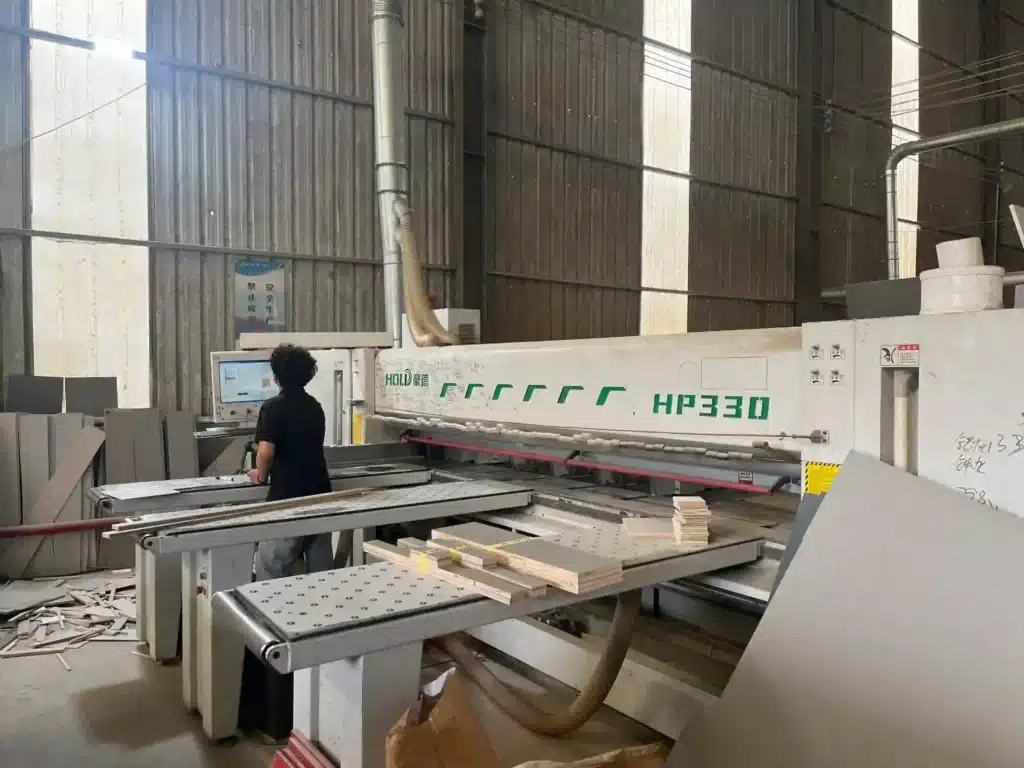
Cutting machine-1
Operational Practices for Airflow and Access Control
Effective moisture control starts with simple operational discipline, not expensive equipment. The most significant factor in managing warehouse humidity is strict access control. Keeping loading bay doors and other entry points closed whenever possible prevents ambient moisture from entering the facility. This single practice is often more impactful than complex infrastructure upgrades. Within the warehouse, optimizing internal airflow with strategically placed fans prevents stagnant, humid air pockets from forming around raw materials like MDF or plywood, ensuring a consistent and stable environment.
Integrated Dehumidification and Smart Monitoring
Modern facilities integrate smart technology with mechanical systems for more precise climate management. Instead of running a single, high-capacity dehumidifier constantly, factories now use hybrid systems adapted to regional climates and internal temperature needs. These systems are governed by automated controls linked to a network of sensors that monitor humidity in real time. This data-driven approach allows for precise adjustments, activating dehumidification only when needed and significantly improving energy efficiency.
Building Envelope Enhancements
The warehouse structure itself is the first line of defense against moisture. A well-maintained building envelope—the roof, walls, windows, and foundation—is critical, especially in high-humidity regions. Sealing gaps, upgrading insulation, and ensuring proper drainage block external moisture from infiltrating the storage space. These structural improvements don’t just protect materials; they also reduce the load and operational strain on internal climate control systems, lowering overall energy consumption and maintenance costs.
QC Process: How Does In-Line Inspection Differ from Final Inspection?
In-line inspection is a proactive tool used to correct the manufacturing process in real-time, while final inspection is a reactive gate that validates the finished product before it ships.
Timing and Focus: Proactive vs. Reactive Checks
The fundamental difference between these two quality control stages is timing. In-line inspection is designed for early intervention, occurring while products are still on the assembly line. This allows for immediate correction. Final inspection is a concluding check after everything is built and mostly packaged, serving as a pass/fail judgment on the entire batch. One prevents widespread issues, the other verifies the final outcome.
- In-line inspections are conducted when production is between 10-60% complete, enabling adjustments on the factory floor before a problem escalates.
- Final inspections only happen after production is 100% finished and at least 80% of the goods are packaged, acting as the last quality gate before shipment.
- The goal of in-line is to fix the *process*, while the goal of final is to validate the *product* against all specifications.
| Attribute | In-Line Inspection (During Production) | Final Inspection (Post-Production) |
|---|---|---|
| Timing | When 10-60% of the order is complete. | When 100% of the order is produced and at least 80% is packaged. |
| Objective | Process correction and cost prevention. | Product validation and brand protection. |
| Scope | Raw materials, machine settings, workmanship, and assembly consistency. | Visual defects, measurements, component function, labeling, and packaging. |
| Outcome | Identifies and resolves systemic issues before they affect the entire batch. | Provides a final verdict on whether the completed order meets quality standards. |
Scope of Evaluation: Process vs. Product
Each inspection type examines different elements. An in-line check focuses on the inputs and methods of production—are the materials correct, are the machines calibrated properly, is the assembly technique consistent? A final inspection ignores the process and focuses exclusively on the output—the finished, packaged product ready for the customer.
- In-line inspections look at raw material quality, machine configurations, worker technique, and the consistency of semi-finished parts during assembly.
- Final inspections check the finished goods for visual flaws, dimensional accuracy, hardware functionality, correct labeling, and secure packaging.
Strategic Value: Cost Prevention vs. Quality Assurance
Both inspection stages are critical, but they deliver value in different ways. In-line inspection is a cost-control measure. Catching a mistake early saves significant money and time that would be wasted producing an entire batch of defective goods. Final inspection is a brand-protection measure, ensuring that no non-compliant products reach your end customer.
- Fixing a problem identified during an in-line check prevents an entire production run from being flawed, drastically reducing rework expenses and material waste.
- A final inspection serves as a non-negotiable quality gate. Any defects found must be fixed before the order is paid for and shipped, holding the factory accountable.
- A robust quality framework uses both. In-line inspections manage the process, and final inspections guarantee the product.
Social Compliance: What Do BSCI and SMETA Certifications Verify?
BSCI provides a rigid, brand-driven framework with a clear A-E grade for labor conditions, while SMETA offers a flexible 2-pillar or 4-pillar audit that centralizes results for multiple buyers to access.
Social compliance audits are no longer optional—they are a core part of supply chain due diligence. The two dominant frameworks in the market are BSCI and SMETA. While both aim to verify ethical practices, they operate differently, and understanding their scope is critical for selecting a qualified manufacturing partner.
BSCI: A Unified Standard for Labor Conditions
The Business Social Compliance Initiative (BSCI) uses a standardized methodology to assess workplace standards, focusing almost exclusively on labor rights. Brands must sponsor their suppliers for this audit, making it a structured, top-down compliance system. Its clear A-E rating system allows brands to quickly score a factory’s performance against internationally recognized labor conventions.
- Labor-Centric Scope: The audit concentrates on labor rights, health, and safety, based on conventions from the International Labour Organization (ILO).
- Simple Grading System: It assigns a straightforward A-E grade, which simplifies the process for brands to assess factory compliance at a glance.
- Membership Model: This is a closed system. Brands that are members sponsor their suppliers for audits, which are then conducted by approved firms.
SMETA: A Flexible Framework for Broader Ethical Audits
The Sedex Members Ethical Trade Audit (SMETA) is a more flexible and transparent auditing platform. Factories can opt for a basic 2-pillar audit covering labor and safety or a comprehensive 4-pillar audit that includes environmental practices and business ethics. A key feature is the Sedex data platform, where results are shared, allowing multiple customers to access a single audit instead of commissioning redundant ones.
- Modular Approach: A 2-pillar audit covers core labor standards, while the 4-pillar option provides a complete review of ethical and environmental accountability.
- Data Transparency: It centralizes audit reports on the Sedex platform, promoting an “audit one, share with many” model that reduces audit fatigue for factories.
- Industry Standard: The 4-pillar audit is becoming the de facto standard for a complete view of a supplier’s operational ethics, especially in high-visibility consumer goods industries.
Audit Red Flags: What Warning Signs Should You Watch For?
Auditors prioritize operational discipline over compliance theater, focusing on documentation integrity, facility conditions, and process controls as direct indicators of systemic risk.
Inconsistent or Missing Documentation
A primary warning sign emerges when a factory’s documentation—production logs, material certifications, or equipment calibration records—is disorganized, incomplete, or appears fabricated. This points to a lack of operational discipline and makes it impossible to verify claims about quality control and compliance. Any discrepancy between written procedures and the actual practices on the factory floor is a serious issue.
- Gaps in traceability systems for raw materials or finished products.
- Failure to produce current ISO or other industry-standard certifications.
- Discrepancies between written procedures and actual practices observed on the floor.
| Audit Area | Red Flag (High Risk) | Green Flag (Low Risk) |
|---|---|---|
| Documentation Integrity | Disorganized, incomplete, or fabricated production logs. | Systematic, verifiable records for production and QC. |
| Traceability | Cannot track raw materials from source to finished product. | Clear batch coding and material tracking system in place. |
| Certifications | Expired or missing ISO 9001, BSCI, or other relevant certs. | Current, valid certifications are readily available. |
Poor Facility Conditions and Maintenance
The physical state of a facility offers direct insight into its operational standards. An experienced auditor will immediately note poor housekeeping, visibly neglected equipment, and inadequate safety protocols. These are clear signs that management does not prioritize a controlled and safe manufacturing environment, which directly impacts product quality and consistency.
- Cluttered workspaces that hinder efficient workflow and pose safety risks.
- Lack of a clear preventative maintenance schedule for critical machinery.
- Inadequate safety measures, like missing machine guards or unavailable personal protective equipment (PPE).
Lack of Transparency or Evasiveness
Any attempt by factory management to obstruct or control the audit process is a significant red flag. Evasive behavior can range from denying access to certain areas to providing vague or contradictory answers. This conduct suggests the factory has systemic issues it is actively trying to hide from buyers and auditors.
- Refusal to allow unannounced visits or access to specific production lines or warehouses.
- Providing falsified records or “ghost data” to simulate compliance.
- Hesitancy or inability from staff to explain their roles in the quality control process.
Conclusion
A factory audit goes beyond verifying a finished vanity; it confirms a supplier’s ability to deliver consistent quality. By inspecting equipment, material handling, and quality control systems, you can evaluate a partner’s true capabilities. This due diligence protects your investment and prevents supply chain disruptions before they start.
Use this checklist to assess your current or future suppliers. If you need a manufacturing partner who meets these standards, our refundable sample program offers a straightforward way to verify our quality.
Frequently Asked Questions
How to audit a furniture factory in China?
Auditing a furniture factory in China involves a systematic evaluation of its capabilities and compliance. Key areas to focus on include: the Quality Management System (QMS), checking for certifications like ISO 9001; production capacity, including machinery condition and maintenance logs; raw material sourcing and storage, ensuring traceability and proper handling of wood to prevent defects; and social compliance, verifying ethical labor practices through standards like BSCI or SMETA. Finally, a thorough review of their in-house final inspection and packaging processes is crucial to ensure product quality is maintained through to shipment.
What is a BSCI audit?
A BSCI (Business Social Compliance Initiative) audit is a standardized assessment used to evaluate a factory’s adherence to principles of social responsibility and ethical labor practices. Managed by the organization amfori, it covers key performance areas such as fair remuneration, decent working hours, occupational health and safety, prohibition of child labor, and environmental protection. The goal is to promote supply chain transparency and continuous improvement in working conditions. A single BSCI audit report can be shared with multiple clients, reducing audit fatigue for the manufacturer.
How to check for dust in a paint shop?
To check for dust in a paint shop, use a combination of visual and tactile methods. The most effective technique is using a high-intensity, low-angle light source to illuminate the surface; dust particles will cast small shadows, making them visible. Another common method is to gently wipe the surface with a tack cloth and inspect the cloth for particle adhesion. For a more direct feel, run a clean, gloved hand across the surface to detect any grit or contaminants. In advanced facilities, digital particle counters are used to monitor airborne dust levels within the spray booth to ensure a clean environment.
What machines should a vanity factory have?
A well-equipped vanity factory should have machinery for each stage of production. For cutting raw materials like MDF or plywood, a CNC beam saw is essential for precision. A CNC router is used for shaping doors and components, while an edge banding machine applies finished edges. For assembly, equipment includes dowel insertion machines and case clamps to ensure strong, square construction. The finishing department requires a dedicated, dust-controlled spray booth for paint or lacquer application, and the sanding process relies on wide belt sanders for flat panels and orbital sanders for detailed work.
Can I hire a 3rd party inspector?
Yes, hiring a 3rd party inspector is a standard and highly recommended practice in global manufacturing. These independent agencies act as your representative on-site to provide an unbiased assessment of product quality, production status, and factory compliance. Services typically include Pre-Shipment Inspections (PSI), During Production Inspections (DUPRO), and factory audits. Using a third party mitigates risk, ensures your specifications are met before final payment, and provides a detailed report with photographic evidence, giving you crucial oversight without being physically present.
Signs of a bad manufacturer?
Key signs of a bad manufacturer often relate to communication, transparency, and consistency. Red flags include poor or slow communication, an unwillingness to provide documentation or allow a factory visit, and a noticeable drop in quality from the initial sample to mass production. Other warning signs are persistent missed deadlines with weak excuses, a disorganized or unsafe factory floor, and a lack of a clear Quality Management System (QMS). These issues point to poor internal processes that will ultimately impact your product and delivery schedule.




0 Comments