


Choosing the right 3pl for furniture is the single decision that separates a profitable B2B program from one buried under freight damage, retail chargebacks, and unsustainable return costs. Standard fulfillment centers are not built to handle 200-pound bathroom vanities or oversized case goods, and forcing them through an inadequate system leads directly to damaged inventory and refused shipments from major retailers. Without a specialized partner, your profit margins are exposed with every mishandled pallet, quickly eroding the financial viability of your entire supply chain.
This guide provides a technical framework for vetting and selecting a fulfillment partner capable of managing heavy goods. We will break down the core operational differences between B2B and B2C fulfillment, clarify the cost structures for warehousing bulky items, and detail the integration requirements for EDI and Shopify. We’ll also cover bi-coastal warehouse strategies and the complex process of handling furniture returns, giving you a clear operational checklist for making a sound decision.
Why Amazon FBA Rejects Vanities (Oversize Fees)
Amazon’s FBA model effectively rejects bulky items like bathroom vanities by imposing a punitive fee structure on oversized goods, making it unprofitable for all but the highest-velocity sellers.
The Oversize Classification and Fee Structure
Amazon’s fulfillment system automatically categorizes large products like bathroom vanities into oversized tiers. This classification triggers a cascade of compounded fees designed to penalize large, slow-moving inventory. Even a small miscalculation in dimensions can push a product into a more expensive tier, destroying margins without warning. The financial penalties are built directly into the operational cost structure.
- High Fulfillment Fees: Each unit is subject to fees ranging from $9.61 to over $40.12, plus additional charges based on weight.
- Elevated Storage Costs: Monthly storage fees run from $1.75 to $5.95 per cubic foot, a significant drain on profitability for any item that doesn’t sell immediately.
- Strict Dimensional Tiers: An error of less than an inch can trigger a jump to the next fee category, creating unpredictable and often unsustainable costs.
Financial Risks of Slow-Moving Inventory
The economic model for oversized goods on FBA only works if the product has a proven, high sales velocity. The risk of slow-moving inventory creates a substantial barrier for most furniture sellers. If a vanity doesn’t sell quickly, the accumulating storage fees can quickly erase any potential profit. Worse, getting rid of unsold stock incurs its own steep penalties.
Sellers must pay for removal or disposal, which can cost up to $14.32 or more for every unit that needs to be cleared from the warehouse. This fee structure creates a powerful disincentive to stock large furniture. The potential losses from just a few unsold units can easily outweigh the gains from successful sales, forcing sellers to find alternative fulfillment solutions outside of the FBA ecosystem.
B2B vs. B2C: Which Do You Need?
Your choice between a B2B or B2C model defines your entire operational footprint, from factory production runs and sales cycle length to logistics complexity and customer support structure.
The B2B Model: Supplying Global Distributors
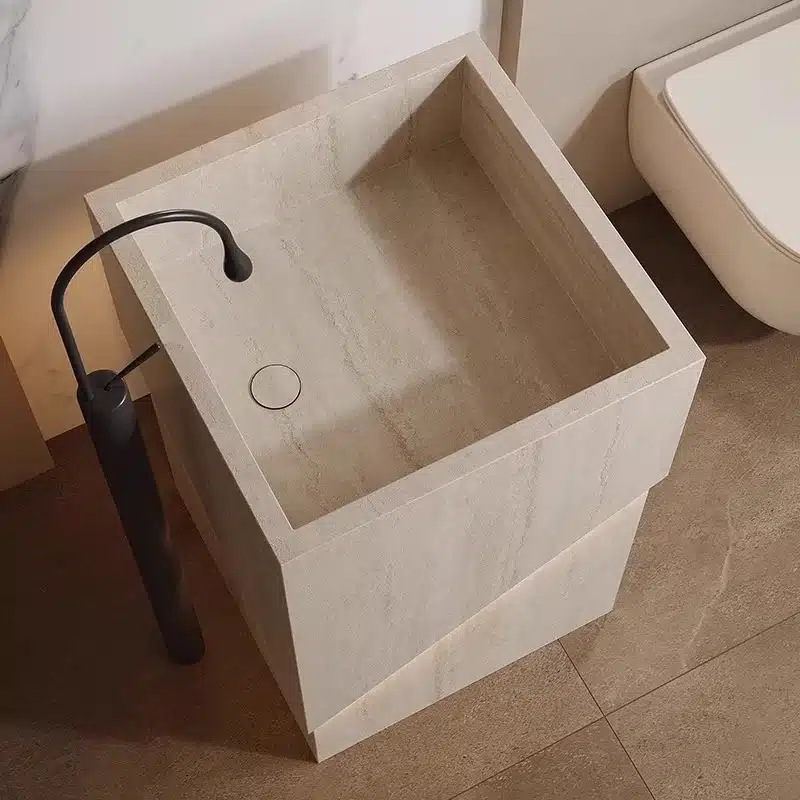
The business-to-business (B2B) model focuses on selling bathroom vanities to other companies, not individual homeowners. This approach involves long-term partnerships with distributors, contractors, and large retailers who purchase in bulk. The sales process is longer and more complex, emphasizing relationship management, negotiation, and providing solutions that help business partners succeed in their own markets.
- Targets businesses needing products for large-scale projects like hotels, residential developments, or retail inventory.
- Involves longer sales cycles, contract negotiations, and customized solutions to meet specific regional and regulatory demands.
- Success depends on manufacturing reliability, rigorous quality control, and the ability to support partners with OEM/ODM services.
The B2C Model: Selling Directly to Consumers
The business-to-consumer (B2C) model means selling products directly to the end user through e-commerce platforms like Shopify, marketplaces, or physical showrooms. Marketing in this model is geared toward individual buyers, using social media and online ads to build brand appeal and simplify the purchase. The entire operation must be optimized for single-unit transactions, from customer service to final-mile delivery.
- Focuses on individual transactions with a much shorter, often immediate, sales cycle.
- Marketing relies heavily on digital advertising, brand storytelling, and consumer-facing promotions.
- Requires robust systems for managing individual customer service inquiries, processing returns, and handling single-unit shipping logistics.
| Operational Focus | B2B Model (Wholesale) | B2C Model (Direct-to-Consumer) |
|---|---|---|
| Target Customer | Businesses (Distributors, Projects) | Individual Homeowners |
| Order Volume | Bulk (Containers, Pallets) | Single Units |
| Sales Cycle | Long (Weeks to Months) | Short (Minutes to Days) |
| Logistics Focus | Freight & Palletization | Parcel Shipping & Returns Management |
| Product Strategy | High Customization (OEM/ODM) | Standardized SKUs |
Why FocusCabinet Operates as a B2B Partner
We operate exclusively within the B2B framework. This model allows us to leverage our core manufacturing strengths for large-scale impact. By partnering with over 1,000 global distributors, we efficiently place highly customized, region-specific products into markets without managing the operational overhead of individual consumer sales. It’s a strategic decision that aligns our factory capabilities with the needs of professional buyers.
- This strategy enables large, predictable production runs, with the factory producing up to 5,000 vanity units monthly.
- It supports deep market penetration by empowering local distributors who understand their specific customer base and logistics networks.
- It simplifies complex customization and regulatory compliance (UL, CE, AS/NZS) that are best managed through professional partnerships.
Source Custom Vanities Built For Your Region

West vs. East Coast: Do You Need Both?
For nationwide distribution, the data is clear: an East Coast 3PL is the default starting point, offering better shipping economics to over 70% of the U.S. population. A West Coast facility only becomes a viable addition when order volume justifies the complexity.
The East Coast Advantage for Nationwide Coverage
For any brand targeting nationwide sales in 2026, an East Coast fulfillment center is the primary choice. The logistics are straightforward. This single location provides superior economics and faster delivery times to the vast majority of the U.S. consumer base. We consistently see clients benefit from this focused approach before considering any expansion.
- It directly reduces ground shipping costs by 15-25% for broad distribution models.
- You can reach over 70% of U.S. consumers 1-2 days faster compared to a West Coast-only operation.
- This strategy serves as the standard, most efficient starting point for scaling fulfillment.
When a Bi-Coastal Strategy Is Justified
A dual-coast strategy is a significant operational commitment and is only viable for high-volume brands with specific logistical needs. Adding a second warehouse increases inventory holding costs and management complexity. The decision must be justified by hard numbers, not just the desire for coast-to-coast presence. The traditional advantage of West Coast ports has also diminished as more international shippers shift to faster air freight, bypassing previous bottlenecks.
- A second facility makes sense once you consistently process over 3,000 orders per month, per location.
- It primarily benefits brands with a heavy sales concentration in California or those managing high-volume ocean freight from Asia.
- Start East Coast, and only supplement with a West Coast location when the volume absolutely requires it.

What Is the Cost Structure?
Understanding 3PL pricing requires looking beyond a single number; it’s a blend of receiving, storage, and per-order handling fees that determines your total cost of fulfillment.
Core Fulfillment Fees
The primary costs in any 3PL partnership are the recurring operational fees for handling and storing your products. These aren’t just line items; they represent the physical management of your inventory from the moment a container arrives until a vanity ships to a customer. The process starts with receiving fees, billed either at an hourly rate ($35–$55) or as a flat fee per pallet ($5–$15) to unload and log new inventory. Once stored, you’ll pay monthly for the space your vanities occupy, typically calculated per pallet ($15–$40) or by cubic footage. Finally, pick-and-pack fees are applied to each order, often a small base fee plus an additional charge for each item in the shipment.
| Fee Component | Standard Industry Rate | Implication for Vanity Sellers |
|---|---|---|
| Receiving & Inbound | $5–$15 per pallet or $35–$55 per hour | Per-pallet receiving is common for container shipments. Hourly rates may apply for non-standard unloading or detailed inspections. |
| Monthly Storage | $15–$40 per pallet or ~$0.46 per cubic foot | Vanities are bulky and often unstackable, making per-pallet or cubic foot pricing critical. This is a major cost driver for slow-moving inventory. |
| Pick & Pack | $0.20–$2.00+ per order, plus per-item fees | Order complexity is low (one SKU per box), but handling fragile, heavy items requires specialized labor and packaging, like our ISTA 3A-rated cartons. |
Initial Setup and Pricing Models
Beyond the recurring operational fees, you need to account for initial setup costs and understand the different pricing models available. Most providers charge a one-time fee between $150 and $1,500 for account setup and system integration with platforms like Shopify. Once you’re onboarded, the pricing structure can vary. Some 3PLs offer simplified “all-in-one” rates that bundle receiving, storage, and a set number of picks into a single price. Others use volume-based tiers, where per-unit costs decrease as your monthly order volume grows—often providing discounts for businesses shipping over 2,500 units per month.
How to Integrate EDI & Shopify?
Integrating Electronic Data Interchange (EDI) with Shopify is essential for selling to major retailers, as it automates the exchange of orders, invoices, and inventory data that Shopify can’t handle on its own.
Shopify doesn’t have native EDI functionality. This creates a significant operational gap for businesses aiming to supply large retail chains like Walmart or Target, who rely on standardized electronic documents for their supply chain. To bridge this gap, you need a third-party solution—either a dedicated EDI provider or a custom-built integration—to translate data between your Shopify store and your trading partners’ systems.
Key Steps for EDI and Shopify Integration
A successful integration requires a structured process to ensure data flows accurately and reliably. It’s not a simple plug-and-play setup; it demands careful planning and testing to prevent costly errors in orders, shipping, and invoicing. The goal is to create a seamless, automated workflow that requires minimal manual intervention.
- First, identify the exact EDI document standards your retail partners require. This could be ANSI X12 in North America or EDIFACT in Europe. Each partner will have a specific implementation guide you must follow.
- Next, you must map the data fields. This is the most critical step, where you translate fields from an EDI document (like a purchase order) to the corresponding fields in Shopify (like customer name, SKU, and quantity). Incorrect mapping leads directly to fulfillment errors.
- Finally, conduct comprehensive end-to-end testing with your trading partner. This ensures that purchase orders are created correctly in Shopify and that shipping notices and invoices are sent back without any data corruption.
Common EDI Transaction Types
EDI uses standardized numeric codes, known as transaction sets, to represent different business documents. While there are hundreds of codes, a handful of them handle the core functions of an e-commerce operation, automating the entire order-to-cash cycle.
- EDI 850 (Purchase Order): This is how a retailer sends you an order. A properly integrated system automatically creates a new order in your Shopify dashboard, ready for fulfillment, the moment the EDI 850 is received.
- EDI 856 (Advance Ship Notice – ASN): After you ship the order, you send an ASN. This digital packing slip tells the retailer what items are in the shipment, how they are packed, and provides tracking information. Many large retailers require the ASN before the physical shipment arrives at their distribution center.
- EDI 846 (Inventory Inquiry/Advice): This transaction provides your retail partners with real-time updates on your stock levels. It automatically syncs your Shopify inventory, which prevents overselling and ensures your partners have accurate availability data for your bathroom vanities.
How to Handle Returns?
By 2026, efficient reverse logistics is less about processing returns and more about using data from those returns to fix upstream problems in product design and packaging.
The Standardized Returns Workflow
Returns management now operates on a clear, technology-driven workflow. The entire process, from initiation to resolution, is designed for transparency and speed. It begins when a customer requests a Return Merchandise Authorization (RMA) and typically concludes within 10-14 days of the warehouse receiving the item. This system minimizes ambiguity and keeps all parties informed.
- A unique RMA is generated for each return, creating a traceable digital record from start to finish.
- Items are tracked using barcode scanning at every touchpoint, from the receiving dock to the final disposition, ensuring real-time inventory accuracy.
- Automated communication systems keep customers updated on their return status, reducing inbound service inquiries.
Inspection and Product Categorization
Once a returned product arrives at the fulfillment center, it undergoes a rigorous inspection to assess its condition. This triage process is critical for recovering value and determines whether the item can be resold, needs refurbishment, or must be written off. For large items like bathroom vanities, this step prevents damaged goods from re-entering the supply chain.
- Restockable: Items in new, undamaged condition with intact packaging are immediately returned to saleable inventory.
- Repairable: Products with minor cosmetic issues or functional defects are sent to a dedicated refurbishment stream to be restored.
- Disposable: Unsalvageable items are processed for disposal or recycling, with a growing focus on environmentally responsible methods to minimize landfill waste.
Data Analytics for Root Cause Identification
Modern reverse logistics platforms are no longer just operational tools; they are data goldmines. Information from every return is collected and analyzed to understand precisely why products are coming back. This transforms the returns process from a cost center into a valuable feedback loop that drives continuous improvement.
- Return data helps identify recurring product defects or patterns of shipping damage, pointing to specific issues in manufacturing or carrier handling.
- Analytics can pinpoint weaknesses in product design or packaging, such as a vanity top that frequently cracks in transit, prompting a switch to stronger, ISTA-3A compliant packaging.
- This feedback loop enables manufacturers to make targeted improvements to quality control, ultimately reducing overall return rates and protecting profit margins.

Conclusion
Choosing the right fulfillment partner is critical when selling heavy, oversized items like bathroom vanities. Standard networks can lead to unsustainable fees and high damage rates, directly impacting your profit margins. A specialized heavy-goods 3PL provides the expertise needed to manage inventory, control costs, and deliver a positive customer experience.
Your fulfillment strategy begins at the factory, not just the warehouse. Contact our team to learn how our E-commerce Ready packaging and flexible manufacturing can prepare your products for a smoother, more cost-effective logistics journey.
Frequently Asked Questions
Best 3pl for heavy items?
For heavy and oversized items, the best 3PLs specialize in non-conveyable inventory and LTL (Less Than Truckload) freight. Top providers include GXO Logistics (formerly XPO), known for its extensive freight network, and SEKO Logistics, which offers specialized handling and white-glove delivery services. Modern tech-forward options like ShipBob’s freight program also provide integrated solutions. The ideal partner will have robust warehouse management systems (WMS), experience in your specific product category, and strong relationships with freight carriers to manage costs and reduce transit damage.
Furniture fulfillment services?
Furniture fulfillment services require specialized capabilities beyond standard parcel logistics. Key services include storage solutions for large, non-stackable items, expert handling to prevent damage, and coordination with LTL freight carriers for delivery. Many providers also offer “white glove” services, which include in-home delivery, room-of-choice placement, assembly, and debris removal. Unlike standard fulfillment centers, they are equipped with the appropriate material handling equipment and staff trained to manage bulky and fragile goods safely and efficiently.
FBA for bathroom vanities?
Using Amazon FBA for bathroom vanities is generally not economically viable. As large, bulky items, they fall into Amazon’s oversized product tiers, which incur exceptionally high costs. These include elevated fulfillment fees (from $9.61 to over $40.12 plus per-pound charges), steep monthly storage fees ($1.75–$5.95 per cubic foot), and significant removal penalties. This fee structure creates a major barrier for furniture, making it profitable only for sellers with extremely high and consistent sales velocity to offset the heavy operational costs.
Cost of warehousing furniture?
The cost of warehousing furniture is significantly higher than for standard products due to the space required. Within Amazon FBA’s oversized tiers, storage costs can range from $1.75 to $5.95 per cubic foot per month. With a specialized 3PL, costs are typically calculated per pallet position (e.g., $15-$30/month) or by cubic footage. The final cost depends on factors like warehouse location, storage density (as furniture is often non-stackable), and any special handling requirements. Overall, businesses should budget for higher storage fees compared to standard-size inventory.
Drop shipping vanities logistics?
Drop shipping vanities involves complex logistics centered on LTL freight, not standard parcels. The primary challenges include finding a supplier or manufacturer with the capability to package and ship single units directly to consumers. Coordination is key, requiring scheduling freight pickups and managing final-mile delivery appointments. Damage rates are a major financial risk due to the fragile nature of mirrors and countertops, necessitating robust packaging, carrier insurance, and a clear process for handling returns and freight claims, which are far more complicated than standard returns.
West coast vs east coast warehouse?
The choice between a West Coast and East Coast warehouse depends entirely on your customer distribution. A West Coast warehouse (e.g., in California or Nevada) is ideal for serving customers in the western states and is advantageous for inventory arriving from Asian ports. An East Coast warehouse (e.g., in New Jersey, Pennsylvania, or Georgia) provides faster, cheaper shipping to the densely populated Northeast and Southeast. For national brands, the best practice is a multi-warehouse strategy, using locations on both coasts and often a central hub (like Texas or Illinois) to optimize shipping costs and delivery speed for all U.S. customers.





0 Comments