
Your 2027 assortment gets decided before 2027 arrives. With samples quoted at 10 working days, bulk production at 20–30 days, and 4–6 weeks total delivery to the United States, Canada, and Mexico, a vanity order placed this season lands on your dock next year. Choose the wrong color family or material story and you tie up working capital in slow-moving stock. This article gives distributors a working read on 2027 bathroom vanity trends: which color families and materials carry momentum, which finishes behave like safe inventory, and how to test new ideas with small orders instead of full containers. You will also get a practical checklist for verifying finish quality, compliance documents, and delivery terms with your factory before you commit.
Why 2027 Bathroom Vanity Trends Matter Now
Distributors do not buy for the current season; they buy for the season after next. A North American importer who places a bulk order in early fall receives it in time for the winter and spring selling windows, which means the 2027 conversation starts in 2026. Lead times set the pace. Main Focus Cabinet (brand MFBATH), a bathroom vanity manufacturer in Changge, Henan, China, quotes samples at 10 working days and bulk production at 20–30 days, with 4–6 weeks total delivery to the US, Canada, and Mexico, shipped FOB (Free on Board) from Qingdao port. Ordering early is not only about price; it is about having the assortment on the shelf when buyers walk in.
Three directional shifts are shaping what distributors should watch for 2027. Color palettes are moving warmer. Materials are leaning natural. Finishes are trending matte. None of these are dramatic breaks; they are extensions of the soft-neutral, wood-forward direction that has been building through the current cycle, and they align with styles your customers already recognize, from Japandi and mid-century modern to modern farmhouse. The practical question is not whether to follow the trend but how to follow it without over-committing.
That is where SKU (Stock Keeping Unit) discipline comes in. A trend is a signal, not a mandate. Distributors who win the next cycle separate anchor colors — the shades that sell even when the trend wobbles — from trial colors that deserve a small order before a container. The factory’s MOQ (Minimum Order Quantity) of 15 sets per model, per color, per size makes that trial step affordable, and mixed-container shipping means a test never has to be a full container. Distributors who treat every trend as a full bet either miss the wave entirely or get stuck with inventory they cannot move. The rest of this guide walks through the color forecast, the material math, the stocking mix, and the factory verification steps that turn a trend read into a profitable purchase order.
The 2027 Color Forecast: Warm Neutrals, Soft Earth Tones, and Matte Finishes
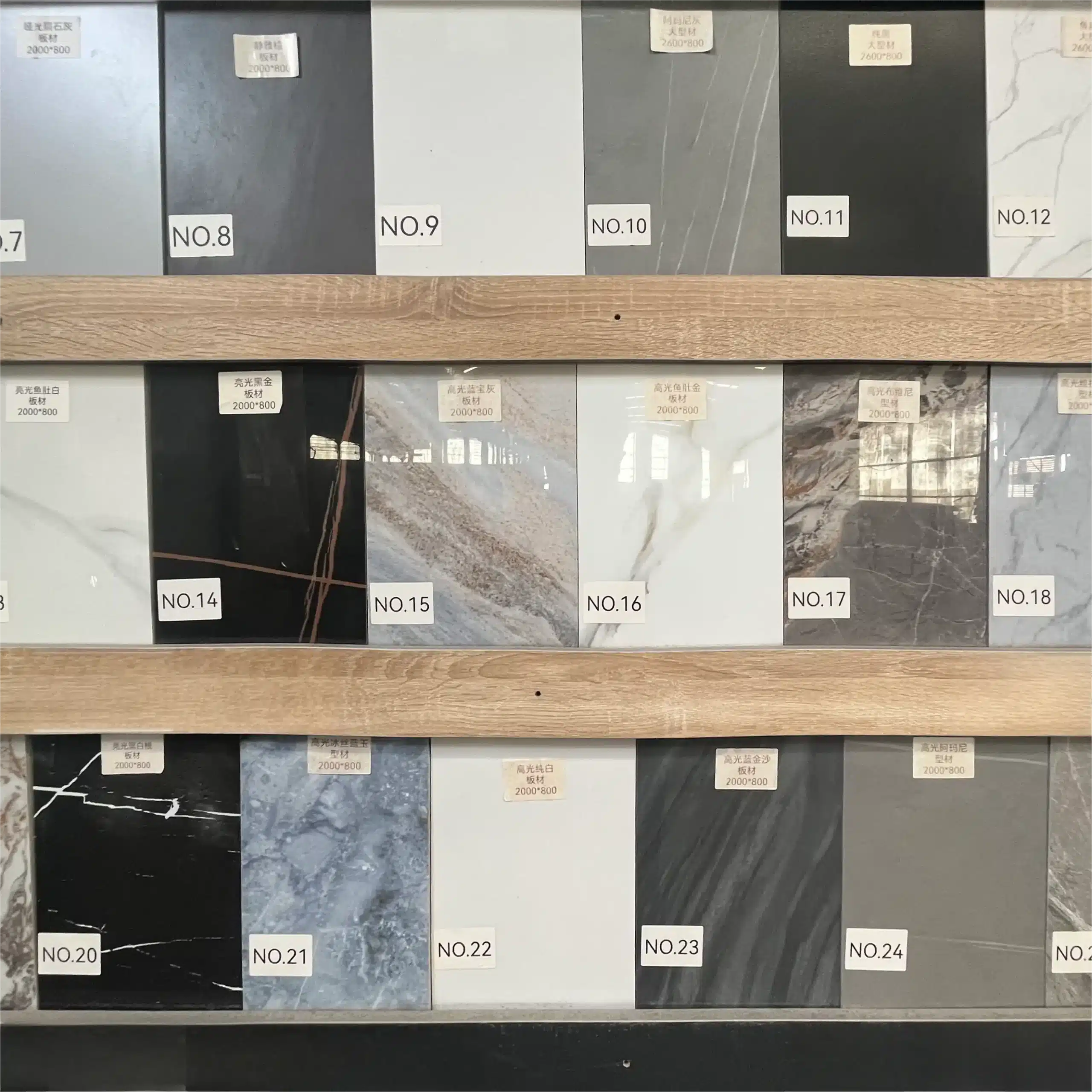
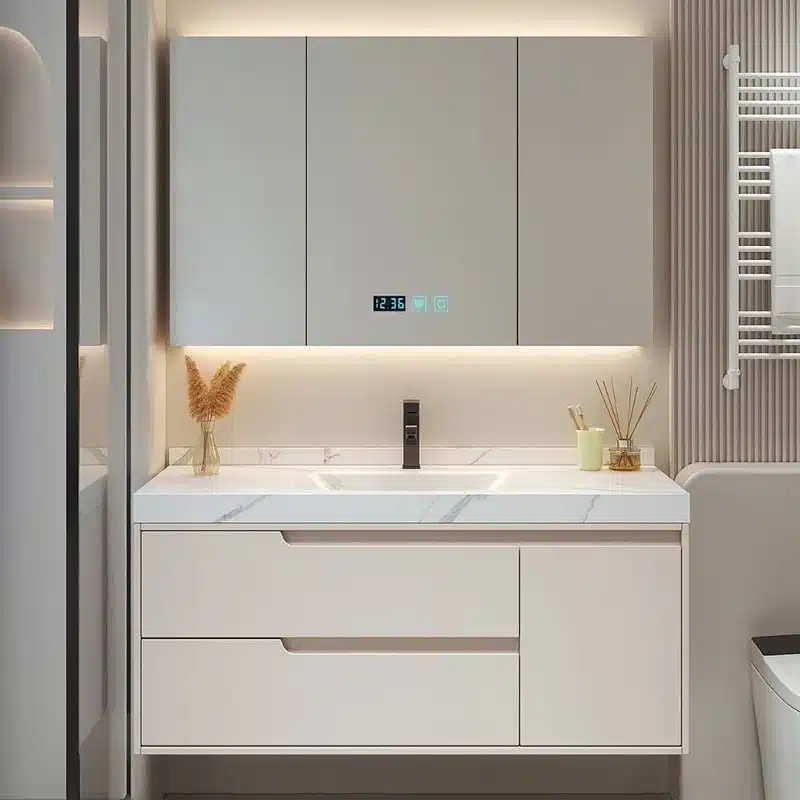
The clearest color story for 2027 is warm and grounded. Expect cream, warm beige, greige, and taupe to carry the neutral segment, with soft earth tones — sage, clay, muted terracotta — appearing as accent colors and as full-body statements in smaller runs. Wood grain continues to warm up as well: lighter to mid-tone oak reads more current than dark, red-heavy cherry or espresso, and warm grays hold their crossover appeal for buyers who are not ready to commit to beige. For color authority reference points, follow Pantone’s seasonal releases and compare them against what your existing customers actually order before you commit to a shade.
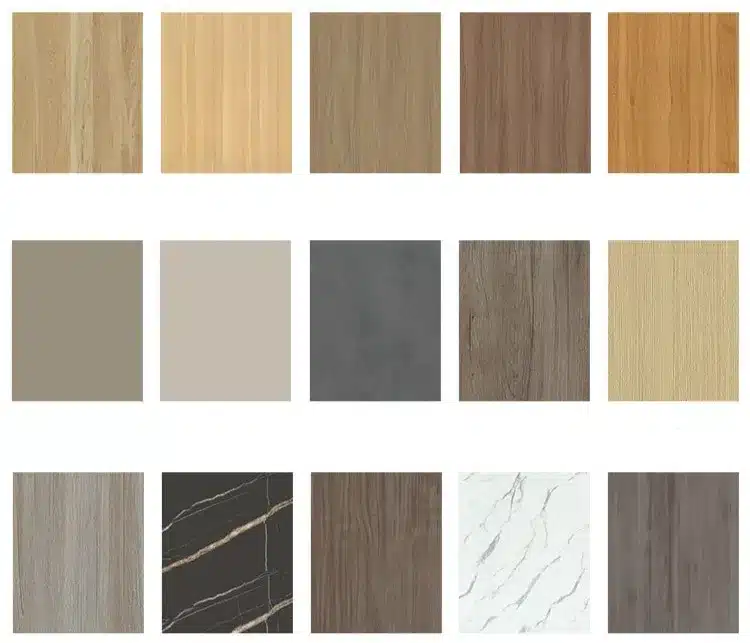
The table below turns 2027 bathroom vanity trends into a working stocking framework. It is directional, not a promise of sell-through; treat it as a starting point for your own assortment review, then pressure-test each row against your channel’s buying patterns.
| Color family | 2027 direction | Finish pairing | Stocking advice |
|---|---|---|---|
| Warm whites and cream | Soft, welcoming base that pairs with wood grain and stone | Matte or satin | Core inventory; low risk |
| Greige and taupe | Crossover neutrals for transitional and modern spaces | Matte | Safe stock with broad appeal |
| Soft sage and clay | Earth tones that add depth as accents or full-body looks | Matte, lightly textured | Trial at small order size before scaling |
| Mid-tone oak wood grain | Natural warmth; supports Japandi and modern farmhouse lines | Natural grain, matte | Volume line for the year |
| Gloss black | Contrast statement for trims, hardware, and bold looks | High-gloss | Consistent secondary line |
Matte is the finish direction across most color families for 2027. It reads softer, photographs better in showroom lighting, and hides fingerprints better than reflective surfaces. That does not mean gloss is dead — high-gloss finishes retain a steady niche in modern and transitional lines — but when you add a new SKU, matte is the lower-risk finish. If a customer asks for gloss, you want it available as a secondary option rather than as the default of your newest lines. For a deeper comparison of the two treatments, see our guide to high-gloss bathroom vanity finishes.
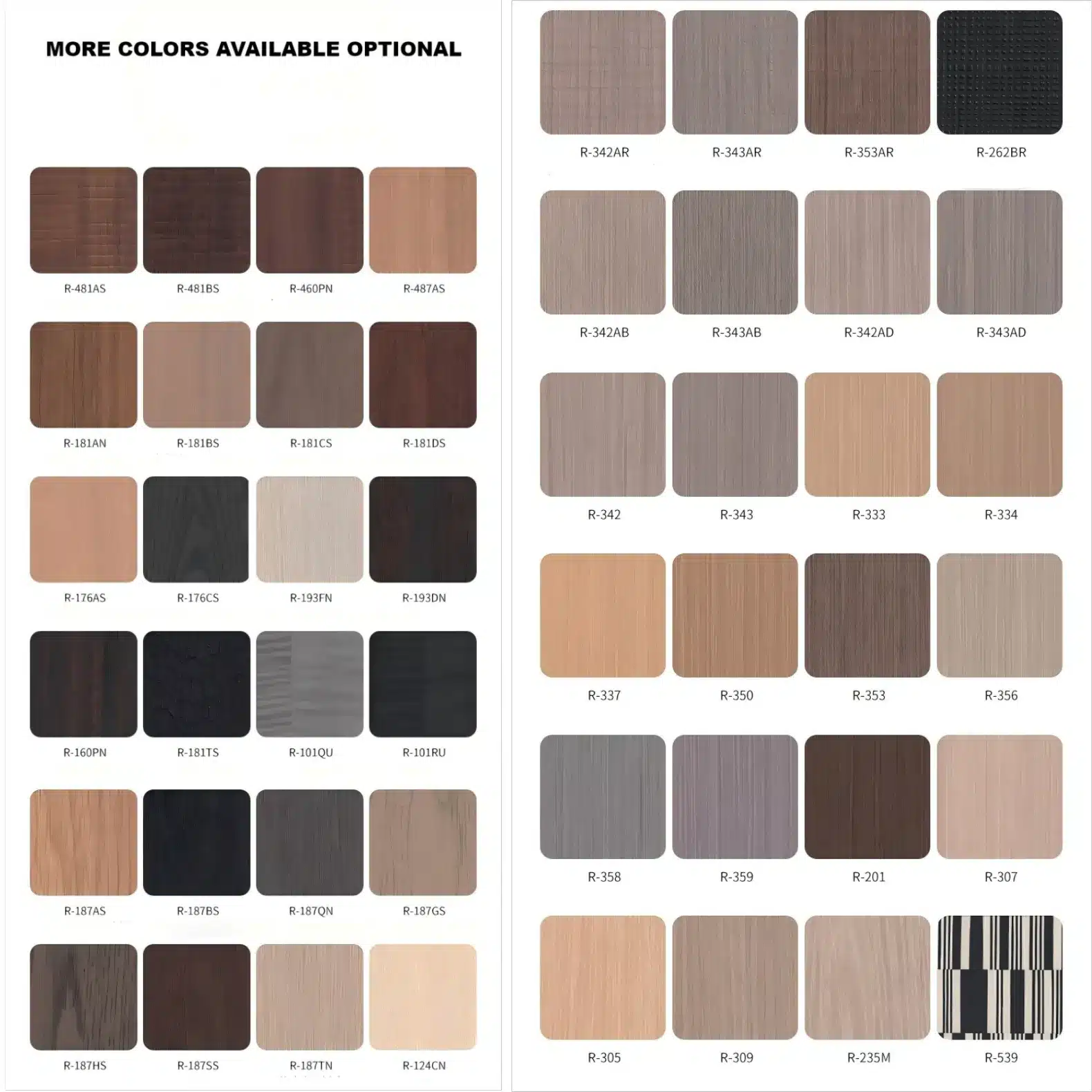
Custom color is where a trend becomes a sellable SKU. The factory maintains a library of 1000+ standard finishes — including matte white, gloss black, and wood grain — and offers Pantone-matched custom colors starting at 15 sets per color. That is a low-cost way to own a shade before competitors copy it, and because custom colors carry the same MOQ structure as standard ones, the exclusivity does not demand a container. If you want to lock in a signature color for your catalog, the custom color vanity program covers the matching process, finish samples, and order terms from the first Pantone reference through production.
Material Trends: What Carries Volume and What Carries Margin
Material strategy for 2027 is really a price-point strategy. PVC (polyvinyl chloride) carries value-tier volume. Plywood carries the structural middle. Solid wood carries the natural-grain premium. Sintered stone — as countertops and, increasingly, full-body surfaces — carries the step-up sale. Most distributors need all four in some proportion; the mix depends on your channel and on how price-sensitive your customers are. The table below summarizes the role each material plays in a 2027 assortment.
| Material | Where it earns its place | Key properties | 2027 stocking read |
|---|---|---|---|
| PVC | High-moisture bathrooms, rentals, value tiers | 100% waterproof; no warping; easy to clean; scratch resistant | Core volume |
| Plywood | Structural cabinets and painted programs | BWR or marine grade; E1 low formaldehyde | Core volume and step-up |
| Solid wood | Natural-grain premium lines | Oak, walnut, maple, ash; waterproof coating; FSC option | Margin driver |
| Sintered stone | Countertops and full-body looks | Mohs 7–8; heat resistant to 300°C; non-porous; antibacterial | Step-up and margin |
PVC stays the volume workhorse
PVC remains the workhorse for high-moisture bathrooms, rental units, and value lines. The material is 100% waterproof, does not absorb water or warp, cleans easily, and resists scratching — properties that matter when a vanity sits in a humid bathroom for years. It is the line you can stock deep with the least regret: when price pressure builds, PVC is where you defend margin without apologizing for the product. Because the finishes are sealed rather than painted, color consistency across batches is easier to control, which matters when you reorder the same SKU three times in a season. Our PVC vs plywood comparison walks through where each material earns its place.
Plywood for stability and compliance
Plywood is the middle-market structural choice, and 2027 is a good year to deepen it. The factory offers BWR (boiling water resistant) and marine-grade plywood options with E1 low-formaldehyde levels, plus 15 standard finishes with access to the 1000+ finish library. Compliance terms to know: E1 refers to a formaldehyde emission limit of ≤0.1 ppm; CARB (California Air Resources Board) Phase 2 and TSCA (Toxic Substances Control Act) Title VI are the US-oriented regulatory benchmarks; and low-VOC (volatile organic compound) finishes round out the environmental picture. For engineering references on plywood performance grades, consult the APA – The Engineered Wood Association. If your buyers compare products on formaldehyde and structural claims, plywood is the line you can defend with paperwork instead of promises.
Solid wood for the natural-grain premium
The natural-material direction favors solid wood. Oak, walnut, maple, and ash are the core species, finished with a multi-layer polyurethane waterproof coating that keeps natural grain practical in a bathroom. The solid wood line carries 20 standard finishes, and custom colors start at 15 sets per color, so the premium tier still gets the same flexible color program as the rest of the range. FSC-certified lumber — certified under the Forest Stewardship Council — is available as an option for buyers who need verified sourcing. Oak in particular anchors the Japandi and Scandinavian-influenced segment; see the white oak bathroom vanity line for the finish range. Solid wood is a margin driver, not a volume play; treat it as the reason a customer trades up rather than the reason a container fills.
Sintered stone: the premium countertop story continues
Sintered stone keeps its position as the premium countertop story. It rates 7–8 on the Mohs hardness scale, resists heat up to 300°C, is non-porous and stain resistant, holds color under UV (ultraviolet) exposure, and carries antibacterial properties — a combination that sells itself to designers and homeowners who have lived through laminate wear. Texture options include marble, granite, cement, and solid-color looks in matte, satin, or polished finishes, which means the countertop can carry the trend even when the cabinet stays conservative. For spec-level details, review the sintered stone vanity specs page, and see the sintered stone bathroom vanity product page for available configurations. If your channel sells to designers, this is the line that earns the margin.
2027-Ready Vanity Colors and Materials for Distributors
Browse this product, solution, or service page to explore relevant offerings.
Building a Balanced 2027 SKU Mix
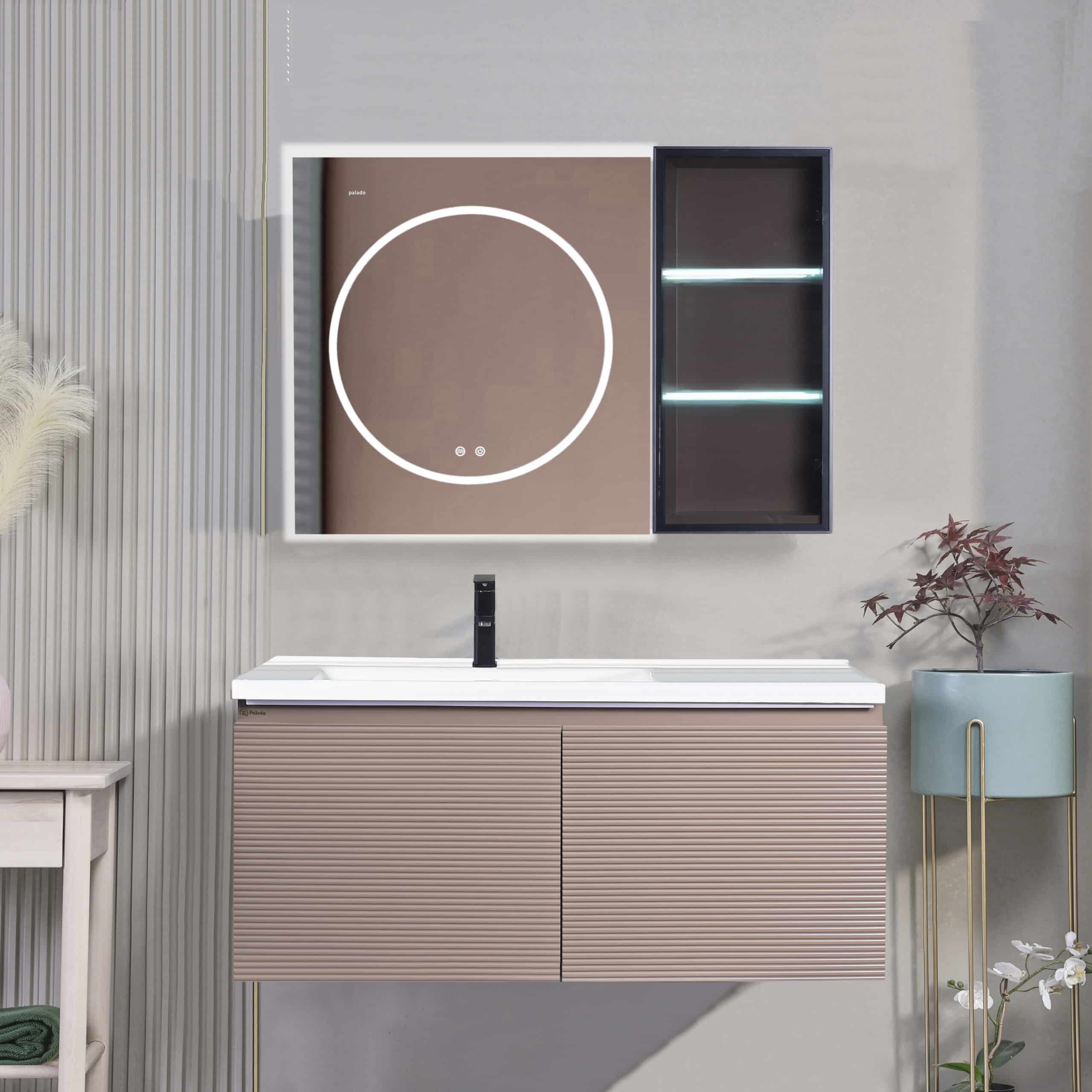
Start with anchors. Matte white, gloss black, and wood-grain finishes are the safe inventory of this category: they are permanent residents of the standard finish library, they photograph well, and they sell in most markets even when the trend wobbles. Anchor colors should be your deepest stock because they are the lines you can reorder with confidence while you test everything else. A distributor who keeps the anchors deep and the experiments shallow rarely gets stuck with a container of a shade that did not move.
Then add trials. The MOQ (Minimum Order Quantity) is 15 sets per model, per color, per size, and custom Pantone colors start at 15 sets per color. A 15-set trial is enough to photograph the unit, price it, put it in front of your sales channel, and decide whether the shade earns container space in the next order. Mixed containers make the trial cheap: combine trial SKUs with core SKUs in a single shipment, so the freight economics of a 15-set experiment look like the freight economics of a normal order. The goal is not to minimize risk to zero — it is to make the cost of being wrong small enough that you can be right more often.
Build the mix so that volume lines — PVC and plywood — carry the base load, while solid wood and sintered stone create the step-up story that protects overall margin. The factory’s customization layer keeps the mix flexible: 40,000+ custom combinations cover Pantone colors, eco-friendly materials, basin configurations, and brand hardware, which means a distributor can differentiate SKUs without changing factories. If you want to shortlist models before committing, the free 2025 product catalog (100+ pages) covers the standard range, and samples arrive in 10 working days. Track sell-through on trial SKUs by container, not by unit; a trend either earns a reorder in one cycle or it gets retired.
How to Validate Trend Calls with Your Factory
A 2027 bathroom vanity trends call is only as good as the order behind it. Validate in four steps, and put every answer in writing before you sign.
Step 1: Order samples before you order stock. Samples take 10 working days. Check the finish against your Pantone reference under showroom lighting, and confirm the door feel, the drawer action, and the countertop edge before you commit to bulk. A color that looks right in a digital rendering can read entirely differently on a full door panel.
Step 2: Confirm the finish program. If you are testing a custom color, confirm the 15-set minimum per color, the finish texture (matte, satin, or gloss), and whether the color applies across the material lines you want — PVC, plywood, or solid wood — because the same shade can read differently on each substrate.
Step 3: Verify compliance documents. Request current documentation for E1 (≤0.1 ppm), CARB Phase 2, and TSCA Title VI — the federal formaldehyde standard administered by the US Environmental Protection Agency (EPA) under the Toxic Substances Control Act. The factory uses low-VOC finishes and holds ISO 9001 (quality management) and ISO 14001 (environmental management) certifications, certified since 2017 and confirmed current in 2025. FSC-certified wood is available as an option, and CE and UL markings are held on relevant product lines. For a deeper look at the US regulation, see the TSCA Title VI requirements guide, and for the factory’s environmental program, start with the eco-friendly vanity manufacturer overview.
Step 4: Confirm capacity and delivery terms. Main Focus Cabinet has operated since 2015 with 95 employees and monthly capacity of 5,000 sets, and every product passes 5 quality checks. Bulk production runs 20–30 days; total delivery to the US, Canada, and Mexico is 4–6 weeks; and shipments leave from Qingdao port on FOB terms. Written confirmation of these terms in the purchase order prevents the lead-time surprises that kill a seasonal launch.
Frequently Asked Questions
Which colors and finishes are the safest to stock for 2027?
Matte white, gloss black, and wood-grain finishes are the anchors; they sit inside the factory’s 1000+ standard finish library, so restocking is routine and color consistency is documented. Warm neutrals such as cream, greige, and taupe are the crossover plays: they serve Japandi, mid-century, and farmhouse programs without the risk of a trend-specific shade. Treat soft sage, clay, and other earth tones as trial colors first, using the 15-set minimum per color before scaling to container volume.
What is the minimum order quantity to test a new 2027 color?
The MOQ (Minimum Order Quantity) is 15 sets per model, per color, per size, including custom Pantone colors, which start at 15 sets per color. Samples take 10 working days, so you can approve a color before production begins. Mixed containers let you combine trial SKUs with core lines in one shipment, which keeps freight economics intact while you measure sell-through. A 15-set trial is enough to photograph the unit, test it with your sales channel, and decide whether the shade earns container space in the next order.
How do I verify compliance documents before placing a 2027 order?
Ask for current documentation, not claims. Main Focus Cabinet can provide E1 (≤0.1 ppm), CARB Phase 2, and TSCA Title VI compliance documents, plus low-VOC finish specifications. The factory holds ISO 9001 and ISO 14001 certifications, certified since 2017 and confirmed current in 2025, and FSC-certified wood is available as an option. CE and UL markings are held on relevant product lines. Check documents against your destination: TSCA Title VI matters for US-bound goods, while Canadian and Mexican buyers should confirm CARB Phase 2 documentation.
The Bottom Line
2027 bathroom vanity trends point to warm neutrals, natural wood grain, and matte finishes, and the practical way to ride them is a mix of deep anchor stock and small trials. Stock matte white, gloss black, and wood-grain lines for volume, then test cream, greige, and earth tones at the 15-set minimum before scaling. Order samples, confirm compliance documents, and lock written lead times before you commit. Keep your first order small enough that the trend call stays correctable.




0 Comments