

The sintered stone vs engineered wood decision usually gets settled at sample approval, then comes back to haunt the buyer weeks later at the distribution warehouse. That’s where a $50K order starts to feel expensive: the pre-production cabinet looked clean, but the mass production run shows swollen edges around the sink cutout and a finish that didn’t survive the humidity of a sea-freight container.
For an e-commerce brand owner, the real comparison isn’t just material beauty. It’s moisture behavior and long-term cost. Engineered wood — MDF, plywood, and particle board — varies wildly by grade. Sintered stone, by contrast, has a water absorption rate below 0.02%, a fraction of what any wood-based panel can claim.
FOB pricing on a sintered stone vanity runs higher than an engineered wood cabinet, but that doesn’t automatically make it the wrong call. The premium looks different by region: in Asia and Oceania, sintered stone vanities command 15–20% higher price points because buyers treat durability as the baseline. In North America, engineered wood still carries cost-sensitive projects.
Quality tolerance is the hidden variable. A wood-based cabinet can pass inspection on a dry showroom floor and fail after a year in a coastal bathroom. Sintered stone doesn’t swell, warp, or delaminate. That difference matters when your customer leaves wet towels on the vanity edge, and it should drive how you source — not just what you pay per unit.
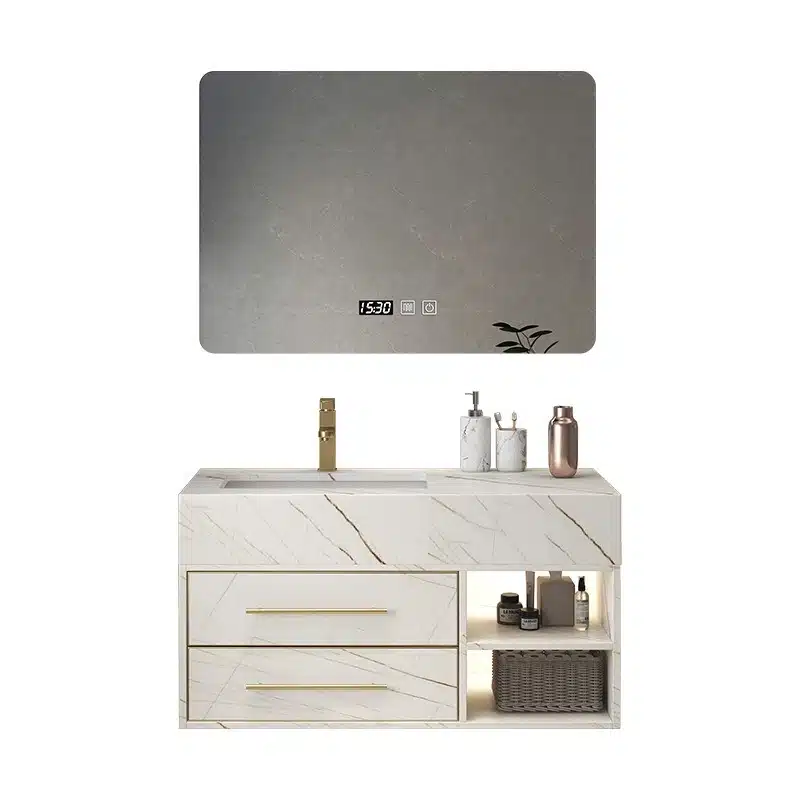
Understanding the Two Materials
Sintered stone absorbs water at under 0.02%; wood-based panels swell when water finds a cut edge.
The real bathroom vanity material comparison 2026 comes down to one question: how does each material behave when moisture is locked inside a vanity cabinet for years? Engineered wood is a family of resin-bonded panels with very different moisture tolerances. Sintered stone is a mineral slab whose porosity is effectively zero. That single difference drives the price premium, the return rate, and the regional demand you’ll see as an e-commerce brand owner.
Three engineered wood variants dominate wholesale bathroom cabinetry. MDF (medium-density fiberboard) is pressed wood fibers and resin, valued for its seamless painted finish. Plywood is cross-laminated veneers, which hold screws better and resist warping in humidity. Particle board is the low-cost option, and the least moisture-tolerant of the three. In a bathroom, the failure point is almost always the cut edge or the hinge hole — if the edge banding lifts, water wicks in and the panel swells. This is why E1/E0 plywood bathroom vanity buyers sourcing from China should verify edge-banding coverage during sample approval, not just skim the formaldehyde certificate.
-
-
- MDF: Smooth surfaces for modern painted vanities; swells quickly when water enters an unsealed edge.
- Plywood: Cross-laminated construction; best screw-holding strength and dimensional stability in humid air.
- Particle board: Lowest cost per unit, highest swelling risk; insist on P3 moisture-resistant grade for any bathroom application.
-
Sintered stone starts as clay, feldspar, and silica, pressed under high pressure and fired above 1,200°C. The process fuses the minerals into a dense slab with no open pores. Focuscabinet’s internal tests put the sintered stone basin water absorption rate below 0.02% — a fraction of what any wood-based panel absorbs. For a basin that holds standing water, soap film, and cosmetics daily, that number separates a ten-year product from a warranty claim waiting to happen.
-
- Composition: Clay, feldspar, and silica pressed under high pressure and fired above 1,200°C.
- Water absorption: Below 0.02% in Focuscabinet internal testing — a fraction of engineered wood’s rate.
- Failure mode: Unsealed wood edges swell and delaminate; sintered stone has no edge for moisture to attack.
| Feature | Engineered Wood | Sintered Stone | Sourcing Insight |
|---|---|---|---|
| Core Composition | MDF, plywood, and particle board variants made from wood fibers, veneers, or chips bonded with resin adhesives | Ultra-compact surface crafted from natural minerals, clay, and feldspar fired under extreme heat | Composition determines baseline durability, moisture risk, and price tier for wholesale orders |
| Manufacturing Process | Layered pressing with adhesives; particle board relies on heat and resin compression | Pressed under high tonnage and sintered at 1,200°C+ to form a dense, non-porous slab | Sintered stone’s densification delivers a structural edge for humid bathroom environments |
| Moisture Resistance | Prone to swelling and delamination unless sealed; E1/E0 plywood offers improved protection | Zero porosity with a sintered stone basin water absorption rate below 0.02% | Lower water absorption reduces warranty claims and quality disputes for distributors |
| Heat & Stain Resistance | Sensitive to heat damage and water stains on unprotected surfaces | Highly resistant to heat, scratches, and staining — ideal for commercial use | Critical distinction for hotel and commercial projects that demand long-term surface integrity |
| Aesthetic Flexibility | Excellent for painted finishes, wood veneers, and varied cabinet color matching | Large-format slabs replicate natural marble and concrete with consistent veining | E-commerce brands need photogenic, trend-forward designs to win online conversion |
| Weight & Logistics | Lightweight structure lowers shipping cost per container and simplifies handling | Denser and heavier; raises freight expense and requires reinforced packaging | Veteran importers must model landed cost differences before annual contract negotiation |
| Cost per Unit | Lower initial cost; remains dominant in cost-sensitive North American projects | Commands a 15–20% price premium in Asia and Oceania for perceived durability | Align material choice with regional price ceilings to maximize margin per container |
| Regional Best-Fit | Best for North American residential and budget-to-mid-range bathroom vanities | Preferred in Asia, Oceania, and Europe for luxury homes, hotels, and high-end commercial spaces | A region-ready bathroom vanity strategy helps brands penetrate local markets faster |
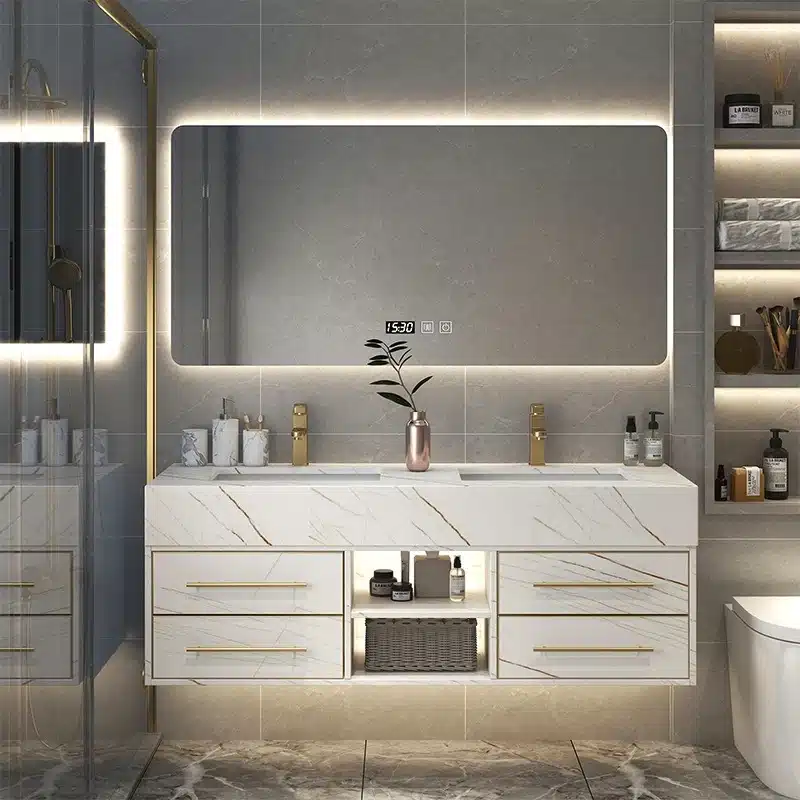
Comparison 1: Moisture and Heat Resistance
E0 and E1 are emission classifications, not waterproof ratings.
Most importing brands request the wrong spec at the sample-approval stage — they ask for “E0 board” assuming it means waterproof. E0 and E1 regulate formaldehyde emissions, not water resistance. P3, the EN 312 classification for moisture-resistant particleboard, is the only engineered-wood rating in that group that speaks to humidity. Even then, P3 only limits swelling under controlled testing; it does not make the board impermeable.
The key number on the stone side: sintered stone basins produced by Focuscabinet show a water absorption rate of <0.02% under the ISO 10545-3 test — the same test method used for porcelain tile. Engineered wood, whether MDF, plywood, or particleboard, remains a porous composite. Run the 24-hour water soak test (EN 317) and standard particleboard swells in the high single or low double digits. In a real bathroom, that translates to edge swelling, warped doors, and delaminated laminate within two wet seasons.
-
- P3 board: Moisture-resistant particleboard per EN 312, tested through a cyclic soak. It tolerates humid conditions only while the factory lamination and cut-edge sealing stay intact. A drilled hinge hole or an unsealed back-panel edge becomes the failure point.
- E0/E1 board: Formaldehyde emission limits — E0 ≤0.050 mg/m³, E1 ≤0.124 mg/m³ under the 1m³ chamber method (GB/T 39600-2021). The cleanest emission label offers zero protection against water.
- Sintered stone: Fired above 1,200°C until the raw minerals vitrify into a densified mass. Zero porosity means moisture has no path into the material, so 24-hour soaks, mold, and heat exposure are non-events.
Heat follows the same split. A curling iron left face-down on a laminate countertop will burn a permanent white ring at 200°C. Sintered stone absorbs the same heat without a trace because its manufacturing temperature is roughly six times higher than anything a bathroom appliance produces. That combination — water and heat — is exactly where sintered stone pulls away from engineered wood in any humid-climate bathroom.
| Feature | Sintered Stone | Engineered Wood | Impact |
|---|---|---|---|
| Water Absorption Rate | <0.02% (virtually zero) | 5%–15% depending on board type and sealing | Prevents warping, swelling, and delamination over time |
| Porosity | Non-porous, zero micro-cavities | Porous core exposed at cut edges and drill holes | No route for water ingress or bacterial growth |
| Moisture Protection Rating | Inherent to material; no coating required | P3, E1, E0 grades define moisture tolerance and emission limits | Rating must match the humidity level of target region |
| Steam & Condensation Resistance | Unaffected by continuous steam exposure | Surface swelling and film peeling after prolonged steam | Sintered stone outlasts wood in enclosed or high-humidity bathrooms |
| Heat & Fire Resistance | A1 non-combustible; withstands high temperatures | Scorches at ~150°C; combustible core | Safer for hotel, commercial, and near-heat-source installations |
| Mold & Mildew Growth | No organic content—zero mold food source | Moisture-damaged areas can harbor mold in 24–48 hours | Hygienic for luxury homes and health-sensitive projects |
| Edge & Cutout Vulnerability | CNC-cut edges remain sealed and waterproof | Unsealed cuts become wicking points for moisture | Lower reject rates and fewer warranty claims for distributors |
| Long-Term Structural Stability | Dimensionally stable across climate cycles | Expansion-contraction cycles weaken joints over time | Sintered stone suits regions with extreme humidity swings |
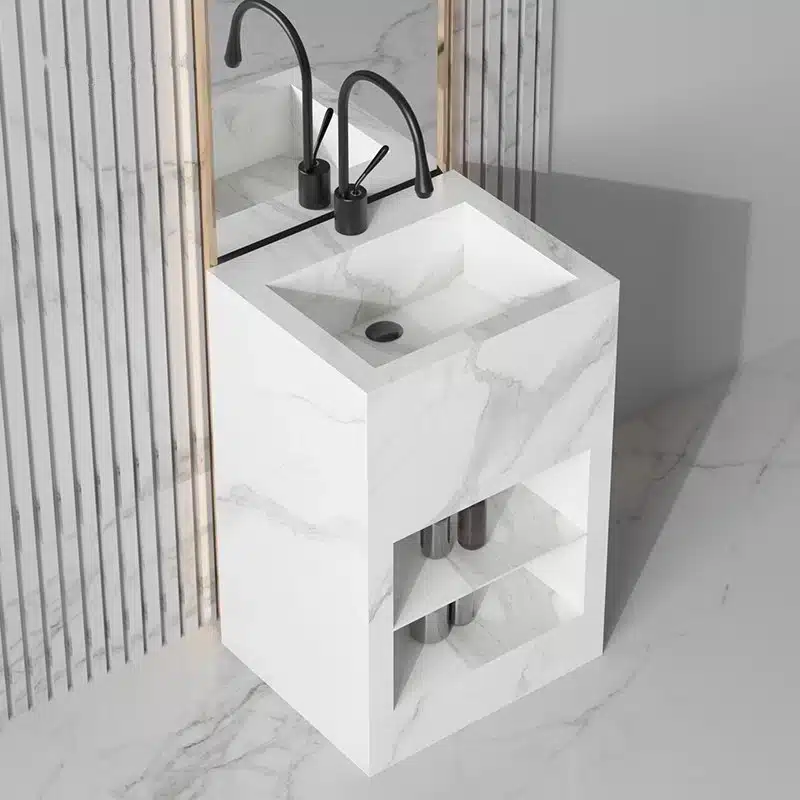
Comparison 2: Aesthetic Flexibility and Customization
Aesthetic flexibility is a production-planning question, not a design-catalog question.
When an e-commerce brand owner weighs a sintered stone bathroom vanity vs engineered wood, the surface-level read is that wood wins on color choice and stone wins on status. The production read is different. Engineered wood (MDF or plywood core) accepts any RAL paint code, and laminate wraps copy oak, walnut, or greige trends at volume-friendly pricing. Sintered stone is restricted to the slab patterns your supplier actually stocks — marble, travertine, cement-look, and a limited set of neutrals.
What moves the buy decision is what survives the container journey and a customer’s phone camera. Painted wood delivers color flexibility up front, but gloss mismatch and edge-banding seams are the recurring complaints on repeat orders. Sintered stone is through-body — the veining runs the full slab thickness, so a chipped edge or a drilled tap hole shows the same color as the surface. That is why it photographs cleanly and why buyers in Asia and Oceania accept a 15–20% price premium on sintered stone vanities. For North America, where cost-sensitive projects keep engineered wood dominant, the customization question is finish consistency at scale, not pattern range.
-
- Finish breadth: Engineered wood accepts any RAL or Pantone-matched color; sintered stone is capped by slab availability, so pattern selection and MOQ must be locked before sample approval.
- Edge integrity: Wood edges rely on PVC or ABS banding that can telegraph after humidity cycles; sintered stone edges hold because color and texture run through the entire thickness.
- Basin integration: A custom sintered stone basin manufacturer can fabricate the counter and basin as one integrated unit — the clean look that drives premium pricing in Asia and Oceania. Wood requires a drop-in or undermount basin, adding a sealant joint that becomes the first leak point.
- Custom program risk: If a supplier quotes custom wood colors with no lead-time impact, verify their batch-change protocol. Color drift between production runs is a known aesthetic failure in painted vanities.
| Aesthetic Dimension | Sintered Stone | Engineered Wood | Brand Impact |
|---|---|---|---|
| Pattern & Finish Range | Photorealistic HD digital printing across the full slab — marble, travertine, concrete, and wood-look options with depth and veining precision. | Wood-grain laminates and veneers dominate; stone-look imitations exist but often show repeat patterns and less visual depth. | Sintered stone creates a premium, trend-forward catalog that justifies 15–20% higher price points in Asia and Oceania. |
| Color & Batch Consistency | Digitally controlled production delivers near-zero color drift between batches — critical for distributor reorders and multi-unit hotel projects. | Natural wood-grain variation can cause visible mismatches across batches unless strict supplier-side grading and QC are enforced. | Consistent color science protects e-commerce brands from return triggers and negative reviews about mismatched vanity sets. |
| Edge Profiles & Basin Integration | CNC waterjet cutting allows ultra-thin 6–20mm edge profiles, sharp angles, and fully seamless integrated sink basins. | Routed edge profiles are possible, but integrated basins are uncommon; visible seams and bead joints remain around the sink area. | A seamless sculptural basin look is a powerful differentiator for luxury homes, hotel bathrooms, and project procurement specifications. |
| Texture & Tactile Feel | Matte, silk, polished, and structured stone textures — all non-porous, fingerprint-resistant, and easy to wipe clean. | Smooth laminate or veneer surfaces; can show water spots near the basin and risk edge swelling if the seal is compromised. | Touch-and-feel textures sell well in showrooms; non-porous surfaces reduce after-sales claims and warranty issues. |
| Customization & MOQ Flexibility | Custom digital patterns, exact dimensional cutouts, and basin mold options ideal for medium-to-large premium collections. | Faster lead times, lower setup costs, and smaller MOQs for custom cabinet colors — ideal for e-commerce brands launching entry-level lines. | Dual-material flexibility lets one supplier serve both premium sintered stone lines and value-engineered wood collections. |
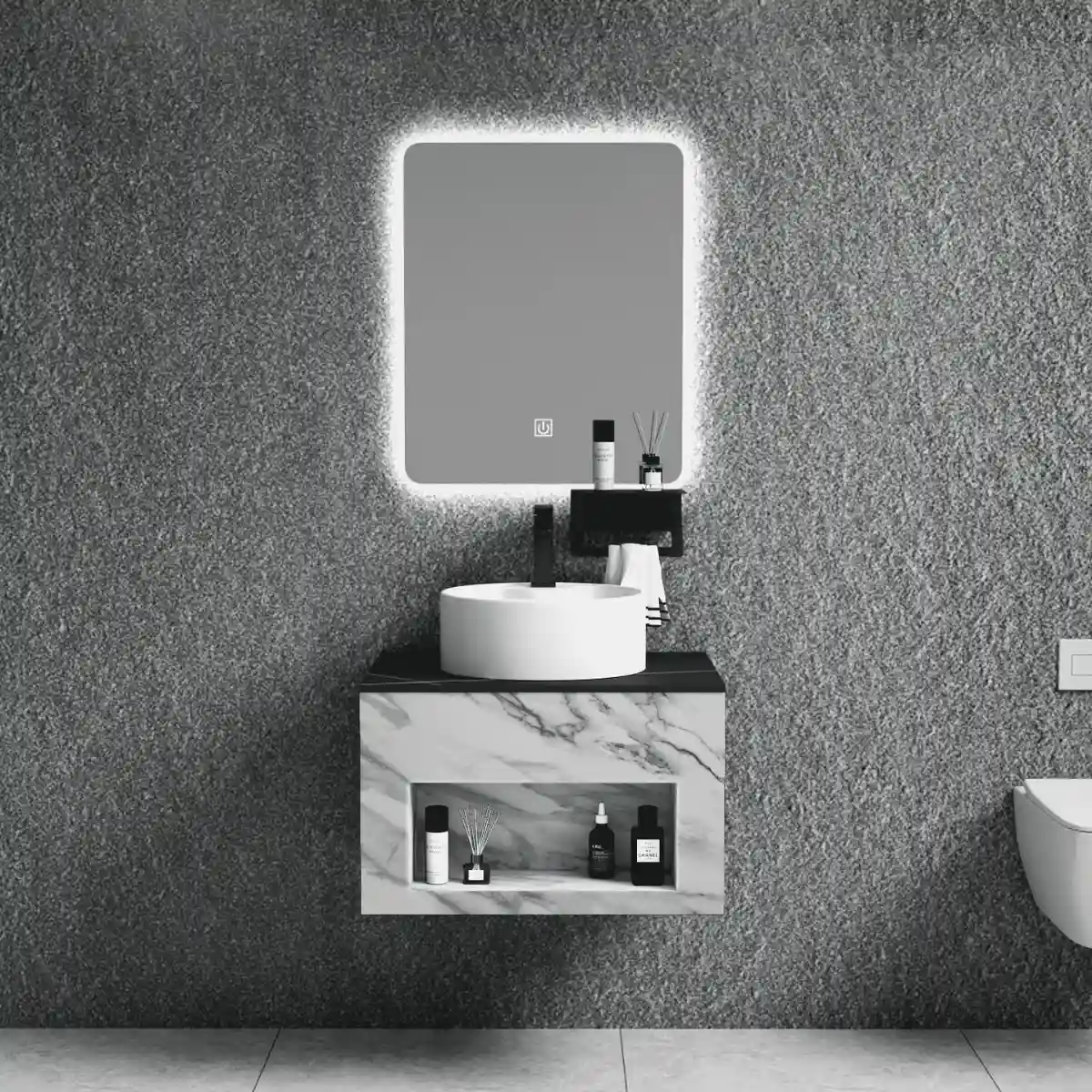
Comparison 3: Weight, Installation, and Shipping Constraints
A 36-inch sintered stone top alone can weigh more than a complete engineered wood vanity — plan freight before you price it.
In the sintered stone bathroom vanity vs engineered wood comparison, weight is where operational costs hide. Sintered stone is a mineral panel fired near 1,200°C, with a density of roughly 2.4 g/cm³ — about three times a 0.7 g/cm³ MDF core. A 36-inch vanity with an integrated basin means the stone top alone lands between 40 and 60 kg. The full engineered wood equivalent, cabinet plus top, typically holds at 25–40 kg. A complete unit with sintered stone runs 2–2.5× heavier, and every downstream cost moves with that number.
-
- Last-mile reclassification: FedEx Ground and UPS residential parcels cap out at 68 kg (150 lb). A fully assembled sintered stone vanity can cross that threshold, forcing LTL freight quotes that add $150–400 per delivery depending on lane.
- Ocean freight billing: Engineered wood loads volume out before they weigh out. Sintered stone loads push toward the container’s weight floor far faster. LCL freight is charged on the higher of tonnage or CBM, so heavier stone tops raise the effective rate per cubic metre.
Installation compounds the problem. Engineered wood can be fitted solo, trimmed on site, and shimmed to uneven walls. Sintered stone needs two people, a cabinet frame level within 1–2 mm, and no field cutting. For ecommerce brand owners, a cracked top means an insurance claim plus a 40 kg return shipment; a dented engineered wood cabinet is usually settled with a partial credit.
Watch the packaging, too. Wood-based vanities survive transit with polystyrene corner blocks. Sintered stone requires a fully enclosed foam cradle and double-wall carton, which adds 5–8% cubic volume to every shipment. When comparing FOB pricing, ask for the shipped carton dimensions, not just the unit price. Some suppliers cut packaging weight to make their quote look competitive — the damage claim lands on your desk, not theirs.
| Constraint | Sintered Stone | Engineered Wood | Impact for E-Commerce Brands |
|---|---|---|---|
| Unit Weight (typical 60cm combo) | 45–65 kg (density ≈ 2.4–2.7 g/cm³) | 15–25 kg (MDF/plywood ≈ 0.6–0.8 g/cm³) | Sintered stone is 2.5–3× heavier; factor weight-based freight quotes into landed cost early. |
| Shipping Cost Driver | Dead-weight charges dominate; fewer units per container by weight | Volumetric weight dominant; up to 2× more units per 40ft HQ container | Engineered wood suits dense, price-driven SKUs; sintered stone works best for premium lines with higher margin per unit. |
| Transit Breakage Risk | Moderate — edge chipping possible; requires foam-edge protectors and wooden crates | Low — panels flex and absorb shock; standard carton packing is sufficient | Budget 3–5% for damage claims on sintered stone with budget carriers — or upgrade export packaging to protect margins. |
| Installation Complexity | Needs 2-person team, reinforced wall brackets, diamond-tip drill bits | 1 person with standard tools; DIY-friendly | Sintered stone adds roughly $80–150 per unit to end-user installation cost; wood is safer for direct-to-consumer DIY buyers. |
| Flat-Pack & Warehouse Storage | Not flat-packable — one-piece fired slab with fixed dimensions | Flat-packable cabinets maximize container and warehouse space | Engineered wood can reduce warehouse footprint by up to 40%, lowering storage overhead for fast-turn inventories. |
| Post-Installation Stability | Zero warping; <0.02% water absorption (Focuscabinet basins); stable in high humidity | Susceptible to edge swelling and warp if moisture penetrates exposed panels | Sintered stone cuts after-sales callbacks in humid coastal and tropical markets — a key warranty cost lever. |
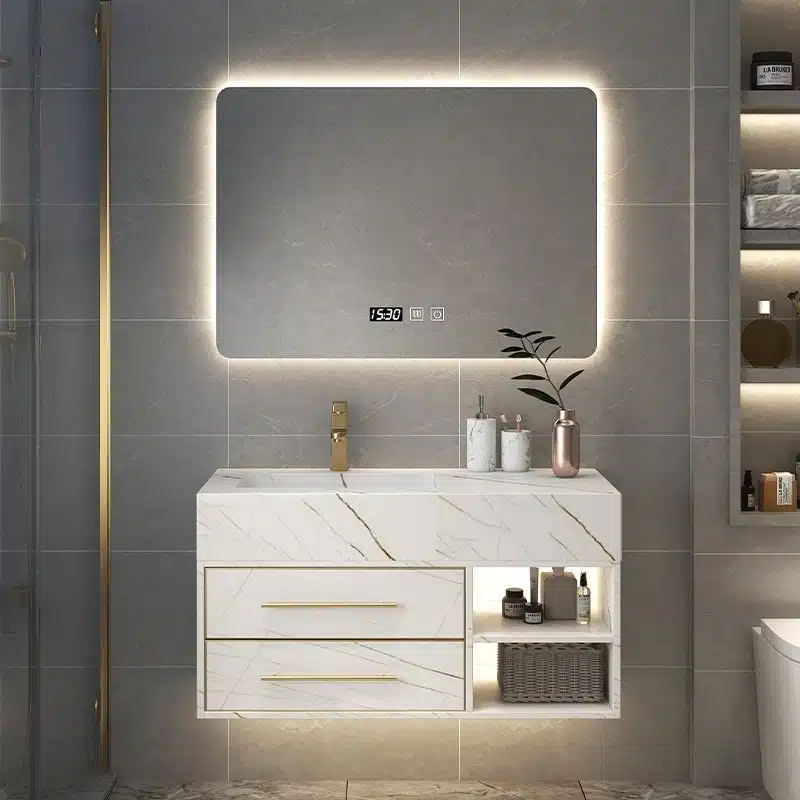
Comparison 4: Cost per Unit – Initial vs. Long‑Term
Engineered wood wins on invoice price.
Straight to the math: on FOB pricing, engineered wood is the cheaper ticket. An E1/E0 plywood vanity starts at a substantially lower per-unit cost than a sintered stone configuration, which is why engineered wood still dominates budget-conscious vanity imports in North America. For an e-commerce brand owner watching first-order cash flow, that lower invoice price is hard to ignore.
But the initial unit cost is just one line in the P&L. Every swollen MDF door or delaminated cabinet top that gets returned after months 6–18 in a humid bathroom converts your cheap buy-in into a negative-margin transaction. You absorb return freight, repackaging labor, and the discounted resale of a damaged unit, plus the invisible cost of star-rating damage on your listing.
-
- Sintered stone (initial cost): Higher FOB price per unit, but the material is fired at high temperature with a water absorption rate below 0.02%. It doesn’t wick moisture, so the failure modes that drive warranty claims — swelling, delamination, edge sealing — are largely absent.
- Engineered wood (long-term cost): Lower FOB price, but moisture-driven failures typically surface within the first 18 months in high-humidity markets. Once you price replacements, cross-border shipping, and customer churn into the unit cost, the apparent savings evaporate.
Regional pricing tells the same story. In Asia and Oceania, sintered stone vanities command a 15–20% price premium at retail because buyers already associate stone with durability. A premium you can price into the product isn’t a cost — it’s margin. Skip the moisture-resistance conversation during sourcing, and you’ll have it forced on you later, one return label at a time.
| Cost Factor | Engineered Wood | Sintered Stone | Long-Term Impact |
|---|---|---|---|
| Initial unit price (wholesale, FOB China) | Lower initial cost; dominant for cost-sensitive buyers and E1/E0 plywood bathroom vanity China supplier volume orders. | 15–30% higher upfront wholesale price for premium finishes and custom sintered stone basin manufacturer specs. | Higher upfront cost is recovered through fewer warranty claims and a 15–20% retail premium in Asia and Oceania. |
| Water absorption rate | 5–15% moisture absorption; edges prone to swelling without P3-rated sealing and proper coating. | <0.02% absorption — a fraction of engineered wood — with near-zero porosity. | Zero porosity eliminates the leading cause of bathroom cabinet failure: moisture intrusion. |
| Repair & replacement frequency | Higher delamination risk in humid bathrooms; moisture resistant bathroom vanity material wholesale buyers must specify P3/E1-E0 boards. | Stain-, scratch-, and heat-resistant; maintains surface integrity for 20+ years. | Fewer replacements over a decade lowers the total cost of ownership for sintered stone. |
| Installation & handling | Lightweight panels; standard tools; lower labor cost and faster install. | Heavier slabs require professional cutting, mounting, and reinforced cabinetry. | Higher installation cost is offset by durability — especially for hotels and commercial projects. |
| Shipping & logistics | Compact and lighter; higher unit count per 40HQ container reduces freight per piece. | Heavier; lower container utilization; export-grade crating is mandatory. | Focuscabinet’s five-stage QC and marine-grade packaging minimize freight damage on both material paths. |
| Regional price positioning | Region-ready bathroom vanity for North America favors wood for value-tier, high-volume sales. | Commands a 15–20% price premium in Asia and Oceania, where durability is a perceived value. | E-commerce brands can segment catalogs: engineered wood for entry-level, sintered stone for premium tiers. |
| Life-cycle cost outlook (2026 comparison) | Low initial spend, moderate ongoing risk; acceptable in low-humidity climates for the sintered stone vs engineered wood decision. | Higher upfront investment, minimal maintenance, and lower long-term cost of ownership. | For wholesale sintered stone bathroom vanity China sourcing, the long-term margin story favors sintered stone. |
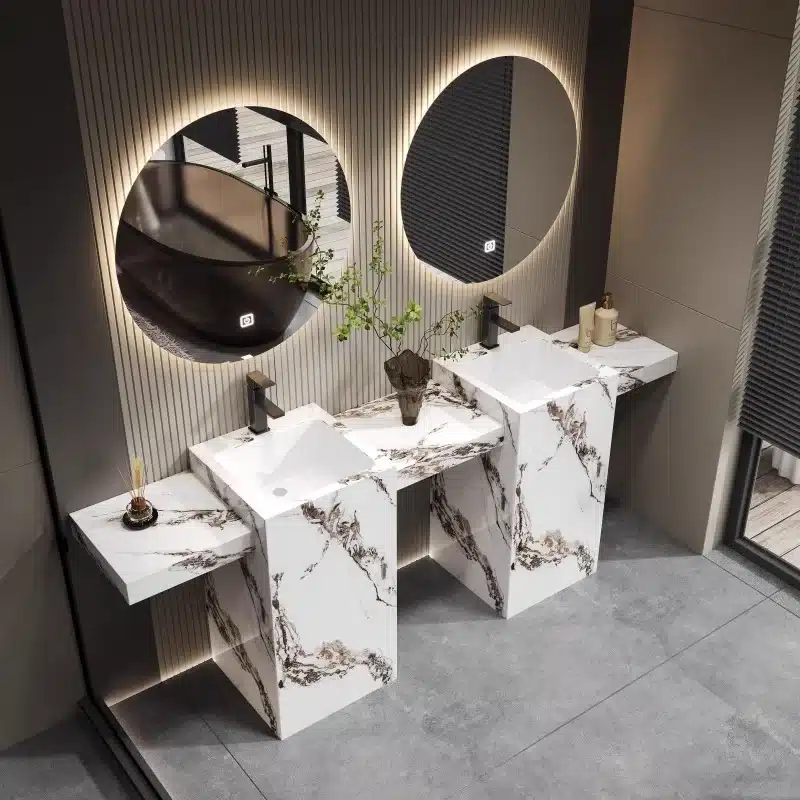
Regional Best‑Fits: Where Each Material Wins
Let the destination decide your SKU mix.
Material choice is a regional margin decision, not a materials science debate. In North America, engineered wood still carries the volume. Renovation buyers anchor on the entry price point, and the vanity is budgeted as a replaceable component inside a 10-year cycle.
Asia and Oceania run the opposite play. Sintered stone vanities command a 15–20% price premium over engineered wood equivalents in these markets. Focuscabinet’s sintered stone basins measure water absorption below 0.02% — a fraction of what engineered wood substrates soak in. In coastal, high-humidity cities, that difference closes the sale at a higher ticket.
-
- North America: Engineered wood remains the mass-market workhorse. Price anchors the sale; sintered stone is an upsell, not the default.
- Europe: E1/E0 emission specs push cost onto plywood builds. Sintered stone side-steps certification friction on hotel and commercial projects.
- Asia & Oceania: The 15–20% sintered stone premium holds because humidity plus design-led hospitality demand non-porous surfaces.
- South America & Africa: Price-sensitive and climate-diverse. PE-film-wrapped engineered wood dominates; sintered stone gains share only in upscale residential.
A brand owner who locks into one material leaves margin or volume on the table, depending on the region. Working with a factory that runs both material lines lets you tune the SKU mix market by market without splitting sourcing across two suppliers. Sample approval and FOB pricing both get simpler when one production schedule covers both lines — that is the practical definition of a region-ready bathroom vanity program.
| Region | Best-Fit Material | Why It Wins | Key Specifications | Market Insight |
|---|---|---|---|---|
| North America | Engineered Wood (Plywood / MDF) | Cost-sensitive projects demand durable vanities at accessible price points; E1/E0 plywood handles standard bathroom moisture reliably | E1/E0 moisture-resistant boards; P3-rated MDF; five-stage quality control | Engineered wood remains dominant; sintered stone reserved for premium and hotel projects |
| Europe | Sintered Stone (premium) / Engineered Wood (mid-range) | Strict formaldehyde and moisture standards reward certified materials; design-forward buyers want photogenic, modern finishes for e-commerce | E1/E0 certified plywood; zero-porosity sintered stone (<0.02% water absorption) | Region-ready bathroom vanity designs with EU compliance and trend-driven aesthetics |
| Asia | Sintered Stone | High-humidity climates and strong perceived durability; luxury homes and hotels drive premium preference | Sintered stone basin water absorption rate <0.02%; heat- and stain-resistant finish | Sintered stone vanity price premium of 15–20% over engineered wood across Asia |
| Oceania | Sintered Stone | Coastal moisture, humid bathrooms, and long-term durability expectations favor non-porous surfaces | Zero porosity; mold/mildew-resistant; custom sintered stone basin options | 15–20% price premium; custom sintered stone basin manufacturer solutions in high demand |
| Africa | Engineered Wood (value) / Sintered Stone (commercial) | Budget-conscious projects require affordable moisture-resistant vanities; sintered stone suits high-end hotels and harsh climates | Moisture-resistant bathroom vanity material wholesale options; E1/E0 boards; non-porous stone | Wholesale sintered stone bathroom vanity imports growing for hospitality and coastal developments |
| South America | Engineered Wood (cost-driven) / Sintered Stone (tropical zones) | Price-sensitive importers rely on engineered wood; sintered stone wins in humid coastal and resort settings | E1/E0 moisture-resistant plywood; <0.02% water absorption sintered stone | Bathroom vanity material comparison 2026: hybrid sourcing strategies gaining traction |
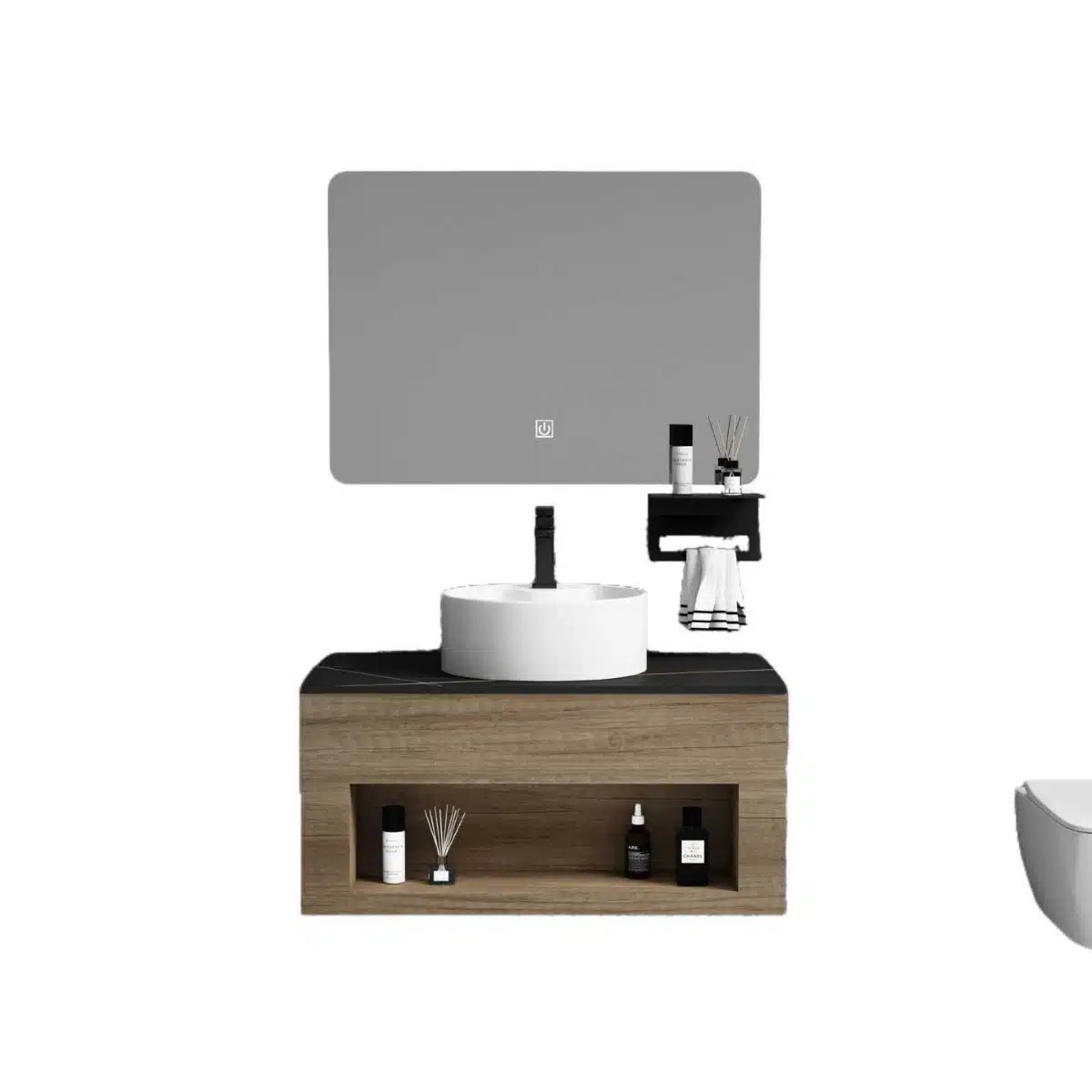
Focuscabinet’s Offerings: Both Materials, One Partner
One factory, two material systems: sintered stone for premium markets, engineered wood for volume price points.
Most suppliers force you to commit to one material lane. That is a commercial constraint you don’t need. Focuscabinet operates on both sides of the sintered stone vs engineered wood debate, which means you can build a regional assortment without splitting your vendor base. The same factory that ships E1 plywood bathroom vanities to North American distributors also produces custom sintered stone basin manufacturer lines for Asia and Oceania.
For the engineered wood side, the in-house standard is E1-approved plywood with moisture-resistant sealing on all cut edges. That matters for North American projects where price points are tight and buyers expect a five-year lifespan from a mid-tier vanity. For sintered stone, the internal test data shows a water absorption rate below 0.02% — a fraction of what any wood substrate can achieve. This is the material you quote when a client in Singapore or Sydney asks for something that will not swell, stain, or telegraph humidity damage.
-
- Sintered stone premium: Vanities built around sintered stone basins command 15–20% higher price points in Asia and Oceania, where perceived durability drives purchasing decisions. You can position these as tier-one product lines without changing suppliers.
- Engineered wood volume: E1-rated plywood remains the default for cost-sensitive North American projects. One partner supplying both lets you test regional demand with lower MOQs per material instead of committing to a full container of a single construction.
From a procurement standpoint, consolidating both materials under one factory simplifies quality tolerance enforcement. You set the approved sample standard once, and the same five-stage QC checkpoint applies whether the order is a laminated wood cabinet or a full sintered stone basin run. You do not have to coordinate FOB pricing, shipping windows, or defect liability between two separate factories that might not even ship from the same port. That is the practical value of a dual-material partner: less coordination overhead, fewer excuses, and a single accountable throat to grab if a batch misses spec.
| Product Line | Material & Build | Performance Specs | Regional Fit | Business Advantage |
|---|---|---|---|---|
| Sintered Stone Basins & Countertops | Zero-porosity sintered stone; <0.02% water absorption | Heat-, scratch-, and stain-proof; non-porous hygiene surface | Asia & Oceania — commands 15–20% price premium | High-margin luxury upgrade for hotels and premium e-commerce lines |
| Engineered Wood Cabinets | Plywood, MDF, or particle board with E1/E0 and P3 moisture ratings | Five-stage QC; sealed edges resist humidity and warping | North America — dominant for cost-sensitive projects | Low MOQs; consistent export-grade quality for volume distributors |
| Smart LED Mirrors | Copper-free silver mirrors; anti-fog; integrated LED lighting | Dimmable, motion-sensor options; region-specific voltage and certifications | Europe & North America — high demand in hospitality and luxury homes | Photogenic, trend-ready SKU that lifts online conversion and basket value |
| Turnkey Vanity Package | Cabinet + sintered stone basin + smart mirror matched as one set | Custom dimensions; CFR/CE/E1/E0 compliance per destination market | 20+ countries across NA, EU, Asia, Africa, SA, and Oceania | One partner, one invoice, one QC standard — cuts sourcing complexity |
| Quality & Compliance | Rigorous five-stage inspection at 10,000㎡ factory | Water absorption, formaldehyde, and fire-rating tests documented per batch | Region-ready designs adapted to local regulatory and climate needs | Serving 1,000+ distributors since 2015 with repeatable, audited quality |
Making the Final Choice Based on Market and Price Point
Match material to market willingness to pay.
After you stack up durability, moisture resistance, shipping weight, and FOB pricing line by line, the final call comes down to a simpler question: what does your end customer actually pay for at that price point? Not what your supplier pushes — what the market rewards.
For North American e-commerce and distributor channels, engineered wood stays the volume mover. E1/E0 plywood with properly sealed edges supports the entry and mid-market price bands that cost-sensitive projects demand. A sintered stone vanity in the same channel, without the durability premium that buyers in Asia and Oceania accept, becomes a slow-moving SKU tying up warehouse capital.
Flip the map and the math reverses. In Asia and Oceania, sintered stone basins with a water absorption rate below 0.02% are the perceived durability standard. Distributors there routinely move sintered stone vanities at 15–20% above engineered wood equivalents and clear stock faster. Sourcing only engineered wood for those markets means competing on price against buyers already selling the upgrade.
-
- North America mid-market: Engineered wood (E1/E0 plywood). Prioritize sealed edges and quality tolerance checks that hold across the full production run.
- Asia/Oceania premium: Sintered stone. Accept the higher container weight; the 15–20% price premium absorbs the freight cost.
- Mixed portfolio: Run both. Engineered wood anchors entry pricing; sintered stone carries the margin.
One rule from the audit side: set your quality tolerance by the market’s acceptance criteria, not the supplier’s catalog. Sintered stone demands a different inspection checklist than engineered wood — different edge treatment, mounting hardware, and transit bracing. Confirm the pre-production sample covers the exact material system you’re buying, and verify the same baseline on mass production. That habit turns a $50K order into a repeat line, not a lesson.
| Market / Buyer | Material Pick | Price Point | Key Driver | Focuscabinet Edge |
|---|---|---|---|---|
| North America | E1/E0 Engineered Wood | Cost-competitive, value-driven | Cost-sensitive projects; P3 moisture-rated boards | Region-ready E1/E0 plywood vanities with five-stage QC |
| Asia & Oceania | Sintered Stone | 15–20% premium positioning | Zero porosity <0.02%; humid, coastal climates | Custom sintered stone basin manufacturer for luxury builds |
| Europe | Hybrid — Wood + Stone | Mid-to-premium tier | E1/E0 compliance; high-end hospitality demand | Dual-material catalog with regulatory adaptation |
| South America & Africa | Engineered Wood | Entry-to-mid; high cost sensitivity | Budget-driven residential and commercial projects | Wholesale sintered stone bathroom vanity China pricing |
| E-Commerce Brand Owners | Tiered: Wood entry SKUs + Stone signature lines | Tiered from accessible to premium | Photogenic, trendy designs with low MOQs | Low MOQs and custom aesthetics for online brands |
Conclusion
Choosing between sintered stone and engineered wood is not a surface-level design call. It is a moisture-risk decision, a warranty calculation, and a regional pricing signal folded into one material spec. Sintered stone’s <0.02% water absorption rate outperforms every engineered wood variant, and in Asia and Oceania that durability justifies a 15–20% price premium. If you treat this as a purely aesthetic choice, the failure shows up after installation — swollen doors, warped cabinets, and clients who remember the defect long after they forget the savings.
Before you approve your next sample batch, map your target market’s humidity profile and price ceiling against both material builds. If your ecommerce brand sells into coastal or tropical regions, or competes on premium positioning, request a custom sintered stone basin sample from Focuscabinet and compare FOB pricing against the engineered wood alternative side by side.
Frequently Asked Questions
Which vanity material lasts longer in bathrooms?
Sintered stone lasts longer in wet bathroom conditions because its near-zero porosity resists water and heat. Engineered wood can perform well if sealed properly, but it swells when moisture finds a cut edge. Choose sintered stone for high-moisture commercial or rental projects.
Is sintered stone worth the higher initial cost?
Sintered stone is worth it when you factor in fewer warranty claims and longer service life in high-use bathrooms. The higher upfront price offsets replacements and repairs that engineered wood may need in humid regions. Calculate lifetime cost per unit before deciding.
What are the main differences between sintered stone and engineered wood?
Sintered stone is mineral-based, non-porous, and heat-resistant, while engineered wood is wood-based and moisture-sensitive. Engineered wood offers lower initial cost and easier machining, but sintered stone provides better durability and lower maintenance. Match the material to the project’s moisture and budget specs.
Can engineered wood be used in humid climates?
Engineered wood can be used in humid climates only if it meets the right moisture-resistant grade and is sealed at all cut edges. E0 and E1 labels are emission ratings, not. Ask your supplier for the actual board grade and edge-sealing spec.
How should I choose between sintered stone and engineered wood for my market?
Choose sintered stone for commercial projects, high-humidity regions, and premium lines where durability is the selling point. Choose engineered wood for price-sensitive markets or dry climates where lower cost and flexible. Use regional warranty history and climate data to finalize the mix.





0 Comments