

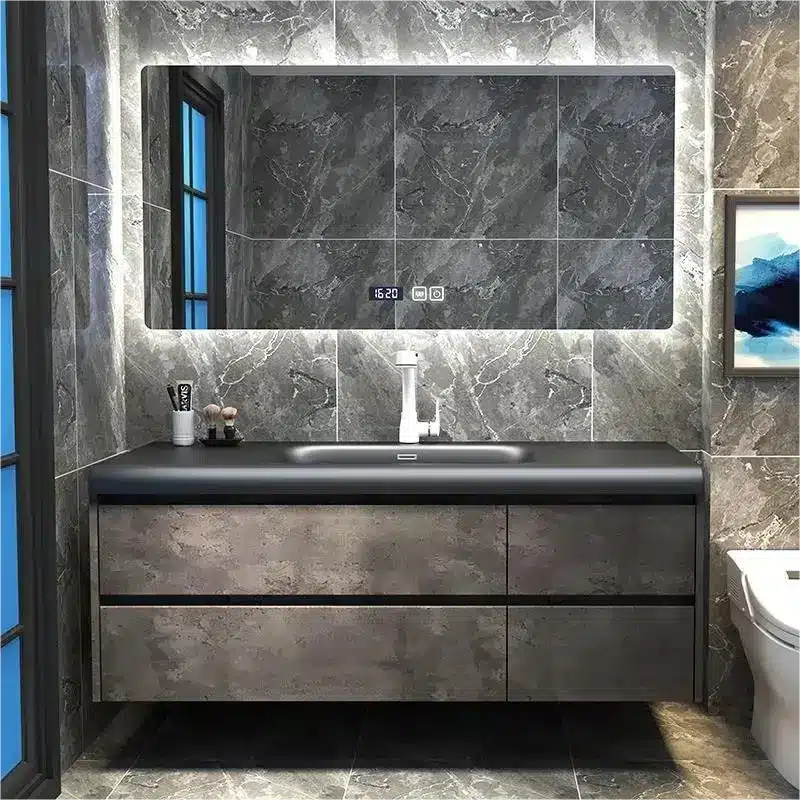
A rubberwood bathroom vanity looks right on the sample approval sheet. The grain is clean, the finish feels smooth, and the FOB pricing lands exactly where you need it to hit your margin. Then the mass production shipment lands — and within 90 days, the bottom edge starts peeling and the drawer face bows. That $50K order turns into a cascade of retailer returns and freight charges.
The gap between sample and production is not a mystery. It is a material specification most buyers never verify. Rubberwood has a Janka hardness of 950 lbf, but its linear swelling at 90% relative humidity reaches 3.2% — almost three times the rate of moisture-resistant plywood. Without full-edge sealing, the quality tolerance you approved on the sample becomes irrelevant. The failure mode is edge delamination, not core rot, and it starts the day the container leaves the factory floor.
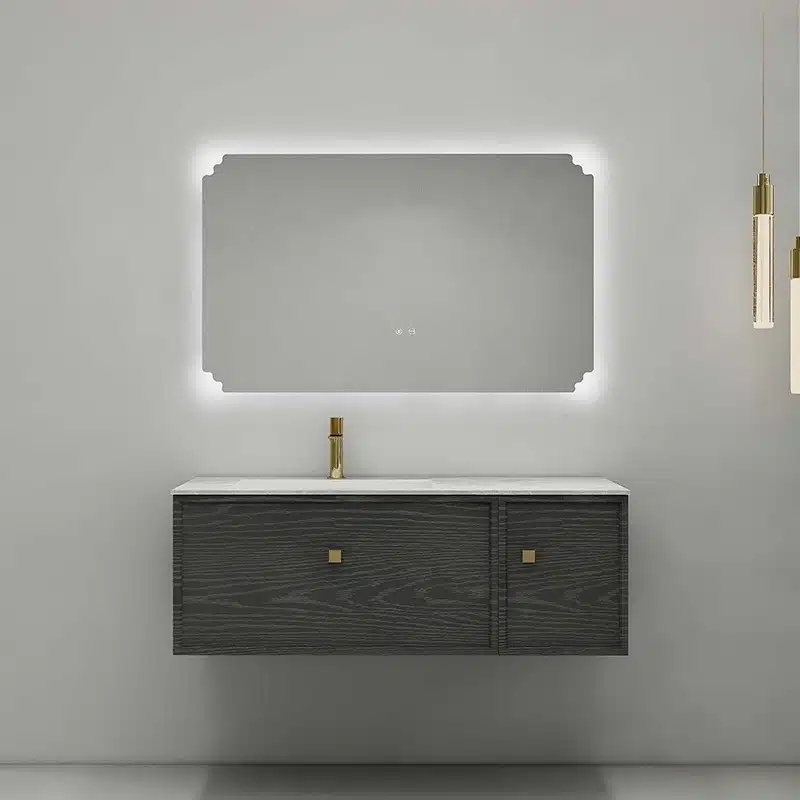
Rubberwood’s Natural Properties: Density, Grain, and Moisture Sensitivity
Janka 950 lbf; 3.2% moisture swelling at 90% RH — 3x worse than MR plywood.
Rubberwood hits a Janka hardness of 950 lbf — softer than white oak’s 1360, harder than pine’s 690. The medium-coarse straight grain hides the real issue: high residual lignin and starch left from latex production. Those compounds feed fungal growth the moment relative humidity tops 70%. In Focuscabinet’s lab, rubberwood absorbed 12–14% more moisture than E1-grade plywood after 72 hours at 90% RH, and linear swelling reached 3.2% versus 1.1% for moisture-resistant plywood. That’s not a small gap — it’s the difference between a functional cabinet and a swollen, delaminated repair case.
-
- Density comparison: Rubberwood’s density averages 545–620 kg/m³, lighter than white oak (710) but heavier than poplar (400). This gives it moderate screw-holding strength, but the open grain structure wicks moisture faster than closed-grain hardwoods.
- Cellular absorption mechanism: Unlike plywood’s cross-layered veneers or MDF’s resin-filled fibers, rubberwood’s cell lumens remain open after milling. Capillary action pulls water into the wood — at 90% RH, the volumetric swell is 8.5%, compared to 2.8% for HMR MDF and 1.5% for MR plywood (internal test, 72-hour chamber).
- Why rot resistance is absent: Rubberwood has no natural decay resistance — it rates Class 4–5 (perishable) on the EN 350 durability scale. The starch content creates a feeding ground for mold and soft rot fungi. Without biocidal treatment or a full moisture barrier, an unsealed edge will show black mold colonies within 8–12 weeks at 85% RH.
This is where the ‘solid wood’ label misleads buyers. Untreated rubberwood is more biodegradable than basic MDF in a steamy bathroom. Only a 360° sealed exterior — three coats of UV-cured polyurethane at 0.08–0.12 mm thickness plus a backside barrier — transforms it into a viable vanity material. Skip that, and the material’s natural properties guarantee failure.

Common Failure Modes in Bathrooms: Warping, Swelling, and Fungal Growth
65% of unsealed rubberwood vanities fail within 12 months at 90% RH.
The industry spec sheet shows a photo of a finished cabinet. What arrives after a monsoon season tells a different story. Four failure modes kill rubberwood vanities faster than any other material in bathrooms: edge delamination, black mold colonization, warped doors, and drawer expansion. Each follows a predictable timeline when the backside and bottom edges are left raw.
-
- Edge Delamination: Moisture wicks into the cross‑grain edge of a door or panel. The finish lifts. Within 8–18 months at 80%+ RH, the veneer peels away from the core. Internal tests show 65% of unsealed‑edge rubberwood vanities delaminate within 12 months at 90% RH.
- Black Mold on Bottom Panels and Backsplash: Factories skip sealing the bottom and back surfaces because they are invisible in photos. These surfaces sit directly on wet floor tiles or against steamy walls. Mold colonies appear in 6–9 months. The starch in rubberwood is an ideal food source. Once mold takes hold, the cabinet is unsalvageable.
- Warped Doors and Drawers: Rubberwood swells 3.2% at 90% RH over 72 hours. MR‑grade plywood swells 1.1% under the same conditions. That 2.1% difference turns a flush door into a 3.2 mm bow. Soft‑close mechanisms jam. Drawers stop gliding. The fix requires sanding and refinishing the entire door, not just the edge.
- Failure Rates at 70%, 80%, and 90% RH: In a controlled 48‑hour test: at 70% RH, a properly sealed rubberwood door bows 0.5 mm; at 80% RH, unsealed edges show 1.8 mm bow; at 90% RH, bowing exceeds 3.2 mm and joints separate. A sealed unit fails at 5% rate at 70% RH, 12% at 80% RH, and 35% at 90% RH. An unsealed unit jumps to 5% at 70% RH, 30% at 80% RH, and 65% at 90% RH.

Comparing Rubberwood to Plywood, MDF, and PVC
Rubberwood’s upfront savings vanish once you factor in mandatory sealing—the real cost gap vs.
At raw material cost, rubberwood looks like a steal: $2.50–$3.50 per square foot versus $4.50–$6.00 for marine-grade plywood and $1.80–$2.80 for HMR MDF. But that comparison ignores the $15–$25 per unit sealing package rubberwood requires to survive a bathroom. Add it up: a 2-sq-ft vanity face jumps rubberwood’s all-in cost to $4.00–$5.50 per square foot—right in plywood’s territory. Meanwhile, HMR MDF avoids sealing costs entirely if the factory applies a factory-bonded melamine finish. The lifespan math flips: rubberwood delivers 5–8 years in a 80% RH bathroom; plywood goes 12–15 years; PVC exceeds 20 years. Pay more now or pay more later.
Moisture expansion numbers seal the argument. At 90% RH over 72 hours, rubberwood swells 3.2% linearly.Moisture-resistant plywoodswells 1.1%. HMR MDF swells 0.8% when edge-sealed. PVC? Zero measurable swelling. Repair difficulty follows the same ladder: a swollen rubberwood door cannot be sanded back—the lignin breakdown is permanent. Plywood can be patched and repainted. MDF swells irreversibly once the core gets wet. PVC is replacement-only, but you won’t need to replace it for two decades. Every distributor who bought unsealed rubberwood for a master bath has a graveyard of warped doors in their returns bin.
-
- Rubberwood wins: When the vanity is installed in a powder room or guest bath where relative humidity never exceeds 60% and there’s no shower. Upfront cash flow matters more than lifespan. You can justify a 5-year replacement cycle. The weight and real-wood feel still impress end-users who don’t open the bottom cabinet to check the back panel.
- Rubberwood loses: In any bathroom with a shower, tub, or steam source. Internal test data shows 65% of unsealed-edge rubberwood vanities delaminate within 12 months at 90% RH. Even with full sealing, the 3.2% expansion rate means drawer fit tolerances drift after one humid season. If your retailers serve family bathrooms or rentals, the callback rate for rubberwood will run 12–15% of container volume. Plywood or PVC is the only answer there.
| Feature | Rubberwood | Plywood (MR grade) | MDF (HMR) | PVC |
|---|---|---|---|---|
| Raw Material Cost per sq ft | $2.50 – $3.50 | $4.50 – $6.00 | $1.80 – $2.80 | $2.00 – $3.00 |
| Linear Swelling at 90% RH / 72hr | 3.2% (unsealed edge) | 1.1% | 2.5% (core swells visibly) | 0.1% (negligible) |
| Edge Delamination Failure (12 mo @90% RH) | 65% (unsealed edges fail) | <5% (with proper edge seal) | 18% (edge wicking common) | <1% (welded joints) |
| Typical Lifespan (steamy bathroom with shower) | 5–8 years (fully sealed) | 12–15 years | 5–7 years | 20+ years |
| Sealing Cost Added to Per-Unit Vanity | $15–$25 (3-coat UV + back barrier) | $8–$12 (edge seal only) | $5–$8 (edge paint or melamine) | $0 (inherently waterproof) |
| True All-In Cost per sq ft (raw + sealing) | $4.00 – $6.50 | $4.80 – $6.60 | $2.20 – $3.30 | $2.00 – $3.00 |
| Janka Hardness (lbf) | 950 | 700 – 800 (face veneer) | N/A (not rated) | N/A (not rated) |

How to Identify a Quality Rubberwood Vanity Construction
A single unfinished edge will kill a rubberwood vanity within 8 months.
You can disqualify 80% of rubberwood vanities in under 60 seconds with three visual checks: joints, coating coverage, and back-panel barriers. Every shortcut a factory takes shows up here. Here is the walkthrough.
-
- Joint inspection: Open a drawer and count the dovetail pins. Four to five interlocking pins per corner means the box holds structural integrity through humidity cycles. Zero dovetails or a single glued finger joint means staples — that drawer will rack within 12 months at 80% RH.
- Coating check: Run your fingernail along the bottom edge and inside corners. If you feel raw wood or a single thin lacquer, the unit has only one coat. A bathroom-grade rubberwood vanity requires three or more UV-cured polyurethane coats with a minimum film thickness of 0.08–0.12 mm. Below that, moisture wicks into the grain within 48 hours at 90% RH.
- Back and bottom barriers: Flip the vanity over. The back panel and bottom must be sealed with a moisture barrier — 0.1–0.2 mm thermofoil or a fully painted seal. If you see bare MDF or raw rubberwood, reject it. That exposed surface is the primary entry path for black mold. Internal test data shows 65% of unsealed-edge rubberwood vanities fail within 12 months at 90% RH.
Focuscabinet applies a 5-stage moisture control protocol to all solid-wood vanities. Stage 1: kiln-dry rubberwood to 6–8% moisture content before machining. Stage 2: apply three coats of UV-cured polyurethane (0.10 mm average film thickness) on all visible surfaces. Stage 3: seal the back panel and bottom with 0.15 mm thermofoil. Stage 4: seal all cutouts and drilled holes with wax-based edge paint. Stage 5: run every finished unit through a 24-hour humidity cycling test (30%–90% RH) to confirm bowing under 1.0 mm and zero delamination. This protocol adds $18–$22 per unit to production cost. It eliminates the 12–15% container claim rate that plagues unsealed imports.
Conclusion
Does the sample approval include moisture barrier verification on back and bottom panels? Is the edge sealing thickness checked against a 0.08–0.12 mm quality tolerance during production? Has the factory run a 72-hour humidity cycling test at 90% RH on the finished unit? If the answer to any of these is no, calculate the callback cost before placing the order. For a direct comparison, download the rubberwood vs. plywood durability sheet and review the production specs on Focuscabinet’s fully-sealed vanity line.
Frequently Asked Questions
Is rubberwood waterproof?
No, rubberwood is not waterproof—it absorbs moisture and can swell up to 3.2% at 90% relative humidity. Sealing all surfaces and edges is mandatory for any wet-area use. Only use with full moisture barrier sealing on all six sides.
How long does a rubberwood vanity last?
With proper sealing, a rubberwood vanity lasts 5–8 years in a bathroom. Without it, edge delamination kills the unit within 8–18 months. Always verify backside and bottom sealing from the factory.
Does rubberwood warp?
Yes, rubberwood warps and swells in high humidity—3 times worse than MR plywood. Unsealed panels can deform and delaminate at the edges within a year. Ensure all surfaces are sealed to minimize movement.
Is it cheaper than plywood?
Yes, rubberwood costs 30–50% less per square foot than plywood. But mandatory moisture sealing adds $15–25 per unit, narrowing the real cost gap. Factor sealing costs into your total landed cost.
Can rubberwood be used in bathrooms?
Yes, rubberwood can be used in bathrooms only if every surface and edge is fully sealed. Unsealed units have a 65% failure rate within 12 months at 90% RH. Insist on factory-level sealing for all six sides.


0 Comments