
Your phone rang twice this week. A hotel group in Brisbane is sourcing vanities for a renovation, and a retail chain in Auckland is reviewing its bathroom range. Both conversations arrive at the same question: where do the cabinets come from, and how do they land legally?
An Australia bathroom vanity import program starts with paperwork, not price lists. The National Construction Code, water efficiency rules, and shipping terms decide which suppliers can actually deliver. Distributors who map those requirements before signing anything control their own entry timeline.
This guide covers what Australia requires, which products fit the region, and how to structure the first order with a China-based factory. The compliance layers, the product lines that answer local conditions, and the shipping terms that keep a first container predictable are all here. Use the checklist at the end as your working document.
Key Takeaways
- Australia bathroom vanity import decisions rest on the National Construction Code (NCC) and on WELS (Water Efficiency Labelling and Standards) registration for any tapware in the range.
- Demand concentrates in project fit-outs, hotel renovations, and retail showroom ranges rather than a single mass channel.
- A factory that holds CE and UL certificates plus ISO 9001 and ISO 14001, valid since 2017 and confirmed in 2025, covers the documentation importers need.
- The MFBATH line spans PVC, plywood, solid wood, and sintered stone vanities from 24 to 60 inches, with an Oceania-focused style range.
- First orders start at a minimum order quantity (MOQ) of 15 sets per model, color, and size, with mixed container loading across models.
- Free samples ship in 10 working days, bulk production runs 20–30 days, and goods leave Qingdao on Free On Board (FOB) terms.
- Every cabinet passes 5 in-house checks, and third-party inspection by SGS or TÜV can be arranged with advance notice.
Table of Contents
- Why Distributors Look at Australia Now
- What Australia Requires on Compliance
- Product Fit for the Australian Market
- Sourcing and Logistics From China
- Entry Checklist for Your First Container
- Your Route Into the Australian Market
- Frequently Asked Questions
Why Distributors Look at Australia Now
Distributors across Oceania are adding Australia to their sourcing plans for a practical reason: project pipelines keep asking for complete bathroom packages. Hotel refurbishments, serviced apartments, and housing developments specify vanities in volume, and showrooms need ranges that match. Demand concentrates in these channels rather than in one mass retail segment, which suits importers who can quote consistent product lines.
The buying pattern differs from the North American market in two visible ways. Australian projects favor compact layouts and clean, light finishes, and specifiers check moisture performance before they check decoration. Coastal humidity and daily shower use put waterproof construction near the top of every evaluation list.
Documentation discipline is the second difference. Australian buyers expect certificates, test reports, and product details in writing before they issue a purchase order. Suppliers who answer with only a catalog and a price list lose ground to those who send a compliance folder with the quotation.
Who buys matters as much as what they buy. Procurement teams at hotel groups evaluate suppliers on documentation and lead time, while showroom owners weigh range depth and MOQ. Both groups respond to a factory that answers quickly with real certificates. That response speed separates the suppliers that survive the first evaluation round.
The channel mix has another practical consequence for importers. Hospitality buyers order in waves, while retail showrooms order in depth across a color range. Housing developers sit in between, ordering mid-size quantities with fixed delivery dates. A supplier with flexible MOQs and mixed container loading fits all three rhythms.
The opportunity is real, and the entry bar is about evidence rather than luck. Distributors who bring a documented, waterproof, correctly sized range find receptive buyers. Those who treat the market like a price auction run into friction at the specification stage.
What Australia Requires on Compliance
Australia regulates buildings, not furniture catalogs, and that distinction shapes the whole import path. The National Construction Code (NCC) sets the technical requirements for building work across states and territories, and the Australian Building Codes Board maintains it. Local regulators enforce the code on site, which means a vanity must match the requirements a project specifier has already written into the tender. Start with the code text and the National Construction Code overview when you build your compliance file.
The second layer is water efficiency. The WELS scheme, formally the Water Efficiency Labelling and Standards scheme, requires registered products such as taps, showers, and toilets to carry a water rating label. Tapware supplied with a vanity falls inside that scheme, so an importer pairing cabinets with mixer taps must plan registration through the WELS registration portal before the range launches.
For the cabinet itself, Australian projects look for evidence of quality systems rather than a single national sticker. That is where existing factory certificates do the heavy lifting. Main Focus Cabinet holds CE and UL certificates. Its ISO 9001 and ISO 14001 systems, obtained in 2017 and confirmed valid in 2025, cover the management standards Australian buyers ask about first.
Material emissions matter in the same review. The factory’s boards meet E1 at or below 0.1ppm, CARB Phase 2, and TSCA Title VI, with low-VOC finishes. FSC-certified timber is available on request for wood programs. None of these is an Australian badge, but together they answer the indoor-air and environmental questions that project teams raise during evaluation.
One more layer sits inside the project itself. Builders and certifiers pass documentation along the contract chain, and each handover adds a signature requirement. An importer who supplies clean English-language paperwork saves the whole chain time. That is why the certificate folder matters more than the catalog in the Australian tender process.
Treat compliance as a pre-order task, not a border task. Send the certificate folder with the quotation, and confirm which documents the specifier wants before production starts. Importers repeat the same documentation mistakes across markets, and the five costly compliance mistakes article shows how they happen.
Ask for the certificate folder with the quotation, not after it. Late documentation requests stall approvals and delay the whole program.
Certification stacks differ by destination market, and a compliance checklist for global markets helps you compare them side by side. The factory’s CE paperwork follows the process mapped in the CE marking step-by-step guide, which is the same evidence discipline Australian specifiers expect. Ask for these documents in the first exchange, and keep the answers in the same folder as the quotation.
The Documents Worth Asking For
- NCC compliance evidence tied to the project type, residential or commercial.
- WELS registration status for any tapware included in the range.
- Factory quality certificates and material emission reports.
- Sample approval records before bulk production begins.
Product Fit for the Australian Market
Australian bathrooms combine high humidity, coastal salt air, and constant use, so moisture resistance ranks ahead of decoration in the selection process. The MFBATH range answers with four construction families: PVC, plywood, solid wood, and sintered stone. Standard widths run from 24 to 60 inches, which matches the compact layouts typical of Australian apartment and hotel bathrooms.

For wet zones and coastal properties, the PVC line is the direct answer. The material is 100% waterproof, so doors and carcasses do not swell after years of steam and splash. Specifiers who want a timber look with water tolerance step up through plywood grades: standard board, BWR (boiling water resistant), and marine-grade construction. E1 emissions at or below 0.1ppm and CARB Phase 2 compliance sit on the baseline for every board option.
Solid wood suits premium residential projects, with oak, walnut, maple, and ash finished in multi-layer polyurethane waterproof coating. The honest trade-off is that solid wood carries a warmer surface, while engineered construction carries stronger dimensional stability in wet rooms. For hotel and rental volumes, engineered options are the safer recommendation. High-end houses justify solid wood, and FSC-certified timber can be specified when the project requires it; the FSC chain of custody article explains the paperwork.
Sintered stone handles the other Australian stress test: heat and staining. The material resists heat up to 300°C, measures 7–8 on the Mohs hardness scale, and stays non-porous, so coffee, cosmetics, and hair dye do not leave marks. Floating units run 600–1800mm, and floor-standing units run 800–2000mm, which gives projects a continuous countertop look without a visible seam.
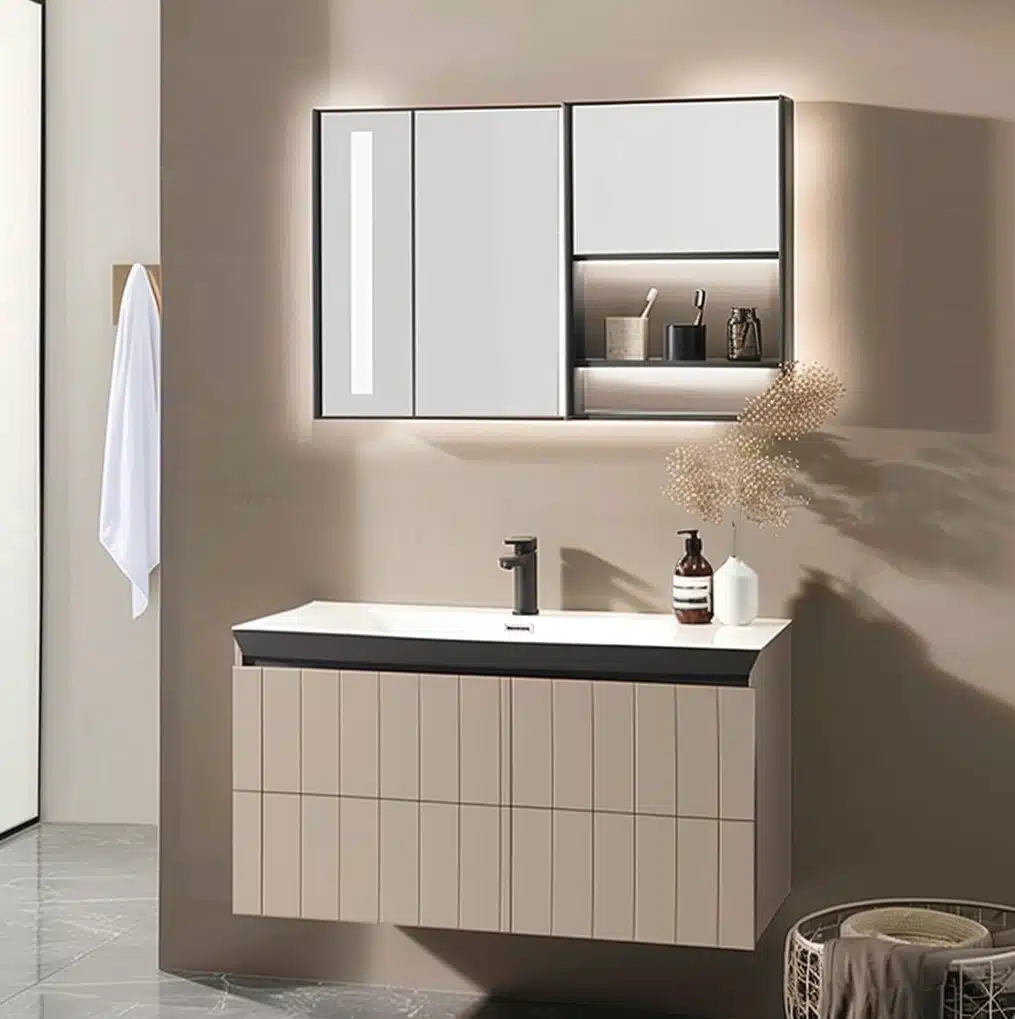
Matching mirrors close the package. Classic mirrors cover budget lines, while smart LED mirrors add adjustable brightness and color temperature, anti-fog heating, and touch control. Hotel operators list those features as standard in modern rooms, and they lift the perceived value of an imported range without adding freight weight.
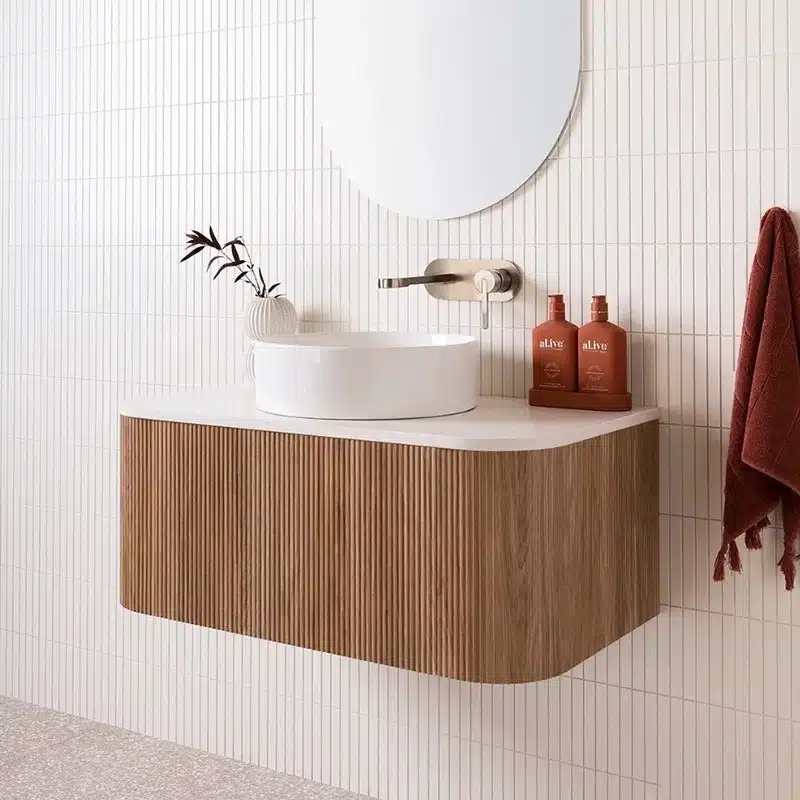
The Oceania-style collection was developed for this exact climate and specification mix. Clean lines, light finishes, and space-efficient storage define the range, and the same units carry the waterproof construction buyers expect. Customization handles the regional touches, with Pantone color matching, logo printing, laser engraving, and custom packaging available on order. A distributor can run the same cabinet body across three projects with three different finishes.
Export-Ready Vanities for the Australian Market
Browse this product, solution, or service page to explore relevant offerings.
Sourcing and Logistics From China
Sourcing terms decide whether the first container is a pilot or a problem. The MFBATH MOQ is 15 sets per model, per color, and per size, which keeps first trials affordable. Mixed container loading means different models and sizes share one container once the total reaches the minimum, so a distributor can test several lines in a single shipment.
The sampling step is designed to remove guesswork. Samples are free and take 10 working days, with freight at the buyer’s cost. That timing lets an importer put a physical unit in front of a specifier before committing to volume.
Bulk production runs 20–30 days after the sample is approved. Payment follows a standard export pattern: a 30% deposit places the order, and the balance is due within one week after receiving the draft bill of lading (draft BL). Goods ship FOB from Qingdao, and the factory arranges the export documentation that customs brokers expect.
Factory scale matters for continuity. Main Focus Cabinet was founded in 2015 in Changge, Henan, operates a 10,000 m² plant with 95 employees, and produces around 5,000 sets per month. More than 1,000 distributors across 20+ countries resell its ranges, which signals that production and shipping routines already exist. For the established North American markets, total delivery runs 4–6 weeks including production and logistics, with real-time tracking on every order.
Customization turns a standard range into a proprietary one. The factory supports 40,000+ custom combinations, including Pantone color matching, logo printing, laser engraving, and custom packaging. The 2025 catalog, more than 100 pages, is free, and it is the fastest way to show a hotel specifier the full lineup.
Plan the first container like a test lab rather than a full commitment. Use the 15-set minimum across two or three models, and reserve the balance of the container for the sizes that sell fastest. That structure returns sales data from the first shipment, which makes the second order far easier to size. Distributors who start with a full program of one model carry the whole risk in one color.
The commercial backstop is equally direct. Every cabinet carries a 2-year warranty on the complete unit, and the documented return rate sits below 1%. For a distributor explaining the supplier story to a project buyer, those two numbers carry more weight than any discount.
Entry Checklist for Your First Container
A first container works when every step has an owner and a date. The checklist below turns the compliance and sourcing sections into one sheet your operations team can follow. Review it before you send the first inquiry, and update it after the sample approval.
Australia Bathroom Vanity Import Checklist
| Stage | Action | Why It Matters |
|---|---|---|
| Compliance mapping | Confirm NCC requirements with the project specifier; check WELS registration for tapware | Avoids border delays and approval rejections |
| Supplier documents | Request CE and UL certificates, ISO records, E1 and CARB reports | Builds an evidence-based shortlist |
| Product selection | Match PVC, plywood, or sintered stone to moisture and heat exposure | Aligns the range with the project climate |
| Sample approval | Order free samples; allow 10 working days; freight at your cost | Physical check before volume |
| Order terms | 15-set MOQ per model, color, and size; 30% deposit; balance after draft BL | Predictable cash flow |
| Production window | Reserve 20–30 days for bulk production; confirm inspection dates early | Keeps the schedule honest |
| Quality control | Rely on 5 in-house checks per cabinet; book SGS or TÜV inspection ahead | Independent evidence for buyers |
| Shipping | FOB Qingdao with mixed container loading; plan the ocean leg to Australian ports | Controls landed cost and timing |
Quality control is the layer buyers cannot see from a catalog. Every cabinet passes 5 in-house checks before packing, and third-party inspection by SGS or TÜV can be arranged when the production date is set. Book inspection early, because the schedule works only when the inspector’s visit matches the production window.
Documentation planning should include the next market as well as this one. Distributors who later extend the same line to the United States face state-level rules such as California’s Prop 65, and the Prop 65 for vanity imports guide covers that layer. Keep the certificate folder organized from the first container, and every future market becomes cheaper to enter.
The 2025 product catalog, more than 100 pages, works as a pre-sale document. Send the relevant pages with the quotation so the specifier sees the full lineup before the sample arrives. The free sample then confirms the physical quality that the catalog can only suggest.
Your Route Into the Australian Market
The route into Australia follows five steps, and none of them depends on luck. Map the compliance layer first: NCC basics for the project and WELS registration for any tapware. Shortlist factories that answer documentation requests from the first email, because that behavior predicts the whole working relationship.
Select products against moisture and heat exposure rather than against catalog photos. Run the free sample step and put the unit in front of your specifier. Place the first container at the 15-set minimum with mixed loading, and use the 20–30 day production window to schedule third-party inspection.
This order of operations keeps the first shipment small, documented, and on time. It also builds a supplier track record you can present when the second, larger order comes up. The market rewards importers who arrive with evidence and leave with a repeatable template.
Frequently Asked Questions
Do bathroom vanities need WELS registration in Australia?
WELS registration applies to water-using products such as taps, showers, and toilets, not to the cabinet itself. If your range includes tapware, plan registration for those fittings before the first launch.
What is the minimum order for the first container?
The minimum is 15 sets per model, color, and size. Mixed container loading lets you combine different models and sizes, so one first shipment can test several lines against a single minimum.
How long does sample and bulk production take?
Free samples take 10 working days, with freight at your cost. Bulk production runs 20–30 days after approval, and the ocean leg from Qingdao is planned with your freight forwarder.
The Bottom Line
The Australian market rewards importers who bring documented, moisture-proof vanities in the right sizes. The compliance map is clear, the entry order is small, and the supplier evidence is ready. Start with the free sample, confirm the paperwork, and the first container becomes a template for the whole region.




0 Comments