


A bathroom vanity quotation looks simple until freight, duty, and port charges get added on top. The same cabinet can land at your warehouse for $290 or $610 depending entirely on order size and routing, and suppliers rarely volunteer that math. A disciplined bathroom vanity landed cost calculation is the only reliable way to compare a small trial against a full container. This guide lays out the complete formula, then runs two labelled worked examples: a 15-unit trial that matches the factory’s Minimum Order Quantity (MOQ), and a 500-unit ocean shipment. Every rate below is nominal — a worked example, never a quote — so you can swap in live numbers and see which scenario your cash flow actually supports.
The Landed Cost Formula for Bathroom Vanity Imports
A bathroom vanity landed cost calculation captures everything you spend to move one sellable unit from the factory floor into your warehouse. Six components build it, and leaving any one of them out is how margin surprises happen.
Landed cost = product cost + freight + insurance + duties + port and drayage charges + inspection and miscellaneous costs
- Product cost — the FOB unit price multiplied by quantity. These worked examples hold the cabinet at a nominal $220 per set in both scenarios so the comparison isolates logistics. Real prices move with material, size, and volume tier.
- Freight — the largest swing factor in the whole equation. Air and express bill on chargeable weight; ocean bills per container or per cubic meter (CBM). The dimensional math behind that choice comes next.
- Insurance — cargo cover typically prices around 0.2–0.5% of declared value (nominal), often with a minimum premium that stings small shipments disproportionately.
- Duties — the tariff assessed on the customs value of the goods. Wooden bathroom vanities entering the US usually classify as furniture under Harmonized System heading 9403; confirm the exact line and rate in the Harmonized Tariff Schedule (HTS) before committing. One nuance worth knowing: US duty assesses on FOB value with freight excluded, while the EU assesses on CIF value with freight included.
- Port and drayage — origin-side terminal and documentation charges sit with the factory under FOB terms; destination terminal handling, chassis, and inland trucking sit with you.
- Inspection and miscellaneous — third-party pre-shipment inspection, sample freight, and bank fees. No single line is large; together they are real money.
MFBATH quotes FOB (Free On Board) Qingdao. Under that term the factory delivers the goods on board the vessel at Qingdao Port and covers everything that happens before that moment: inland trucking, export documentation, and origin port charges. The ocean leg, insurance, import duty, and destination drayage belong to the buyer. If you would rather have the supplier own the entire journey, that is a DDP conversation, and the comparison of FOB vs DDP for vanities maps when each term pays off.
Payment terms belong in a landed-cost model because they decide when cash leaves your account. The factory terms are a 30% deposit on order, with the balance due within one week of the draft BL (Bill of Lading). Samples take 10 working days; mass production runs 20–30 days. On US, Canada, and Mexico lanes, total door-to-door timing typically lands at 4–6 weeks with real-time logistics tracking, and duty hits at import clearance — weeks after the balance is already paid.
Treat the formula as a worksheet with one column per order scenario. Enter the supplier’s FOB quote in the product row, your forwarder’s rate in the freight row, and leave duty as a placeholder cell until you pull the live HTS rate for your exact classification. Two common errors corrupt the output. The first is quoting freight for the wrong Incoterm — a CIF freight quote double-counts insurance that FOB buyers must arrange themselves. The second is forgetting destination charges entirely. Port congestion, chassis fees, and detention can add hundreds of dollars per container in a busy season, and none of them appear on a factory quotation.
Carton Dimensions and Volumetric Weight Explained
Carriers bill freight on whichever measure earns them more: actual weight or volumetric weight. For bathroom vanities — bulky, foam-padded, awkwardly shaped — volumetric weight almost always wins, and that single fact reshapes the whole landed-cost picture.
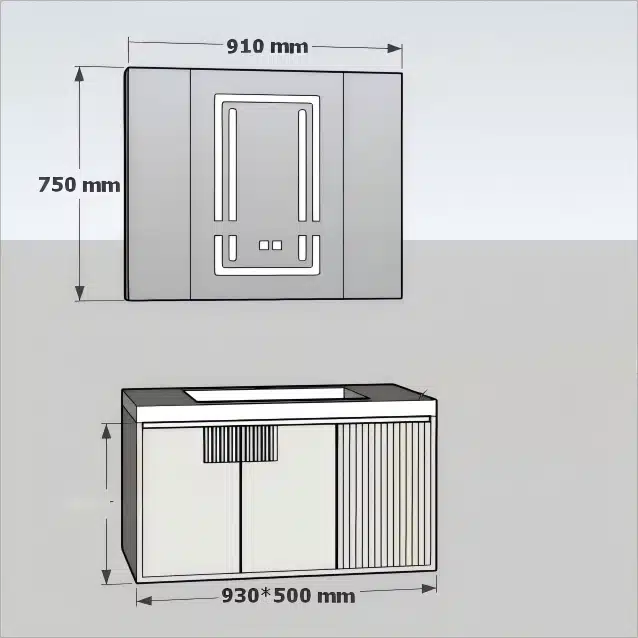
Volumetric weight, also called dimensional weight, converts the space a carton occupies into billable kilograms. Air carriers divide cubic centimeters by 6,000. Take a 36-inch vanity cabinet packed in a 100 × 55 × 65 cm carton. That is 357,500 cubic centimeters divided by 6,000 — 59.6 kg of volumetric weight. If the carton actually weighs 45 kg (nominal), the airline bills on 60 kg. You pay freight on 15 kg of protective air. Express couriers often divide by 5,000 instead of 6,000, which pushes the billable weight of that same carton to 71.5 kg. The divisor changes; the principle does not.
This is why packaging engineering is a freight decision, not only a damage decision. Thinner foam, nested components, or knock-down construction all shrink carton volume — but only if cabinets still arrive intact. The guide to bathroom vanity packaging costs breaks down those trade-offs.
Ocean freight uses a different ruler. FCL (Full Container Load) bills per box regardless of weight up to payload limits; LCL (Less than Container Load) bills per cubic meter. The same 100 × 55 × 65 cm carton occupies 0.36 m³. Fifteen cartons fill roughly 5.4 m³ of a consolidation; five hundred fill about 180 m³, which translates to three 40-foot high-cube containers. Dimensional math decides which mode fits before you ever request a rate, and the primer on LCL vs FCL vanity container loading covers the break-even logic. The overview of shipping bathroom vanities maps the full door-to-door route.
Worked Example for a 15-Unit Trial Order
Scenario one: you want to validate a new 36-inch model with real customers before committing serious capital. The factory’s MOQ is 15 sets per model per color per size, unified across all product lines, so a 15-unit order is not a special favor — it is the standard entry point. A trial at exactly that quantity buys sellable inventory to photograph, display, and ship to a pilot customer, not just a sample collecting dust in a showroom. If you have never held the product, the sequence runs sample first — the factory quotes 10 working days for samples — then the 15-set trial, then volume.
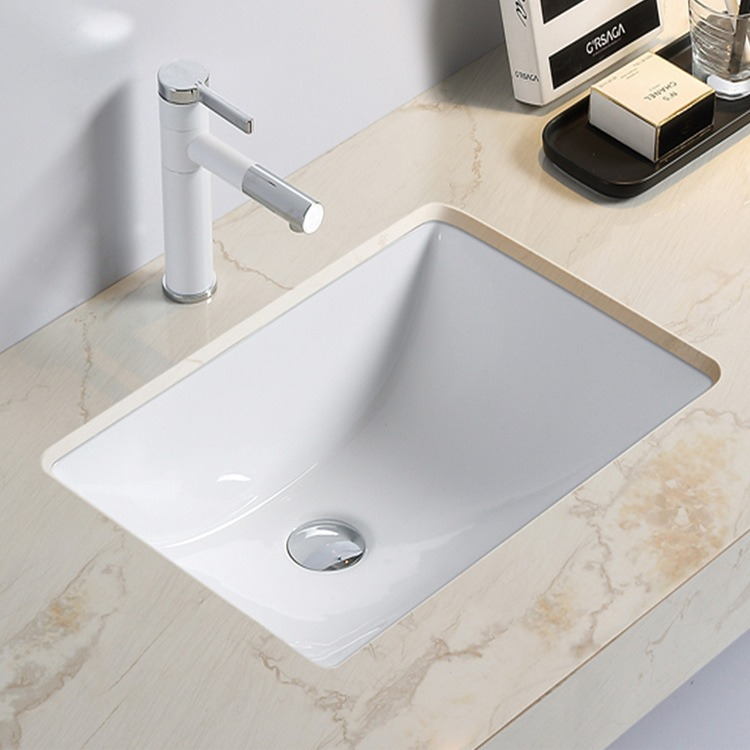
Route the trial by air or express and the math turns uncomfortable. Fifteen cartons at 59.6 kg of volumetric weight each give roughly 894 kg of chargeable weight. At a nominal air rate of $4.5–5.5 per kg, freight lands between $4,000 and $5,000 — call it $4,500. The freight line now exceeds the entire product value of $3,300 (15 sets at a nominal $220). Express couriers price still higher per kilogram but bundle door-to-door delivery and customs clearance, which can earn their premium when a launch date is fixed.
The slower, cheaper path is LCL sea freight. The same 5.4 m³ travels in a consolidation for a nominal $650–1,350 all-in with origin and destination local charges — roughly a quarter of the air figure. The price paid instead is time: the same 4–6 week door-to-door window the factory quotes for its North American lanes, plus a few days of CFS (container freight station) handling at each end.
Build the air-trial landed cost line by line, every figure nominal: product $3,300; freight $4,500; insurance $50 minimum premium; duties as a placeholder — apply your actual tariff rate to FOB value, illustrated here at 20% for $660; destination handling $200; third-party pre-shipment inspection $400. The total comes to roughly $9,110, or about $607 per set. Some buyers skip inspection on a trial to save that $400. The factory runs five inspection checkpoints on every unit and welcomes third-party inspection arranged in advance, so keeping it in the plan is cheap protection against a bad surprise.
Worked Example for 500 Units on Sea FCL
Scenario two: the same 36-inch cabinet, now a reorder of 500 sets. The volume is 500 × 0.36 m³, about 180 m³. A 40-foot high-cube container realistically loads around 60 m³ once pallets and stacking limits are accounted for, so the order travels in three FCL boxes. Each container is sealed at the factory and opened at your dock — no shared space, no consolidation handlings, and the lowest damage exposure of any mode covered here.
Before booking, request the factory’s container loading plan: a carton-by-carton map showing how each of the three boxes fills. A written plan catches oversize pallets and weight limits before they become rework fees at the port, and it doubles as the document your broker needs for the manifest.
Ocean freight flips the unit economics. Budget a nominal spot rate of $3,500 per 40-foot high-cube from Qingdao to the US West Coast — live rates swing hard, so check the Freightos Baltic Index or the Drewry World Container Index before you commit. Three containers cost $10,500, which divides to $21 per set. The cabinet that absorbed $300 of air freight in the trial now absorbs $21. That is per-unit freight dilution at work: a container costs roughly the same whether you fit 100 cartons or 170, so every extra carton loaded pulls down the freight burden on all of them.
Run the same bathroom vanity landed cost calculation at 500 units, nominal throughout: product $110,000 (500 × $220, held identical to scenario one); freight $10,500; insurance $350; duty placeholder at the same illustrative 20% of FOB value for $22,000; destination drayage and port charges $1,400; one pre-shipment inspection $400. The total comes to roughly $144,650, or about $289 per set. In a real negotiation the unit price would likely step down at this volume too — the breakdown of bathroom vanity unit price tiers shows how pricing moves with quantity — which only widens the gap.
Side-by-Side Comparison of the Two Scenarios
Every number below is a nominal worked example — planning arithmetic, not a quotation. Swap in your live freight rate, your actual tariff line, and your real unit price before spending a dollar.
| Line Item | 15-Unit Trial (Air) | 500-Unit Order (Sea FCL) |
|---|---|---|
| Order quantity | 15 sets — matches the factory MOQ | 500 sets |
| Freight mode | Air freight, billed on volumetric weight | Sea FCL, three 40-foot high-cube containers |
| Product cost (nominal) | $3,300 ($220 per set) | $110,000 ($220 per set) |
| Freight (nominal) | $4,500 (about $300 per set) | $10,500 (about $21 per set) |
| Insurance (nominal) | $50 minimum premium | $350 (about 0.3% of value) |
| Duties | Placeholder: actual HTS rate × FOB value (illustrative 20% ≈ $660) | Placeholder: same method (illustrative 20% ≈ $22,000) |
| Port and drayage (nominal) | $200 destination handling | $1,400 across three containers |
| Inspection (nominal) | $400 third-party pre-shipment | $400 third-party pre-shipment |
| Per-unit landed cost (nominal) | ≈ $607 per set | ≈ $289 per set |
The product line barely moves between the two columns; logistics and fixed costs do all the damage. The trial pays about $607 per set for the privilege of committing only $3,300 of inventory money. The container pays about $289 because freight, inspection, and drayage dilute across 500 units instead of 15.
Ready to Run Your Own Landed-Cost Numbers?
Browse this product, solution, or service page to explore relevant offerings.

Mixed SKUs and Basin Co-Loading Strategy
Few buyers order 500 identical cabinets, and MFBATH does not require it. Mixed-container loading is supported: different models and sizes share one container, with the MOQ of 15 sets per model per color per size met in aggregate. A 500-set program can split across three finishes and two widths, with basins and mirrors soaking up the remaining space.
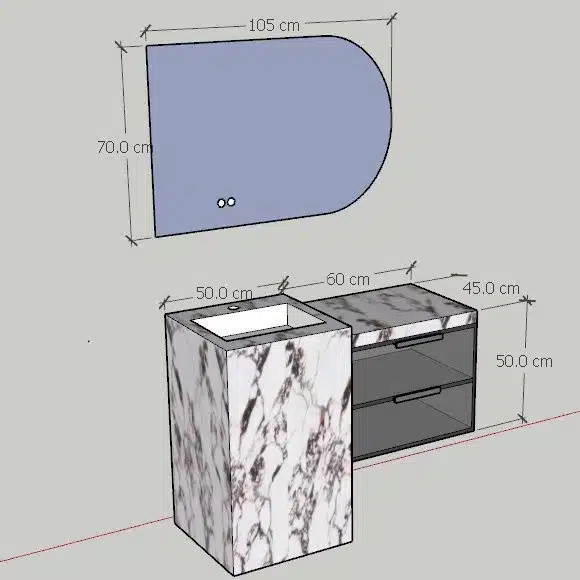
Co-loading shifts the landed-cost arithmetic in your favor. Freight bills per container no matter what sits inside, so every basin packed into dead space above a cabinet is sellable value riding on freight you already paid. Dense items such as sintered stone basins raise the value per cubic meter of the whole box. Ask the supplier for a loading plan against the technical drawings before booking; carton dimensions on paper are what make the volumetric math in this article reproducible for your own orders.
Documentation follows the packing. A mixed container needs a packing list broken down by SKU — model, color, size, carton count, and position — so customs brokers can map every unit to its tariff line and your receiving team can check stock without opening every box. Vague manifests slow clearance and invite inspection holds. Ask for the breakdown up front; a supplier confident in mixed loading produces it without hesitation.
Routing matters as much as packing. The factory’s logistics program claims roughly 15% freight savings for US, Canada, and Mexico customers versus booking spot rates independently, and shipments carry real-time tracking across the 4–6 week door-to-door window. Whatever supplier you shortlist, ask them to show that math in writing before you accept freight as part of the deal.
Making the Decision Between Trial and FCL
The two scenarios answer different questions. The trial asks whether this model sells in your market; the container asks what your steady-state margin looks like. Running the 15-unit trial makes sense when the SKU is unproven, when a customer or listing needs physical stock quickly, or when you are qualifying a new supplier’s quality with your own inspection. Jumping to FCL makes sense once demand is validated. The nominal math here drops per-unit landed cost from about $607 to $289, and almost all of that gap is freight and fixed-cost dilution.
Run the trial when any of these apply:
- The SKU has never sold in your market and demand is a guess, not a number.
- A retailer, project, or listing needs physical stock within weeks rather than months.
- You are qualifying a new supplier and want your own inspection evidence before scaling.
- Your cash position caps inventory spend — the trial commits about $3,300 of product money in the worked example, versus $110,000 for the container.
Jump to FCL when these hold instead:
- Demand is validated by real sales, and the open question is margin, not interest.
- Your sell-through clears 500 units within a sensible restock window, so the stock will not age in a warehouse.
- The freight dilution math flips the unit economics — about $318 of landed-cost difference per set between the two scenarios in this example.
- You can use mixed-container loading to spread the MOQ of 15 sets per model per color per size across an assortment rather than one bet.
Key takeaways:
- Landed cost has six components: product, freight, insurance, duties, port and drayage, and inspection. Miss one line and the margin disappears with it.
- Volumetric weight rules air freight: a 100 × 55 × 65 cm vanity carton bills at about 60 kg even when the scale reads 45 kg.
- The nominal examples put a 15-unit air trial at roughly $607 per set against $289 for 500 units on sea FCL. The trial buys speed and low commitment, not cabinets.
- An MOQ of 15 sets per model per color per size with mixed-container support means a trial can test a full assortment, and FOB Qingdao keeps origin-side costs on the factory’s books.
Rebuild the bathroom vanity landed cost calculation with your own freight quote, your tariff line from the Harmonized Tariff Schedule, and your target retail price, and the decision usually makes itself. If the numbers hold, the next step is choosing the assortment worth loading — explore the cabinet range before you request a loading plan.
Frequently Asked Questions
Is air freight ever the right choice for a bathroom vanity trial?
Yes, when speed outranks cost. If a launch date, showroom opening, or first customer cannot wait out a 4–6 week ocean transit, air moves 15 units in days. Expect freight to rival product value — about $4,500 against $3,300 of cabinets in the worked example. LCL sea is the cheaper middle path when the timeline allows.
What exactly does FOB Qingdao cover?
FOB — Free On Board — means the factory delivers the goods on board the vessel at Qingdao Port and pays everything up to that point: inland trucking, export clearance, and origin charges. You cover ocean freight, insurance, import duties, and destination drayage. Separately, payment runs 30% deposit on order, balance within one week of the draft Bill of Lading.
How can I lower per-unit landed cost without overcommitting?
Three levers. Co-load basins, mirrors, or accessories into dead space so more sellable units share one container rate. Consolidate mixed SKUs so the MOQ of 15 per model per color per size is met in aggregate. Ask about the supplier’s logistics program — the factory’s program claims around 15% freight savings on US, Canada, and Mexico lanes.





0 Comments