

You ordered a container of bathroom mirrors, and the units looked right in the showroom photos. Then the first install crew calls: black lines creeping in from the edges, coating flaking behind the glass, faces that warp when you stand at the sink. These are not cosmetic nits; they are the visible results of skipped bathroom mirror quality inspection at the factory, and they turn into chargebacks, reorders, and damaged distributor relationships. This guide walks through the inspection points that matter most: edge work, coating structure, face defects, factory QC flow, sampling, and packing. You will learn what to check, why each check exists, and how to verify it before your container ships.
Key Takeaways
- Every mirror passes five inspection gates before packing: glass, coating, edge work, face, and packaging. The gates cover classic and smart LED mirrors alike.
- The quality system has been ISO 9001:2015 certified since 2017, and the certificate was confirmed current in 2025.
- Returns across the range stay below 1%, backed by a 2-year warranty on full containers.
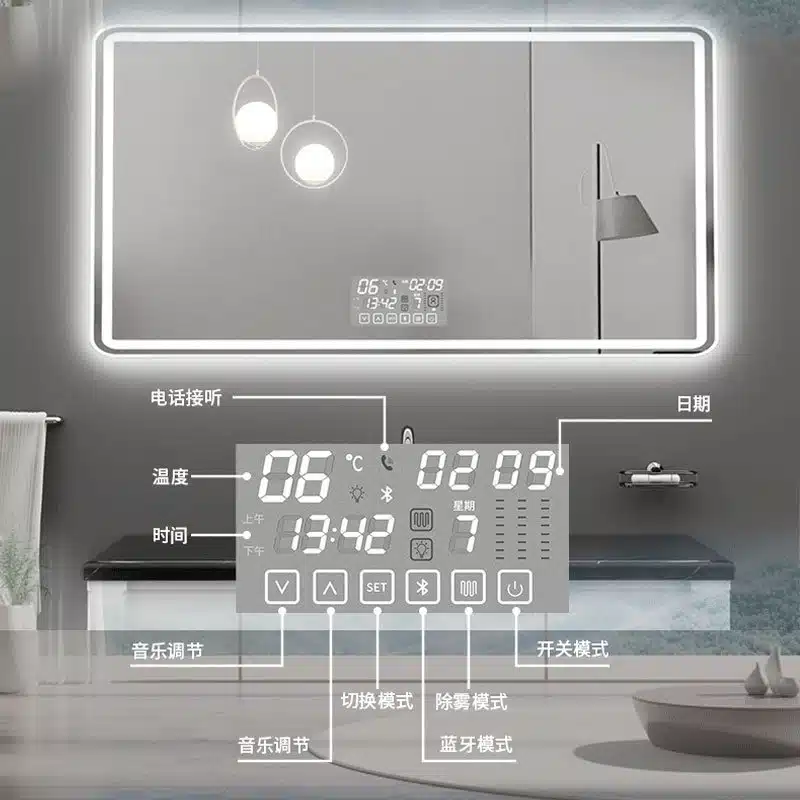
- Classic mirrors ship from 24×36 to 48×72 inches; smart LED mirrors add anti-fog heat, touch control, adjustable brightness, and color temperature.
- MOQ is 15 sets per model, color, and size. Samples take 10 working days; production takes 20–30 days; US, Canada, and Mexico delivery runs 4–6 weeks.
- SGS and TÜV third-party inspection are supported, but slots must be booked at order time.
Table of Contents
- What Mirror Quality Problems Actually Cost
- Edge Work: What to Inspect on Cut and Polished Edges
- Coatings That Decide Mirror Lifespan
- Face Defects and How Inspectors Catch Them
- The 5-Point QC Flow Inside a Mirror Factory
- Sampling Plans and Third-Party Inspection
- Packing That Survives Long Transit
- Frequently Asked Questions
- The Bottom Line
What Mirror Quality Problems Actually Cost
Picture the scene. A distributor receives 400 mirrors, signs the delivery note, and sends the units to retail. Three months later the complaints start: a grey-black line eating along the bottom edge, paint flaking behind the glass, and a face that shifts when you step side to side. Every complaint costs more than the mirror it is about.
Distortion is the quiet failure. A mirror has one job: return a true image. When the glass waves or the coating is uneven, the end user notices within seconds, and the unit comes back. In hotel projects, a failed mirror means a room out of service, a call-back crew, and a schedule penalty for the contractor.
Black edge is the slow failure. It starts at a cut edge where humidity reaches the silver layer, then spreads inward month by month. The mirror looks clean at the dock and fails in the second year, inside the warranty window. The 2-year warranty covers full containers, and the below-1% return rate only holds when the QC gate actually catches this.
Coating peel is the visible failure. Back paint lifts, silver dulls in patches, and the reflection turns cloudy. None of these defects appear in showroom photos, and all of them appear under a pointed inspection light. That gap is what this guide closes: what to check, where to check it, and how to make sure the check happens before your container leaves the factory.
Engineers read mirrors the way lawyers read contracts: slowly, and from the edge inward. The inspection habit pays off at the container door, where a rejected unit costs freight in both directions. It pays off again at the retailer, where a silent failure stays silent for months.
Edge Work: What to Inspect on Cut and Polished Edges
The edge is where most mirrors die. Cutting glass exposes the silver layer, and every chip, scratch, or uneven polish on that edge is an entry point for humidity. Edge work comes in two families: flat edges and polished edges. A flat edge is a straight cut with grinding marks; a pencil edge adds a rounded profile; a bevel edge cuts a slanted face. Each profile needs its own acceptance check.

Check the chips first. Pass all four edges under a bright light, then inspect the corners with a magnifier. Chip-outs cluster at corners, where the wheel exits the cut. Agree the maximum chip size with your supplier before production, not after arrival. The limit belongs in the PO, and the limit sample belongs on the factory floor.
Check grinding uniformity next. A clean edge shows consistent surface, no deep wheel marks, no burnt spots. Run a fingertip test with gloves on: the edge should feel continuous. Any snag point is a crack starter under transit vibration.
Know what the standard does not cover. ASTM C1503, Standard Specification for Silvered Flat Glass Mirror, covers mirrors that have had no further processing, which means edge work falls outside its scope. Once a mirror is cut and edged, your PO spec is the standard. If your spec is silent, your inspector has nothing to enforce.
The consequence is measurable. A chipped edge breaks in the carton, and a broken mirror costs three times its price: the unit, the freight, and the claim handling. A clean, uniform edge costs nothing extra to specify. Skip the edge check and you are betting a container on a corner protector.
A polished edge gets one extra check: continuity of the polish line. A bevel should show the same width from corner to corner, and a pencil edge should show the same radius along its full length. Tape a straight edge against the profile and look for gaps. Uneven profiles do not break the mirror today; they concentrate stress at the thinnest point, and transit finds that point.
Coatings That Decide Mirror Lifespan
A silvered mirror is a sandwich. Float glass on the front, then a silver layer, then a copper layer, then back paint. In a standard silver mirror, the copper layer protects the silver during processing and improves adhesion. In a copper-free mirror, a protective alloy layer replaces the copper, removing the material that corrodes fastest at cut edges.

Black edge is a coating problem, not a glass problem. When humidity reaches the silver through a cut edge or a back-paint pinhole, the silver corrodes and the mirror goes grey at the boundary. The fix is structural: sealed edge treatment, solid back paint, and copper-free mirror construction in wet climates.
Back paint is the armor. Two coats on the rear keep humidity off the silver, and adhesion matters as much as coverage. A tape test on a sample — press, pull at a right angle, check for lifting — tells you more than a coating certificate. Ask for the test result, not the brochure line.
Read the standard’s own warning. ASTM C1503 says standard silvered mirrors are not intended for environments where high humidity or airborne corrosion promoters are consistently present. Swimming pool areas, coastal bathrooms, and unvented hotel baths all match that profile. If your market does, copper-free construction is the engineering answer, not an upgrade.
Smart LED mirrors add a second system. Anti-fog heaters, touch controllers, and LED drivers sit behind the same silvered glass, and they bring electrical risk alongside optical risk. MFBATH holds CE and UL certification for that side of the product, and every unit runs the same five gates as a plain mirror.
Ask the factory one question: what is the coating stack, and what is the edge treatment? A direct answer means the process is documented. A vague answer is the answer.
Face Defects and How Inspectors Catch Them
Face defects split into point blemishes and linear blemishes. Pinholes and bubbles are points; scratches and hairline marks are lines. Then there is distortion — ream, string, and line distortion — which bends the reflection without leaving a mark you can touch. ASTM C1036, Standard Specification for Flat Glass, sets out the blemish and distortion appraisal methods that inspectors use.
Catching points and lines is a light game. Inspectors view the face under controlled light at an angle, in a darkened room, so imperfections catch the light against the dark backing. The front gets checked at several angles, and the viewing zone — where a person actually looks — gets the strictest pass.
Catching distortion is a geometry game. Hold a straight reference — a grid, a straight edge, a window frame — in the reflection and sweep it across the face. A true mirror keeps the line straight. A wavy mirror bends the line as it crosses the defect zone.
Turn the mirror over for the rear check. Back paint should be continuous, with no bare patches, pinholes, or rust-colored staining where moisture has already worked in. Edge sealant, where specified, should run the full perimeter without gaps. Rear defects cost nothing to catch at the factory and a full claim after arrival.
Sampling reality: no factory inspects every square inch of every mirror at full intensity. Zones are graded, with the center viewing area checked harder than the margins. Standards define how far from the edge a blemish may sit. Your job is to agree the grade before production and let the inspector enforce it.
Ask for limit samples. A physical sample showing the worst acceptable pinhole, the worst acceptable scratch, and the worst acceptable wave settles more arguments than a paragraph of text. Keep one set at the factory and one at your office.
Mirrors Built to Pass Inspection
Browse this product, solution, or service page to explore relevant offerings.

The 5-Point QC Flow Inside a Mirror Factory
MFBATH runs five inspection gates on every mirror that leaves the floor, and the gates are identical for a plain 24×36 mirror and a touch-control LED unit. An inspector at any gate has stop authority: a mirror that fails does not move to the next step. Every gate is documented, and every gate has a named owner. That is the difference between a checklist and a system.
- Gate one, incoming glass: thickness, flatness, and blemish level are checked against the grade ordered.
- Gate two, coating: silver and back-paint layers are verified during the line run, with adhesion checks on samples.
- Gate three, edge work: the checks from the section above run on every cut edge.
- Gate four, face: the final visual pass under controlled light, front and back.
- Gate five, packaging: carton, foam, corner protectors, and labeling are confirmed before staging.
The system behind the gates is ISO 9001:2015 certified, first achieved in 2017 and confirmed current in 2025. The requirements it follows are published by ISO as ISO 9001:2015, Quality management systems — Requirements, and the certificate is audited, not assumed. A certified system does not make defects impossible; it makes them findable. That distinction separates documented QC from a sticker on the wall. Our ISO 9001 certified quality system is open to the same scrutiny on a factory visit.
The five gates sit inside a 10,000 m² plant with 95 staff and a monthly capacity of 5,000 sets. QC is a fixed cost here, not a bottleneck, and it applies to every product line, not just mirrors. The same discipline that holds vanity returns below 1% runs the mirror line.
Smart LED mirrors run the same gates plus electrical checks: insulation, driver function, anti-fog heater, and touch response. The electrical side holds CE and UL certification, and the optical side follows the same standard as the plain mirror. Both systems get checked before the unit is packed.
You can verify the flow before you commit. Samples ship in 10 working days and travel the same five gates as production units. The bathroom mirror collection page lists the sizes and options that run on this line. If a factory cannot show you its gates, ask yourself what it is hiding.
Sampling Plans and Third-Party Inspection
You do not need to inspect every unit yourself. That is what sampling plans are for. Mirror factories work to industry-standard sampling: a defined number of units drawn from the batch, checked against agreed criteria, and accepted or rejected on the defect count found. The exact plan numbers belong in the inspection contract, and a serious factory will tell you its plan without hedging.
The third-party route is the one that holds up in a dispute. SGS and TÜV inspectors can run pre-shipment checks at the factory, and MFBATH supports their visits. Slots are booked in advance, so schedule them at order time, not the week before loading. An independent report turns a warranty argument into a paperwork exercise.
A third-party inspection covers seven things: carton count and marking, sample drawing, and a dimensional check against the approved drawing. Then come the quality steps: a light pass for face defects and edge work against the limit samples. LED function tests run when the order includes them, and packing gets confirmed before the container door closes. The same structure runs in our five-stage inspection process for vanities, and it works for your own visits between orders.
The audit route goes deeper. A factory audit covers documents, line observation, and test records — the things a pre-shipment inspection never sees. Pair an annual audit with per-shipment inspection and you have a control loop. Run neither and you have faith. The factory audit checklist for importers shows exactly which documents to pull.
One warning: a bathroom mirror quality inspection only finds what the sampling plan looks for. If the scope does not cover black-edge potential or distortion, a clean report means nothing for those risks. Write the risks into the scope of work, then book the inspector.
Packing That Survives Long Transit
Mirrors break in transit when the box design ignores physics. Glass is strong in the face and fragile at the edge, so packing isolates the edges and the corners. Foam cushions the face, corner protectors shield the highest-risk points, and a rigid carton spreads impact across a larger area. Every mirror at MFBATH gets these elements inside the fifth QC gate.
Orientation is the part buyers ignore. Mirrors ride upright in the carton and in the container, never flat under other cargo. A flat mirror under two hundred pounds of vanities is not a packaging problem; it is a decision. Mark the cartons clearly, where the forklift driver will see them.
Long transit adds humidity cycles. A container crossing the equator heats and cools, and condensation forms inside the carton. The back paint and edge treatment from the coating section are what survive this. Packaging cannot fix a coating that was wrong at the factory.
Ask whether the carton design was validated against a recognized transit test protocol. A factory that ships mirrors weekly has claim data, and it should be willing to share the rate. At MFBATH, the return rate across the range stays below 1%, and packaging design is part of that number.
Check the loading, not just the carton. MFBATH confirms packing in the final gate before staging, and the same logic applies on your side. Photograph the container floor, watch the first rows go in, and verify upright loading before the truck leaves.
The packing spec belongs in the PO, same as the edge spec. Carton construction, foam density, corner protection, and orientation: if they are written down, they get inspected. If they are not, they get assumed.
Frequently Asked Questions
What causes black edges on bathroom mirrors?
Black edge is silver corrosion. Humidity reaches the silver layer through a cut edge or a back-paint pinhole, the silver oxidizes, and a grey-black boundary spreads inward over months. Copper-free construction and sealed edge treatment prevent it, and the copper-free versus standard silver mirror comparison explains why the coating stack matters. Standard silvered mirrors are not rated for consistently humid environments, so wet-climate markets should specify copper-free.
How do inspectors check mirror distortion before shipment?
With a straight reference. Inspectors reflect a grid or a straight edge in the glass and sweep it across the face; a wavy mirror bends the line. Point and linear blemishes are caught under controlled light at an angle. Both methods trace back to the appraisal methods in ASTM C1036, the flat glass quality standard.
Should I book third-party inspection for a mirror order?
Yes, for first orders and for large containers. SGS and TÜV inspectors verify quantity, dimensions, face defects, edge work, and packing against your agreed criteria, and the independent report strengthens any later claim. Book the slot at order time; MFBATH schedules third-party visits when the PO is placed.
What makes smart LED mirrors different in quality control?
The optical checks are identical, and the electrical system adds a second layer: insulation, driver function, anti-fog heater, and touch response. The LED line holds CE and UL certification for that side. Ask for the electrical test records with the same seriousness you apply to the glass.
The Bottom Line
Skip bathroom mirror quality inspection and you pay twice: once in the claim, once in the account. Edge chips, coating failures, and distortion are all detectable at the factory gate, and all of them get expensive after the container ships. Put the five checks in your PO, keep limit samples at the factory, and book the third-party slot at order time. That is the whole job, and it costs less than one returned container.





0 Comments