
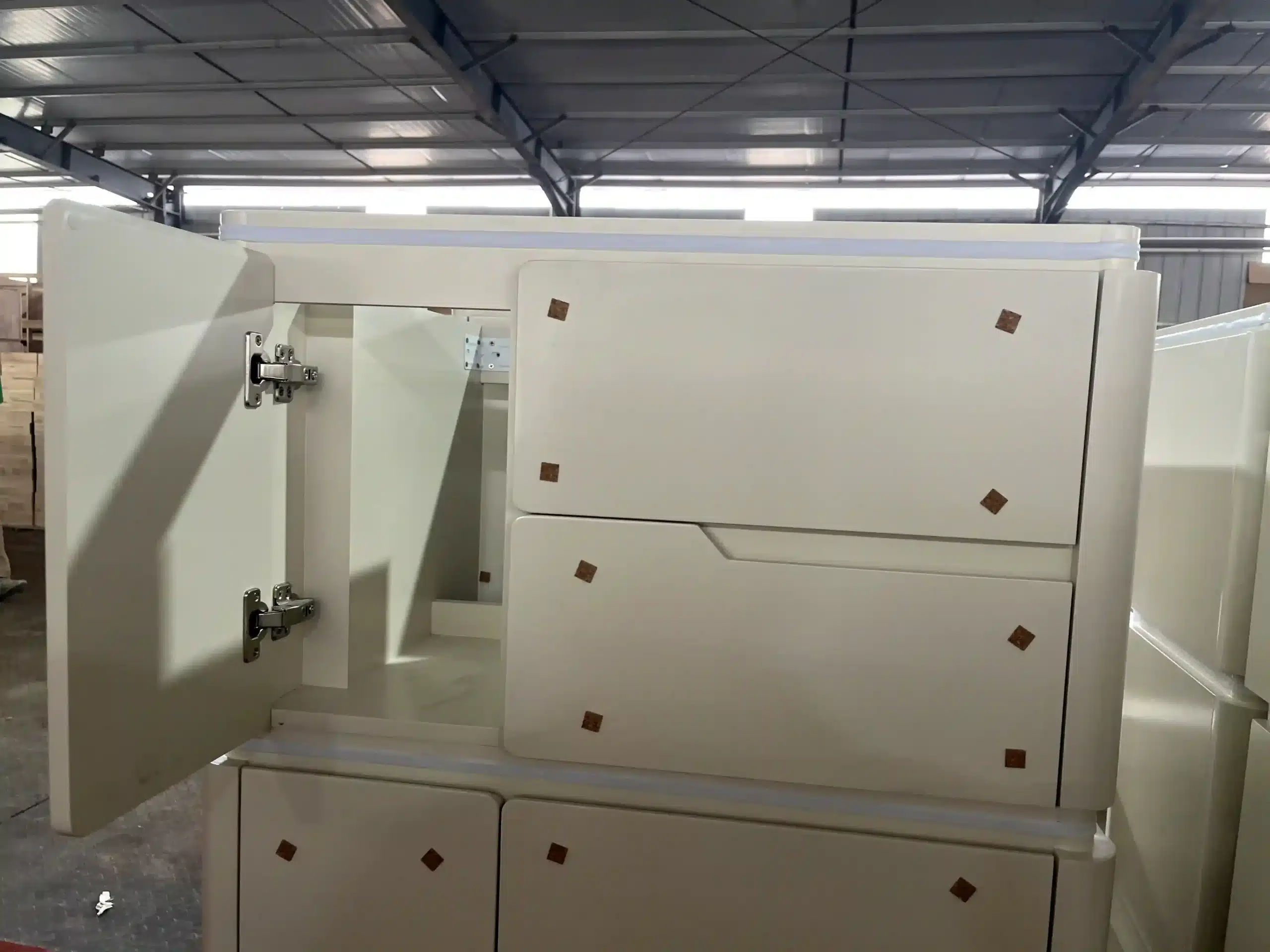
ANSI/BHMA A156.9 is the performance standard behind the words “cabinet hardware” on a vanity spec sheet — and it proves both more and less than most buyers assume. It tests whether hinges, pulls and drawer slides can operate, survive repeated use, carry their rated loads and meet finish criteria under laboratory conditions, grade by grade. It does not test your cabinet box, your drawer construction, or the assembled vanity, and it is not a certification unless the product actually carries one. Requiring it correctly is a matter of writing the clause precisely: which hardware types, which grade, which edition, and what evidence accompanies the claim. BHMA’s own A156.9 highlights page describes the scope; this guide translates it into a vanity-program requirement.
Key Takeaways
- A156.9 tests the hardware — hinges, pulls, slides — for operation, cycle life, strength and finish; it does not test your cabinet box or the assembled vanity.
- Name the hardware types, the edition (2020 or latest), the grade, and the evidence: independent test report or genuine certification listing.
- Add your program layer separately: load ratings for stone-top drawers, cycles, soft-close retention, and environmental finish testing beyond the standard’s floor.
What the Standard Actually Covers
A156.9 is BHMA’s cabinet-hardware performance standard, sitting inside the ANSI/BHMA A156 series that covers builders hardware generally. Its scope is specific: hinges including concealed and self-closing types, knobs and pulls, catches and latches, shelf rests and standards and brackets, drawer and sliding-door hardware. Its test categories are operational, cycle-life, strength and finish — in plain terms, does the part move as intended, does it keep moving after thousands of operations, does it survive the loads a drawer or door puts on it, and does its surface meet the standard’s finish criteria. The standard distinguishes grades, and drawer slides carry additional heavy-duty classifications for the duty levels a hotel drawer actually sees. The manufacturer is responsible for identifying the applicable type and grade, and the product must meet the tests associated with that claim.
For a vanity program, three hardware families matter most. Drawer slides are judged on repeated cycling under load, operation across their extension, stop and retention behavior, and the strength tests appropriate to their grade — the difference between a slide that cycles smoothly on a showroom sample and one that sags after a season of guest use is exactly what those tests separate. Hinges are judged on deformation under load, operating life through repeated opening, self-closing performance and closing force, and resistance to over-opening — the failure modes of a door that gets swung hard every morning. Knobs and pulls are judged primarily on resistance to applied loads: whether the pull survives a yank without failing or loosening at its mounting. Each of these maps to a daily-use reality in a hotel bathroom, which is why the standard is worth naming even though — precisely because — your guests will never see it.
What It Does Not Prove — the Half That Saves Arguments
The standard’s own scope language makes the limits explicit, and repeating them into your file prevents the most common warranty-side confusion. A156.9 says nothing about whether the cabinet box is structurally sound, whether the drawer box will resist racking and splitting, whether the cabinet sides will hold the slide screws over years of moisture cycling, whether the door panels and mirror and fasteners are adequate, or whether the complete assembled vanity survives shipping, installation and a humid bathroom. It tests the hardware product under laboratory conditions; results in the field vary with installation quality, maintenance and environment, as the standard itself cautions. And a product merely marked “ANSI/BHMA” is not independently certified — certification is a specific program with specific listings, separate from a manufacturer’s compliance claim.
The finish criteria deserve their own caution. A156.9 includes finish-related requirements for the hardware it covers, but that is a hardware-finish requirement, not a corrosion or chemical-resistance specification for a bathroom environment. Humid bathrooms, coastal markets and aggressive housekeeping chemicals demand more: either the companion BHMA finish standard, A156.18, or your own environmental testing — the salt-spray and humidity disciplines our guide to cabinet hardware salt-spray testing describes. Treat A156.9’s finish clause as a floor, and write the environmental layer separately.
Writing the Clause: Edition, Grade, Evidence
A usable A156.9 requirement names four things and omits the rest. First, the hardware types: drawer slides and hinges at minimum, plus pulls if your program uses heavy stone-front drawers — say so in the clause rather than assuming. Second, the edition: the current published edition is A156.9-2020, and BHMA’s published highlights show a newer edition in the works, so the contract should either pin the edition or say “or the latest published edition at the time of manufacture” — the two options behave differently when a revision changes a test, and the choice should be deliberate. Third, the grade: require the supplier to identify the exact type and grade offered for each hardware position — a slide grade that suits a residential drawer may not suit a drawer carrying a stone top, and the heavy-duty classifications exist for precisely that reason. Fourth, the evidence: an independent laboratory test report or a certification listing for the offered model, not a brochure sentence. A clause that reads “Drawer slides and hinges shall comply with ANSI/BHMA A156.9-2020, or the latest published edition, for the specified type and grade; supplier shall identify the type and grade and provide independent test evidence” fits in three lines and closes most of the loophole space.
Then add the program-specific layer the standard cannot know: your load ratings for drawers carrying stone tops, your cycle expectations for hotel duty, your soft-close and retention requirements, your hinge opening angles and adjustment-retention expectations after cycling, and your acceptance limits for looseness, noise and sag at receiving — the acceptance language our guide to soft-close vanity hardware discusses from the user-experience side. The standard tells you the hardware was tested to a grade; your clause tells the supplier which grade your program actually needs.
Grades and the Heavy-Duty Question
The grade system is the part of A156.9 most quotations leave vague, and it is the part that decides whether the hardware matches hotel duty. Within each hardware type the standard defines grades — levels of performance the product must meet for the tests in its category — and drawer slides carry additional heavy-duty classifications for the highest duty levels. The grade is chosen by the manufacturer when they claim compliance, which means the grade only means something when it is declared against a duty level you specified. A slide offered in a standard grade may pass every test in its grade and still be wrong for a drawer carrying a stone top that gets slammed shut forty times a day; the heavy-duty classification exists for exactly that application. When the supplier declares “A156.9 compliant,” your next question is always the same: which type, which grade, tested by whom — and does that grade match the load and cycle expectations you wrote into the program.
Matching grade to application is a two-step exercise. First, characterize the duty: what the drawer carries, how it is used, how many guest cycles a year it must survive, and what failure would cost — a sagging slide in a sold-out hotel is a maintenance ticket, a guest complaint and a room out of service at once. Second, ask the supplier to propose the type and grade for that duty and to say, in writing, why that grade fits. Suppliers who engineer hardware into their cabinets answer that question fluently, because they have already matched grades to their own drawer weights; suppliers who buy hardware by price answer it with silence. The answer pattern is a sourcing signal as reliable as the test report itself — and it costs one email to collect, the same one-question diligence our guides to supplier replies recommend before committing a program.
Verify Like Any Other Claim
A compliance claim on a quotation is a claim until verified, and hardware claims verify cheaply. Ask for the test report or certification listing against the exact part numbers on your order — a report for a similar slide from the same family is not a report for your slide. Check that the report identifies the type and grade your clause requires, that the testing laboratory is identifiable, and that the edition tested matches the edition your contract pinned. Where the supplier claims certification rather than testing, confirm the listing exists on the certifier’s own channel rather than on a logo in a PDF — the same callback discipline our guides to verifying test reports apply to lab evidence. And connect the claim to the physical product: the slide model in the report should be the slide model in the sample you approved and the cartons you receive, with the part numbers traceable through the order documents — the same identifier-matching logic our guide to vanity data sheets builds into the specification itself.
Finally, keep A156.9 in proportion inside the qualification package. It is one line among many: cabinet construction and moisture performance, finish environmental testing, packaging standards, inspection and warranty each carry their own requirements — the standard covers the moving parts, and the moving parts are where hotel vanities live or die in year three, but they are not the whole product. A program that requires A156.9 on the slides and hinges, environmental testing on the hardware finishes, and its own standards on the cabinet around them, has covered the hardware question from both directions: the component’s laboratory performance and the assembly’s real-world survival.
Specifying Vanity Hardware?
Send us your drawer and door schedule. We will match slides and hinges to the duty level — with the standard, grade and evidence named in writing.
The Bottom Line
ANSI/BHMA A156.9 is the right standard to name for vanity drawer slides, hinges and pulls — and it is only as strong as the clause around it. Name the hardware types, pin or deliberately float the edition, require the supplier to declare type and grade, and demand independent test evidence or a genuine certification listing. Then add your own load, cycle and environmental requirements, because the standard proves the component, not the vanity.
Frequently Asked Questions
Does A156.9 certification mean my whole vanity is tested?
No. The standard tests the hardware products — slides, hinges, pulls — under laboratory conditions. Cabinet structure, drawer box construction, moisture performance and the assembled vanity are outside its scope and need their own requirements.
Which edition should my contract reference?
The published A156.9-2020 is the current baseline most spec sheets cite, and BHMA has published information on a newer edition. Either pin the edition for a fixed baseline or write “or the latest published edition at the time of manufacture” — decide deliberately, because a revision can change test details mid-program.
Is a product marked “ANSI/BHMA compliant” automatically certified?
No. Compliance is the manufacturer’s claim that it meets the standard; certification is a separate program with listings you can verify. For critical hardware, ask which one you are getting and verify accordingly.




0 Comments