
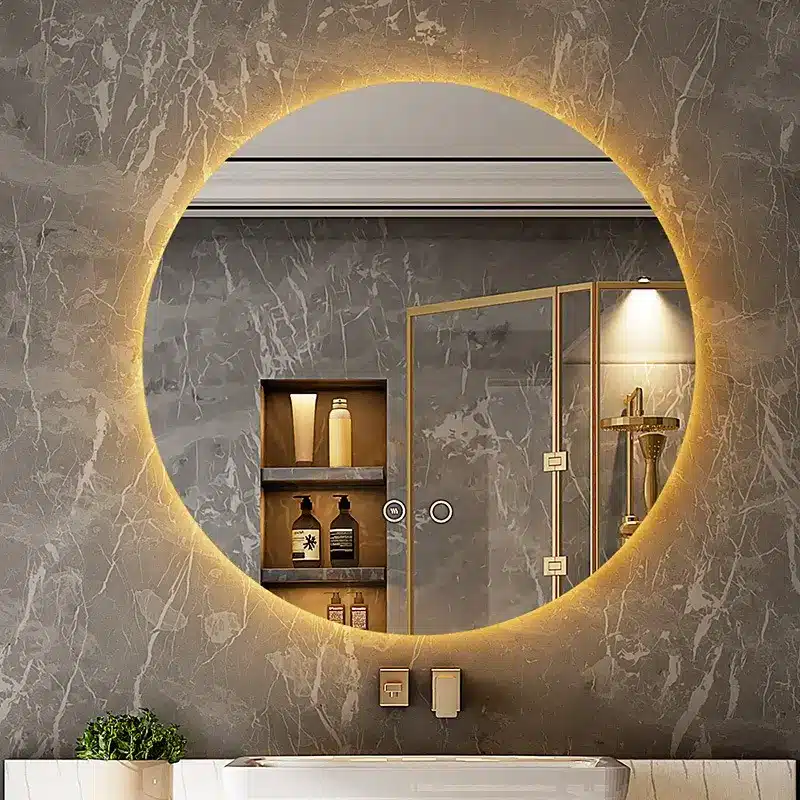
A bathroom mirror looks like a simple purchase until the black edge shows up. Most buyers pick a mirror by its glass, frame, and price, then find out a few years later that the reflective coating on the back corroded under bathroom humidity. A mirror is a composite: glass, a thin reflective layer, and protective paint. The coating system, not the glass, decides how the mirror ages. This guide compares silver and aluminum mirror backings, explains copper-free construction, and gives you a verification checklist for bulk orders. The running example is Main Focus Cabinet (MFBATH), a bathroom vanity and mirror manufacturer in Changge, Henan, founded in 2015.
Every importer who adds mirrors to a vanity program asks the same question: should the specification say silver, copper-free silver, or aluminum? The answer depends on where the mirror hangs and on what the factory can prove about its coating process. This article walks through how mirrors are built, why classic silver backings fail in wet rooms, what aluminum changes, what copper-free silver adds, and which documents and samples to request before you commit to production quantities. MFBATH’s published terms serve as the reference points: free sample support within 10 working days and a minimum order quantity (MOQ) of 15 sets per model, color, and size.
Key Takeaways
- The coating system decides a bathroom mirror’s life: reflective layer, protective paint, and edge seal. Put the backing type in your written specification before the order, not after a black edge appears.
- Classic silver backings tarnish at cut edges when moisture gets behind the mirror; in bathrooms the edge seal and paint coverage matter more than the glass itself.
- Aluminum coatings avoid silver’s tarnish reaction, but reflectivity and moisture resistance vary with the deposition process and the paint system above the layer.
- Copper-free silver targets edge corrosion within the silver family; confirm the construction on the specification sheet, because mirrors look identical from the front.
- Verify with paper and samples: written coating specification, humidity or salt-spray reports when available, free samples within 10 working days, and an MOQ of 15 sets per model, color, and size.
Table of Contents
- Anatomy of a Mirror: Glass, Backing, and Paint
- Why Silver Backings Fail in Bathrooms
- Aluminum-Coated Mirrors: The Humidity-Focused Alternative
- Copper-Free Silver: The Upgrade That Stops Black Edge
- What to Verify Before Ordering Bulk Bathroom Mirrors
- Match the Backing to Market and Price Point
- Frequently Asked Questions
- The Bottom Line
Anatomy of a Mirror: Glass, Backing, and Paint
Think of a bathroom mirror as three layers bonded into one product. The glass substrate carries the shape and the flatness. The reflective coating is deposited on the back surface, so light passes through the glass, bounces off the coating, and returns to your eye. Over that coating, the factory applies protective paint that seals the reflective layer against moisture. When you buy a mirror you are buying that stack, and the weakest layer decides the service life. Two mirrors can look identical on a showroom wall and age completely differently in the same bathroom.
The glass is the least mysterious layer. Most mirror glass is soda-lime glass, the same flat-glass family used for windows and tabletops, and Wikipedia’s article on soda-lime glass documents the composition and the reasons it dominates flat-glass production. Glass contributes flatness, weight, and breakage resistance, not corrosion resistance. Thickness is the specification buyers negotiate, and we cover how mirror glass thickness affects durability in a separate guide because large mirrors are routinely under-specified.
The reflective coating is where suppliers differ. Mirror makers used silver for centuries, laid down on the back of the glass and protected with paint, and the architecture of that stack is what Wikipedia’s mirror construction entry describes. Today the same position is occupied by silver, copper-free silver, or aluminum, applied on wet-chemical or vacuum deposition lines. The differences between the options are small at delivery and large after a few years of bathroom air, so the rest of this guide focuses on the backing rather than the face.
One structural fact drives everything that follows: the reflective coating faces the wall cavity, not the room. Mounted on a bathroom wall, the back of the mirror sits in an air space that carries steam, condensation, and cleaning-product vapors, and moisture reaches the coating at the edges, through mounting holes, or wherever the protective paint is thin. MFBATH’s mirror line runs from 24 by 36 in to 48 by 72 in classics in round, rectangular, and oval silhouettes. In every silhouette the same rule applies: ask the supplier to write down which backing each model carries, because that one line predicts the mirror’s future.
From the front, a new silver mirror and a new aluminum mirror look nearly identical, which is why the backing rarely surfaces in a buyer’s questions until it fails. Add frame, lighting, and packaging to the order and the coating becomes an afterthought. That order of attention is backwards for a product whose working life is measured against steam: the backing is the only layer the buyer cannot see, and therefore the only layer that must be documented rather than inspected. Without it, every mirror in the order carries whatever the production line applied that week.
Why Silver Backings Fail in Bathrooms
Silver is the classic backing because it reflects visible light evenly, which produces the warm, color-accurate image buyers expect from a premium mirror. Its weakness is chemical. Silver reacts with moisture and with sulfur compounds in the air to form dark silver sulfide, and a bathroom concentrates both: steam condenses on every surface, and cleaning products release vapors that a living room never sees. The corrosion starts invisibly at the edge and works inward, and by the time you can see a dark rim from the front, the reflective layer in that zone is already gone.

The moisture almost always enters at the edge. Protective paint is cut flush with the glass, leaving a hairline seam, and humid air behind the mirror condenses and creeps along that seam. Mounting holes drilled after production open the same path unless the cut edges are resealed. Over months the silver along the seam converts to dark compounds, and the discoloration spreads inward as a black edge. Framed mirrors hide the early stage, which is why a black-edge problem in a hotel bathroom often surfaces only when the mirror is removed for replacement.
The factory controls three variables: the completeness of the paint coverage, the sealing of cut edges and holes, and the quality of the reflective layer itself. A standard silver mirror with a complete protective system can serve a ventilated bathroom well, and a thinly painted one fails in the same room within years. Two installation details deserve the same attention. Seal mirrors with neutral-cure silicone, because acid-cure types release vapors that attack silver backings, and store mirrors dry before installation, because stacked units trap humidity between their faces.
Buyers typically spend their one question budget on glass clarity or frame material and never ask about the backing. One email line closes that gap: ask the factory to state the coating type, the protective paint system, and the edge treatment on the quotation. A plant with a controlled silvering line answers from memory; one that buys mirrors in from outside often cannot. The same line then belongs on the purchase order, because the moment the backing is written down it becomes a defect criterion instead of a rumor.
Aluminum-Coated Mirrors: The Humidity-Focused Alternative
Aluminum-backed mirrors are the humidity-focused alternative. A thin aluminum layer is deposited on the back of the glass, and aluminum does not tarnish the way silver does when sulfides reach it, which removes the most common cause of black edge in wet rooms. The trade-off is optical and process-dependent. Silver’s even reflection of visible light has long been the reference for color-true mirrors, while aluminum’s reflectivity and color tone vary with the deposition process and the protective layers on top. In most installations the visible difference is subtle, which is why aluminum has become a serious option for humid commercial projects.
Do not read aluminum as maintenance-free. Aluminum forms a protective oxide skin in air, but a mirror coating sits under paint and stays exposed at cut edges, where the same humidity that attacks silver can pit a thinly protected aluminum layer. Because performance varies with the coating line, the useful question to a supplier is not silver or aluminum, but what protective system sits on the layer, and whether the factory can share a humidity or salt-spray test report. A supplier that answers with a process description rather than a brochure phrase is telling you how it controls quality.
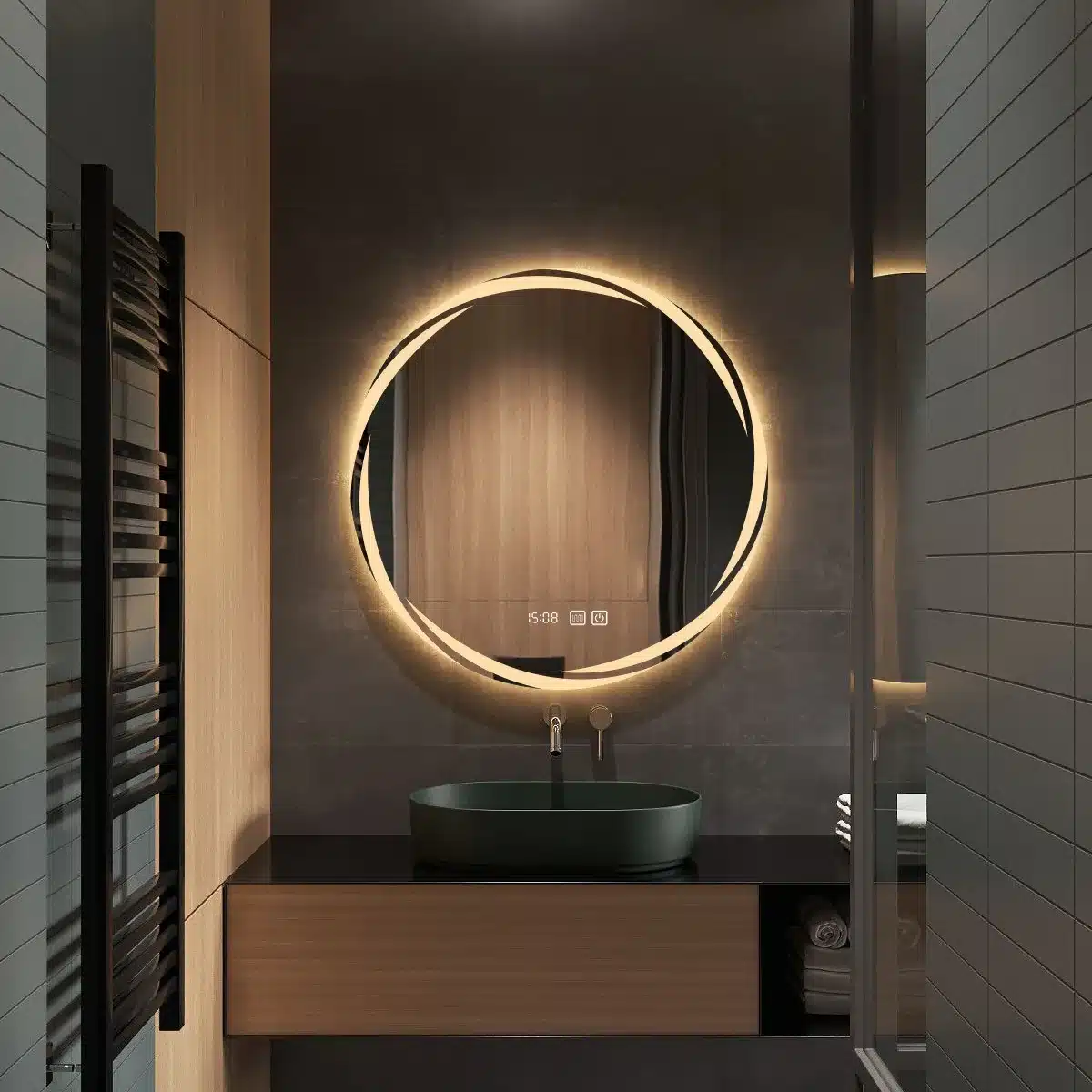
Aluminum backings appear on mirrors built for steamy rooms, including models that add electronics. MFBATH’s smart LED mirror range, for example, offers adjustable brightness and color temperature, an anti-fog function, touch controls, and a clock display in round and rectangular formats. The electronics face the same humid air as the backing, so an LED mirror is only as durable as its least protected component. Whatever coating you select, treat the specification, the sealant, and the mounting method as one system, and keep the humidity story consistent from the sample to the full container.
Copper-Free Silver: The Upgrade That Stops Black Edge
Copper-free silver is the third option, built for the humid conditions that expose standard silver backings to edge corrosion. In the traditional silvering process the factory protects the silver with a thin copper film before painting; copper improves paint adhesion but brings its own corrosion behavior at the edge. Copper-free silver replaces that film with a protective layer engineered to stop the edge reaction. The silver itself is not fundamentally different: the upgrade lives in the protective system around it. We walk through the two constructions in detail in our guide to copper-free vs. standard silver mirror backing.
What copper-free prevents is specific. The black edge on a standard silver mirror comes from corrosion of the silver, the copper layer, or both, wherever moisture enters at cut edges and mounting holes. Removing the copper eliminates one corrosion path and slows the other, which is why procurement documents for hotel and multifamily projects often name copper-free silver explicitly. Put the term in the specification sheet as a written line rather than a verbal assurance. Mirrors look identical from the front no matter what sits behind the paint, so the only proof you will ever see is on paper.
Three questions settle the conversation with any factory. First, is copper-free construction standard or an option on the quoted model? Second, how are edges treated after cutting, given that custom shapes, holes, and cutouts reopen the protective shell? Third, will the quotation and the purchase order state the backing system by name? A supplier that hesitates on question three is answering it. Copper-free silver is a legitimate upgrade, but it earns its place only when the factory can document the protective system that makes it work.
Specify a Mirror Backing Built for Humid Bathrooms
Browse this product, solution, or service page to explore relevant offerings.
What to Verify Before Ordering Bulk Bathroom Mirrors
Before you order mirrors in bulk, put the coating system in writing. The specification should name the reflective material, state whether the construction is copper-free, describe the protective paint and edge treatment, and reference any test reports the factory can supply, such as humidity or salt-spray results. If a supplier cannot document its coating process, expect the same silence on the shipping documents later. Written verification is the difference between a mirror order and a mirror gamble, and it costs nothing to request at the quotation stage.
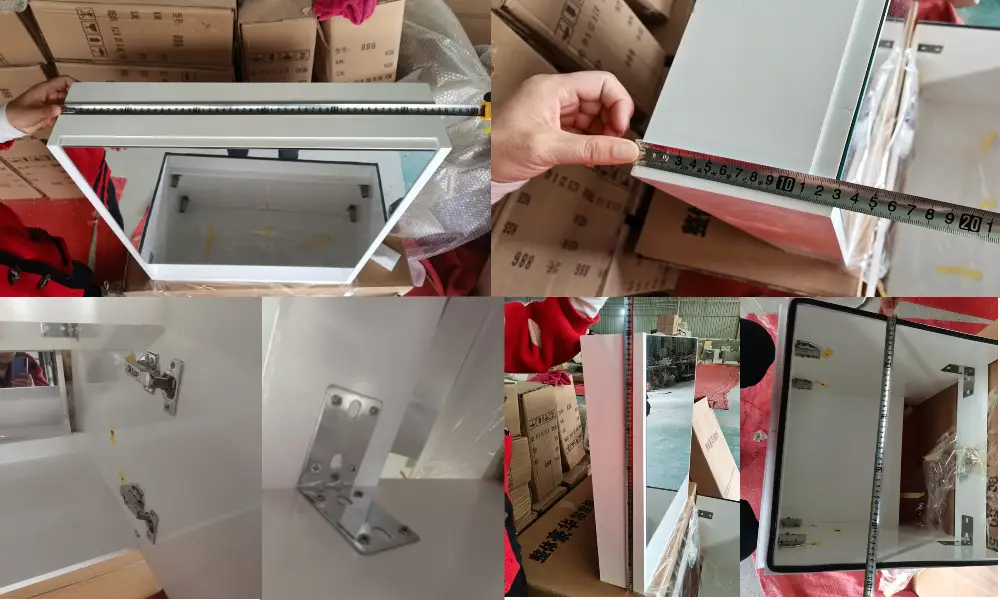
Samples are the fastest verification instrument. MFBATH provides free sample support with samples ready within 10 working days, and its MOQ of 15 sets per model, color, and size keeps a first order small enough to test across the bathroom mirror product range. When the sample arrives, inspect the back, not the face: check paint coverage at the edges and around mounting holes, feel the edge seal, and hold the mirror under a strong light to catch haze creeping in from the rim. Then compare what you see against the written coating specification before you approve production.
The comparison below generalizes on purpose, because every coating behaves differently depending on its protective system. Use it as a starting point, then hold the supplier to its own documentation.
| Coating Type | Typical Humid-Area Behavior | Where It Is Commonly Specified | What to Verify Before Ordering |
|---|---|---|---|
| Copper-free silver | Designed to resist edge corrosion and tarnish where moisture enters at cut edges; still depends on complete paint coverage and sealed edges | North American bathroom and hospitality specifications for hotel and multifamily projects | Copper-free statement in writing, protective paint description, edge treatment details, humidity test report when available |
| Standard silver | Classic warm reflection; can develop black edge where moisture reaches the layer through edge gaps or unsealed holes | Residential and dry retail environments with ventilated bathrooms, where silver’s optical quality is the priority | Edge seal quality, paint coverage, dry storage and handling before installation |
| Aluminum | No silver-style tarnish reaction; long-term moisture behavior depends on the deposition process and the paint system above the layer | Humid commercial lines and wet-area mirror products | Deposition process details, protective coating layers, salt-spray or humidity test report, edge seal specification |
The pattern behind the table: the coating type matters less than the protective system that surrounds it, and the verification column looks nearly identical for all three. Copper-free silver is usually the right starting point for steamy commercial spaces because it removes a documented corrosion path; aluminum is a legitimate alternative when the supplier can show process control; and standard silver with a complete paint system remains a cost-effective construction for dry retail stock. State the choice in the specification, then compare quotes only on identical coating systems, because a price difference across different backings is not a price difference at all.
Factory-level checks close the loop. Every unit at MFBATH passes a five-point inspection, and third-party inspection by firms such as SGS or TÜV can be arranged in advance of shipment. On a container order, schedule one pre-shipment inspection and make the coating specification part of the checklist, so the report confirms that production matches the approved sample rather than a sales description.
Match the Backing to Market and Price Point
Choose the backing by the environment first and by cost position second. For hotel bathrooms, spas, and multifamily units, where replacing a failed mirror means taking a room out of service, specify copper-free silver or aluminum with documented protection. For retail stock bound for ventilated residential bathrooms, standard silver with a complete paint system is usually the cost-effective starting point. The silver versus aluminum mirror glass coating decision has no universal winner, which is exactly why it belongs in the specification before suppliers quote, so that every bid prices the same backing.
Price the failure, not just the unit. The real cost of a mirror is the unit price plus the labor to remove a black-edged mirror from a finished bathroom plus the downtime of the room or display while the swap happens. Once the failure cost is in the calculation, a documented coating system on a mirror destined for years of steam looks like the cheap end of the deal. A supplier that quotes the same specification without a written backing statement is quoting a different product.
Order terms provide the final filter. MFBATH has held ISO 9001 and ISO 14001 since 2017, with the certificates confirmed current in 2025, and it backs its orders with a two-year warranty and a recorded return rate below 1%. Production runs 20-30 days after sample approval, and total delivery to the United States, Canada, or Mexico takes 4-6 weeks including ocean freight. Those published terms give a buyer concrete expectations to compare against any other supplier’s stated schedule.
Bring the same discipline to the rest of the mirror, because the backing decision interacts with the frame and the mounting system. Before you finalize the specification for commercial projects, read our comparison of aluminum vs. plastic mirror frames for commercial bathrooms, which covers how the frame protects or exposes the mirror edge. Frame, backing, and sealant work as one assembly, and each part of the assembly deserves its own written specification.
Structure the purchase in steps so the backing choice is tested before it scales. MFBATH’s minimums make that practical: samples within 10 working days, then an MOQ of 15 sets per model, color, and size, with mixed-container loading so a mirror trial can ride on a vanity container order. Bulk production takes 20-30 days after sample approval, so the verification work in this article fits inside the weeks you would spend waiting anyway. If the first small lot holds its edge, the container order is a repeat of a proven specification rather than a leap of faith.
Frequently Asked Questions
How can you tell whether a mirror has a silver or an aluminum coating?
You cannot read the backing reliably from the front: the reflective layer sits behind the glass, and tone differences between silver and aluminum are subtle. Ask the supplier to state the coating type on the specification sheet, and repeat the same line in the purchase order. On a sample, examine the edge and the back paint; a copper-free construction is normally called out by name, while a plain silver or aluminum backing is described by its material. When a factory cannot name the coating in writing, treat the answer as unverified rather than assuming silver.
Is copper-free silver always more durable than standard silver?
Not automatically. Copper-free construction removes one corrosion path at the edge, but real-world durability still depends on protective paint coverage, edge sealing, and the humidity of the room. A standard silver mirror with a complete paint system can outlast a copper-free mirror with thin protection. Treat copper-free as an upgrade you verify in writing, not a label you trust, and ask for the coating specification plus any humidity test report before paying the difference.
Is black edge a glass problem or a coating problem?
In nearly every case it is a coating problem. Mirror glass is soda-lime glass, which is stable in bathroom conditions. Black edge forms when moisture reaches the reflective layers through an unsealed edge, a mounting hole, or a gap in the protective paint, and the silver corrodes into dark compounds. Cutting or drilling a mirror after production reopens the same path unless the cut edges are sealed again.
What verification materials should you request when buying mirrors in bulk?
Request a written coating specification that names the reflective material, states whether the construction is copper-free, and describes the protective paint and edge treatment. Ask for humidity or salt-spray test reports when the factory has them, and order samples before bulk production: MFBATH sends free samples within 10 working days. Its MOQ is 15 sets per model, color, and size with mixed-container loading, and its orders carry a two-year warranty with a recorded return rate below 1%. Third-party inspection by firms such as SGS or TÜV, arranged in advance, should reference the approved coating specification.
The Bottom Line
Write the coating system into the specification first, then verify it with samples, documents, and inspection before the container order grows. Silver, copper-free silver, and aluminum can each perform in a bathroom; the differences show up in how well the protective system is built and how rigorously you check it. MFBATH publishes terms a buyer can test against, from free samples within 10 working days and a 15-set MOQ to a two-year warranty with a return rate below 1%, and the rest of our mirror glass product knowledge series covers thickness, frames, and installation with the same verification-first approach.

0 Comments