

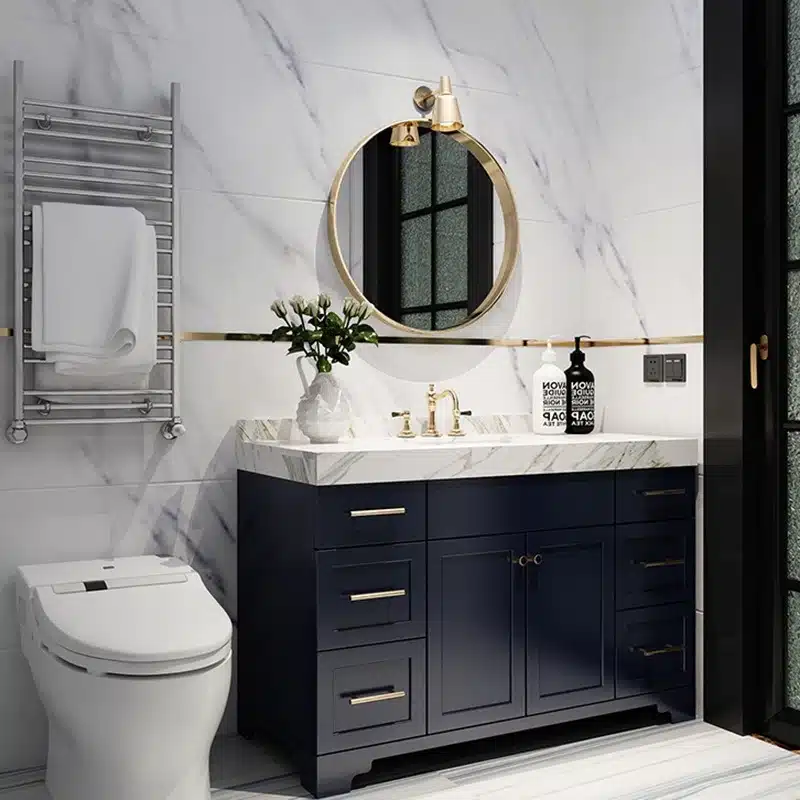
A jobsite conversation usually turns on the same subject: contractor bathroom vanity specifications, and whether the supplier can back them up. Widths, materials, compliance wording, and lead times all surface in that first call. The contractor who asks first controls the bid; the one who asks later controls the fallout.
This guide follows a simple pattern: each section pairs the question contractors ask first with the reason behind it and the shape of a qualified answer. Look for spec-sheet detail, not scripted phrases.
Every number here comes from MFBATH’s published manufacturing data at Main Focus Cabinet, a factory making bathroom vanities since 2015. Nothing is invented, and every claim can be verified before you send a request for quotation (RFQ).
Key Takeaways
- Confirm the size envelope first: standard widths run 24–60 inches with 18–24 inch depth, and sintered stone lines add floating units from 600–1800mm plus floor-standing units from 800–2000mm.
- Material claims must be specific: PVC is 100% waterproof, plywood comes in standard, BWR, and marine grades, and solid wood carries a multi-layer polyurethane coating. Every unit ships with a 2-year whole-unit warranty and a return rate below 1%.
- Check the countertop’s abuse rating: sintered stone tops measure Mohs 7–8 hardness, withstand heat up to 300°C, and resist stains on a non-porous surface.
- Read compliance wording closely: ADA, CSA, and NOM statements are “designed to meet,” while CE and UL certification are held. ISO 9001 plus ISO 14001 were obtained in 2017 and confirmed as current in 2025.
- Lock the calendar early: free samples ship in 10 working days, production runs 20–30 days, and US, Canada, and Mexico deliveries complete in 4–6 weeks with real-time tracking.
- Quantity terms stay flexible: the minimum order quantity (MOQ) is 15 sets per model, color, and size, and mixed models and sizes can share one container.
- Confirm the commercial terms: FOB (free on board) Qingdao Port with a 30% deposit to start production. The balance is due within one week after the draft bill of lading (draft BL).
Table of Contents
- The First Questions Contractors Ask
- Materials and Construction Questions to Ask
- Compliance Questions That Decide Projects
- Lead Time and Ordering Questions
- How to Turn Answers Into a Better RFQ
- The RFQ Checklist That Gets Answers
- Frequently Asked Questions
- The Bottom Line
The First Questions Contractors Ask
Size comes before style on every project schedule. The rough-in is fixed, the drain position is set, and the cabinet has to land inside an opening that will not move. Open the conversation with the size question and let the supplier prove the fit.

Ask: What widths and depths do you build as standard? A qualified answer names a range, not a single SKU. MFBATH builds standard widths from 24–60 inches and depths from 18–24 inches, which covers most residential and commercial openings.
Floating and floor-standing configurations change the install plan, so ask which mounting styles the line covers. Floating units for sintered stone vanities run 600–1800mm, while floor-standing units run 800–2000mm. Contractors who skip this check often spend the install day fixing a mounting surprise — the Floating Vanity Installation: 5 Costly Mistakes guide catalogs what those surprises look like.
Double-basin jobs deserve their own question: does the supplier build wide enough for two basins without an off-size custom unit? Wide sintered stone configurations cover most double-basin layouts. If the design uses vessel sinks, confirm the basin pairing before ordering — Vessel Sink Basins on Vanities walks through the compatibility checks.
Rough-in questions rarely stop at cabinet width. Supply lines and drain placement decide whether a 24–60 inch cabinet sits cleanly or needs field rework, so send the rough-in drawing with the first inquiry. The Vanity Rough-In: Supply Lines and Drain Placement reference shows what to include, and the International Plumbing Code gives the framework most inspectors will apply.
Contractor: “The rough-in is set and the opening will not move. What do you build?”
Supplier: “Standard widths run 24–60 inches with 18–24 inch depth. Sintered stone lines add floating units from 600–1800mm and floor-standing units from 800–2000mm. Send the rough-in drawing and we confirm the fit in writing before sampling.”
Treat the first answer as a filter. A supplier that answers with a range and asks for the rough-in drawing is working the problem; one that quotes from a catalog picture without questions will produce surprises later. The filter works because sizing errors are the most expensive error class on vanity work, and they are also the most preventable.
The same logic applies to depth. An 18–24 inch depth range covers most countertop overhangs, but the supplier should confirm the depth against the planned countertop before the sample is cut. Ask for the drawing dimension, not the catalog dimension.
Materials and Construction Questions to Ask
Material questions separate a quote from a promise. Contractors are the ones who explain failures to owners, so the material claim has to survive moisture, cleaning chemicals, and daily use. Ask about the body first, then the finish, then the countertop.
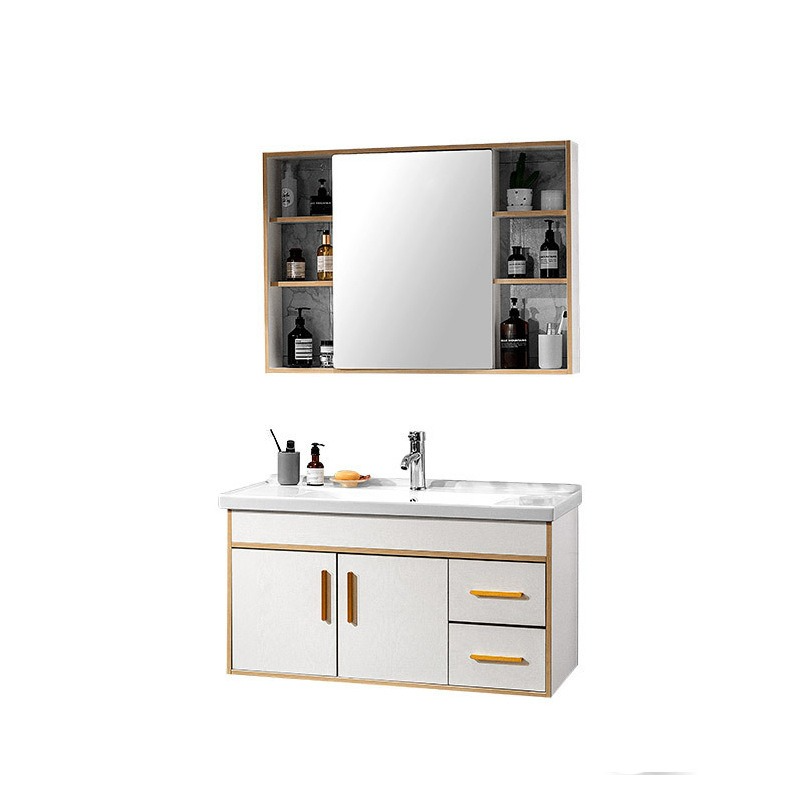
Ask: Is the cabinet body waterproof or water-resistant? PVC vanities from MFBATH are 100% waterproof, which makes them a direct answer for rental units, multifamily bathrooms, and any space where humidity never fully leaves.
Plywood buyers should push one level further and name the grade. Standard, BWR (boiling-water-resistant), and marine-grade panels are different products with different price points. Emission data should arrive with the answer: E1 at or below 0.1ppm, CARB Phase 2, TSCA Title VI, and FSC-certified lumber where the spec calls for it.
Solid wood lines use oak, walnut, maple, or ash with a multi-layer polyurethane waterproof coating. Ask which species is standard and which is an upgrade, because the answer changes both the quote and the maintenance profile.
The countertop question follows the box question. Sintered stone tops rate Mohs 7–8 hardness, tolerate heat up to 300°C, and resist stains because the surface is non-porous. Those three numbers answer most hotel and commercial abuse questions before they are asked.
Construction quality shows up in the checks, not the brochure. Every MFBATH unit passes 5 inspection checks, and third-party inspection with SGS or TÜV can be arranged when the inspector is scheduled in advance. The Bathroom Vanity QC: 5-Stage Inspection article details what those checks cover.
Between PVC and plywood, choose by exposure. For shared and rental bathrooms with constant moisture, PVC’s 100% waterproof body is the safer call because it removes the most common callback from the list. Projects that need structural screws in the panel, or a furniture-like finish, fit a BWR or marine-grade plywood cabinet better. Decide the environment first; the material choice then follows.
Hardware belongs in the material conversation too. Ask about hinges and slides before the mockup: soft-close hardware is what owners touch every day, and it is simpler to confirm in the sample than to retrofit later. Sample review is where material claims get verified. Order the free sample, run the finish past the same cleaning products the building will use, and load the drawers the way tenants will.
Compliance Questions That Decide Projects
Compliance language decides whether a project passes inspection, and contractors have learned to read the wording closely. The first question is simple: what does the supplier put in writing?
For accessible bathrooms, ask how the line addresses ADA design requirements. The correct supplier wording is “designed to meet” or “compliant with” the ADA Standards, so treat stronger claims with caution. The official ADA Design Standards are the reference to check those claims against.
Market-specific requirements follow the same pattern. For Canadian and Mexican projects, ask whether the units are designed to meet CSA and NOM requirements. CE and UL certification are held for the relevant product lines, and ISO 9001 plus ISO 14001 were obtained in 2017 and confirmed as current in 2025.
Emission questions surface on green-building jobs. E1 at or below 0.1ppm, CARB Phase 2, TSCA Title VI, and low-VOC finishes cover most spec sheets and close the indoor-air loop.
Compliance also lives in the drawing files. When the BIM model carries the wrong mounting or material data, the field order and the spec sheet disagree, and the mismatch becomes a change order. The BIM Bathroom Vanity Spec Mistakes piece lists the drafting errors that cost contractors time. For project-level rules, the International Building Code is the framework to reference.
Contractor: “The spec calls for accessible units. What can you state in writing?”
Supplier: “The line is designed to meet ADA design requirements, and the shop drawing shows the access provisions. CE and UL certification are held where required. ISO 9001 plus ISO 14001 have been current since 2017, reconfirmed in 2025.”
Ask the compliance question twice — once for the product and once for the paperwork. Some vendors sell compliant cabinets but issue invoices that never name the standard, and inspectors want the standard stated on the shipping documents. Confirm that the commercial invoice and packing list carry the same compliance language the sales sheet does.
Contractor-Grade Bathroom Vanities for Project Orders
Browse this product, solution, or service page to explore relevant offerings.
Lead Time and Ordering Questions
A vanity that arrives late stalls a whole floor of finish work. Timeline questions come second only to sizing, because the schedule is part of the contract.
Ask: How fast can I get a sample, and what does it cost? MFBATH ships samples in 10 working days, and the samples are free; the buyer covers freight. Ten working days is fast enough to validate color, hardware, and finish before the order locks.
Production runs 20–30 days from order confirmation, which is the number to put on the project calendar. For US, Canada, and Mexico, the total door-to-door window is 4–6 weeks, including ocean freight, and the factory provides real-time tracking on every shipment.
Ask about minimums before you design the order. The MOQ is 15 sets per model, color, and size, and mixed containers are allowed. Different models and sizes can share a container as long as the total reaches the MOQ, which keeps small project orders viable.
Phased projects change the timeline question. If the job needs units in two waves, ask whether partial shipments are possible before the order is placed. Mixed-container planning gets easier when the MOQ total is met across the full order.
Warranty terms belong in the same RFQ. MFBATH backs the complete cabinet with a 2-year whole-unit warranty, and the return rate sits below 1%. Ask the warranty question in writing, because the answer shows how the vendor treats a failed unit after the container clears customs.
Commercial terms matter as much as the timeline. Shipments leave from Qingdao Port on FOB terms, and the order starts with a 30% deposit. The balance is due within one week after the draft bill of lading (draft BL) is issued. Ask for the freight estimate as well: the factory’s logistics setup saves US, Canada, and Mexico customers about 15% on freight.
Unpack and install planning belongs in the same conversation. An RTA Vanity Installation Checklist: 12 Steps keeps the field sequence straight when cabinets arrive flat-packed and staged across multiple units.
Contractor: “I need six units on site by week 20. Can you commit to that?”
Supplier: “Production takes 20–30 days, and the US delivery window is 4–6 weeks total from Qingdao on FOB terms. We confirm the arrival date against the vessel schedule before the 30% deposit is placed.”
How to Turn Answers Into a Better RFQ
An RFQ built on these questions gets better answers than a one-line price request. Put the questions in writing, ask for numbers, and attach the rough-in drawing on the first pass.
The table below turns the whole conversation into a comparison tool. Use it as the skeleton of your request for quotation, and score every vendor’s reply against the same cells.
Your Contractor Bathroom Vanity Specifications Checklist
| Question to Ask | Why It Matters | What a Qualified Answer Includes |
|---|---|---|
| What standard widths and depths do you build? | Confirms the cabinet fits the fixed rough-in before the bid locks. | 24–60 inch widths, 18–24 inch depth, floating and floor-standing options. |
| Which material is under the finish? | Moisture performance decides callbacks and owner complaints. | PVC at 100% waterproof; plywood up to BWR and marine grade; E1 ≤0.1ppm and CARB Phase 2; FSC lumber optional. |
| How is the countertop rated for abuse? | Hotel and commercial tops take heat, scratches, and stains. | Sintered stone at Mohs 7–8, heat resistant to 300°C, non-porous surface. |
| What compliance language goes in writing? | Accessibility and market requirements can block occupancy. | “Designed to meet” ADA, CSA, and NOM statements; CE and UL certification held; ISO 9001 and ISO 14001 current since 2017. |
| What are the sample and production timelines? | Milestones tie directly to the construction schedule. | Sample in 10 working days; production in 20–30 days; 4–6 week total window for US, Canada, and Mexico. |
| What is the MOQ and how do you mix? | Small and phased projects need flexible quantities. | 15 sets per model, color, and size; mixed models and sizes in one container. |
| What are the payment and shipping terms? | Cash flow and freight cost change with every quote. | FOB Qingdao Port; 30% deposit, balance within one week after draft BL; about 15% freight savings for US, Canada, and Mexico. |
Read each answer against one test: every cell should contain a number, a grade, or a document, not an adjective. A vendor that writes “designed to meet ADA,” lists 24–60 inch widths, and names a 15-set MOQ has done the work before the order exists. A vendor that answers with phrases has not, and the RFQ will expose the difference.
The RFQ Checklist That Gets Answers
The request for quotation is where asking turns into ordering. Attach the rough-in drawing, list the width and depth the opening allows, name the material grade, and require compliance wording in the vendor’s own words.
Add the calendar: sample in 10 working days, production in 20–30 days, and a 4–6 week total window for US, Canada, and Mexico. State the MOQ structure you expect, confirm FOB Qingdao terms, and note the 30% deposit with the balance after the draft BL.
Send the same RFQ to several suppliers and compare the replies cell by cell. The answers will sort vendors faster than any price list, because contractor bathroom vanity specifications in writing are the closest thing to a performance record a bid contains.
One round of questions will not fix a weak vendor, but it will find one before money moves. Keep the checklist file, update it after every project, and the next RFQ takes minutes instead of days.
Frequently Asked Questions
What is the minimum order quantity for vanity projects?
The MOQ is 15 sets per model, color, and size. Mixed models and sizes can share one container as long as the total order reaches the MOQ, which keeps smaller project orders practical.
How long do samples and production take?
Samples ship in 10 working days and are free, with freight paid by the buyer. Production runs 20–30 days, and US, Canada, and Mexico deliveries complete in 4–6 weeks.
Can I verify quality before the container ships?
Yes. Every unit passes 5 inspection checks, and third-party inspectors such as SGS or TÜV can be arranged with advance notice before shipment.
The Bottom Line
Ask the size question, the material question, the compliance question, and the timeline question before you compare prices. A supplier that answers with numbers — 24–60 inch widths, 100% waterproof PVC, a 15-set MOQ, 10-working-day samples, 4–6 week delivery — is a supplier you can schedule against. Put those questions into a written RFQ, send it, and let the answers pick the vendor.





0 Comments