


The canada import bathroom vanity duties question arrives in nearly every first email we get from Canadian buyers, usually attached to a quote request. The honest answer is that the number depends on three things you control before the container leaves China: tariff classification, the document chain, and the way customs values your shipment. Get those three right and the border becomes a predictable line item instead of a surprise invoice.
This guide walks through each from the importer’s side. You will see how HS codes set your duty base, which five documents Canada Customs expects, and how GST and HST attach to the shipment total. Compliance checks come last, before production starts. Commercial terms are included as reference: MOQ 15 units per model, free samples in 10 working days, and bulk production in 20–30 days. Total delivery to Canada runs 4–6 weeks from Qingdao Port under FOB terms.
HS Classification Sets Your Duty Rate
Duty starts with classification, not with the invoice. The Harmonized System (HS) code is the international 6-digit product number that tells customs what you are shipping. Canada extends that number with national digits into a tariff line that carries its own duty treatment. Two vanities that look identical in a showroom can sit under different tariff lines: one built with PVC board, one with plywood, one with solid wood. The material you declare on the entry must match what the factory actually built, so the classification conversation starts on the factory floor, not at the broker’s desk.
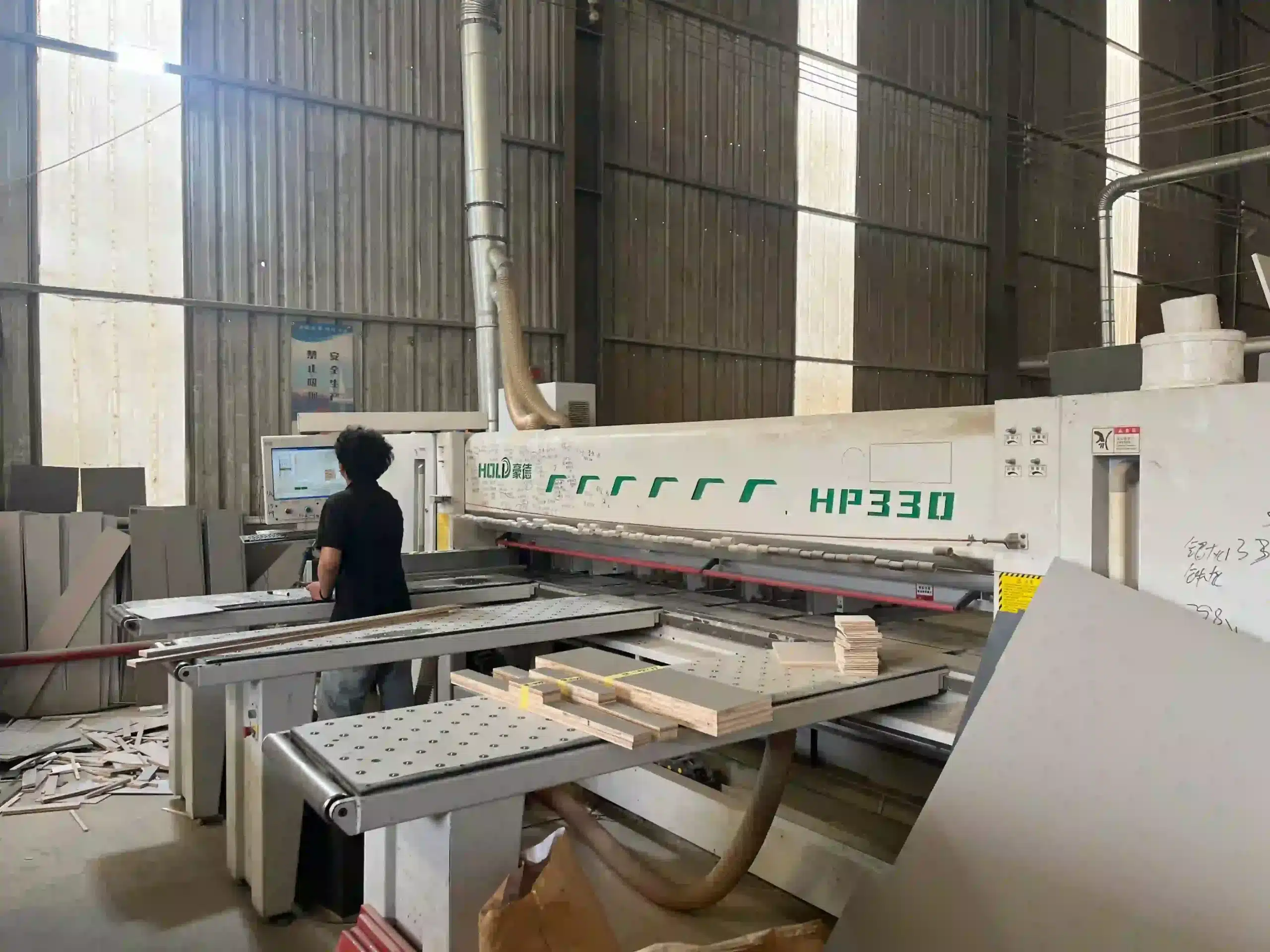
MFBATH runs its PVC, plywood, and solid wood lines inside one 10,000 m² plant in Changge, Henan, producing roughly 5,000 vanity sets a month. Every cabinet carries its material grade before packing. Ask your supplier for a written material breakdown per model, covering board type, thickness, finish, and hardware, and keep it with the commercial invoice. That sheet is your classification evidence if an officer ever questions the entry.
For most bathroom vanities the classification is a materials call. A 100% waterproof PVC unit, a plywood cabinet built with E1 boards, and a solid wood unit with a multilayer polyurethane coating each describe differently at the border. If your product line mixes materials across SKUs, keep one tariff line per material instead of grouping everything under the closest match. Ten minutes with the broker now saves a reclassification later.
Verify the Rate Before You Sign
Never trust a duty figure pulled from memory or a forum thread. Use the CBSA tariff finder to check the current duty rate for your tariff line. That lookup gives you the canada import bathroom vanity duties number you can defend to a buyer. Rates shift with annual tariff updates and trade measures, so recheck before each order. If the classification is genuinely unclear, ask the CBSA for a ruling or an advance ruling before you commit the container. A licensed customs broker can file that request for you.
A wrong tariff line does more than move the duty number. It can change which taxes apply, slow the release at the port, and attract penalties on repeat shipments. Canadian importers who treat classification as a one-time task end up paying for that shortcut twice — once in the correction fee and again in the delay.
Build the evidence pack while the order is still in production. That means the factory spec sheet, the material breakdown, the board test reports, and the classification note your broker prepared, all filed under the purchase order number. When customs asks a question, the answer should be one folder away — not a week of emails with a supplier on the other side of the ocean.
USMCA/CUSMA: Why Origin Still Matters
Canada trades with its neighbors under the United States-Mexico-Canada Agreement (USMCA), called CUSMA in Canada, and the agreement’s rules of origin decide which goods qualify for preferential treatment. A bathroom vanity manufactured in China and shipped directly to a Canadian port does not qualify — plan for the regular tariff line. The nuance matters when components enter the picture. If part of your unit originates in the United States or Mexico, ask your broker whether any preference applies before you rely on it.
Classify first, quote second. A container cannot be reclassified after it lands.
Five Documents Canada Customs Expects
A customs entry is a document puzzle where every piece has to agree with every other piece. The commercial invoice, the packing list, and the bill of lading must describe the same goods in the same quantities, and the declared value must match what you actually paid. Mismatches between these three are the most common reason a shipment gets pulled for examination.
Beyond the commercial documents, Canada wants the importer of record identified on the entry. The importer of record is the legal entity that owns the shipment at the border, owes the duties, and answers for the declaration. Canadian buyers register under a Canada Revenue Agency business number (BN) and either self-clear or authorize a licensed customs broker to file on their behalf. Confirm in writing with your supplier who carries that responsibility on every shipment.
MFBATH builds the exporter side of that chain into every order. The commercial invoice, packing list, and certificate of origin are prepared against the same production record. The draft bill of lading (draft BL) arrives for your review before the vessel departs. Your job is to check that all four documents tell one story — the same model names, the same carton counts, the same port codes.
What happens when the documents disagree? The shipment gets held for examination, the truck sits at the terminal, and storage charges start accruing from day one. The mismatch is usually small: a packing list that shows 52 cartons when the invoice says 48, or a weight that does not match the bill of lading. The correction costs the same effort whether the error is large or small.
Five Documents for a Canada Import Bathroom Vanity Shipment
| Document | Issued By | Purpose | Watch-Out |
|---|---|---|---|
| Commercial invoice | Exporter | Sets the declared value and product description for the entry | Description must match the HS classification and the packing list |
| Packing list | Exporter | Itemizes cartons, weights, and dimensions per model | Quantities must total exactly what the vessel carries |
| Bill of lading | Carrier | Proves shipment and title; shows FOB Qingdao terms | Review the draft BL before the vessel departs |
| Certificate of origin | Exporter | Supports the origin claim and the tariff treatment applied | Origin must match where manufacturing actually happened |
| Customs entry | Importer or broker | Files the goods with the CBSA and pays the duty | Filed after arrival; verify the tariff line before payment |
That same document set feeds your landed cost calculation. The canada import bathroom vanity duties line sits inside that total, next to invoice value, freight, insurance, and tax. Each item decides whether a 24-inch vanity still carries margin at retail. Build the checklist into your purchase order template so the paperwork is born complete instead of assembled at the border.
Keep the complete set for every entry: the invoice, packing list, bill of lading, certificate of origin, broker statements, and the duty and tax receipts. Importers with a clean file per shipment answer post-clearance reviews in hours instead of weeks. That file also prices the next order faster, because last shipment’s real numbers are sitting right there.
How GST and HST Apply at the Border
Canada collects the Goods and Services Tax (GST) on most commercial imports, and in participating provinces the Harmonized Sales Tax (HST) replaces it with a combined provincial-federal tax. The CBSA collects the amount at the border on the customs value of your shipment — the goods value plus freight and insurance, with duty added on top. Rates differ by province and change over time, so check the official GST/HST pages before you build the cost sheet.
If your company is registered for GST/HST and imports for resale, the tax paid at the border generally becomes an input tax credit on your next return. That turns the border tax into a cash-flow issue rather than a permanent cost, but the cash still has to sit with customs until filing. A licensed customs broker can quote the full border package, including duty, GST or HST, and fees, before the vessel arrives, which removes the last unknown from your price.
A complete border estimate for one vanity container includes:
- Goods value: the transaction value on the commercial invoice
- Freight and insurance: added to the customs value base
- Duty: from the tariff line you verified in the CBSA finder
- GST or HST: applied by the province of import
- Broker and terminal fees: quoted in advance by your broker
Who pays and when is worth settling before the vessel arrives. The importer of record pays the duty and tax at release, either directly or through the broker’s account, so the cash needs to be available on the day of arrival. A broker can front the payment under your authorization, but that service carries its own fee and its own deadline.
The GST/HST treatment follows the province where the goods clear, not where your head office sits. A distributor clearing in one province and selling into another should confirm how the provincial portion is handled on the sale side. The import side is settled at the port of clearance.
Container configuration changes the estimate too. Less-than-container-load and full-container-load shipments carry different freight and handling profiles, which is why the border estimate and the shipping plan belong in the same spreadsheet.
Wholesale Bathroom Vanities Built for Canadian Import
Browse this product, solution, or service page to explore relevant offerings.
E1, CARB Phase 2 and CSA Alignment
Compliance for a Canadian buyer is mostly a materials conversation. Formaldehyde limits sit at the top. The E1 emission class caps board release at or below 0.1 ppm, and California’s CARB Phase 2 rule is the benchmark most Canadian retailers reference in purchase contracts. MFBATH’s plywood line runs E1 boards that meet CARB Phase 2 and TSCA Title VI limits. Waterproof edge sealing protects every panel, and the same detail that keeps moisture out also keeps the board stable through a long ocean transit.
The E1 and CARB Phase 2 limits attach to the panels, not to the finished cabinet as a whole. The documentation comes from the board supplier and flows through the factory to your file. Ask for the panel lot reference on the packing list so the report can be traced to the actual goods in the container.
Formaldehyde Limits and CARB Phase 2
Ask for the test report, not a verbal assurance. Before production, request the panel documentation that supports the E1 or CARB Phase 2 claim. Forward it to your Canadian buyer before the order ships, so the paperwork travels with the goods. MFBATH issues internal QC reports and photos for every order, and third-party inspection by SGS, TÜV, or another agency is welcome when you book it in advance.
CSA Alignment and Third-Party Inspection
Canadian distributors sometimes ask whether a cabinet meets CSA-referenced expectations for construction and safety. MFBATH designs its cabinets to meet CSA-aligned construction requirements and builds plumbing-connected units to the installation expectations Canadian codes reference. The wording matters: “designed to meet” and “compliant with” describe the product accurately, while a certification claim would need documentation from the issuing body. If your contract demands a named CSA certification, confirm the standard number with your buyer and the factory before production starts.
Country-of-origin marking is part of the same discipline. Cartons that clearly state the country of manufacture and the manufacturer’s identity speed the inspection process, and unmarked cartons draw attention nobody wants at the port. Ask your supplier to print the marking on the carton and match it on the commercial invoice.
The inspection conversation is separate from the compliance conversation. A third-party visit checks the goods against the agreed spec, from board grade and edge sealing to hardware and packaging, while the documentation proves the material claims. Book both early; an inspection added after production closes means a later vessel.
For electrical add-ons such as smart LED mirrors, Canadian buyers usually ask for CSA-listed components. Confirm the mirror model’s listing status with the factory before bundling it into a vanity set. Wood buyers should note that FSC-certified lumber is available on request, handled on the factory side. And if your line also serves US customers, remember that Prop 65 obligations follow California rules that do not cross the border into Canada. Check both regimes for cross-border e-commerce.
Logistics, Payment and Mixed Container Loading
The commercial terms MFBATH quotes to Canadian buyers are fixed and repeatable. Orders ship free on board (FOB) from Qingdao Port, sample lead time is 10 working days, and bulk production runs 20–30 days. Total delivery to Canada lands in a 4–6 week window including ocean transit, with real-time logistics tracking on every order. The cabinet itself carries a 2-year warranty, and the return rate sits below 1% — the same process already serves 1,000+ dealers across 20+ countries.
Payment follows a two-step schedule that protects both sides. A 30% deposit places the order. The balance is due within one week of the draft bill of lading (draft BL), the carrier’s preliminary document you review before the final version is issued. That week is your window to confirm the load, check the destination, and release the balance; after release, the documents move toward collection and the vessel sails.
- Sample lead time: 10 working days
- Bulk production: 20–30 days
- Total delivery to Canada: 4–6 weeks from Qingdao, FOB
- Payment: 30% deposit, balance within one week of the draft BL
- MOQ: 15 units per model, color, and size
The repeatable shape of a first Canadian order is simple: request free samples, check the build against your market, approve, and place a 15-unit trial per model. Samples ship in 10 working days, so the decision loop fits inside a month. Once the trial container clears customs and sells through, the second order repeats the same terms without renegotiating the paperwork.
Mixed container loading keeps that MOQ workable for Canadian distributors. You can combine models, sizes, and finishes in one container as long as each variant reaches 15 units, which suits a first order testing several SKUs. Customization runs 40,000+ combinations, from Pantone colors and basin types to brand hardware and logo printing, so the same cabinet can carry different brands across retail banners. The packing list becomes your master key: cartons are marked by SKU, and the customs entry, the trucker, and the warehouse team should all read the same list.
If your contract requires third-party inspection, schedule it before the production window closes. SGS or TÜV visits need advance booking, and the inspection report becomes part of the document set. The same container logic applies whether you ship less than a container load or a full one; the LCL vs FCL container loading guide covers the trade-offs. Buyers comparing routes across North America can also read the Mexico distribution logistics playbook and the NOM certification notes for the counterpart market. MFBATH’s full line of PVC, plywood, solid wood, and sintered stone vanities is listed on the product page. The practical first step is a free sample order that lets you check the build before you commit a container.
Frequently Asked Questions
Do I need a licensed customs broker to import bathroom vanities into Canada?
You can self-clear as the importer of record with a Canada Revenue Agency business number, but a licensed broker is usually worth the fee on first shipments. Classification errors and mismatched documents cause most holds, and a broker can correct an entry faster than a first-time importer.
Can a China-made vanity qualify for USMCA/CUSMA preferential duty?
Generally no. Preferential rates under the USMCA/CUSMA apply only to goods that meet the agreement’s rules of origin, which require production in the United States, Mexico, or Canada. A vanity manufactured in China and shipped directly to a Canadian port enters under the regular tariff line.
What lead time and payment terms does MFBATH offer Canadian buyers?
Free samples ship in 10 working days, bulk production takes 20–30 days, and total delivery to Canada runs 4–6 weeks from Qingdao under FOB. Payment is 30% deposit at order placement, with the balance due within one week of the draft bill of lading. MOQ is 15 units per model, color, and size, with mixed container loading supported.





0 Comments