


A 40-foot container of bathroom vanities clears customs in Monterrey on Tuesday and sits on a distributor showroom floor in Guadalajara by Friday. That lane — factory gate in China to Mexican shelf — is what this playbook maps. Mexico vanity distribution logistics comes down to four calls: which channels you sell through, which import path the goods take, which port or border crossing handles them, and whether the product fits the market.
This guide is written for North American distributors and importers weighing a Mexico entry. It covers channel structure, USMCA and import routing, ocean versus overland freight, where NOM compliance fits, and the deal terms and product specs that move in this market. Certification detail lives in a dedicated article linked below — the focus here is distribution mechanics.
How Mexico’s Vanity Channels Are Structured
Mexico sells bathroom vanities through three channel families: national home-improvement retail chains, regional building-materials distributors, and the project channel covering hotels, residential developments, and remodel contractors. Each buys differently, pays differently, and punishes different mistakes. Choosing where to start matters more than choosing what to ship.
Retail chains move the largest volumes but set the strictest terms: vendor compliance programs, long payment cycles, price reviews, and penalty clauses for late containers. Most of them source through established importers or run their own import arms. A new overseas supplier rarely lands a national chain as a first customer, and chasing one first is the slowest route into the market.
Regional building-materials distributors are the workhorse channel. They hold state-level coverage, keep showroom stock, extend credit to local contractors, and understand their city’s preferences. For a foreign manufacturer, they convert market knowledge into orders — and for them, breadth of range matters more than depth. A distributor wants ten finishes on the floor, not two hundred units of one finish.
That is exactly where minimum order quantity (MOQ) changes the math. Main Focus Cabinet (MFBATH) sets MOQ at 15 sets per model, color, and size, and supports mixed containers across models. As a worked example, six SKUs at 15 sets each is 90 vanities — a realistic trial footprint for a regional distributor testing a showroom range without freezing cash in slow-moving stock.
The project channel — hotels, multifamily developments, hospital and dormitory washrooms — buys on specification: batch consistency, lead-time reliability, and documentation. Project volumes often flow through distributors or a dedicated project importer rather than direct from the factory, which is one more reason to build the distribution relationship first.
Start with regional distributors, prove sell-through on a handful of SKUs, and let the chain conversations find you. They almost always start once a product shows movement in the field.
E-commerce is growing as an extension of these channels rather than a fourth one. Established distributors list vanities on national marketplaces and their own webstores, and a few online-first sellers import directly. For a new supplier, the practical move is the same either way: an online listing still needs a warehouse, returns handling, and installation support in-country, which is exactly what a distributor already provides.
Channel choice also sets your pricing architecture. Each layer — importer, distributor, retailer, installer — adds margin and adds service: warehousing, credit, showroom space, last-mile delivery. Work backward from the price the market pays and confirm each layer keeps enough to stay motivated. A distributor who cannot cover warehousing and credit costs on your pricing will not push the product, no matter how good the catalog looks.
USMCA and Your Import Path Into Mexico
The United States-Mexico-Canada Agreement (USMCA) governs trade between the three North American markets and sets the frame every vanity importer works inside. It entered into force on July 1, 2020, replacing NAFTA, and it shapes routing decisions even for goods made outside North America. The official USMCA overview is maintained by the U.S. Trade Representative.
Here is the nuance that trips up first-time importers: USMCA duty preference applies to originating goods. A vanity manufactured in China does not become USMCA-originating by passing through a US warehouse. When that container crosses from Texas into Nuevo Laredo, Mexican customs assesses it on its Chinese origin, not its US departure point. Routing through the US buys speed and warehouse flexibility — not duty preference.
Two import paths dominate for China-made vanities as a result. The first is direct ocean service from Chinese ports to Mexico’s Pacific coast. The second is ocean freight to a US port, then overland movement into Mexico — either as a through-shipment or transloaded into a US warehouse for staged deliveries into northern Mexico.
Neither path is universally right. Direct ocean suits consolidated, planned replenishment for central and western Mexico. The US-routed path suits buyers serving Monterrey, Tijuana, or other northern demand points who already run US warehouse operations. One structure question to settle early: who acts as importer of record. Most Mexican distributors clear customs under their own tax registration; foreign suppliers shipping direct should confirm the importer-of-record arrangement with a customs broker before quoting.
Documentation discipline matters as much as routing. Mexican customs clearance runs on a standard set: commercial invoice, packing list, bill of lading for ocean freight, and a certificate of origin where an origin claim is made. The customs classification assigned to bathroom furniture determines duty treatment and which formalities apply, so agree with your broker how the product is classified before the first container ships — not after it arrives and the correction costs money.
Ocean Ports Versus Overland Border Crossings
Mexico receives Asia-origin container traffic primarily through two Pacific gateways: Manzanillo, the country’s busiest container port, and Lázaro Cárdenas, a deep-water alternative with strong rail connections into the industrial center. On the northern border, overland trade funnels through crossing pairs such as Laredo–Nuevo Laredo and El Paso–Ciudad Juárez, moving cargo that arrived earlier at US ports.
Direct ocean works on simple economics. MFBATH ships Free On Board (FOB) Qingdao, meaning the factory delivers the loaded container onto the vessel at Qingdao and the buyer’s forwarder takes over from there. A full container load (FCL) spreads one flat ocean rate across every set inside. Production runs 20–30 days, and the factory quotes 4–6 weeks total delivery for the US, Canada, and Mexico including production and logistics, with shipment tracking.
The overland path adds cost but compresses time for northern demand. Containers land at US ports, then move by truck or rail to the border and clear Mexican customs on the other side. For ready-to-assemble (RTA) vanities and faster replenishment cycles, that speed can outweigh the premium — the breakdown of RTA vanity wholesale logistics covers how flat-pack density changes the freight math.
Whether you fill a full container or consolidate as less-than-container-load (LCL) cargo decides the cost per set. The gap between the two is not trivial for a first order, and the FCL versus LCL container loading guide walks through the math for vanity dimensions.
Worked example — nominal figures for lane planning only. The transit windows and cost rankings below are illustrative planning values, not quotes. Confirm current rates with a freight forwarder before budgeting.
Route options for China-made vanities entering Mexico
| Route | Transit (nominal) | Cost profile (nominal) | Suits |
|---|---|---|---|
| Ocean FCL, Qingdao to Manzanillo | 20–28 days port to port | Lowest cost per set; inland drayage adds on | Central and western demand, full-container replenishment |
| Ocean FCL, Qingdao to Lázaro Cárdenas | 22–30 days port to port | Close to Manzanillo level; schedule-dependent | Rail-linked delivery toward the industrial center |
| Overland via US, Long Beach to Laredo | Ocean leg plus 5–9 days overland | Highest all-in; pays for speed and border proximity | Northern states, faster replenishment, mixed lanes |
| LCL consolidation to either coast | 7–14 days longer than FCL | Highest per-set cost; no full container required | Trial orders below container volume |
Pick by demand geography, not by habit. If your buyers cluster around Mexico City, Guadalajara, or the Bajío manufacturing corridor, direct ocean usually wins on landed cost. If you serve Monterrey or the border states, the US-routed path often wins on speed even at a higher nominal cost. Run both lanes with real quotes before deciding.
One lever worth asking about: MFBATH’s published logistics planning targets roughly 15% freight savings for US, Canada, and Mexico customers compared with standard booking. Route consolidation and loading density drive it — request the specifics when you ask for a quote.
Inland drayage is the cost line importers most often underweight. Manzanillo and Lázaro Cárdenas sit on the Pacific coast, while a large share of demand sits in Mexico City and the Bajío — a long truck or rail move after discharge. Quote door-to-door delivery when comparing lanes. A nominally cheaper ocean rate can evaporate once inland haulage is added on top.
Where NOM Fits in the Playbook
NOM stands for Norma Oficial Mexicana — Mexico’s official mandatory technical standards, covering product safety, labeling, and performance. Which standards touch your import depends on the product: cabinet furniture, mirrors, and electrically powered items like LED mirrors attract different requirements. The Norma Oficial Mexicana framework overview is a reasonable starting point before talking specifics with a compliance advisor.
Three practical points matter for importers. First, electrical components draw the most scrutiny: a smart LED mirror with touch controls and anti-fog heating needs a documented compliance path in a way that a plywood cabinet does not. MFBATH holds CE and UL certificates for electrical components and designs products to meet applicable NOM requirements. “Designed to meet” is the honest phrasing, and any supplier claiming more than they can document deserves hard questions. Second, commercial labeling rules apply to retail-bound goods, so packaging artwork should be reviewed before printing. Third, ask any factory for test reports and component documentation up front — hesitation is itself an answer.
The full standard-by-standard picture, including which NOM rules apply to which vanity components, lives in our dedicated NOM certification guide for Mexico. This playbook keeps the focus on distribution; that article keeps the focus on compliance.
Stock SKUs Built for Mexican Demand
Browse this product, solution, or service page to explore relevant offerings.

Deal Terms That Work for Mexican Distribution
MOQ structure decides how fast a distributor can learn. Across MFBATH’s catalog, MOQ is 15 sets per model, color, and size, with mixed containers permitted. That structure lets a Mexican distributor launch a range — say, two widths across three finishes — on one container instead of betting the season on a single SKU.
Payment terms set the cash rhythm. The standard structure is a 30% deposit at order, with the balance due within one week of the draft bill of lading (BL). Paying against a draft BL means funds move after the container loads but before it arrives — combined with the 4–6 week door lead time, a distributor can sequence deposits against showroom sell-through rather than stockpiling inventory months ahead.
Samples should precede every first container. MFBATH ships free samples with a 10-working-day lead time. Order the sample in the exact finish code you plan to sell and view it under the lighting your showroom actually uses; warm LED light changes how a wood grain reads. It is a small step that prevents expensive disagreements.
Reorder rhythm deserves the same attention as the first order. Production runs 20–30 days and total door delivery takes 4–6 weeks, so replenishment decisions have to be made on trend, not on empty shelves. As a worked example: assume one SKU moves 30 sets per month across a distributor’s network. With roughly six weeks of pipeline time, a reorder trigger at eight to ten weeks of cover keeps a safety margin without stacking cash into stock. Negotiate the trigger and the forecast share up front, not after the first stockout.
Inspection is leverage, not an insult. Every unit passes five quality checks before packing, and third-party inspection by SGS or TÜV is supported — schedule it before shipment, not after arrival. The importing QC checklist shows what to verify when goods will travel four weeks before you see them.
If you plan to sell under your own brand, the mechanics are straightforward: white-label production, logo printing or laser engraving, custom packaging, and access to more than 40,000 finish and configuration combinations. Browse the full product range to match SKUs to the channel structure described above.
What Mexican Buyers Expect From a Vanity
Demand in Mexico is shaped by climate and by space. Coastal and southern cities live with high humidity year-round, urban bathrooms run compact, and interest in smart features keeps climbing in the mid and premium segments. Product fit is not a marketing exercise here — it decides return rates.
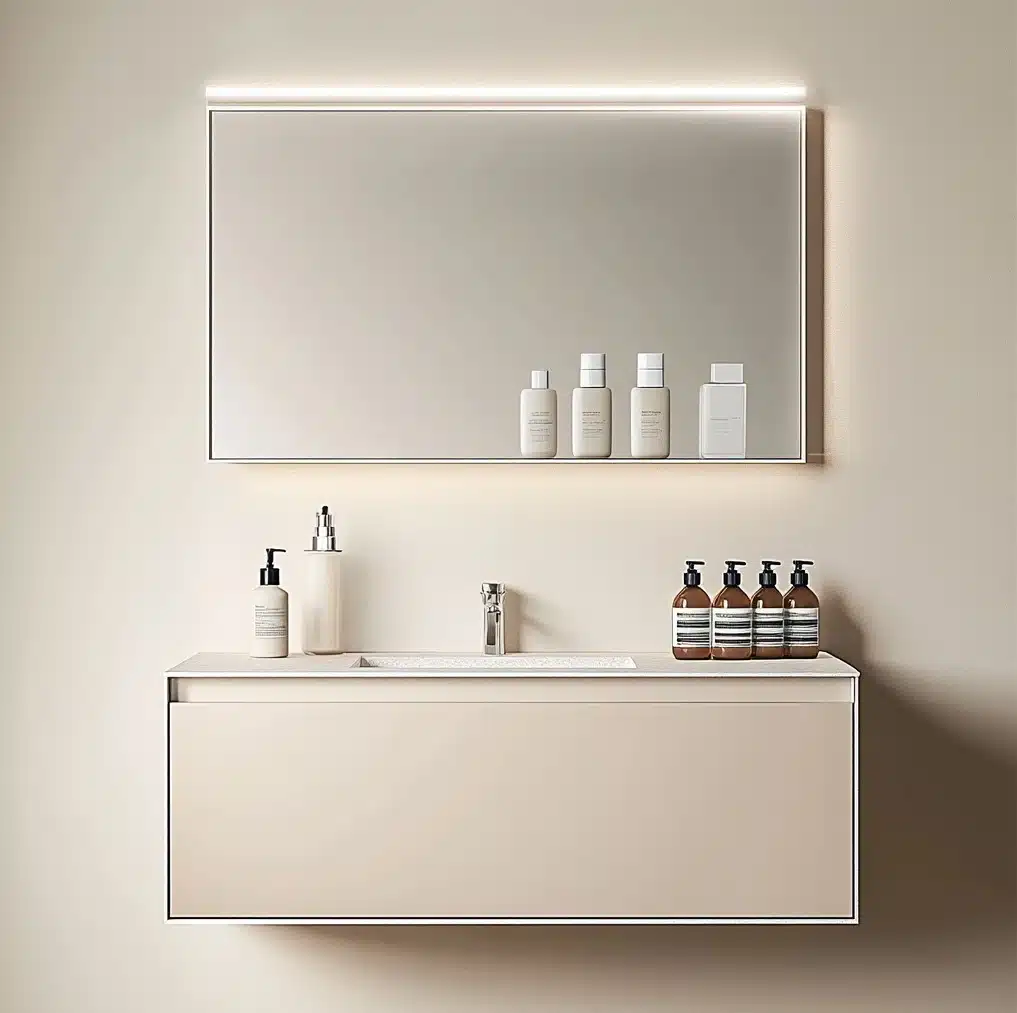
Humidity is the filter that eliminates half the catalog. PVC vanities absorb no water and do not warp, which is why they anchor ranges in coastal markets. MFBATH’s PVC line spans standard widths of 24–60 inches and depths of 18–24 inches, with more than 1,000 standard finishes, a full two-year vanity warranty, and a return rate under 1%. That combination — moisture immunity plus finish breadth — is the safe core of a Mexican assortment.
For buyers who want an engineered-wood story, plywood vanities bring the formaldehyde documentation that spec-driven retailers ask about: E1 emissions at or below 0.1 ppm, CARB Phase 2 compliance, and FSC-certified wood available on request. Solid wood runs — oak, walnut, maple, and ash with multi-layer polyurethane waterproof coatings — sit at the top of the residential range.
The project segment is where sintered stone earns its shelf space. Wall-mounted units run 600–1800 mm (24–71 inches) and floor-standing units 800–2000 mm (31–79 inches), paired with sintered stone basins rated 7–8 on the Mohs hardness scale, heat-resistant to 300°C, non-porous, and UV-stable. Pair them with smart LED mirrors — adjustable brightness and color temperature, anti-fog heating, touch controls — and a distributor can quote hotel and multifamily packages rather than single units.
Mirrors round out the ticket on their own. Classic mirrors run from 24×36 to 48×72 inches in wood, metal, or PVC frames, with optional anti-fog coating; smart LED mirrors add adjustable brightness and color temperature, anti-fog heating, touch control, and digital displays. Sold alongside the cabinet, a matched mirror raises average order value and gives showroom staff a natural upsell that needs no extra floor space.
The assortment logic follows: lead with moisture-proof PVC in the volume sizes, layer in plywood and solid wood for retail differentiation, and reserve sintered stone and smart mirrors for project business. Custom runs start at the same 15-set MOQ, so a distributor can adapt a finish to regional taste without a volume penalty.
Frequently Asked Questions
Do vanities imported from China need NOM compliance documentation for Mexico?
It depends on the product. Cabinet furniture and electrical items face different standards, and LED mirrors draw the closest review. MFBATH designs products to meet applicable NOM requirements and supports documentation requests; route specifics through a compliance advisor.
Should vanities ship direct to Mexico or through the US?
Route by demand location. Central and western Mexico usually favors direct ocean to Manzanillo or Lázaro Cárdenas; northern and border-state demand is often faster overland via the US. Quote both lanes — nominal transit gaps vary by season.
How long does delivery take from order to a Mexican warehouse?
Production runs 20–30 days, and MFBATH quotes 4–6 weeks total delivery for the US, Canada, and Mexico including logistics, with real-time tracking. Samples ship in 10 working days if you need to validate a finish first.
Build the Trade Lane Before You Scale
Mexico rewards distributors who treat entry as a system: channel choice sets the SKU strategy, SKU strategy sets the container plan, and the container plan sets the route. Get the sequence right and a 15-set MOQ can grow into steady replenishment without a bad surprise.
- Start with regional distributors; retail chains follow proven sell-through.
- Route by geography: ocean-direct to Manzanillo or Lázaro Cárdenas for central and western demand, overland via the US for the north. The transit gaps above are worked-example figures — quote both lanes.
- Hold suppliers to documented compliance: NOM-aligned design, CE and UL certificates on electrical components, and third-party inspection rights before shipment.
- Work with these terms: MOQ 15 sets per SKU, mixed containers, 30% deposit, balance within one week of the draft BL, and 4–6 weeks door delivery.
Request the 2025 catalog — 100+ pages, free — and start the lane with a sample order. The trade route you build this quarter is the sell-through you report next year.




0 Comments