

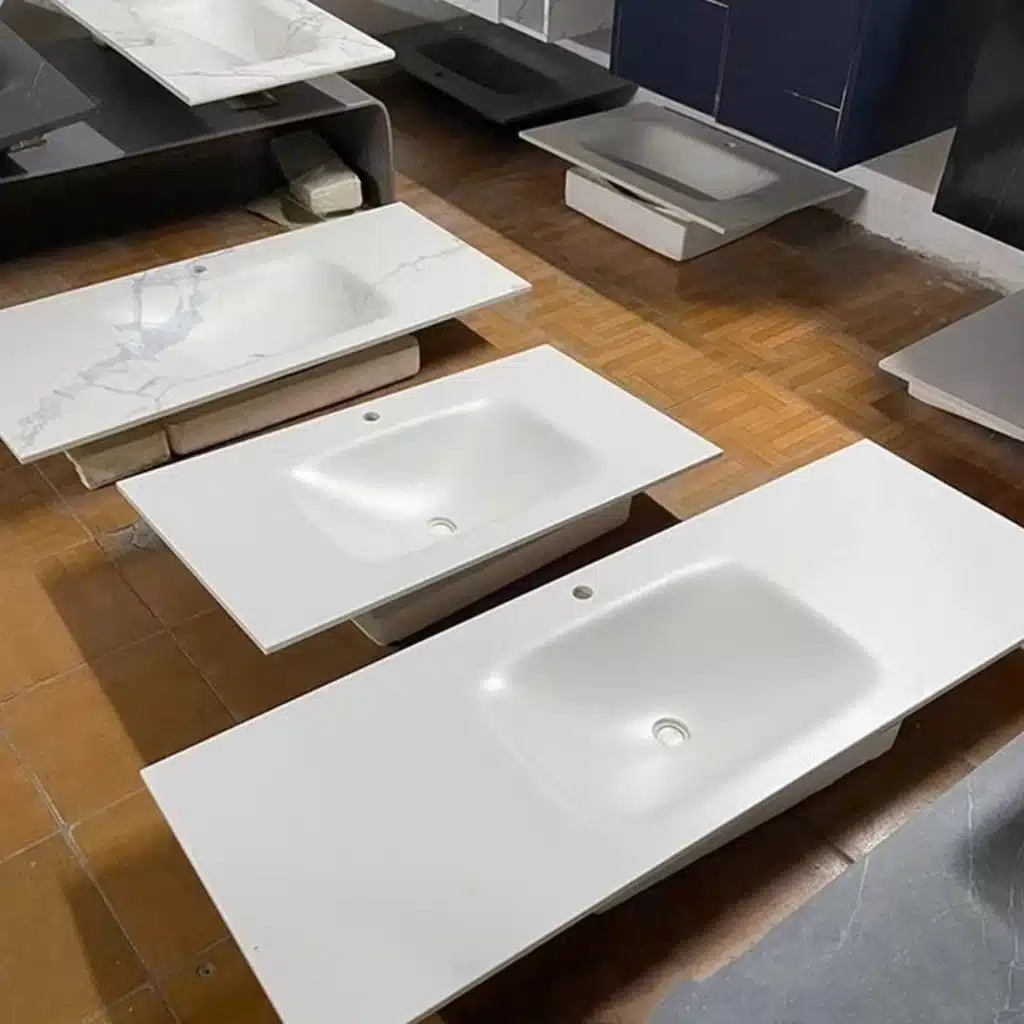
When you spec a bathroom vanity for a wholesale program, the basin material decides more of your landed cost and field-failure rate than the cabinet finish does. Buyers comparing ceramic vs sintered stone basin options, plus resin, run into the same problem: every supplier calls all three durable, but the numbers behind them are very different. This guide compares ceramic, sintered stone, and resin basins for vanity tops across cost, durability, maintenance, customization, and inspection, using the spec sheet MFBATH (Main Focus Cabinet) actually quotes.
You get a side-by-side table plus the MOQ (Minimum Order Quantity) and lead time terms for all three materials. A verification list closes the guide, ready to hand to any factory before you commit a container.
Why Basin Material Decides Vanity Value
The basin is the hardest-working surface in a bathroom. It takes water, soap, heat, and dropped objects every day, and it is the first thing guests and tenants notice. When a basin fails, the replacement happens in the field, at your cost, not on the factory floor. That is why material choice comes before cabinet finish in every sourcing conversation we run at MFBATH.
The three materials sit at different points on the price and performance curve. Ceramic is clay formed and fired with a glazed working surface, a manufacturing process with decades of scale behind it. Sintered stone starts as natural minerals, quartz, feldspar, and silica, fused under high temperature and pressure with no resin binders, which is why it carries published hardness and heat figures. Resin is a cast polymer that can be molded into shapes the other two cannot match without visible joints.
Here is the short version of the decision. Frame the ceramic vs sintered stone basin choice as a cost-versus-durability trade, then place resin against the shapes you need. Ceramic is the safe default for a first container or a price-led program. Sintered stone earns its higher cost in hotels and premium lines where heat and impact show up daily. Resin fits designs that need a one-piece basin and countertop, and it demands the most verification work from the buyer.
MFBATH builds all three materials and ships to 1,000+ dealers across 20+ countries. The comparison below reflects what survives in the field, not what looks good in a showroom.
Before you compare prices, lock three inputs: the end market, the traffic level, and your replacement path. A basin that serves a rental unit and one that serves a hotel lobby have different failure tolerances, and the RFQ should state which one you are buying. We write that into the quote so the material, the packaging, and the price all answer the same question. For program-level cost planning, our bathroom vanity unit price tiers guide shows how basin choice moves per-unit cost across order sizes.
Ceramic Basins Set the Cost Baseline
Ceramic basins come from a mature process: clay is formed, dried, and fired with a glaze that becomes the working surface. The manufacturing base is broad and the tooling is standard, which keeps unit pricing competitive. For a wholesale buyer, ceramic is the reference point every other material has to beat.
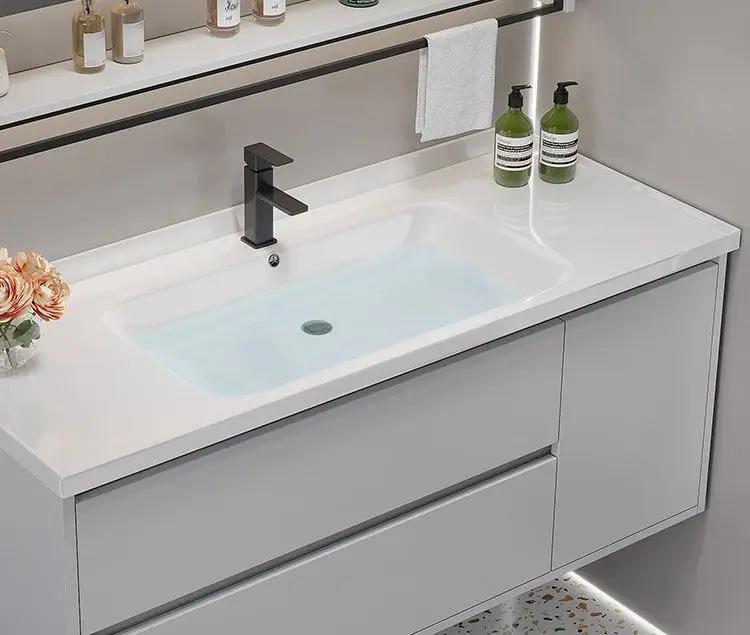
What the glaze gives you is predictable daily performance. Standard bathroom cleaners handle the surface, stains sit on the glaze instead of soaking into the body, and normal use does not scratch it. The trade-off is impact. A heavy bottle or a faucet base dropped onto the rim can chip the glaze or the body edge. A chipped basin is not a cleaning problem; it is a replacement problem.
The chip risk is manageable when you verify before you commit. Check glaze coverage at the rim and around the drain opening. Look for pinholes and rough patches, tap the body for a clean ring instead of a dull thud, and measure the front lip thickness. Ask the factory for its QC report with photos. Transit matters as much as the material itself; confirm the basin is separated from cabinet hardware and braced inside the carton, and get the packing sequence in writing.
Ceramic also carries the widest aftermarket comfort. Standard sizes pair with standard vanities from 24 to 60 inches wide and 18 to 24 inches deep. MFBATH customizes ceramic basins from 15 sets per size or color. That means you can test a small run before you fill a container, and the material science behind the glaze is documented in the ceramic reference if your client asks.
When does ceramic win the spec? When unit cost rules the line, when the program sells through dealers who replace quickly, and when the design is standard rather than sculptural. It is the material I put in front of a buyer who needs margin now and a replacement path later.
Sintered Stone Basins Bring Hardness and Heat Data
Sintered stone is the material that hands you numbers instead of adjectives. It starts with natural minerals, quartz, feldspar, and silica, fused at high temperature and pressure with no resin in the mix. Our Sintered Stone 101 explainer walks through the process in depth. The headline specs we quote: a Mohs scale of mineral hardness rating of 7 to 8 and heat resistance to 300°C. The surface is non-porous, rejects stains, does not fade under ultraviolet (UV) light, and carries an antibacterial finish.
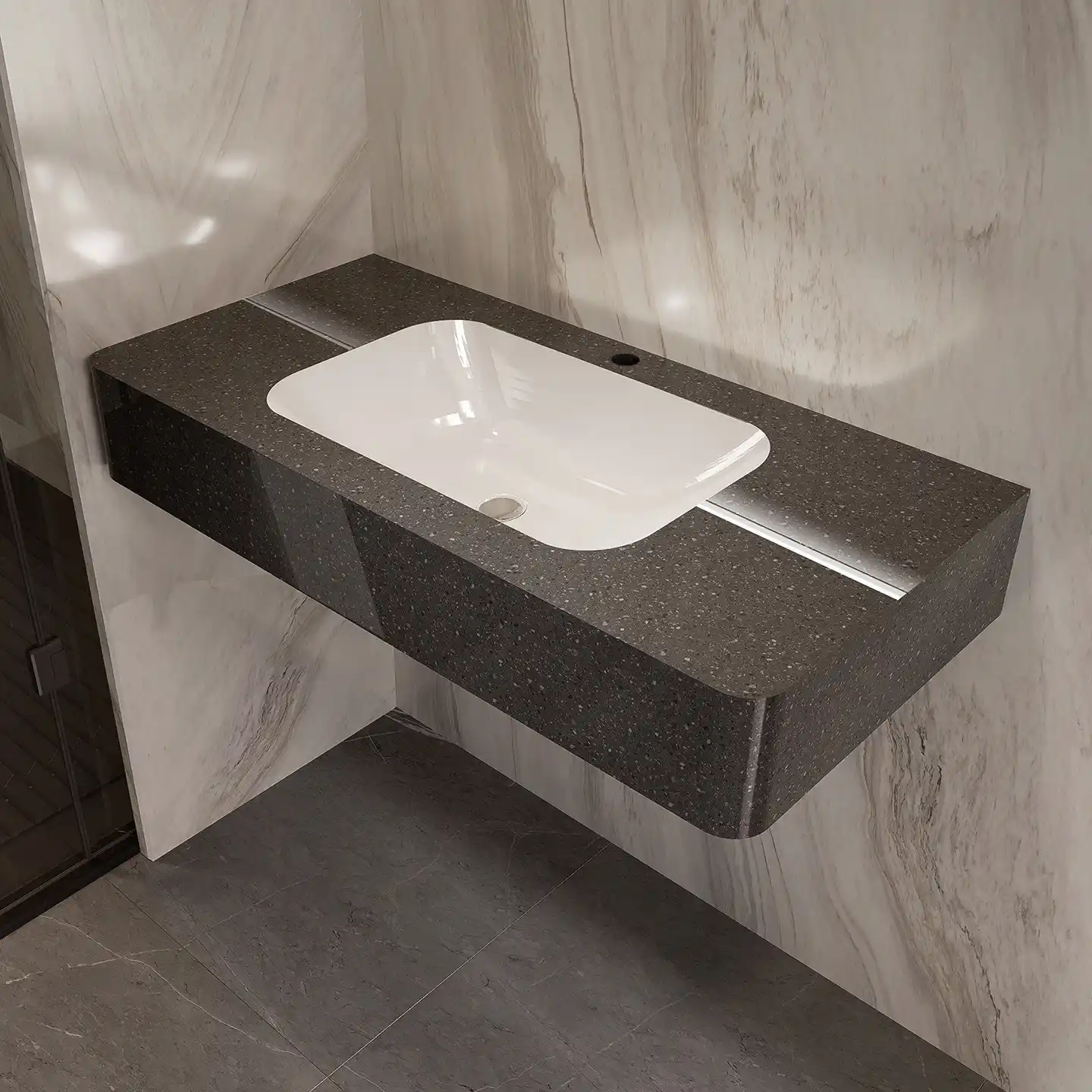
What those numbers mean on a jobsite: 300°C heat resistance matters in hotel bathrooms, where guests rest curling irons and hair straighteners on the rim. A Mohs 7 to 8 rating scratches less easily than the natural stones most buyers have handled. Marble and most granites sit lower on the ladder; the Mohs scale of mineral hardness reference lists the full sequence. Non-porous means hair dye, red wine, and nail polish sit on the surface until you wipe them off.
The antibacterial surface matters in commercial bathrooms, where cleaning cycles are short and occupancy is constant. The sintering process that fuses the minerals is what produces this dense, closed structure; there is no coating layer that can wear off over time.
Sizing is where sintered stone separates from ceramic. Basins run 600 to 2000 mm wide with single or double basin layouts, in marble, granite, cement, and solid color textures, with matte, satin, or polished finishes. The same material builds the full vanity: wall-mounted floating units from 600 to 1800 mm and floor-standing units from 800 to 2000 mm. For hotel specifications, the double-basin option is usually the reason sintered stone enters the drawing at all.
Verifying a sintered stone basin is faster than verifying resin, because the key data is structural. Check the slab thickness at the rim and confirm the drain opening is cut clean with no chipped edges. Ask the factory to photograph the basin under direct light, where surface waves show up immediately. The UV and heat claims come from factory-level tests, so request those test records inside the QC package.
The ceramic vs sintered stone basin cost question is simple: sintered stone costs more per unit than ceramic, and that gap is the whole debate. The value case is a surface that does not stain, does not fade, takes heat without damage, and stays presentable through years of daily use. When a basin works 365 days a year in a commercial bathroom, I recommend sintered stone if the program can carry the price. Ceramic stays the better call when per-unit cost rules the line.
Resin Basins Offer Custom Shapes with Caveats
Resin basins are cast polymer units, and their defining advantage is shape. The basin and countertop can be molded as one piece with no visible joints, which glazed ceramic and sintered stone cannot deliver without seams. That is why resin shows up in curved vanity tops, integrated sink designs, and projects where the transition line has to disappear.
Resin is fully orderable in our program, not a side note. MFBATH’s custom catalog holds 40,000+ combinations, covering Pantone colors, eco materials, ceramic, resin, and sintered stone basins, plus brand hardware. Custom runs start at 15 sets per size or color, and mixed container loading lets you test resin alongside your ceramic and sintered stone lines.
What Resin Basins Do Well
For design flexibility, resin leads the three materials. The one-piece construction removes the seam where water collects. The surface can be finished in solid colors that match a vanity exactly, and the material accepts shapes that would require expensive tooling in ceramic. Buyers use resin when the product story is the form itself.
What resin does not give you is a universal spec sheet. Performance varies with the polymer blend, the casting process, and the factory’s quality control, so every number on a quote is a claim to test, not a standard to trust. That is not a reason to avoid resin; it is a reason to structure the order so verification happens before the bulk run.
How to Verify a Resin Basin Sample
- Order a sample first. Samples ship in 10 working days, and the cost of a rejected sample run beats the cost of a container of rejects.
- Run a hot-water soak, a stain test with coffee and hair dye, and a scratch check on an edge scrap. Leave the sample wet overnight and inspect for clouding or discoloration the next morning.
- Inspect the surface for pinholes and air bubbles, especially at the drain seam, where weak casting shows up first.
- Ask for the factory QC report with photos and video, and book third-party inspection, such as SGS or TÜV, in advance when the order size justifies it.
The buying rule for resin is short. Choose it when the design demands a one-piece form, and never sign a bulk order on the spec sheet alone. The 15-set custom MOQ exists exactly for this: validate a small batch, approve the sample, then scale.
Sintered Stone Basins and Vanities for Wholesale Programs
Browse this product, solution, or service page to explore relevant offerings.
Basin Comparison Table and Sourcing Terms
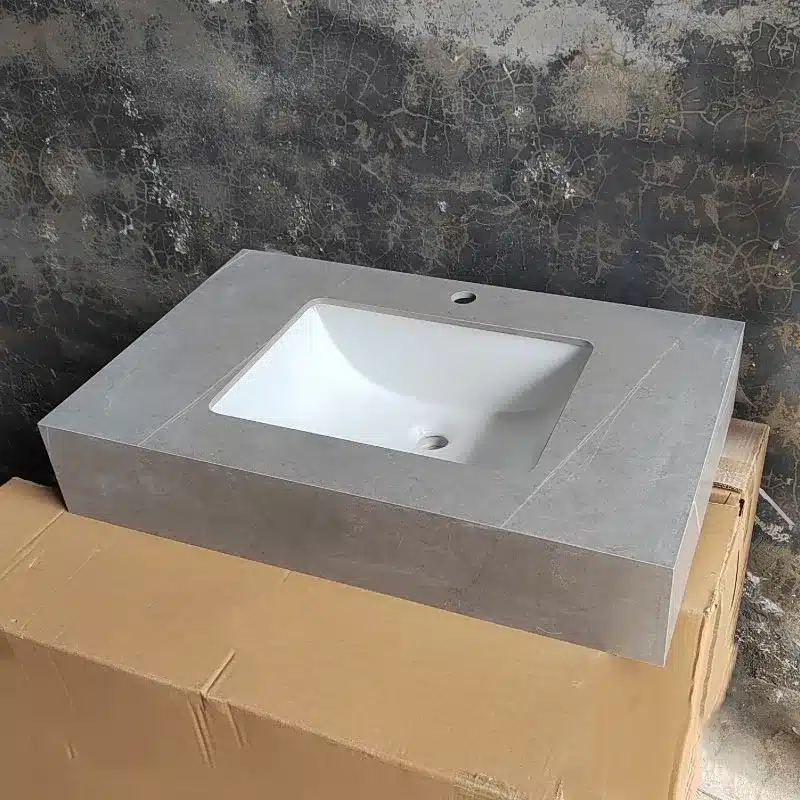
All three materials sit on the same cabinet platform. Sintered stone vanities arrive as wall-mounted floating units from 600 to 1800 mm or floor-standing units from 800 to 2000 mm, in single or double basin layouts. Standard cabinets run 24 to 60 inches wide and 18 to 24 inches deep, and the basin material you pick does not change the MOQ or the lead time structure.
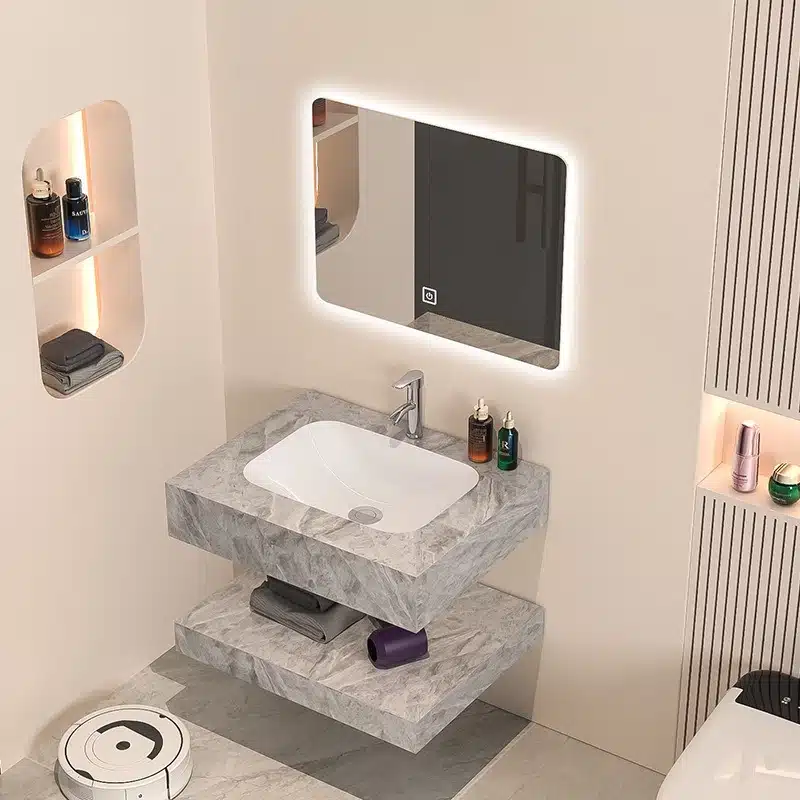
The ceramic vs sintered stone basin table below is the sheet we use in buyer meetings. It compares the three materials across the five decisions that matter at order time: cost, durability, maintenance, customization, and use case. Read it as a sourcing sheet, not a ranking, because the right material depends on your price point, your end market, and how much verification your team can run.
Ceramic vs Sintered Stone Basin Comparison Table
| Material | Cost | Durability | Maintenance | Customization and Use |
|---|---|---|---|---|
| Sintered Stone | Premium material cost; value shows in service life and low care | Mohs 7 to 8; resists 300°C heat; non-porous; UV stable; antibacterial | Wipes clean; no sealant or special cleaner needed | 600 to 2000 mm widths; single or double basin; hotel and premium lines |
| Ceramic | Cost-effective; the budget reference point for most programs | Fired glaze resists scratches and stains; chips on hard impact | Easy wipe-down; glaze keeps stains out of the body | Custom sizes and colors from 15 sets; homes, rentals, mid-range hotels |
| Resin | Varies by formulation; confirm price with a sample order | Heat and scratch resistance depend on the polymer blend | Wipe with mild cleaner; verify stain behavior before bulk | One-piece shapes without visible joints; verify supplier by supplier |
Two notes before the terms. First, pairing matters. A sintered stone basin on a wood cabinet depends on the cabinet’s waterproof coating holding up, and our solid wood vanity waterproof coating guide covers that check. Second, when basins, mirrors, and cabinets travel in one shipment, the packing plan decides how much arrives intact. The vanity, mirror, and basin set shipment walkthrough shows the sequence we use.
One more habit pays off across all three materials: ask every supplier for the same spec sheet format. Material, hardness or glaze test, size tolerance, packaging, and lead time, laid side by side. Quotes you cannot line up are quotes you cannot compare, and the format itself tells you which factory runs a real QC process.
The commercial terms below apply to ceramic, resin, and sintered stone alike. They are the numbers we quote, and they do not change with the material.
- MOQ: 15 sets per model, color, and size, with mixed container loading, so one container can combine basin types and cabinet models.
- Customization: from 15 sets per size or color, covering ceramic, resin, and sintered stone basins, Pantone colors, logos, and packaging.
- Samples and lead time: free samples in 10 working days; bulk production 20 to 30 days; total delivery to the US, Canada, and Mexico in 4 to 6 weeks.
- Terms and payment: FOB (Free On Board) Qingdao Port; 30% deposit to start production, balance within one week after the draft bill of lading (draft BL) is issued.
- Quality and warranty: five checks per piece, third-party inspection (SGS or TÜV) with advance notice, whole-cabinet warranty of 2 years, and a return rate under 1%.
- Capacity and standards: 5,000 sets per month out of a 10,000-square-meter factory; ISO 9001 quality system held since 2017 and confirmed valid in 2025; E1 board emission limits at or below 0.1 ppm.
The sintered stone bathroom vanity product page lists current sizes and basin layouts if you want to compare against your program sheet before requesting quotes.
What This Means for Your Order
Basin material is the first spec to lock in a vanity program, because it sets cost, durability, and replacement risk in one decision. Ceramic gives you the budget baseline. Sintered stone gives you the data. Resin gives you the shapes, on the condition that you verify them.
- Ceramic: the cost-effective baseline; check glaze coverage, edge thickness, and transit packaging before the container leaves the factory.
- Sintered stone: Mohs 7 to 8 hardness, 300°C heat resistance, non-porous and UV-stable; widths 600 to 2000 mm with single or double basin layouts.
- Resin: one-piece custom shapes, but verify each supplier with a sample, QC reports, and third-party inspection before the bulk run.
- Terms: MOQ 15 sets per model, color, and size; free samples in 10 working days; bulk 20 to 30 days; FOB Qingdao; 30% deposit with the balance after the draft BL; 2-year whole-cabinet warranty.
MFBATH (Main Focus Cabinet) builds ceramic, resin, and sintered stone basin programs on the same 15-set MOQ, and the 2025 catalog, 100+ pages, is free on request. Start with samples, keep the table above as your negotiation sheet, and browse the full bathroom vanity collection or the company overview at focuscabinet.com.
Frequently Asked Questions
Which basin material fits a mid-range hotel renovation program?
Sintered stone handles the heat and impact hotel bathrooms produce, with Mohs 7 to 8 hardness and 300°C heat resistance. Ceramic keeps the unit cost lower for standard rooms. MFBATH quotes both from 15 sets, so you can split one program between the two materials.
Can one container mix ceramic, resin, and sintered stone basins?
Yes. Mixed container loading is standard, and the MOQ applies per model, color, and size at 15 sets each. Custom sizes or colors start at 15 sets per dimension. Bulk production takes 20 to 30 days, with FOB (Free On Board) Qingdao Port terms.
How do I check resin basin quality before a bulk order?
Order a sample, which ships in 10 working days. Run a hot-water soak, a stain test, and a scratch check, and inspect for pinholes at the drain seam. Ask for the factory QC report with photos and video, or book third-party inspection such as SGS or TÜV in advance.



0 Comments