
A distributor signs a contract for 200 complete hotel bathroom suites. One signature just became a vanity mirror basin set shipment with three production lines, three packing problems and one fixed sailing date. Every piece must arrive matched in finish, intact in carton and early enough for the installers.
Sourcing the vanity, mirror and basin as one coordinated set is how importers keep that promise without juggling three supplier timelines. This guide covers the minimum-order math, the damage profile of each category and the container loading logic that keeps boxes intact. It closes with the quality documents and payment sequence that hold the timeline together from deposit to draft bill of lading.
Why Coordinated Set Sourcing Beats Three Separate Orders
Run the coordination cost first. Three factories means three finish batches, three packing standards and three shipping schedules that rarely align on the first attempt. A warm-white vanity beside a cool-white mirror cabinet looks fine in renderings and terrible on a hotel punch list. Color and size consistency is the entire point of a retail bundle or a project bid, and separate sourcing erodes it batch by batch.

Missing parts are the second failure mode. Containers leave on schedule whether every supplier is ready or not, so one delayed SKU can strand a project with 190 complete sets and 10 orphaned vanities. Retail bundles sharpen the pain. A listing that pairs a vanity with its mirror cannot sell when only one of the two boxes reaches the warehouse.
One factory covering all three categories removes both problems at the source. Main Focus Cabinet, selling under the MFBATH brand, has produced vanities, LED mirrors and sintered stone basins from Changge, Henan since 2015. Stated capacity runs at 5,000 sets per month, and more than 1,000 distributors across 20+ countries buy from the plant. One purchase order, one spec sheet, one inspection file and one bill of lading replace a folder of separate contracts.
Should you still split the order when a specialist quotes a lower unit price? In most three-category projects, no. The unit savings rarely survive the extra freight, the extra inspection visits and the blame game that follows a finish mismatch at destination. Arrival completeness beats marginal unit cost for project buyers, and retail bundlers gain a single point of accountability.
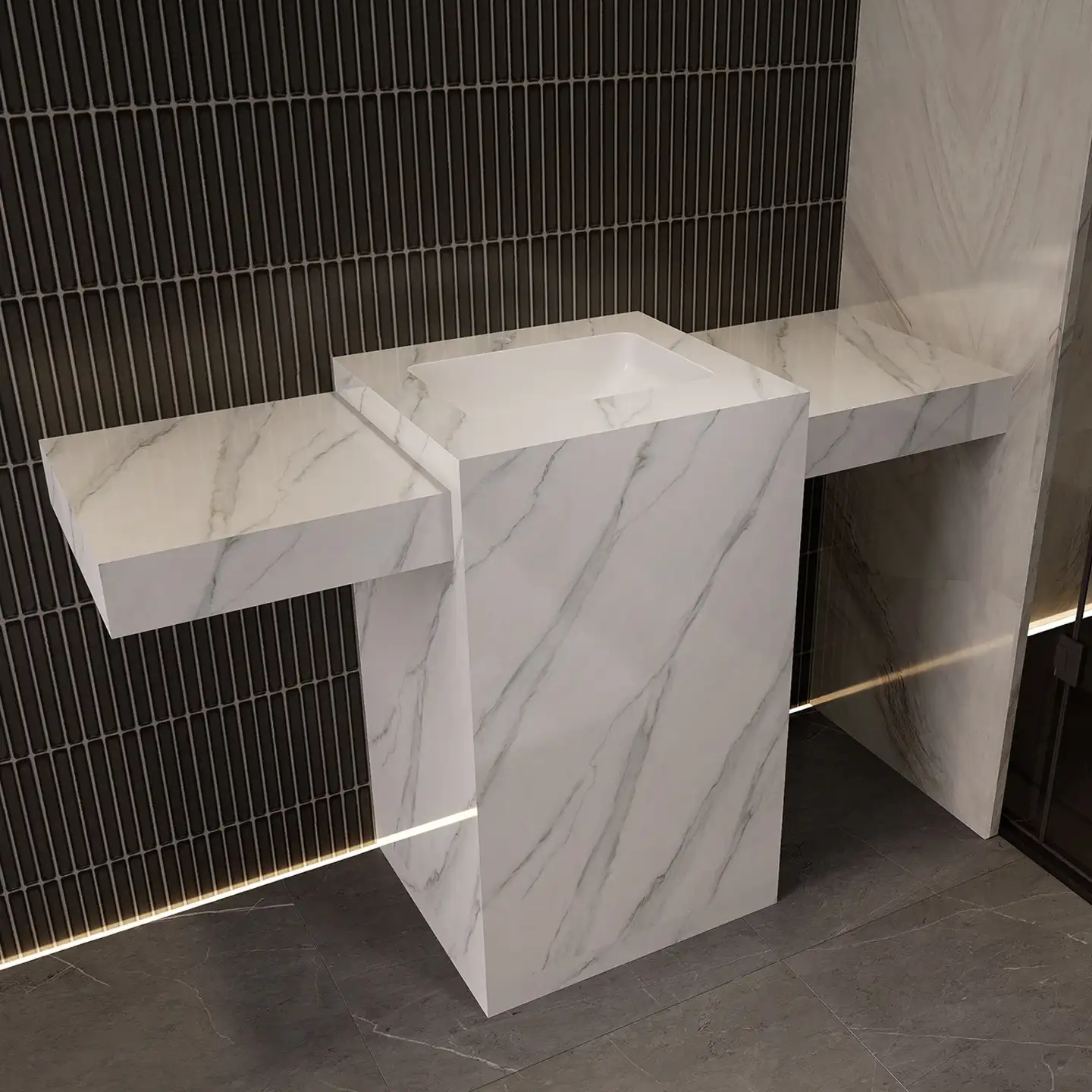
Finish matching also runs across materials, not just color codes. A set can combine a PVC cabinet, a framed mirror and a marble-veined sintered stone basin, and all three surfaces must read as one design intent under hotel lighting. The vanity catalog alone carries more than 1,000 standard finish options, which gives a matcher real room to align the trio.
Reading the MOQ Math Across Three Categories
MFBATH applies one Minimum Order Quantity (MOQ) rule across the catalog: 15 sets per model, per color, per size. The threshold holds for vanities, mirrors and sintered stone basins alike, whether the order covers one category or three. Custom color, size, material, logo or packaging work starts at the same 15-set floor.
The Minimum Complete Set
Treat the coordinated order as three MOQs standing side by side. In a nominal worked example, the smallest complete order is 15 vanities in one model, color and size, plus 15 matching mirrors, plus 15 matching basins. That is 45 pieces forming 15 complete room sets. A 200-room hotel scales the same arithmetic – 200 vanities, 200 mirrors, 200 basins – with room to split sizes across the total.
Splitting sizes does not break the rule. Mixed loading is supported, so different models and sizes can share one container as long as each SKU clears its own 15-set floor. A hotel order might pair 15 double-sink 60-inch vanities with 15 single-sink 36-inch units, then mirror the split across two mirror sizes and two basin widths.
That flexibility changes what a first order can look like. A distributor testing three regional markets can run three different vanity sizes, two mirror formats and one basin line in a single container, every SKU at exactly 15 sets. Container utilization, not the minimum order, becomes the real constraint for small multi-SKU programs. Buyers should ask for the carton dimensions early and model the fill before signing, because an under-filled box is paid for anyway.
Where Mixed Loading Changes the Math
Once every SKU clears its floor, the remaining constraint is how the cartons fit together. The walkthrough on importing bathroom vanity sets maps that container puzzle in detail. The vanity and mirror bundle guide shows how paired SKUs are standardized on one booking, and the catalog’s bathroom vanity mirror set pairings shorten the matching conversation further.
Custom programs follow the same threshold. Color, size, material, logo and packaging customization all start at 15 sets. A branded hotel set – engraved vanity, Pantone-matched mirror frame, specified basin width – can therefore begin at quantities a project can actually absorb. The factory documents more than 40,000 customization combinations, which covers most briefs without opening a new tooling conversation.
Three Categories, Three Very Different Damage Profiles
Every category in the vanity mirror basin set shipment fails in its own way. Vanities ship as boxed cabinets that fear crushing, basins are dense stone that fears point impact, and mirrors are glass that fears almost everything. Packaging that works for one category can be wrong for another. Packing specifications belong in the purchase order, not in a phone call.
Vanities: Carton Armor and Corner Protection
A vanity cabinet is a wood or PVC structure with a finish that scratches and corners that dent. Export packing typically means a corrugated carton sized to the unit, rigid corner protectors, and hardware bagged separately so hinges and handles cannot abrade door panels in transit. Plywood and solid wood lines add one more concern: dry, stable cartons that keep moisture away from edge banding and multi-layer waterproof coatings. Desiccant packs inside each carton are cheap insurance against condensation on a long ocean leg, and the packing spec should list them.
Basins: Hard Does Not Mean Unbreakable
Sintered stone rates 7-8 on the Mohs hardness scale, resists heat to 300°C, absorbs no water and holds color under UV exposure. None of that protects a thin rim from a corner strike. The material’s real weakness is edges and corners under point impact, which is why basin packing relies on foam nesting. Each basin sits cradled in shaped foam, sleeved in a carton, and packed so no two stone edges can touch. Full material background lives in the sintered stone hardness and heat resistance guide.
Weight matters at the pallet level too. A stone basin concentrates mass in a small footprint, so basins travel low in the stack and never on top of hollow cabinet cartons. Packing lists should call out carton weights, giving the loading crew what it needs to plan the floor layout before the container doors open.
The three materials fail differently, and the difference drives the packing. A hollow cabinet crushes when something heavy lands on it. Stone chips when a corner meets a hard edge. Glass cracks when the panel flexes or takes a point strike. Each failure pattern asks for a different countermeasure, which is why a single blanket packing standard for the whole set is a design error.
Mirrors: Glass Fragility Governs the Whole Plan
Mirrors are the most damage-prone SKU in the set, and the packing standard should read like it. Expect corner protection on every edge, foam layers across the face and a rigid outer frame, often a wooden crate for larger formats. Transit testing standards such as the ISTA 3A series exist exactly for this: packaged products are dropped, vibrated and compressed in the lab so they survive the road. The International Safe Transit Association (ISTA) publishes those protocols, and the mirror packaging ISTA 3A guide explains how the test maps to a mirror carton.

Smart mirrors add a second risk layer: electronics. LED drivers, touch controls and anti-fog heating mean the carton must protect both the glass and the wiring. Confirm cable strain relief and connector protection in the packing spec before the order is confirmed.
Damage Mode and Packing Countermeasure Reference
| Category | Typical damage mode | Packing countermeasure | Container position |
|---|---|---|---|
| Vanity cabinet | Corner dents, finish scratches, hardware abrasion | Fitted carton, corner protectors, bagged hardware, desiccant | Floor rows and mid-stack, kept level |
| Sintered stone basin | Edge and corner chips from point impact | Shaped foam nesting, sleeved carton, no stone-on-stone contact | Bottom layer, close to the container floor |
| Mirror | Glass cracks from corner strikes or flexing | Corner protection, foam face layers, rigid crate | Top layer or final wall, nothing stacked above |
Plan a Coordinated Vanity Set Shipment
Browse this product, solution, or service page to explore relevant offerings.

Container Loading Rules for Weight and Timing
Loading order is physics, not preference. Dense cargo – basins first, then vanities – takes the container floor, and mirrors ride on top or against the final wall. Nothing heavy should ever settle on a mirror crate. Spread weight evenly across the floor, and put the nominal plan into the loading checklist so the crew verifies position by position.
Orientation is part of the same discipline. Large glass panels travel on edge rather than flat whenever the crate design allows it, because glass tolerates vertical compression better than bending. That is standard transit practice for flat glass, and it belongs in the loading instruction sheet.
FCL or LCL for a Three-Category Set
Full Container Load (FCL) gives the set exclusive use of one container; Less-than-Container Load (LCL) shares space with other shippers’ freight. For a 200-set hotel order, FCL is the clear call. The volume fills a container on its own, and the set stays under one booking, one seal and one bill of lading. LCL suits the smallest trial orders, where sharing a container beats waiting to fill one – the container loading guide for LCL versus FCL walks through the break-even logic.
Space planning is arithmetic with nominal inputs. A 40-foot high-cube container offers roughly 67 cubic meters of usable volume – a nominal figure, since dimensions vary by unit, as the intermodal container reference documents. If one boxed room set occupies 0.55 cubic meters, a nominal assumption for this worked example, the math holds about 121 sets: 67 divided by 0.55. Real carton dimensions from the supplier replace the assumption before anyone books space.
Request two documents before that booking: actual carton dimensions and gross weight for every SKU in the set. With those, the nominal math converts into a real loading plan row by row, and the weight total can be checked against the container’s payload limit. Voids between pallets deserve dunnage or airbags so nothing shifts at sea. A container that rattles for three weeks delivers a damage claim instead of a product line.
The Production Clock and the Freight Program
FOB Qingdao – Free On Board at Qingdao port – means the factory owns cost and responsibility until the container is loaded on the vessel. From that point onward, the buyer or the buyer’s forwarder carries freight and risk. Production runs 20-30 days for a full order, and the combined production-plus-logistics window to the United States, Canada or Mexico is quoted at 4-6 weeks. Samples move faster: free samples ship in about 10 working days, the right way to approve finishes before committing the full set.
Freight terms deserve one direct question during quotation. Under MFBATH’s published factory logistics program, the factory states its logistics arrangements can save buyers roughly 15% on freight for US, Canada and Mexico shipments. Treat that as a program claim to verify for your lane and volume rather than a standing discount. It still belongs on every quotation request.
Keeping Quality and Documents Synchronized
Three categories on one order need one document spine. Draft a single spec sheet covering the vanity model, mirror model and basin model, with finish codes, dimensions, hardware and the packing standard for each. Revisions then move together across the set. A version mismatch across three separate files is how a cool-white mirror sneaks into a warm-white order.
Inspection Across the Set
Every piece passes a five-step inspection before packing; the factory describes the sequence in general terms rather than publishing each station. QC photos and video should accompany every shipment so the buyer reviews actual cartons before balance payment. Third-party inspection by SGS or TÜV can be arranged in advance for buyers who want independent eyes on the set. The quality system behind all of it holds ISO 9001 and ISO 14001 certification, first issued in 2017 and confirmed valid in 2025.
Certificate coverage continues on the product side. CE and UL certificates are held for the relevant lines, while North American project requirements such as CSA and NOM are treated as design targets rather than claimed certificates. A stated return rate below 1% serves as the factory’s track-record argument, and a two-year whole-cabinet warranty backs the vanity line.
Payment and Paperwork Sequence
The commercial sequence runs on two milestones. A 30% deposit places the order into production, and the balance falls due within one week after the draft bill of lading appears. That draft BL is the moment a shipped container becomes real paperwork. For a mixed set, one bill of lading covering all three categories keeps the bank, the customs broker and the warehouse reading the same documents.
The free 2025 catalog, more than 100 pages, is the fastest way to align models across the three categories before drafting the spec sheet. Lock the spec, schedule the inspection, and let one deposit trigger one production clock instead of three. That synchronization is the entire operational idea behind set sourcing.
Four documents carry the whole shipment. The spec sheet fixes what gets built, the packing list itemizes every SKU and carton, the inspection report records what actually shipped, and the bill of lading turns it into negotiable cargo. Itemization on the packing list matters twice: customs brokers use it to clear three product types under one entry, and claims adjusters use it to locate damaged cartons by number. Ask for a draft of each document before production starts, and correct the format once instead of fixing errors under time pressure.
Frequently Asked Questions
Can vanities, mirrors and basins ship under one bill of lading?
Yes. A mixed container booked as one shipment produces a single bill of lading and one customs entry covering all three categories, with the packing list itemizing each SKU. That is the standard setup for coordinated set orders.
Does mixed loading change the 15-set MOQ?
No. The 15-set minimum applies per model, color and size, and different SKUs can share one container. Mixing changes how cartons fill the box, never the floor each SKU must clear.
How are damage claims handled when cargo arrives?
Claims run on evidence: pre-shipment inspection records, loading photos and video, then arrival photos taken before the container is fully unloaded. Marine cargo insurance covers transit loss, and the inspection file shows whether responsibility sits with packing or handling.
Your Action Roadmap for a Coordinated Set Shipment
A three-category order fails or succeeds before the container is loaded – in the spec sheet, the packing standard and the MOQ structure. Run the sequence in order, and the vanity mirror basin set shipment behaves like one order instead of three. The roadmap below is the sequence a disciplined importer follows.
- Consolidate the three categories into one spec sheet and one supplier conversation; the free 100+ page catalog helps align models first.
- Verify the MOQ SKU by SKU – 15 sets per model, color and size – and plan the mixed container around those floors.
- Write category packing standards into the order: fitted cartons and corner protection for vanities, foam nesting for basins, crated corner protection for mirrors.
- Plan the load with nominal volume math, confirm FCL or LCL, and ask about the factory logistics program for your lane.
- Book inspection coverage before the deposit: factory QC photos and video at minimum, SGS or TÜV for independent eyes.
- Track the timeline: 20-30 days production, FOB Qingdao, 4-6 weeks to North America, balance within one week of the draft bill of lading.
- The MOQ floor is 15 sets per model, color and size in every category; a minimum complete set is 45 pieces – 15 plus 15 plus 15 – in a nominal worked example.
- Damage profiles follow the material: basins rate Mohs 7-8 but chip at the edges, mirrors need corner protection and rigid crates, vanities need corner armor and dry cartons.
- Production runs 20-30 days and North American orders quote 4-6 weeks total, FOB Qingdao; the factory logistics program claims roughly 15% freight savings on those lanes.
- Payment splits 30% deposit and balance within one week of the draft bill of lading, with one bill of lading covering the full set.
If a coordinated set sits on next quarter’s roadmap, start with the catalog and a draft mixed-container plan. Both are low-cost ways to pressure-test the math before any deposit changes hands.




0 Comments