
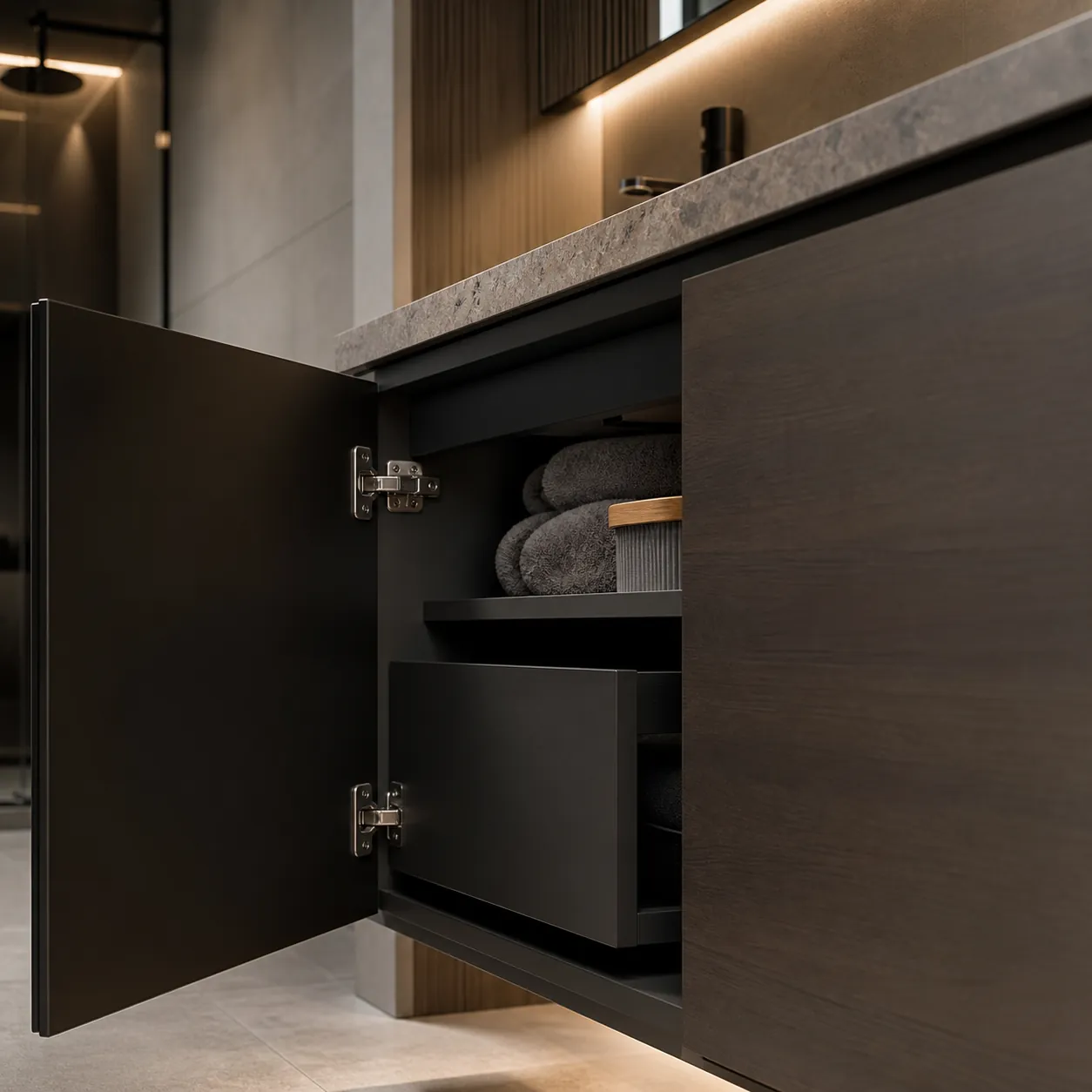
At the showroom, the soft-close demo sells the vanity. Ten seconds of drawer travel, a quiet landing, and the buyer has already decided. The callback rate is decided somewhere else: in the load rating, and in whether that rating holds up in a humid bathroom. When you are specifying undermount vs sidemount drawer slides for a vanity line, the mounting type shapes usable load, drawer width, serviceability, and cost before the first carton ships. This article compares the two systems mechanically, reads their load ratings the way a sourcing consultant would, and hands you a spec-sheet checklist to give any supplier. MFBATH has built bathroom vanities in Changge, Henan, since 2015, and specs hardware the way this article specs it: by data, not by demo.
The Two Mounting Systems, Mechanically
Side-mount slides are the workhorse of cabinet construction. A steel rail bolts to each side of the drawer box, and a matching track mounts to the cabinet side panel. Open the drawer and the rails are visible along both sides of the box, finished in whatever coating the supplier chose. Because the rails occupy space on the left and right, the drawer box itself is narrower than the cabinet opening, roughly by the footprint of two rails plus running clearance. That lost width matters more in a bathroom vanity than in a kitchen base cabinet, because vanity drawers are small to begin with: a 16-inch opening gives up a meaningful share of its width to two rails. The construction is forgiving in return. Side-mount slides attach to the drawer sides, so a simple rectangular box with stapled or screwed side joints works, the screws land in the side panels where the load path is direct, and alignment tolerances are relaxed — one reason side-mount hardware survives field assembly.
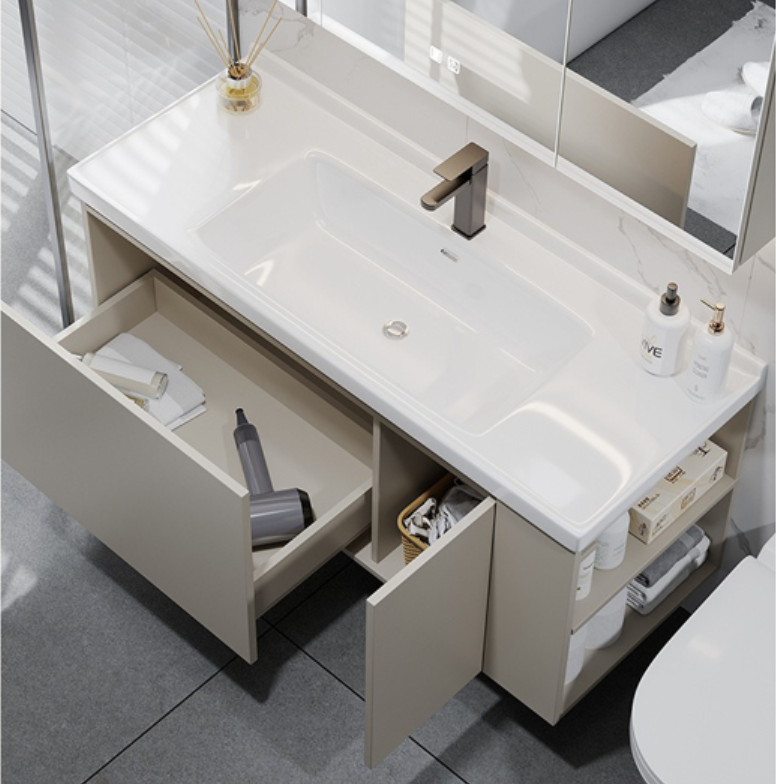
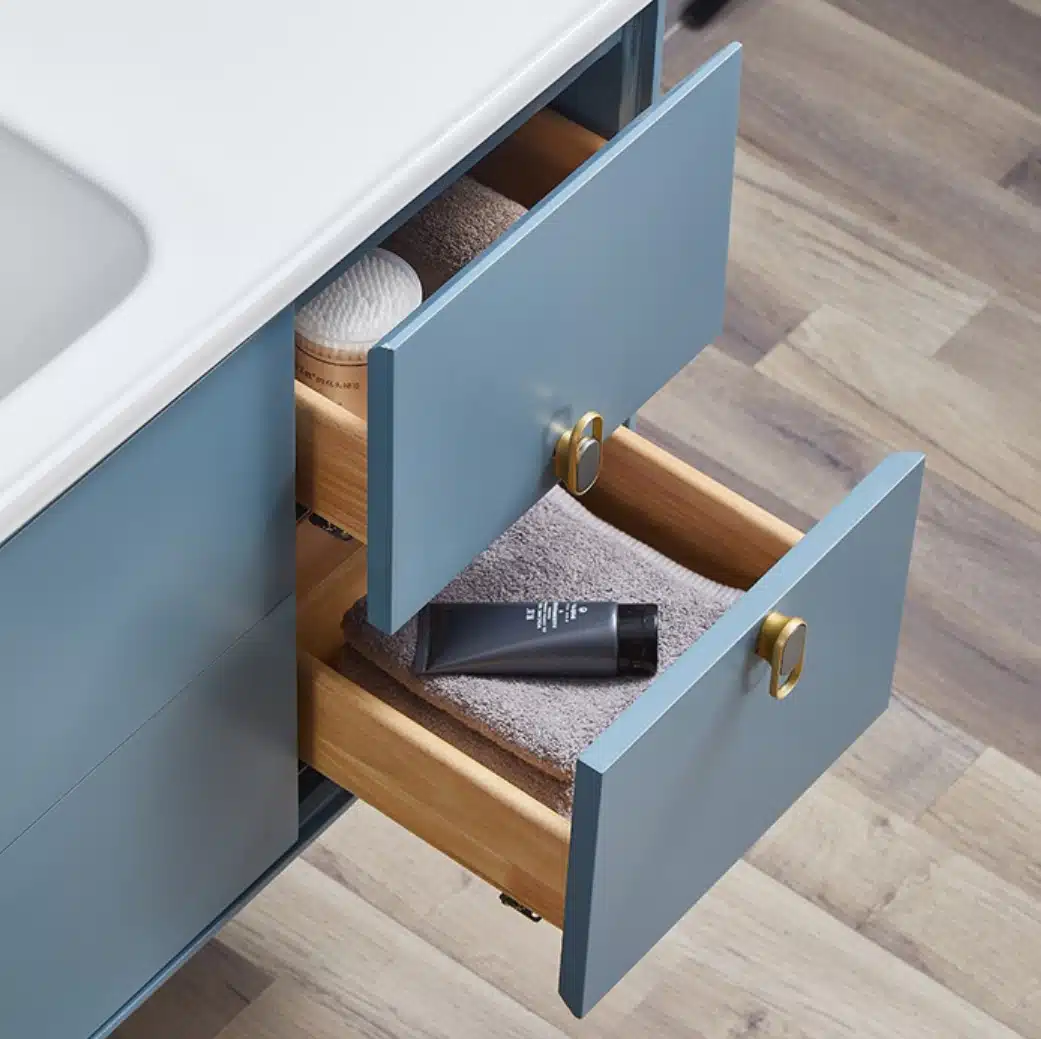
Under-mount slides sit below the drawer box, out of sight. The rails run under the drawer bottom, so the box can fill the full cabinet opening, with no rail footprint on either side. The trade-off lands in the box itself: an under-mount drawer carries its load through the bottom, which means the bottom panel and its joints to the front and back must be built to take that load, and the box needs clips or catches that lock it to the slides without racking side to side. Drawer box construction differs accordingly — thicker bottoms, reinforced joints, and precise clip placement. The width gain is real: a full-width drawer holds the towels or supplies that a side-rail box in the same opening cannot. If the terminology is new, cabinetry covers the basics of box construction and joinery.
Extension type is the second axis of the comparison. Full-extension slides pull the drawer out so the back of the box reaches the front of the cabinet opening, exposing the full drawer length. Seven-eighths extension slides stop short of that mark, leaving the last portion of the drawer inside the cabinet. In a vanity drawer holding tall bottles or stacked towels, the difference is access: full extension means reaching the back item without reaching around the drawer front. Both mounting types are available in both extension styles, and both can be specified with soft-close damping, where a damper slows the final inches of travel so the drawer lands quietly instead of slamming. Claims about what soft-close can and cannot do get repeated at every trade show; our note on soft-close drawer myths separates what the mechanism does from what the brochure says.
Where the damper lives differs by system. On side-mount slides, the damping mechanism is built into the rail or added as a cartridge on the track; on under-mount slides, it is usually integrated into the slide body and engages with a catch on the drawer. The user-facing result is the same — a controlled final approach instead of a slam — but the service part differs, and the spare cartridge should be named in the spec. Both systems accept retrofit damping kits, though a slide designed for damping from the start holds its behavior longer than one fitted afterward.
Load Ratings: What the Numbers Mean
Every slide carries two numbers in its specification: dynamic load and static load. Dynamic load is the weight the slide can carry while the drawer is moving — open, close, loaded, in motion. Static load is the weight the slide can hold at rest, with no movement. For a vanity drawer, the number that matters is dynamic: the drawer spends its life moving under load, and a slide that holds a heavy static load but sags or binds under motion is not doing its job. Our longer explanation of dynamic vs static load ratings works through both definitions with the arithmetic; read it before you compare quotes, because some catalogs print one number and some print the other.
Where do the numbers land in practice? The honest answer is that ratings vary with steel gauge, rail geometry, and manufacturer, so any figure printed here is a starting point, not a fact. As labeled examples of typical commercial specification bands: side-mount slides specified for commercial furniture commonly appear with dynamic ratings in the 75–100 lb range, and under-mount slides are often listed at 100–150 lb. Some under-mount models rate lower; some side-mount models rate higher. Treat those ranges as catalog examples only, and verify every quote against the supplier’s test report for the exact SKU you intend to buy. A test report for a different model in the same product family does not transfer to the model you are quoting.
The reference standard for cabinet hardware in North America is ANSI/BHMA A156.9: the American National Standards Institute (ANSI) standard maintained by the Builders Hardware Manufacturers Association (BHMA). A156.9 defines performance requirements and test methods for cabinet hardware, including load and cycle procedures, and suppliers who work with North American importers generally know it. The BHMA site documents the standard and the structure of the testing behind it. A test report that cites A156.9 methods gives you a common language to compare one factory’s quote against another’s, which is exactly the situation you are in when two suppliers offer the same mounting type at different prices.
Read the quote before you read the price. A quotation that lists only static load is telling you the drawer can sit loaded; it is not telling you how the drawer behaves on the way in and out. A quotation that lists dynamic load without a test method is telling you a number someone typed. A quotation with a report attached, citing the standard, is telling you what the hardware did under defined conditions. The difference between those three documents is the difference between a vanity line that stays quiet in year one and a line with a known list of complaints by year two.
Set the spec with margin. Consider a realistic hotel drawer: bath towels, a hair dryer, amenities, and occasionally a small toolkit or cleaning cloths stored by housekeeping. As a planning example, that load often lands in the 30–40 lb range — treat it as an estimate, not a measurement — and spec the slide above it. If the realistic load is 40 lb, a dynamic rating of 75 lb or higher leaves headroom for uneven stacking, guests who push the drawer past its stop, and housekeeping that overloads on a busy checkout day. The cheap conversation is the buyer who says, “Spec at 75 lb, test report attached.” The expensive one is the retrofit callback two seasons into the project.
Cycle Life and the Humidity Factor
Cycle life is the second number on the sheet, and it is arithmetic rather than marketing. A drawer opened six times a day — morning use, a couple of mid-day trips, evening — for ten years:
6 opens/day × 365 days/year × 10 years ≈ 22,000 cycles
That is plain arithmetic: a decade of ordinary bathroom use comes to roughly twenty-two thousand open-close cycles, and a commercial vanity in a hotel with daily turnover accumulates them faster. When a supplier quotes a cycle rating of 50,000 or 100,000, the number means the slide completed that many cycles in a test rig before failure or unacceptable wear. The test methods matter as much as the number: the way the rig loads the drawer, the speed of cycling, and what counts as failure all change the result. The three tests to demand from any hardware supplier — load, cycle, and finish — are covered in drawer slide standards, and they are where most of the difference between two quotes shows up.
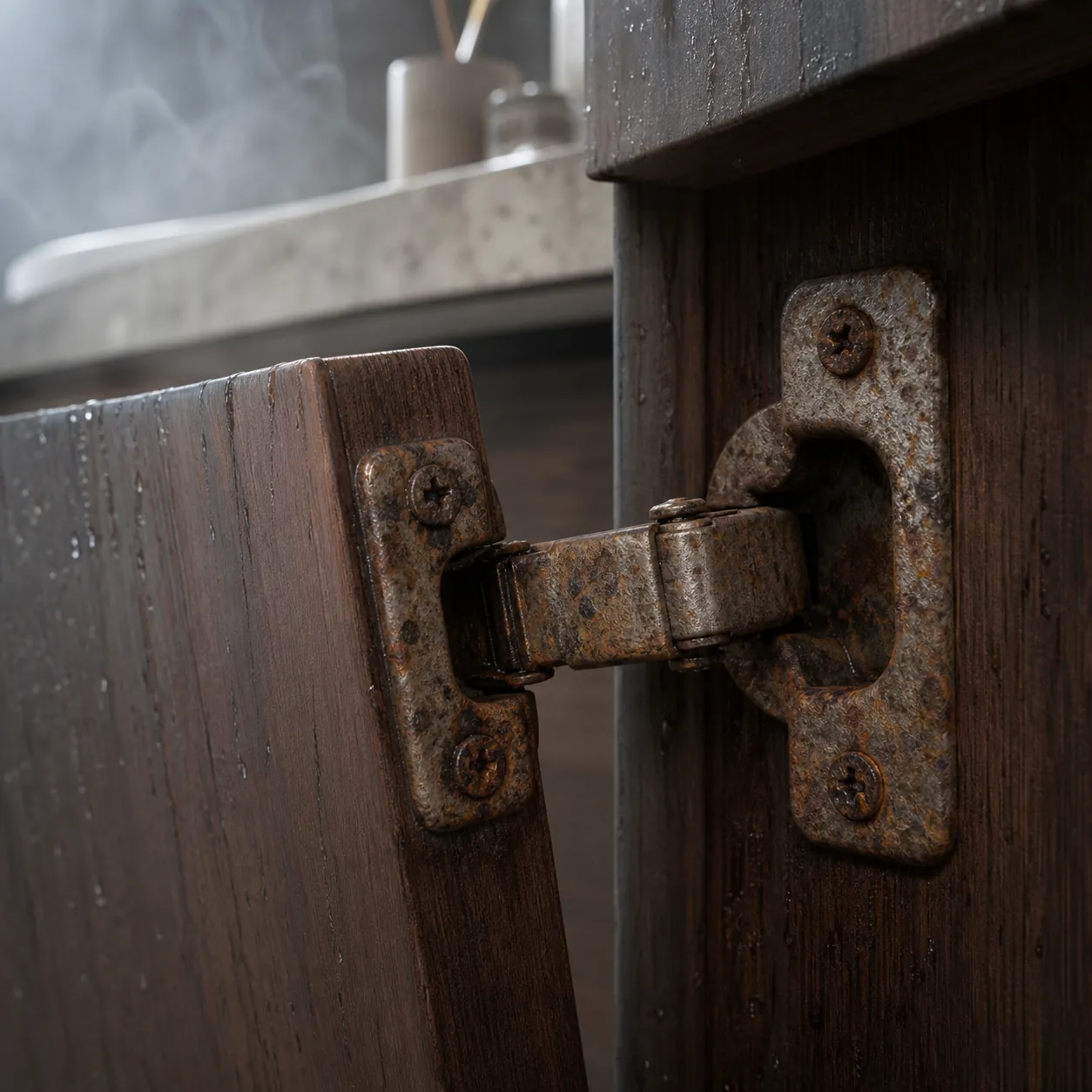
Bathroom humidity is the second stressor, and it attacks the finish before it attacks the steel. A slide that tests clean in a dry lab can show corrosion on its rails within a season in a bathroom where steam settles on cabinet hardware twice a day. Thin zinc plating with no top coat corrodes first, and corrosion changes the running surface: the drawer gets rough, then loud, then stiff, and the soft-close damper has to work harder to mask a slide that no longer moves freely. Ask for a finish specification that names the plating and any top coating, and ask for a salt-spray or humidity test result for the finish, not just for the mechanism. Our 100K cycle humidity test case explains why humidity exposure belongs inside the cycle test rather than around it: a slide that survives the cycle count in a dry lab but not in a bathroom has failed the test that matters.
Cycle failures have recognizable patterns, which is useful when a complaint comes back from the field. A slide that fails at the bracket or screw point usually failed under load or installation torque. A slide that fails at the rollers or bearings usually failed under cycles. A slide that gets stiff before it gets loose usually failed under corrosion. When a returned drawer comes back, the pattern on the rails tells your team which spec line to revisit — load rating, cycle rating, or finish — without waiting for the next batch to fail.
Factory discipline is where the spec either holds or falls apart, and it is inspectable before you commit. Every vanity MFBATH ships passes a 5-stage inspection, so hardware function is part of a per-unit check rather than a sampling event. MFBATH holds ISO 9001 and ISO 14001 certifications, in force since 2017 and current through 2025; the hardware fitted carries CE and UL marks; and CSA, NOM, and ADA requirements are design targets, not certification claims. Third-party inspection by SGS or TÜV is supported at the buyer’s request. The operating reference points: a 2-year whole-unit warranty and a return rate below 1% across shipped product. Those are factory records, not statements about any single slide.
Which Mount Fits Which Vanity Line
Both mounting systems have a place; the sourcing question is which one belongs in which line, including ready-to-assemble (RTA) programs where the end user builds the box. The table compares the two on the criteria that decide the question.
| Criterion | Side-mount | Under-mount |
|---|---|---|
| Visible aesthetics | Rails visible on both sides when the drawer opens | Hardware hidden below the drawer box |
| Drawer width / utilization | Box narrower than the opening by the rails’ footprint | Full-width drawer uses the whole opening |
| Load path and stability | Load carried through the drawer sides into the rails | Load carried through the drawer bottom into rails beneath |
| Serviceability | Rails accessible once the drawer is out; straightforward alignment | Slide hardware sits below the box; drawer removal needed for access |
| Cost position | Lower hardware cost per unit | Higher hardware cost per unit |
| Typical application | Volume and budget lines, rental units, RTA programs | Hospitality, premium retail lines |
Take a clear position: for hospitality and premium retail lines, specify under-mount with full extension. The full-width drawer is what guests and retail buyers notice, the hidden hardware photographs better in listing shots and showroom walls, and the load path suits the mixed loads a hotel drawer carries. Pair the slide decision with the door side of the same cabinet: our note on soft-close hinges for commercial bathrooms covers what to check when the door and the drawer are specified in the same order.
For budget and volume rental lines, specify a heavy-duty side-mount slide and spend the savings where the buyer sees them. A well-made side-mount slide at a sensible rating will outwork an under-mount slide that was chosen on looks and then de-rated to hit a price point. Rental units take a different kind of abuse — turnover, cleaning chemicals, furniture moves — and the side-mount’s simpler geometry and easier alignment mean fewer field complaints per thousand units.
For ready-to-assemble lines, consider install tolerance before anything else. Side-mount hardware forgives slight misalignment when an end customer assembles at home with a screwdriver; under-mount slides ask for a flatter drawer bottom and more precise box work, and the clips must seat cleanly or the drawer racks. If your RTA box quality is tight, under-mount remains an option. If it is not, side-mount protects you from the most common field complaint in flat-pack furniture: a drawer that does not run straight.
Vanities with Hardware Specs You Can Verify
Browse this product, solution, or service page to explore relevant offerings.
What to Put in the Hardware Spec Sheet
A hardware spec sheet is a contract between you and the factory. The demo in the showroom is not part of it. Here is the checklist we hand buyers who ask what to write down:
- Mounting type: under-mount or side-mount, stated explicitly with the extension type.
- Extension type: full extension or 7/8 extension, per drawer size and depth.
- Dynamic load rating with test report: the number and the document, for the exact SKU.
- Cycle-life rating: the tested cycle count and the test method behind it.
- Corrosion protection: plating and top-coat specification, with a humidity or salt-spray result.
- Soft-close damper test: damping behavior verified at rated load, not at empty weight.
- Drawer box pairing: bottom thickness, joint, and clip engagement for under-mount; side height and screw pattern for side-mount.
- Spare-parts availability: damper cartridges and slide sets purchasable after the line is in the field.
Two rows do more work than the others. The test report collapses most of the difference between two quotes, because it replaces catalog claims with a document. The spare-parts row decides whether a worn damper in year three means a service visit or a replacement cartridge by courier, which is a real cost difference when the vanities are installed across multiple floors of a hotel.
The drawer box pairing row deserves a sentence of its own, because it is the row buyers skip. Under-mount slides transfer load through the bottom panel, so the bottom board that works in a kitchen drawer will not carry the same rating in a vanity drawer with a different joint. Ask the factory for the pairing table: which slide SKU works with which bottom thickness and joint, and what the rating becomes after the pairing. Side-mount slides are less demanding, but the screw pattern and side height still need to match the box you are quoting.
Samples come before the bulk decision, and the process is short: MFBATH sends free samples within 10 working days, with the buyer covering shipping. Use the sample to test soft-close behavior with a loaded drawer, check the extension feel, and inspect the drawer box build — not to admire the finish in the showroom. Bulk production runs 20–30 days, terms are FOB Qingdao with a 30% deposit and the balance due within one week of the draft bill of lading, and total time to the US, Canada, or Mexico runs 4–6 weeks from order to arrival.
Ordering facts worth writing into your own notes: minimum order quantity (MOQ) is 15 units per model, color, and size — small enough to start a line or test a new market. Hardware customization — custom hinges, custom slides, and custom logos — is available on original equipment manufacturer (OEM) orders from those same 15 units, so an existing SKU can change its slides without changing the cabinet. The hardware finish catalog spans modern handles, classic knobs, and bar pulls in chrome and brushed nickel, which keeps the drawer face decision independent of the slide decision. Across the vanity lines, soft-close doors and drawers are available, and the catalog counts 40,000+ custom combinations across models, finishes, and hardware. The factory runs about 5,000 sets per month with a team of 95.
Frequently Asked Questions
Are under-mount slides always stronger than side-mount?
No. Load capacity comes from the specific slide’s test data — steel gauge, ball-bearing arrangement, and rail geometry — not from the mounting type alone. A heavy-duty side-mount slide can out-rate a light under-mount slide. What under-mount designs offer is width: because the rails sit below the box, the drawer can span the full cabinet opening, which often lets a wider drawer carry more usable load even at the same rating.
What cycle life should a hotel project specify?
Use typical commercial bands as guidance, not as fixed facts: side-mount and under-mount slides specified for commercial furniture commonly carry cycle ratings in the 50,000 to 100,000 range in supplier literature. Then demand the test report for the exact SKU, with the test method named. The arithmetic from earlier in this article — 6 opens a day for 10 years, about 22,000 cycles — shows that even a modest cycle rating covers normal use; the rating exists to cover the hotel’s faster turnover and the abuse a public space adds.
Can I upgrade slides on an existing vanity SKU?
Yes. Hardware customization — custom hinges, slides, and logos — is available on OEM orders from an MOQ of 15 units per model, color, and size. An existing vanity SKU can move from side-mount to under-mount, or change its extension type, at reorder, as long as the drawer box construction matches the new slide.
Specify by Data, Not by Demo
The demo sells the vanity; the spec sheet keeps it sold. The undermount vs sidemount drawer slides question settles the same way every hardware question settles: with a document. The mounting comparison does not end with “under-mount looks cleaner” — it ends with a rated slide, a test report, and a drawer box built to match. Where that leaves you:
- Spec dynamic load with margin over realistic hotel use, and hold the supplier to the test report for the exact SKU.
- Choose under-mount full extension for hospitality and premium lines; heavy-duty side-mount for budget and volume rental programs; and check install tolerance before putting under-mount slides into RTA boxes.
- Treat cycle ratings as arithmetic: 6 opens a day for 10 years is roughly 22,000 cycles, and the spec should exceed that with room for commercial turnover.
- Verify corrosion protection and soft-close damping under bathroom humidity, with per-unit inspection behind them.
None of this requires a bigger budget; it requires asking for documents you are entitled to. When you are ready to put it on paper, request a free sample — 10 working days, buyer pays shipping — and ask MFBATH for the test report on the exact slide SKU you are considering. The demo will still be the first impression; the data is what you sign. Start with the product page and work the checklist from there.




0 Comments