

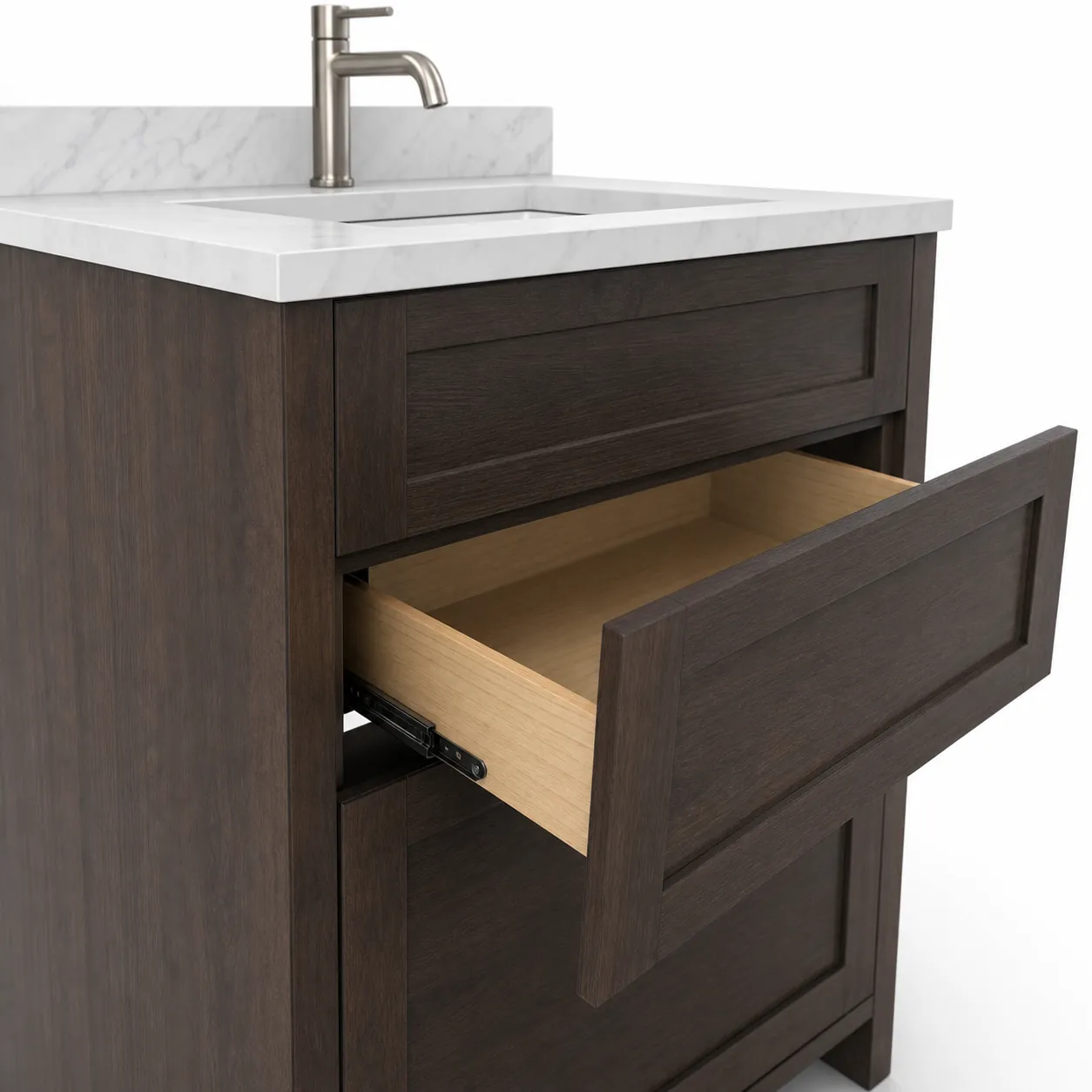
100k cycle hardware test is the first checkpoint buyers should lock before they approve a supplier, budget, or production slot. Day 1 the purchase order lands. Day 14 the pre-production sample clears sample approval. Day 45 the container arrives at the job site. Day 60 a drawer slide in the master bath starts binding. That sequence is why Focuscabinet runs a 100K cycle hardware test before signing off on the hardware used in its bathroom cabinets.
Strip the brand name off that failure and you have the anatomy of a $50K order that turned into a warranty dispute. The approved sample looked correct; the mass production run didn’t match it. Soft damping felt softer, coating thickness came in under spec, and metal-on-metal wear appeared under load. Chasing lower FOB pricing carries a quality tolerance, and humidity exposes it faster than any other condition. Focuscabinet tested hinges and slides from DTC, Blum, and unbranded alternatives in a climate chamber set at 32°C and 90% RH, cycling loaded drawers 100,000 times to compress a decade of bathroom use into four weeks.
Project buyers can pull a concrete benchmark from this bathroom vanity hardware humidity test. DTC soft-close dampers lost only 8% closing force after 100K cycles. Blum held consistent damping force throughout. The unbranded slides failed at 45K cycles, leaving visible zinc whisker growth on the runners — corrosion that eventually binds the drawer and creates the kind of commercial bathroom vanity hardware failure humidity triggers. Write this number down for your next supplier call: 80K cycles at 90% RH is Focuscabinet’s minimum hardware rating for tropical markets. A supplier that won’t share cycle-test data at that level doesn’t belong in a project spec.
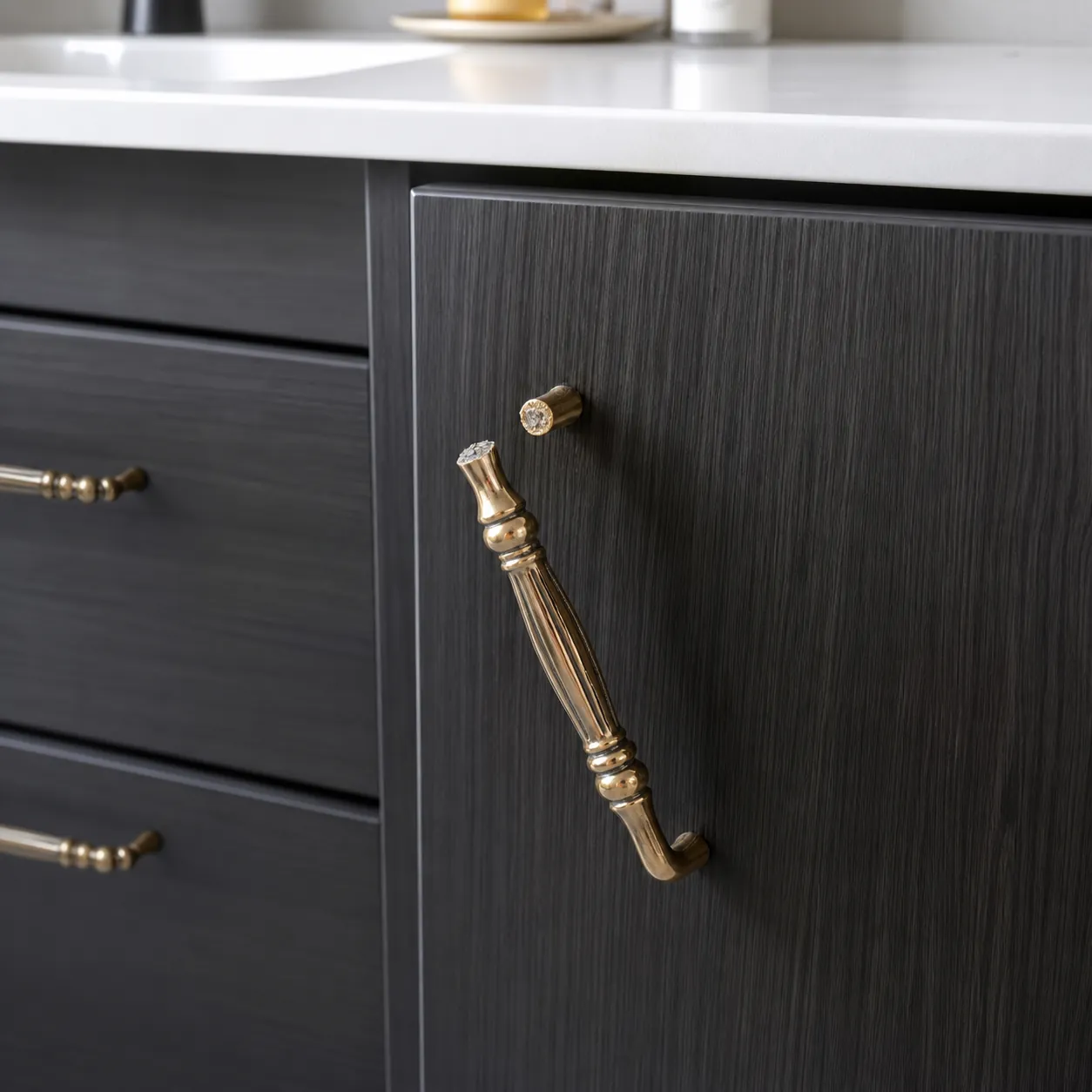
Testing Protocol: Simulating a Decade of Use in 4 Weeks
100,000 open/close cycles in 90% humidity equals roughly ten years of daily bathroom use.
A decade of bathroom use doesn’t require waiting a decade to verify. For humidity-prone markets, the failure risk sits in the hardware—hinges, slides, dampers—not the cabinet box. That’s why this test protocol locks a complete vanity into a climate chamber and runs 100,000 open/close cycles in four weeks. It is a bathroom vanity hardware humidity test built for procurement decisions.
Climate Chamber Parameters (32°C, 90% RH)
The chamber holds 32°C and 90% RH, conditions meant to mimic a Southeast Asian bathroom after a hot shower with weak exhaust. Constant moisture attacks the thin lubricants in drawer slides and the rubber seals inside soft-close dampers. Many standard cycle tests run in dry, room-temperature air. They miss the commercial bathroom vanity hardware failure humidity causes.
-
- Temperature: Held at 32°C to mimic daily heat in tropical cities, where such projects actually deploy.
- Humidity: Fixed at 90% RH, a punishing level that pressures moisture-resistant drawer slides at 90% RH to prove themselves.
- Duration: Four weeks of continuous cycling, compressing roughly ten years of daily guest or family use into one validation window.
Automated Cycle Rig with Loaded Drawers
The mechanical side matters just as much. Drawers run loaded with a weight profile that mirrors real bathroom storage: toiletries, towels, a hair dryer. An empty drawer will pass almost any test. A loaded one reveals flex, binding, and damping fade. Each cycle completes the full open and close travel, so the soft-close mechanism has to work every time, not just on a bench.
The failure mode shows up as metal-on-metal wear, sometimes with visible zinc whisker growth on low-grade slides—an early sign of binding. Generic hardware in this type of setup has failed before the 45,000-cycle mark. That is why Focuscabinet’s minimum standard for tropical markets is 80K-cycle-rated hardware, and why the 100K test runs inside the company’s 10,000㎡ Changge facility under five-stage quality control.
The same protocol records damping force continuously, and it defines the quality tolerance for damping fade. Both DTC soft-close hinges and Blum slides have been run through this rig, so the comparison in the results section is apples-to-apples. Sample approval alone cannot prove a decade of reliability; a loaded, humid, 100K cycle test is the only evidence a project procurement manager should accept.
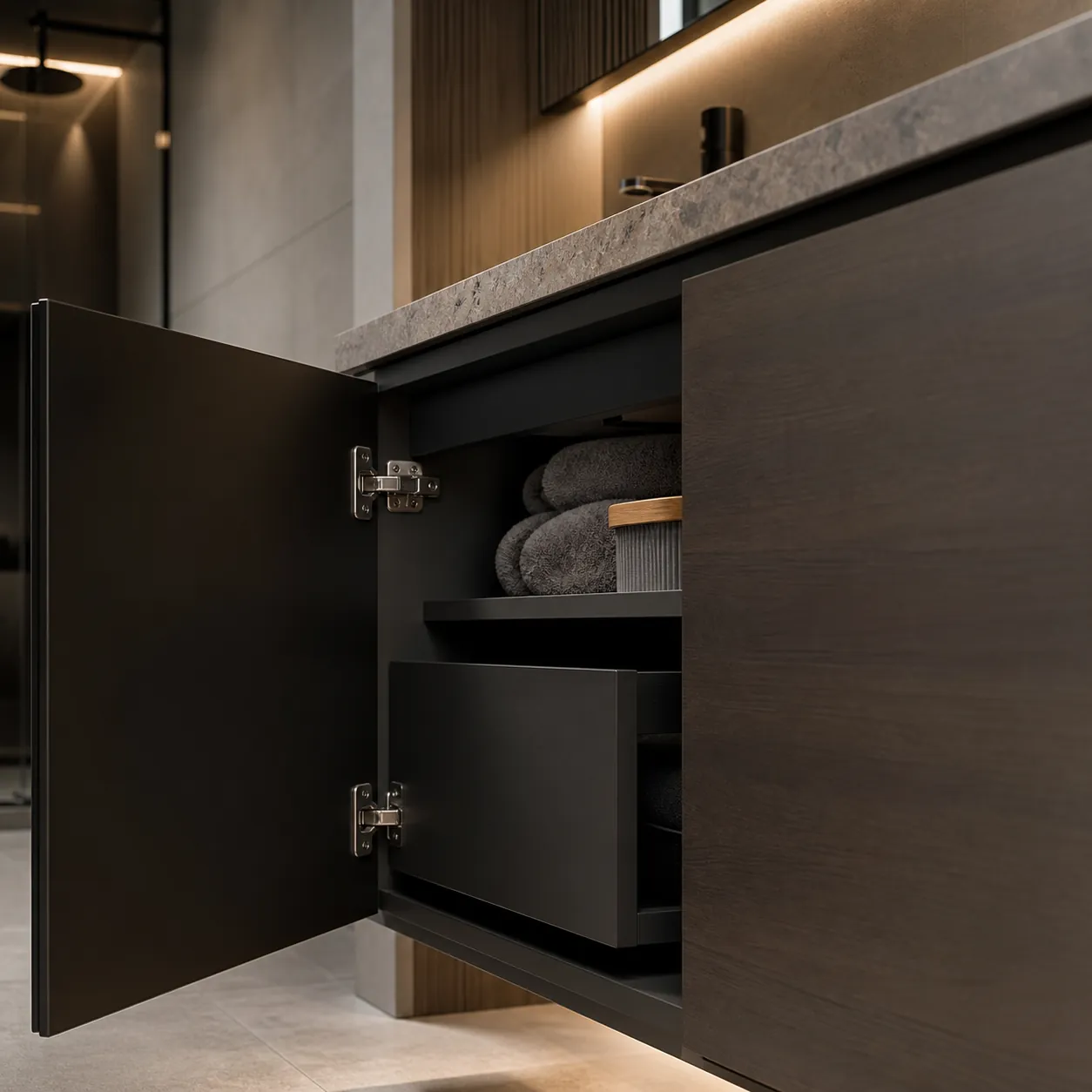
Hardware Under Test: DTC Soft-Close Hinges and Slides
Pre-test inspection flags failures that start before the first cycle does.
The test rig held two hardware groups: DTC soft-close hinges and slides, the standard fitment on Focuscabinet vanities, plus a generic unbranded set sourced to represent the lowest-cost option in the market. Every unit passed through the same initial quality assessment before the first cycle ran. Baseline data matters — without it, the 100K cycle results would be numbers with no reference point.
What the inspection measured
-
- Plating uniformity: Zinc coating across hinge cups and slide rails checked for bare spots, thin patches, and pitting against a defined quality tolerance. Surface defects like these become active corrosion sites once the climate chamber holds at 90% RH for weeks.
- Damper baseline force: Soft-close closing force recorded at cycle zero for every hinge. This is the reference point that made the 8% damping loss in DTC measurable — and made the generic failure at 45K cycles unmistakable.
- Slide travel smoothness: Lateral play and catch points checked across the first 10mm of drawer travel, the zone where binding failures typically announce themselves.
- Ball-bearing race condition: Race plating inspected under magnification. The generic slides showed uneven coverage here — the same components that later developed zinc whisker growth and binding risk after metal-on-metal wear.
The pre-test results split the two groups cleanly. DTC cleared every checkpoint, consistent with Focuscabinet’s five-stage quality control and its minimum production standard of 80K-cycle-rated hardware for tropical markets. The generic set failed inspection on plating consistency before cycling even started.
One thing the assessment could not do was predict the wear curve. It measures starting condition, not longevity — that is what the 100K cycle run exists for. But it separates the manufacturers who control their plating process from those who ship whatever the line produces. For a procurement manager, that distinction is where the real risk lives.
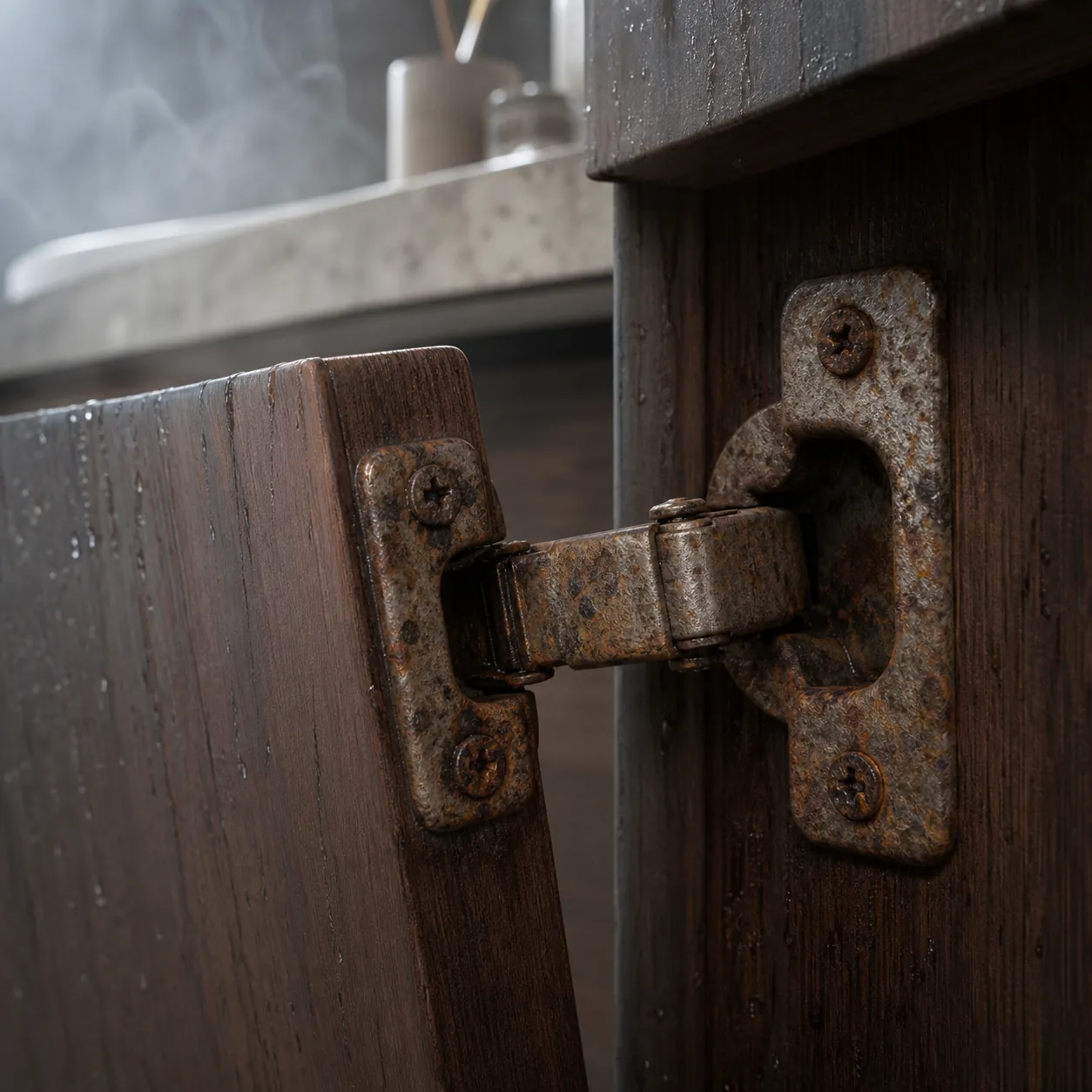
Results: Where Hardware Fails and Why
The test separated hardware tiers.
The cycle test separated hardware tiers in a way that surface inspection never could. After 100,000 open/close cycles at 32°C and 90% RH — roughly a decade of bathroom use compressed into four weeks — the damping force readings told a clear story about long-term wear, closing force, and who pays for replacement when hardware fails.
DTC Performance: Wear Patterns and Damping Degradation
DTC soft-close dampers lost only 8% of their closing force after the full 100K cycle run. The hinge bodies held up, and the damping cylinders kept their seal with no visible oil weeping. The degradation showed up as a slightly quicker final close — noticeable to a trained hand, but well within acceptable function for a mid-tier hardware line.
The failure pattern mattered more than the number. Generic alternatives in the same test didn’t reach the halfway point — they failed at 45K cycles. Metal-on-metal wear on the slide runners produced visible zinc whisker growth, which risks binding inside the drawer channel. That’s not a soft-close inconvenience; it’s a stuck drawer in a hotel bathroom at 6 AM.
Blum Upgrade: Consistent Force Throughout
Blum followed a different curve entirely. Closing force stayed consistent across all 100K cycles, with no measurable damping degradation from first cycle to last. Tighter internal tolerances and humidity-resistant materials explain the gap. For a project procurement manager, that translates into fewer warranty claims and a predictable feel that guests won’t complain about years down the line.
-
- DTC soft-close: 8% closing force loss after 100K cycles; damper sealed, structure intact, slightly faster final close.
- Blum upgrade: Zero measurable damping loss across 100K cycles; consistent feel from cycle 1 to cycle 100,000.
- Generic alternatives: Failed at 45K cycles; zinc whisker growth from metal-on-metal wear created binding risk.
The procurement takeaway is straightforward. DTC’s 8% degradation works on a 5-year horizon; Blum’s consistency makes it the safer call for a 10-year lifecycle where unbudgeted replacements erode your total cost of ownership. Focuscabinet’s minimum standard of 80K-cycle-rated hardware for tropical markets reflects this data directly. Every production batch is verified against that threshold through the company’s five-stage quality control process — so the spec you approve is the performance you get.
Implication for Project Buyers: Selecting Hardware That Survives
Broken slides show up after install, not in the sample.
The 100K cycle hardware test exists to answer one procurement question: will a vanity still function after four to six years of nightly use in a hotel bathroom? In 90% relative humidity at 32°C, DTC soft-close hinges and slides lost only 8% of damping force over 100,000 cycles. Generic alternatives failed at 45,000 cycles.
That gap changes replacement math. 45,000 cycles is where generic slides die, which for a busy hotel vanity lands inside the warranty period. DTC’s 100,000-cycle result pushes failure well past it. For a project buyer, replacing slides in year four is an unbudgeted cost with no margin recovery.
What the Test Data Means for Your Spec Sheet
The test also shows where hardware degrades first. Generic slides developed metal-on-metal wear with visible zinc whisker growth — a crystalline buildup that can bind the slide. A standard sample check won’t reveal that. This is why Focuscabinet’s production standard sets an 80K-cycle minimum for hardware going into tropical markets.
-
- Spec the cycle count: Write 80,000 cycles into your project bathroom cabinet hardware selection, not a vague ‘soft-close’ line. Ask for the test report, not a brochure mention.
- Match hardware to climate: Moisture-resistant drawer slides rated for 90% RH are non-negotiable for Southeast Asia and coastal regions. Standard dry-climate slides are not built for that load.
- Verify the damping curve: DTC retained 92% of its closing force at 100K cycles. If a quote installs generic hardware, request the same cycle data. The absence of a number is the warning.
Blum hardware held up consistently through the same 100K run, with no measurable damping degradation. That makes Blum a valid upgrade for premium projects. But for budget-targeted tenders, the data shows DTC delivers near-identical durability at a more competitive price. The choice becomes a documented performance decision, not a brand-prestige one.
At the Focuscabinet facility in Changge, Henan, the five-stage quality control protocol keeps that 80K floor enforceable before sintered stone basin vanities ship. If a supplier cannot produce the same high-humidity cycle report, the order you approved becomes the test — and you are paying for the sample run.
Conclusion
The 100K cycle hardware test under 90% RH at 32°C separated hardware that survives tropical service life from hardware that doesn’t. DTC dampers held 92% of closing force after 100,000 cycles; generic slides failed at 45,000 cycles with visible zinc whisker growth. That’s the difference between scheduled maintenance and mid-project callback.
-
- At 32°C and 90% RH, DTC soft-close hardware maintained 92% of closing force after 100,000 cycles.
- Generic drawer slides failed at 45,000 cycles, with metal-on-metal wear and visible zinc whiskers that risk binding.
- Focuscabinet uses an 80,000-cycle minimum hardware rating as the baseline for tropical and high-humidity markets.
- The test protocol loaded drawers and ran for four weeks, simulating roughly a decade of bathroom use.
Before you lock in a vanity hardware spec for a Southeast Asian project, ask your supplier for cycle-test data under 90% RH. If they only provide standard dry-cycle numbers, treat that as a red flag. Review the moisture-resistant drawer slide and hinge options on the Focuscabinet product page to match the test results to your next order.
Frequently Asked Questions
What does a 100K cycle hardware test simulate?
It simulates roughly ten years of daily bathroom use by running 100,000 open/close cycles in 90% humidity. That environment accelerates decade-long wear into a four-week lab test. Use this test to compare hardware longevity before specifying.
How long does the 100K cycle test take?
Focuscabinet condenses the test into about four weeks using a climate chamber at 32°C and 90% RH. An automated cycle rig runs loaded drawers continuously to mimic real bathroom conditions. Ask for the cycle count and load spec behind any durability claim.
Which hardware passed the 100K cycle test?
Blum soft-close hinges and slides maintained consistent damping force through the full 100K cycles. DTC hardware showed visible wear and damping degradation under the same humid load. Specify Blum or equivalent grade for high-humidity projects.
Why do drawer slides fail in humid bathrooms?
Humidity degrades lubricants and metal finishes, causing binding and loss of damping force over repeated cycles. In the test, DTC slides wore noticeably while Blum held consistent force. Require corrosion-resistant coatings on all moving hardware.
What should buyers check in hardware samples?
Check pre-test quality flags like surface finish, lubricant coverage, and damping consistency before running cycles. A pre-test inspection catches failures that start before the first cycle does. Request a cycle-test report before approving samples.




0 Comments