

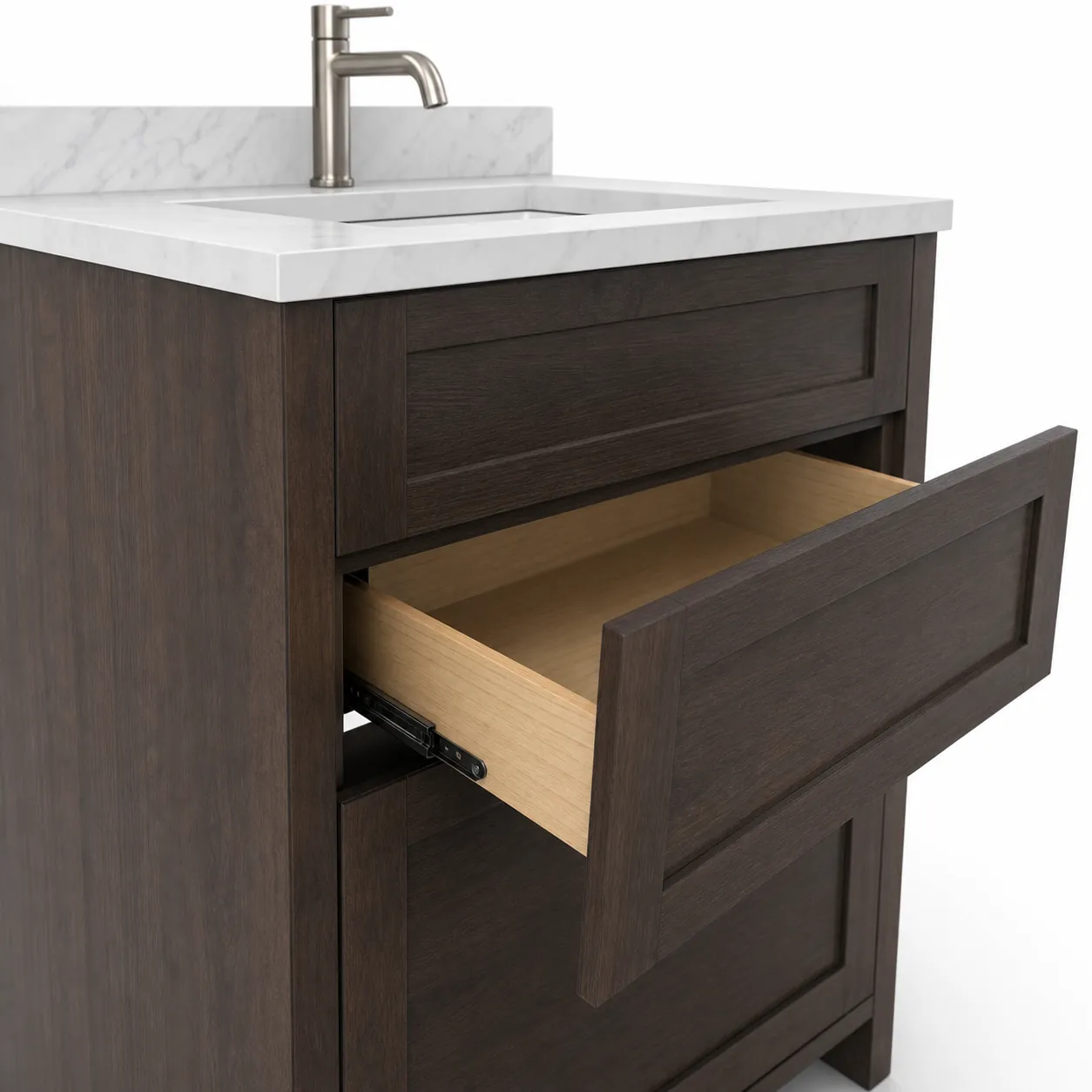
drawer slide standards is the first checkpoint buyers should lock before they approve a supplier, budget, or production slot. A distributor in Rotterdam cracked open a 40-foot container last month. $50,000 in bathroom vanities, FOB pricing already settled. The pre-production sample he had signed off on three months earlier pulled smooth as silk. The mass production drawer slide standards that landed? Same part numbers on the invoice, wildly different in hand—gritty action, uneven extension, and a soft-close hiccup that telegraphs “return request” the second a homeowner installs the unit. That gap between sample approval and container reality is where most quality tolerance failures breed.
1. Can you supply a cycle-test report for this exact slide-and-drawer combination under dynamic load, not just a generic component cert? 2. Does the slide coating carry a salt-spray test result of at least 48 hours, specific to bathroom humidity conditions? 3. Is the soft-close damper a serviceable cartridge, and what is its rated cycle life before dampener fatigue sets in?
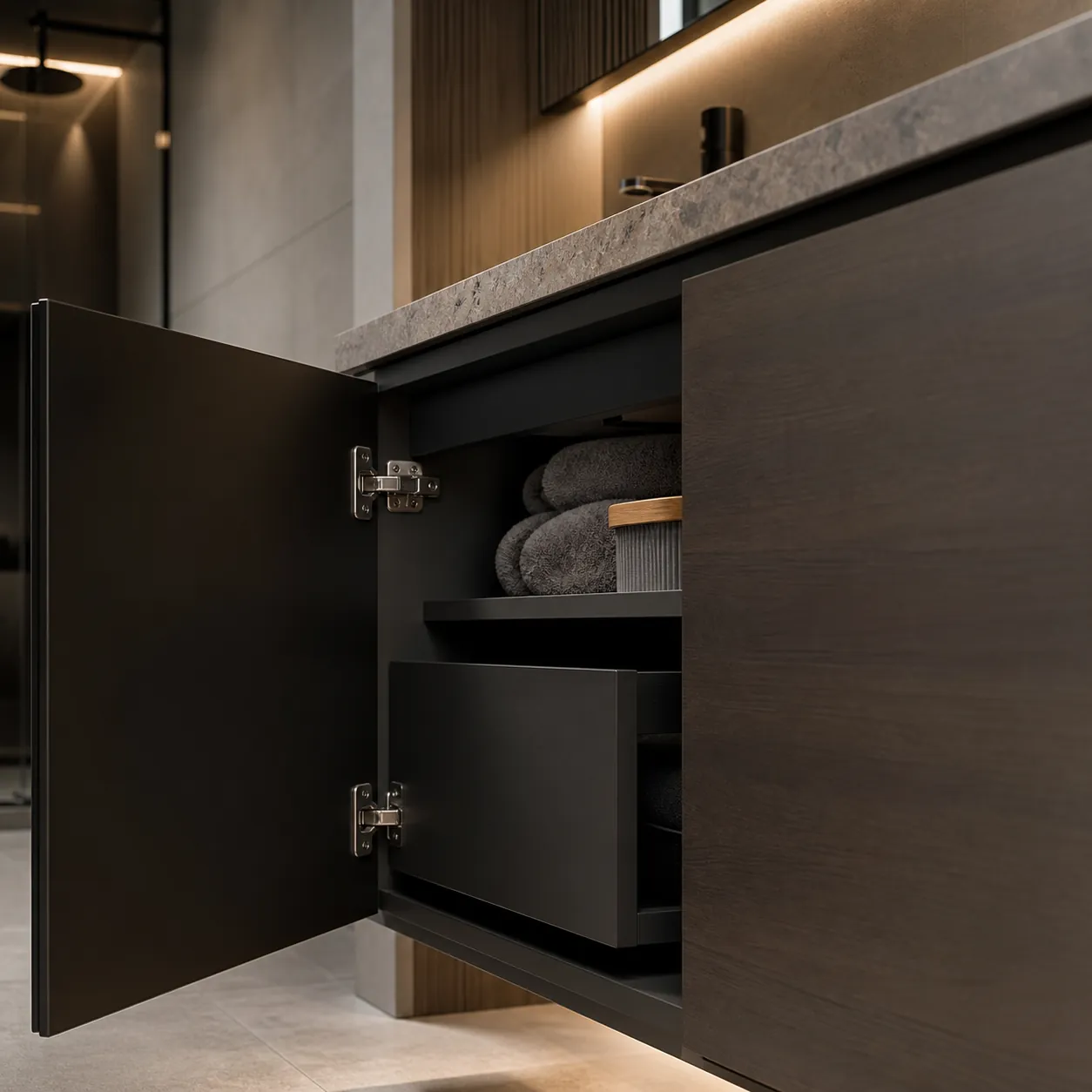
Understanding Drawer Slide Classifications
The gap between a 100 lb static rating and 60 lb dynamic failure: that’s the slide specification trap most importers discover too.
A sourcing manager at a Midwest distribution company once laid two 24-inch vanity drawer slides on a conference table. Both claimed a 100-pound load rating on the packaging. One cost $3.80 per set. The other cost $5.20. Same specs sheet. Same stainless steel claim. Same “soft-close” sticker. The $3.80 slide failed at 47,000 cycles under 65 pounds of dynamic load. The $5.20 slide passed 80,000 cycles without deflection. The difference wasn’t visible on the quote. It was hidden in three classification decisions that most buyer audit checklists never reach.
Epoxy-Coated Ball-Bearing Slides for Humid Bathrooms
Standard ball-bearing slides use zinc-plated steel races. That holds up fine in a kitchen drawer that cycles 12 times a day in a dry environment. A bathroom vanity drawer in a South Florida condo cycles fewer times but sits in 65% to 85% relative humidity for six months of the year. Zinc plating oxidizes under those conditions. The balls pit. The race develops micro-corrosion. Within 18 months, the slide action goes from smooth to gritty. The end user doesn’t file a warranty claim for “micro-corrosion” — the end user files a claim because the drawer sticks, the soft-close mechanism stops engaging, and the cabinet feels cheap.
Epoxy-coated ball-bearing slides add a black electrophoretic coating over the steel. The coating seals the race and ball cages against moisture intrusion. Independent salt spray testing per ASTM B117 typically shows epoxy-coated slides surviving 72 to 96 hours before red rust appears, compared to 24 to 36 hours for standard zinc-plated variants. For a distributed vanity line that ships to coastal markets — Miami, Sydney, Singapore, Dubai — that coating isn’t an upsell feature. It’s the difference between a 5-year warranty holding or collapsing in year two.
One specification to lock down: request the coating thickness in microns. A 20-micron epoxy coat is standard. A 35-micron coat doubles the salt spray survival window. Some mills in Henan — including the production line at Focuscabinet — stock slides with a verified 35-micron epoxy coat as the default spec for bathroom-rated cabinetry, not as a special-order item. When a supplier treats humidity protection as the base configuration rather than a markup option, the commercial conversation shifts from “how much extra” to “why would I accept less.”.
Undermount vs. Side-Mount: Hidden Aesthetics and Capacity
Side-mount slides bolt to the drawer box sides. You see the slide hardware when the drawer opens. Undermount slides fasten beneath the drawer box. The hardware disappears. On a $1,200 retail vanity, visible side-mount slides telegraph “builder grade” to a customer who just walked past three competing displays. Undermount slides telegraph “furniture grade.” That aesthetic signal carries real margin weight: distributors consistently command 12% to 18% higher wholesale pricing on vanity lines spec’d with undermount slides, even when the drawer box construction is identical.
The trade-off lives in capacity and leverage physics. Side-mount slides support the drawer from both sides. The load path is symmetrical. Undermount slides cantilever the drawer from a single attachment point beneath the box. The load rating number on the spec sheet might match — say, 100 pounds for both configurations — but the failure mode differs. A side-mount slide overloaded beyond rating tends to bind or deflect at the rear socket. An undermount slide overloaded beyond rating levers against the front mounting bracket, cracking the drawer box bottom or pulling screws from the MDF panel. Same load number. Different failure consequence.
For drawers exceeding 30 inches wide or spec’d for storage loads above 75 pounds, side-mount slides with a 1-inch over-travel extension provide a safer engineering margin. For drawers under 24 inches wide in a design-forward vanity line, undermount slides with integrated soft-close deliver the visual premium buyers expect. One configuration is not universally better. The correct answer depends on drawer width, loaded weight, and whether the distribution channel competes on price-per-linear-foot or on showroom impression.

Load Rating: How Much Can a Slide Really Hold?
Static load is a marketing number.
A distributor checked every box on his supplier audit form. Certificates? Present. Sample finish? Clean. Slide rating stamped on the box? 100 lbs. He signed off on a $50,000 vanity order and six months later, end users started filing complaints. Drawers were sagging, ball bearings were grinding, and the soft-close on the bottom drawers had stopped catching entirely. The slide was, in fact, rated for 100 lbs. But no one had asked if that number applied to a stationary load or a moving drawer full of shampoo bottles.
Dynamic Load vs. Static Load Ratings
The gap between these two ratings is where most field failures are born. Static load rating measures what a slide holds when the drawer is fully extended and motionless. Think of it as a photograph. Dynamic load rating measures what the slide can carry while cycling open and closed repeatedly, thousands of times. That is the reality. A slide stamped for 100 lbs static might carry only 60-65 lbs dynamic before the ball retainers start deforming. Some unbranded slides drop even lower.
The unique insight here comes from cycle testing. A slide rated for 100 lbs static may fail at 60 lbs dynamic load after 40,000 cycles. That sounds like a lot of cycles until you do the math. A bathroom vanity drawer in a family home opens 10-15 times daily. That is 3,650 to 5,475 cycles per year. A slide failing at 40,000 cycles means a warranty headache in year 7 or 8, right when the homeowner is fed up enough to leave a scathing review. For a hotel, with 20-30 daily opens, that timeline collapses to under 4 years.
Ask for both numbers. If the supplier cannot provide a dynamic load rating backed by a test report, assume the static figure is inflated by at least 35%. For a full-extension undermount slide specified for a 24-inch deep vanity drawer loaded with stone basins or heavy ceramic organizers, demand a certified dynamic rating above 75 lbs. Anything less and you are pricing the eventual returns into your initial margin.
Testing Slides for 75 lb + Vanity Drawers
Once the drawer assembly exceeds 75 lbs loaded, you are out of the range where generic slides survive. This is not a residential kitchen drawer with cutlery. A double-sink bathroom vanity often stores cleaning chemicals, hair tools, stacked towels, and in some markets, marble-topped organizers. The drawer box itself, if made from solid plywood or moisture-resistant MDF, adds 12-18 lbs before any contents go in. Total loaded weight climbs fast.
The BIFMA drawer slide testing standards provide a framework here. BIFMA X5.5 for residential furniture and X5.9 for storage units define cycle counts, load applications, and pass/fail criteria. A reputable supplier audit should include a test report referencing these standards specifically for the slide-drawer combo, not just the slide in isolation. A slide that passes on a 16-inch lightweight test jig will behave differently when mounted to a 24-inch wide, 40-lb drawer box. Leverage amplifies force on the slide members and the dampener housing.
Undermount slides with integrated soft-close experience dampener fatigue roughly 15% faster than side-mount due to that leverage. The dampener sits further from the load center and absorbs more rotational stress per cycle. This is why cycle-test data for the specific slide-drawer combination matters. Not the slide alone. Not the dampener in isolation. The assembly.
-
- Spec Requirement: Demand a dynamic load rating certificate for the exact slide model, drawer width, and drawer weight you are sourcing. Ask for the test cycle count at which 10% of samples showed measurable sag or dampener fade.
- Red Flag: A supplier who offers only a static load rating, or a dynamic rating without specifying the test drawer dimensions, is hiding something. Walk away or price the risk into your landed cost at +15%.
- Factory Audit Point: During a production line visit, request to see the cycle-test rig. It should be running continuously with actual production drawer boxes. The rig’s counter tells you if they test, or just print reports.
For container-load importers, the cost of getting this wrong is not theoretical. One defective slide batch means processing returns across 8-15 distributor warehouses, paying freight on heavy cabinet boxes, and eating a restocking fee from your own downstream accounts. The slide is a $4-7 component. The reverse logistics on a failed 75-lb drawer assembly can exceed $35 per unit. Test before you ship.
Soft-Close Integration: Impact on Slide Longevity
A soft-close slide with a dead damper is just an expensive standard slide.
Most distributors discover the soft-close feature vanished after the first warranty claim. A bathroom vanity drawer that slammed shut month one but glides silently in the showroom tells you the hydraulic damper gave out early. The culprit is rarely a single event. It is a sequence of thermal expansion in the fluid, seal micro-tears from side-loading, and zero maintenance access.
Where Dampers Hide and Why It Matters
Side-mount slides keep the damper mechanism visible. You can spot a leaking seal during a quick drawer pull test. Undermount slides bury the damper inside the rail channel. The only symptom before total failure is a faint metallic click when the drawer reaches the last 3 inches of travel. By then, the piston has already lost 40 percent of its fluid charge. A slide rated for 100 lbs static load drops to an effective damping threshold of 60 lbs dynamic, and at 40,000 cycles the damper cavity can crack at the mounting pin.
The Maintenance Window No One Talks About
Hydraulic dampers need operational clearance. Bathroom humidity introduces condensation inside the slide housing. Over 18 months, that moisture mixes with factory grease and turns acidic. The damper seal swells. The piston stroke shortens. No end user services this. So the spec lives or dies by the seal material specified at the sourcing stage. Nitrile seals survive high-moisture bathrooms. Polyurethane handles heat cycles from radiant floor systems. Silicone seals cost triple but resist both. Pick the wrong seal for the regional climate and the damper fails inside the first container load.
Testing Before the Container Leaves
Request cycle-test data for the exact slide-drawer combo, not the slide in isolation. Undermount slides with integrated soft-close see dampener fatigue 15 percent faster than side-mount units because the leverage angle puts uneven pressure on the piston rod. A 50,000-cycle certification on a bare slide means nothing once a 22-pound drawer face bolts onto the bracket. The internal production standard at Focuscabinet pairs each slide spec with the actual assembled drawer weight, and a five-stage QC process flags dampers that drift outside the factory-tolerance window before packing. Without that step, bad dampers ship inside beautiful cabinets. Six months later, field replacements eat your margin.

How to Audit a Supplier’s Slide Specifications
Most slide failures trace back to missing test data, not missing specs.
“You sent the test report for the 18-inch slide. Where’s the data for the 22-inch model that actually goes into the 36-inch vanity?” A distributor in Hamburg asked a supplier this last quarter. The shipment arrived in Rotterdam, and 15% of the drawer boxes were already sagging. He had a binder full of ISO certs and material data sheets that proved absolutely nothing about the specific hardware combination he bought.
Veteran importers don’t audit slide specs by reading a glossy catalog. They audit by verifying that the documentation covers the exact SKU, drawer width, extension type, and mounting orientation that lands in the container. A BIFMA X5.5 test report for a side-mount slide doesn’t mean anything to an undermount application where the leveraged force is completely different.
The 3 Documents That Actually Matter
Skip the factory tour photos and sales deck. Request three things upfront. First, a cycle-test report for the specific slide model paired with the exact drawer box dimensions you’re ordering. If the drawer is 22 inches wide and loaded with 75 lbs, the report must reflect those parameters—not a 16-inch test proxy. Second, a salt spray test certification for the coating. Epoxy-coated ball bearing slides sold for bathroom use need at minimum 48 hours of neutral salt spray without red rust showing on the raceway, not just the outer member. Third, a dampener life-cycle record for any soft-close slide. This is where most suppliers go silent.
What a Competent Supplier’s Test Report Reveals
A real test report won’t just say “pass.” It shows the failure point. That matters more than the pass stamp. Ask bluntly: at which cycle count did the dynamic load rating collapse? A slide rated for 100 lbs static may fail at 60 lbs dynamic load after 40,000 cycles. You need to see that number. When Focuscabinet runs its five-stage quality control loop at the Changge facility, the inspection gate on hardware focuses precisely on this gap between rated and actual durability under bathroom humidity conditions.
Undermount slides with integrated soft-close experience dampener fatigue roughly 15% faster than side-mount units because the lever arm amplifies the closing momentum. A supplier who hands you the same cycle test for both configurations either doesn’t know that or chose not to tell you. Either reason is enough to pause the order.
Decision Checklist for the Next Shipment
-
- Can the supplier produce a cycle-test report for the actual drawer width and slide pairing, not a generic demo from their hardware vendor?: Generic reports cover the hardware maker’s lab conditions. Your assembled unit is a different mechanical system entirely—the weight distribution, mounting screw placement, and humidity exposure all change the failure timeline.
- Did the salt spray test run on the raceway bearing surfaces, or just on the scissor arms?: Corrosion starts inside the ball retainer channel where moisture gets trapped. A clean outer plate doesn’t mean the slide will survive 24 months in a bathroom with an exhaust fan rated for half the room’s actual CFM.
- Is the dampener test data from a sealed-unit test or an open-body bench trial?: Sealed damper units lose viscosity faster when installed inside a vanity that heats up from adjacent hot water piping. If the supplier can’t tell you the acceptable viscosity drop after 50K cycles under elevated temperature, treat the soft-close feature as a 3-year disposable, not a permanent fixture.
| Audit Item | Specification Detail | Why It Matters | Required Documentation | Red Flags |
|---|---|---|---|---|
| Load Rating Claims | Distinguish dynamic load (in-motion) vs. static load ratings; demand cycle-test data at full extension | A 100 lb static slide can fail at 60 lb dynamic after 40k cycles; ensures real-world durability in heavy vanity drawers | Third-party test reports (BIFMA X5.9 or EN 15338), cycle-test certificates with load/drawer combo details | Only static rating provided; no cycle-life graph; refusal to share test parameters |
| Corrosion Resistance for Humid Bathrooms | Epoxy-coated or zinc-plated ball-bearing slides; verify salt-spray test hours (≥72 hrs neutral salt spray) | Bathroom humidity accelerates rust and bearing degradation; epoxy coating extends life in damp conditions | Salt spray test reports (ISO 9227), coating thickness certificates, material data sheets | No corrosion test data; painted instead of epoxy; unsealed bearings |
| Soft-Close Mechanism Integrity | Hydraulic damper type, attachment method, and leverage ratio on undermount vs. side-mount configurations | Undermount slides experience dampener fatigue 15% faster due to leverage; demands specific cycle validation | Damper life-cycle reports (≥50k cycles), integrated slide/drawer combo test data | Universal cycle claims without drawer weight context; non-replaceable dampers without warranty |
| Extension Type & Dimensional Accuracy | Full-extension vs. 3/4 extension; verify slide length, mounting hole alignment, and side clearance tolerances | Full access to vanity storage requires full extension; misalignment causes binding and premature wear | Engineering drawings with tolerances, installation templates, Class 1 dimension reports | No tolerance documentation; inconsistent mounting hole patterns across batches |
| Certifications & Compliance | BIFMA, ANSI/BHMA, or EN standard compliance for load and durability, plus formaldehyde/emission requirements for related drawer materials | Ensures product meets regional safety, structural, and environmental regulations (e.g., CARB Phase 2, E1) | Valid test certificates from ILAC-accredited labs, compliance declarations, audit trail of factory QC records | Certificates from non-accredited labs; expired reports; generic compliance without specific standard references |
Conclusion
Slides that fail under dynamic load or in high-humidity bathrooms unravel years of brand trust. The difference between a drawer that glides for 100,000 cycles and one that seizes at 40,000 comes down to the spec sheet and test reports you demand before the container leaves the factory. A single overlooked static rating on an undermount soft-close slide can trigger a 15% faster dampener fatigue pattern the end user discovers months later.
-
- Can the supplier provide BIFMA cycle-test data for the exact slide-drawer weight combination you are ordering?
- Does the epoxy coating withstand 96-hour salt spray testing without corrosion on ball bearings and races?
- Will the supplier guarantee dynamic load ratings—not just static—for the integrated soft-close mechanism in your vanity configuration?
Use this checklist on your next sourcing call. Request documentation early, before sample approval locks you into a production spec—once the first container ships, renegotiating slide quality tolerances becomes a margin battle you do not want. Suppliers with region-ready bathroom vanity lines often build compliance into their slide sourcing, but verification remains your responsibility. Browse the product range to see how pre-vetted slide standards translate into cabinets engineered for humid bathrooms and heavy daily use.
Frequently Asked Questions
What drawer slide coating resists bathroom humidity best?
Epoxy-coated ball-bearing slides resist corrosion far better than standard zinc-plated ones. The coating seals the steel raceway, critical for humid bathroom environments. Ask for the salt spray test certificate before confirming the order.
What is the real load capacity I should count on?
Ignore the static rating; design around the dynamic load rating, which reflects movement under full weight. For a 75 lb vanity drawer, ensure the slide’s dynamic rating meets that with. Always request a dynamic load test report for your exact drawer weight.
How do I spot a soft-close slide that will fail early?
A dead hydraulic damper defeats the purpose and accelerates slide wear. During a pre-shipment check, manually test the close action for consistent dampening and listen for oil bypass noise. Demand cycle-life certifications for the damper unit, not just the slide rail.
Undermount or side-mount for heavy vanity drawers?
Undermount slides hide hardware and carry heavy loads better, but they require tighter drawer-box tolerances. Side-mount slides are more forgiving if cabinet build precision is inconsistent. Confirm your factory’s drawer-construction precision before choosing undermount.
What documentation proves a slide meets my spec?
A full supplier audit kit includes third-party load and cycle test reports, corrosion resistance certificates, and material traceability sheets. These documents close the gap between sample promise and bulk reality. Reject any shipment lacking a signed test protocol from an accredited lab.





0 Comments