
floating vanity buying guide is the first checkpoint buyers should lock before they approve a supplier, budget, or production slot. Why does the pre-production sample always look perfect, yet the 50-unit production run arrives with drawer fronts that don’t quite align and a finish that feels different to the touch? That question has cost more than one e-commerce brand owner the entire margin on a $50,000 floating vanity order. The sample approval process should have caught it. In most cases, it didn’t because the buyer was comparing aesthetics instead of locking down the production variables that actually determine consistency.
This floating vanity buying guide is written for the brand owner who has moved past the “find a pretty cabinet” stage and into the harder work of sourcing a product that survives shipping, humidity, and customer expectations. The difference between a wall-mounted vanity that builds a brand and one that generates a wave of one-star reviews usually comes down to a few specific decisions made before you contact a supplier: dimensional accuracy, substrate selection, basin material, and regional compliance. Get those right, and the rest of the process—MOQ negotiations, sample approval, production lead times—becomes far more predictable.
The market is full of sourcing advice that treats every bathroom vanity factory as interchangeable. That assumption is exactly what burns buyers. A workshop with a few hand tools can produce a beautiful sample. Scaling that same quality across a container-load order requires something different: controlled production lines, rigorous quality checkpoints, and a factory that knows how to adapt construction to the climate where the vanity will actually be installed. Those capabilities are not visible in a product photo. You have to know what to ask for, and you have to know which answers actually matter.
A factory’s physical footprint tells you more than its website ever will. A manufacturer operating a 10,000-square-meter facility in Changge, Henan, with dedicated lines for bathroom cabinetry, sintered stone basins, and smart LED mirrors, has a structural advantage over smaller workshops that outsource each component. That distinction matters because a floating vanity is not a single product. It is a cabinet, a countertop, a basin, and sometimes an integrated mirror and lighting system, all of which must arrive coordinated. When a single factory controls more of that chain, you reduce the risk of mismatched finishes, inconsistent dimensions, and finger-pointing when something goes wrong.
Ask a supplier about their minimum order quantity early, and listen to how they answer. Many factories hide behind MOQs of 100 or 200 units because they cannot manage the production changeovers efficiently. That constraint becomes your problem when you want to test a new design, run a private-label pilot, or manage cash flow across multiple SKUs. Some manufacturers with larger facilities and flexible scheduling can offer MOQs as low as 50 units, which gives a brand owner room to validate a design before committing to a full production run. That flexibility is not a sign of lower quality—it is a sign of better production planning.
There is also the quiet trap of ignoring regional standards until the container arrives at customs. A vanity destined for North America may need cUPC certification for the basin and faucet components. European markets have their own compliance expectations, from CE marking to specific material emissions limits. A supplier that works with a “region-ready” approach—building differently for humid coastal climates, dry inland markets, or colder regions where homes are sealed tight—is worth far more than one that sells a single spec to everyone. Moisture resistance is not a nice-to-have in a floating vanity; it is the feature that determines whether the cabinet swells, the finish peels, or the doors misalign after a year of steam and splashes.
This guide walks through the dimensions, materials, compliance questions, and supplier qualifications that matter most for e-commerce brand owners sourcing floating vanities. It ends with concrete questions to ask before you commit to a supplier. If you skip those questions and rely on sample approval alone, the cost of inaction becomes measurable: a $50,000 order that should last years starts generating refund requests and negative reviews within months. The wrong material choice in a humid bathroom can show visible damage in under 12 months. The wrong MOQ can tie up capital for a design that never sells. The wrong supplier can delay your launch by 60 days while you scramble to fix issues that should have been caught during sourcing.
Sourcing a floating vanity is not just about finding a factory that can make one good sample. It is about finding a partner whose production system, compliance knowledge, and material expertise line up with the reality of your market. That distinction is the entire game, and the rest of this guide will show you exactly where to draw the lines.
What Is a Floating Vanity and Why It Matters
A floating vanity is a wall-mounted cabinet with no floor contact; the wall carries the full load.
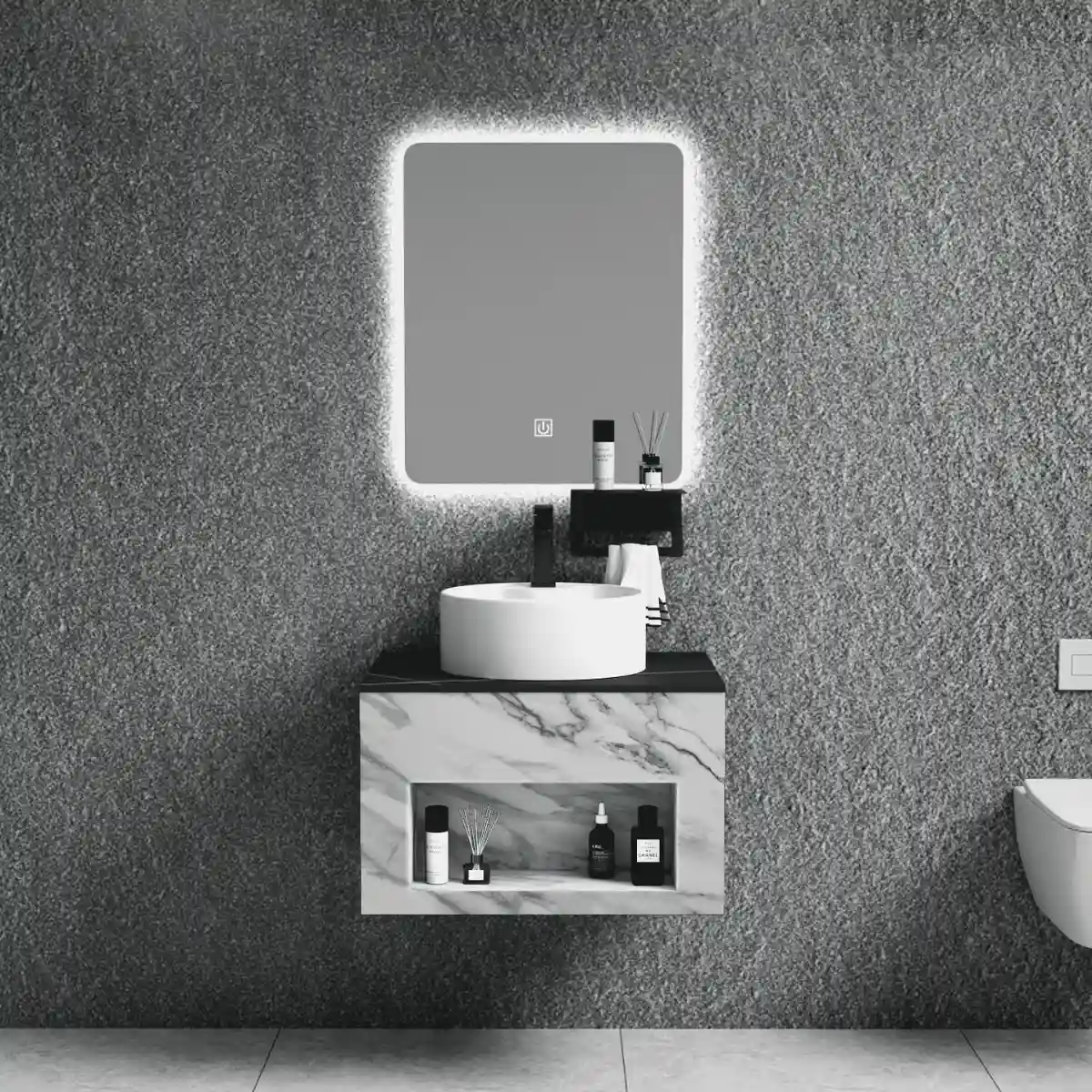
Ever signed off a pre-production sample, then watched the mass production run ship with a different wall-mount bracket pattern? That is how a floating vanity turns into a field modification nightmare. A floating vanity, also called a wall-mounted bathroom vanity, attaches directly to the structural wall using concealed brackets or a hidden frame. There are no legs, no floor support, and the space below stays open. On the surface, it is a modern look; operationally, it is an engineering decision.
For an e-commerce brand owner, floating bathroom vanity dimensions explained through photos is easy, but engineering is harder. A typical 36-inch unit with a sintered stone basin and solid countertop can exceed 90 kg once plumbing, fittings, and everyday supplies are added. The bracket set and the stud wall must carry that weight. If you sell into North America, an ADA-compliant floating vanity also needs a rim height no higher than 34 inches and at least 27 inches of clear knee space below. That only works when the wall structure is planned before you list the product.
The benefits go beyond making a bathroom look expensive. Use this list when you decide whether a floating unit fits your target market.
-
- Floor openness: No legs or toe-kick creates a continuous floor line. Cleaning is faster, the bathroom feels larger, and undereave storage becomes a styled display spot instead of a dead void.
- Mounting consistency: The steel bracket and fixing centers are the real product. Standardize the bracket pattern across your entire line so customers do not face different installation steps for each SKU. That reduces support tickets and return requests.
- Material upgrade potential: A floating vanity pairs well with a sintered stone basin. Internal production data from one bathroom furniture factory in Changge, Henan, shows sintered stone delivers roughly 30% better stain resistance than traditional ceramic, which matters on heavy-use SKUs where online reviews can make or break a listing.
- Low-Moq testing: Floating vanities use fewer side panels than floor-standing models, so production runs can be smaller. A 10,000-square-meter factory with flexible lines can hold MOQs around 50 units, letting a private label floating vanity with low MOQ test the market before committing to a container.
Insider warning: when comparing FOB quotes, ask whether the price includes the wall-mount bracket set, shims, and fixing bolts. First-time importers often discover that the bracket shipped in mass production is thinner than the sample approval. A 0.5 mm reduction in bracket steel does not change the rendering; it changes the load limit. Get the quality tolerance in writing before you place the order.
Critical Dimensions and Sizing
Standard sizes exist for a reason: they fit standard plumbing, freight-friendly boxes, and predictable rough-ins.
Most floating vanities fall into established width increments: 24, 30, 36, 48, and 60 inches in North America, and 400, 500, 550, 600, and 800 mm in metric markets. Depths sit between 18 and 21 inches (450–540 mm) because a wall-mounted cabinet has no toe-kick and needs to clear the trap while leaving walking space. If a supplier quotes something like 37.4 inches, ask what source that dimension came from. Custom sizes are fine, but they should be a deliberate choice, not the default.
-
- Depth: 18-inch depth is the practical minimum for a comfortable basin; 21-inch depth gives more counter space but reduces walking clearance in small bathrooms. In European projects, 450–500mm depth plus a wall-hung WC is the typical space-saving composition.
- Height: Floating vanities are mounted at 30–34 inches to the top surface. If you target North American commercial or multi-family sales, confirm whether the assembled height meets ADA requirements: a 34-inch maximum sink rim for forward approach, plus knee and toe clearance below the cabinet.
Here is what most dimension guides skip: the wall measurement is not the cabinet measurement. When you size a floating vanity for a bathroom, measure from the finished wall — after tile or waterproof board is installed. A 600mm cabinet designed for a 600mm rough opening will not fit if you measure from the substrate and forget the 10mm tile buildout. The same logic applies to the drain. Get the center-line of the stub-out from the finished floor and finished wall, not from the floor joist or the framing.
For e-commerce brand owners, this is not just an engineering issue. Every dimension change alters packaging, freight cube, and return risk. A non-standard 19-inch depth may look like a differentiator on the listing, but it also means custom boxes, slower fulfillment, and more damaged units in transit. If you are sourcing 50 units with a flexible MOQ, use that volume to test one standard size, prove the listing, then add variations. Lock the exact width, depth, and height into the sample approval form. If your supplier opens the door to a 10mm quality tolerance on a floating vanity, the basin will not align with the rough-in and the door will not close. Get the tolerance in writing before you pay a deposit.
| Feature | Standard Dimensions | Selection Guideline | Regional & Compliance Note |
|---|---|---|---|
| Single-Sink Width | 24″, 30″, 36″, 48″ (600–1200 mm) | Match the vanity to the available wall section; keep 4″–6″ clearance on each side for a balanced, furniture-like look | 36″ is the North America baseline; Europe commonly specs 800 mm or 1000 mm units |
| Double-Sink Width | 60″–72″ (1500–1800 mm) | Needs at least 60″ of clear wall width; confirm drain centers before ordering to avoid costly rework | Verify cUPC connection spacing for North American plumbing rough-ins |
| Depth | 16″–21″ (400–550 mm) | Balance counter surface with walkway clearance; 18″–20″ depth is the e-commerce bestseller range | Slimmer 400 mm profiles suit European compact bathrooms; deeper 550 mm supports sintered stone basins |
| Floor-to-Bottom Clearance | 10″–12″ (250–300 mm) | Creates an open-floor feel, simplifies cleaning, and allows under-vanity LED strip lighting | Typical for floating vanity wholesale sourcing guide specifications in North America and Asia |
| Counter Height (ADA) | 34″–36″ (860–915 mm) top of counter | Reserve 27″–30″ of knee clearance for wheelchair access when targeting ADA-compliant projects | ADA compliant floating vanity height is mandatory for many North American public and multifamily orders |
| Cabinet Height | 18″–21″ (460–535 mm) excluding top | Combined with a 12–15 mm sintered stone top, cabinet height determines final ADA-relevant dimensions | Confirm finished floor slope on project sites to keep consistent clearance |
| Custom Sizes & MOQ | Sized in 1″ increments; 50-unit MOQ available | Private label floating vanity with low MOQ is achievable when width changes stay within existing tooling | Confirm sample lead time and packaging specs with your wall mounted vanity MOQ China factory before bulk orders |
Material Choices: MDF, Plywood, Solid Wood, and Sintered Stone
Pre-production samples can look identical until the same cabinet swells at the cutouts — that is a core material failure.
The material spec is the first thing I check on any floating vanity quote. Wall-mounted cabinets carry their entire load through side panels and wall anchors, so the substrate needs real screw-retention strength. MDF paints beautifully and keeps FOB pricing low, but the moment moisture touches a plumbing cutout or a hinge recess, the edges swell and the cabinet starts to loosen.
Plywood with a moisture-resistant film face is the safer default for wall-mounted runs. The cross-layered veneers hold screws better, resist warping, and survive the humidity cycles that a bathroom actually produces. Solid wood looks premium but moves too much for mass production consistency. Sintered stone belongs on the top and basin, not the cabinet box — and factory test data shows sintered stone basins resist staining about 30% better than traditional ceramic under repeated coffee, tea, and hard-water exposure.
-
- MDF: Best for dry, low-humidity projects. If you use it, require sealed cutouts and screw reinforcement in the side panels before you approve the sample.
- Plywood: The practical standard for floating vanity wholesale sourcing. Higher material cost, but it protects your warranty and your brand reputation in humid markets.
- Sintered stone top and basin: Premium positioning and better stain resistance than ceramic. It also handles custom faucet cutouts cleanly for private-label designs.
Cost-versus-quality decisions only work when you compare the installed and warranty cost, not just the factory quote. MDF will show a lower unit price, but one swollen cabinet that gets returned after installation erases that saving quickly. A rough rule: if a supplier cannot tell you exactly how they seal the cutouts on an MDF cabinet, treat that as a red flag.
The real test is sample consistency. The pre-production sample can be perfect while the mass production run swaps in a thinner back panel or unsealed MDF. Ask for the same back-panel thickness in writing, verify the edge-sealing method, and specify moisture-resistant plywood for coastal or monsoon-targeted bestsellers.
| Material | Moisture Resistance | Durability & Structure | Cost vs. Quality | E-Commerce Sourcing Fit |
|---|---|---|---|---|
| MDF (Medium-Density Fiberboard) | Low to moderate — requires moisture-resistant (MR) grade, full edge sealing, and waterproof lamination to prevent swelling | Smooth machinable surface; prone to edge swelling, screw pull-out, and water damage in high-humidity bathrooms | Lowest cabinet cost; ideal for painted and trendy matte finishes, but shorter lifespan and higher return risk | Entry-level price point; lightweight for reduced freight; best for budget SKUs and fast-moving color trends |
| Plywood (Hardwood / Marine-Grade) | Good to excellent — uses waterproof (WBP) adhesive; marine-grade plywood resists delamination and fungal attack | High structural strength, superior screw-holding, and dimensional stability; resists warping better than solid wood | Mid-range cost with the best durability-per-dollar ratio; reliable for long-term bathroom use | Core catalog workhorse; fewer quality complaints, lower return rates, and strong repeat-purchase potential |
| Solid Wood (Teak, Oak, Walnut) | Species-dependent — teak and sealed oak perform well; vulnerable to cupping, cracking, and mildew without regular finish maintenance | Premium structural strength with natural wood grain; needs careful acclimation to bathroom humidity swings | Highest cabinet cost; strong perceived luxury value, but finish upkeep can trigger warranty and after-sales issues | Luxury hero products with high visual appeal; best positioned for ventilated, low-humidity bathrooms and premium listings |
| Sintered Stone (Basin & Countertop) | Non-porous with near-zero water absorption; fully impervious to moisture, mold, and mildew | Ultra-hard, scratch and heat resistant; offers 30% better stain resistance than traditional ceramic basins | Premium upfront cost, but no sealing or reglazing needed — lower lifecycle cost and minimal maintenance | High-margin premium differentiator; photogenic seamless surfaces that command attention online and boost perceived brand value |
Regional Compliance and Climate Adaptations
A beautiful vanity still fails if compliance and moisture protection were afterthoughts.
Most failed floating vanity imports are not actually failed by cabinet construction. They fail at customs, at final inspection, or after installation because the product was not built for the regulatory and climatic environment it was shipped into. A vanity that is fine in a ventilated bathroom in Warsaw can fail in a closed bathroom in Miami, and a unit with the wrong plumbing rough-in will never pass inspection in Los Angeles. Compliance and climate adaptation have to be decided before you commit to a container, not after the sample lands.
-
-
- North America: The market is driven by cUPC certification on anything that touches water, and by mounting requirements such as ADA-compliant heights. A floating vanity that leaves 27 inches of clear knee space and a basin top at no more than 34 inches above the floor is a safer bet for US buyers. The unit also needs to work with standard US plumbing rough-ins, including the waste outlet position. If the factory is not already running a cUPC production line, adding it mid-contract will stretch your timeline by months.
- Europe: European buyers work in metric dimensions and expect CE-marked electricals for smart mirrors and lighting. Basin waste diameters and concealed trap arrangements differ from US setups, and most mass-market EU vanities are built shallower because bathrooms run smaller. A region-ready supplier will switch the plumbing configuration, electrical class, and cabinet dimensions without treating it as a completely new product.
-
Humidity is the second trap, and e-commerce brand owners underestimate it more than anything else. A floating vanity leaves the floor open, which helps the room feel bigger but exposes more sides of the cabinet to damp air. In coastal states where showers run hot and exhaust fans are weak, steam sits in the room for 30 minutes after use. That cycle attacks the back panel, bottom edges, and the basin’s drain cutout first.
The basin material is not a separate decision; it affects the cabinet’s lifespan. Sintered stone basins score about 30% better on stain resistance than traditional ceramic, which matters in regions where hard water and soap scum build up quickly. A surface that resists staining also cleans faster, and for e-commerce reviews that difference shows up in the first month.
-
- Back panel: Never accept a floating vanity with an unfinished back panel. It sits inside a wall cavity and will absorb moisture from both sides. Confirm the factory seals it or applies a water-resistant membrane.
- Ventilation: In markets without mandatory exhaust fans, specify sealed plywood edges, stainless steel hinges, and a sintered stone basin that will not micro-crack under thermal shock.
The practical part of your sourcing process is the sample approval. Treat it as a compliance checkpoint, not a look-and-feel check. Ask the factory for the cUPC or CE documentation, the exact board grade, the plumbing rough-in, and the quality tolerance for each market. If the factory cannot answer those four specifics without escalation, you are not ready to place a PO.
Questions to Ask Before Contacting Suppliers
The MOQ figure is meaningless until you know if it applies per SKU, per color, or per design.
Every e-commerce brand owner asks the same first question: “What’s your MOQ?” The answer only matters once you pin down what that number covers. A wall-mounted vanity MOQ from a China factory can mean 300 units per design, per color, or per container — and those three interpretations change your capital requirement by an order of magnitude. Before comparing quotes, ask whether the MOQ applies per SKU or across a mixed order, and whether sample approval locks the specification for mass production.
-
-
- Per-SKU vs. mixed container: A 300-unit MOQ per design means 900 units across three SKUs. That ties up capital before you know which design sells. Factories with flexible production lines — such as Focuscabinet’s 10,000㎡ facility — can quote from 50 units per SKU with mixed-container consolidation, which lets you test the market without overcommitting.
- What the MOQ actually includes: Confirm whether the quoted number covers standard catalog sizes only, or custom dimensions as well. Some suppliers quote a low MOQ for stock items, then raise the minimum once you request a modification. Ask for a written production schedule that includes the quality control checkpoints between sample approval and container loading.
-
Customization is where low-MOQ factories expose their limits. A small workshop can print your logo on the mirror, but it cannot re-engineer dimensions, swap basin materials, or redesign packaging for e-commerce damage rates. Ask which parts of the product are genuinely customizable — cabinet width, basin material, mirror lighting, carton strength — and whether the factory owns those production steps or outsources them.
-
- Private label packaging: Custom cartons, foam inserts, and multilingual manuals decide whether your unboxing experience earns repeat purchases or return requests. Confirm whether packaging design is included in the unit price or billed as a separate tooling cost, and request a pre-shipment sample of the fully packed carton.
- Basin material control: Sintered stone basins offer 30% better stain resistance than traditional ceramic, but not every factory produces them in-house. If the basin comes from a third-party supplier, the quality tolerance and lead time sit outside the factory’s control. Ask who manufactures the basin before you approve the pre-production sample.
The detail that separates professionals from amateurs: ask how the supplier adapts one vanity model across markets. A factory serving 20+ countries should maintain separate specifications for North America — cUPC certification and 36-inch standard widths — versus Europe’s metric depths and CE compliance. If the supplier runs one blanket spec for every market, you inherit the compliance risk when your container hits customs. Ask to see the certification documents for your destination market before production starts, not after the goods are sitting on the dock.
Conclusion
A floating vanity order only works if the dimensions, material tolerance, and compliance spec are locked before production. A 50-unit MOQ and a five-stage inspection process give you a concrete benchmark to hold any factory against. Write those two numbers down and use them on your next supplier call.
Compare the sintered stone options and cabinet configurations on Focuscabinet’s product page to see how that benchmark translates into an actual line sheet.
Frequently Asked Questions
What sizes do floating vanities come in?
Floating vanities typically come in 24, 30, 36, 48, and 60-inch widths, with 18 to 21-inch depths. The exact sizes depend on your target market and standard plumbing rough-in, so always. Measure your space and rough-in, then confirm sizes with the supplier.
Which material is best for a moist bathroom?
Plywood is the stronger, more moisture-resistant core for panel construction than standard MDF, and sintered stone tops handle humidity better than ceramic. For coastal or high-humidity regions, specify marine-grade or. Choose based on your region and budget, not just the sample look.
What MOQ should I expect from a floating vanity supplier?
A serious manufacturer can offer flexible MOQs around 50 units for custom floating vanities, while smaller workshops often require higher minimums. The exact MOQ depends on your customization scope, materials, and. Request a quote to see the MOQ for your specific spec.
What certifications do floating vanities need for North America?
For North America, cUPC certification is the key compliance mark for the basin or faucet, and the cabinet itself should meet CARB P2 for wood panels. Regional moisture and plumbing standards also affect the final. Confirm certifications before sampling to avoid rework.
How does Focuscabinet ensure quality consistency?
Focuscabinet uses a five-stage quality control process covering incoming materials, in-process inspection, trial assembly, final inspection, and pre-shipment checks. This reduces defects and keeps production runs consistent, which matters more than any single sample. Ask for QC reports on your pre-production batch.




0 Comments