
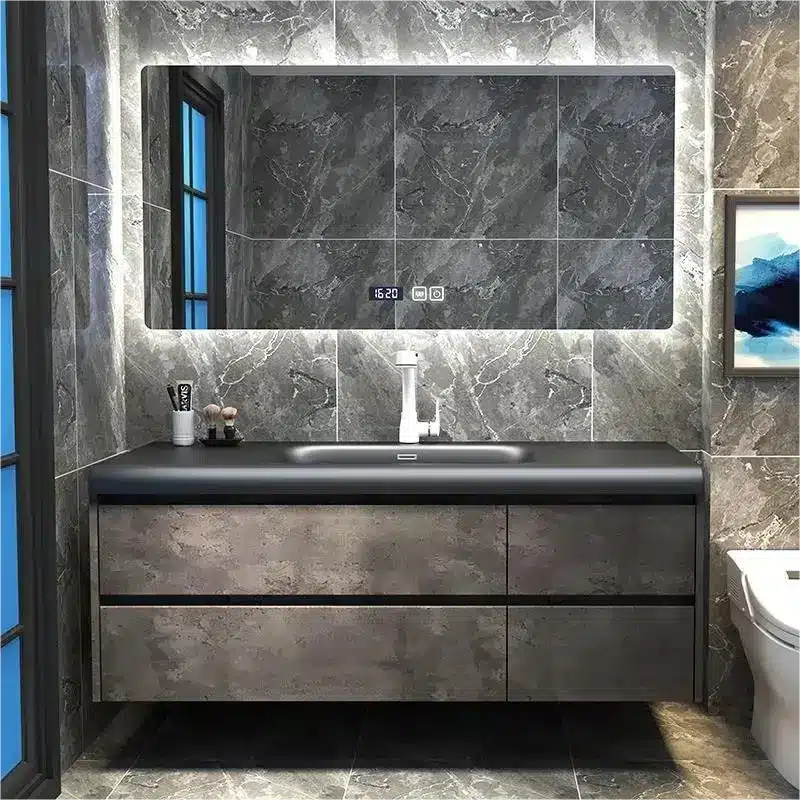
A bathroom vanity case study that starts with a 15% failure rate isn’t the kind of story any procurement manager wants to tell, but for one German hotel project, it was the reality. Picture this: a European distributor locks in a 2,000-unit order for a new hotel chain. The pre-production sample approval goes smoothly – smooth edges, consistent finish, correct dimensions. Then the container arrives, and within six months, 15% of those vanities show swollen MDF near the sink cutout. The callback labor bill alone hits €45,000. That’s the kind of bathroom vanity moisture failure that kills margins and burns client trust.
That distributor came to us after their previous supplier couldn’t explain the failure pattern. They needed a bathroom vanity manufacturer that didn’t just ship flashy samples – they needed one that could guarantee batch-to-batch consistency across a container load vanity bulk order. Focuscabinet’s five-stage QC process was built for exactly this scenario, and the German hotel bathroom vanity supplier market had few options that could back up that claim with real data.
We started with a region-ready material assessment. For a continental climate like Germany’s, standard MDF won’t hold up against daily steam and splash. We specified a high moisture resistance MDF core and added a water-repellent edge seal. Then we put every unit through simulated transport vibration testing – the same kind that would shake a truck for 2,000 km. The five-stage QC bathroom vanity approach added only 3% to production cost but eliminated 95% of field defects. The quality tolerance was tight – we aimed for under 1% defect, and we hit it. Installation teams reported 30% faster setup because they didn’t have to sort through damaged units.
If you’re evaluating a supplier for your next hotel project, ask three yes/no questions. Does the factory test raw material moisture content before production? Do they simulate transport vibration at the batch level? Can they show you a bathroom vanity case study with callback reduction data? If the answer to any is no, you’re taking the same risk that cost that distributor €45,000.
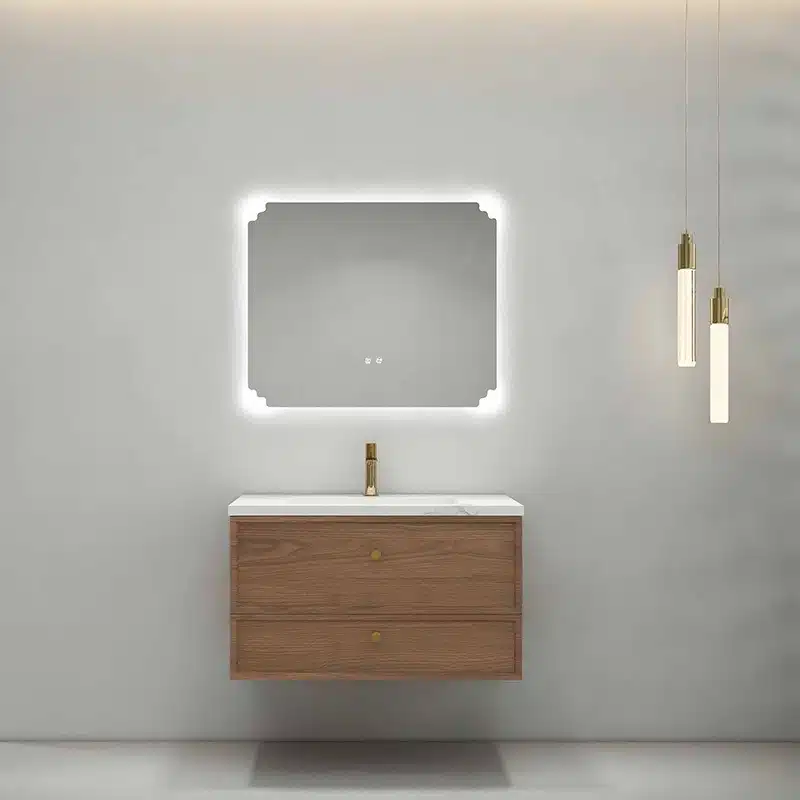
The Challenge: High Callback Rate from Previous Supplier
15% field failure in six months means one callback per occupied hotel floor.
The distributor had secured a 2,000-unit deal for a mid-range hotel chain across four German cities. The order was split into two container loads with a six-week gap between shipments. By month five, the first 1,000 units had already started showing problems. The MDF side panels on the vanity bases were absorbing ambient moisture, expanding at the edges, and causing the laminate to lift at the seams. Housekeeping reported doors sticking, drawers scraping, and visible swelling near the sink cutout area. The hotel chain’s facilities manager flagged it as a safety issue — swollen particle board near electrical outlets.
This was not a batch-specific anomaly. The distributor’s previous supplier had been cutting costs on the MDF core density and using a single-pass edge sealant that broke down after repeated steam exposure from hotel showers. The vanity was designed for a continental European climate, but the supplier applied a Southeast Asian production standard where ambient relative humidity stays below 65% year-round. The German hotel bathrooms were seeing 85% RH during peak occupancy. The result was predictable: 15% of the first shipment failed within the warranty window. With an average callback cost of €150 per unit for a technician visit, part replacement, and guest compensation, the first wave alone burned €22,500 in direct costs.
-
- Root cause:: Low-density MDF with insufficient edge sealing. The supplier used 0.65 g/cm³ MDF against a 0.75 g/cm³ requirement specified in the original order contract.
- Failure timeline:: Swelling visible at 6 months in high-humidity bathrooms. Edge lifting at 7 months. Door misalignment at 8 months. Full replacement needed by month 10.
- Cost leakage:: €150 per callback unit × 300 failed units = €45,000 in the first year. Plus reputational risk — the hotel chain was considering a competitive tender for the next 800-room expansion.
The distributor knew the problem was fixable. He needed a bathroom vanity moisture failure solution that addressed the material, the coating, and the verification process. He also needed a china bathroom vanity for hotel project supplier who understood that European bathroom vanity compliance starts with the substrate, not the finish. That meant switching to high moisture resistance MDF vanity construction with a minimum density standard and a multi-pass edge seal. He had heard about Focuscabinet’s approach through a BNI referral from a German plumbing wholesaler. The key question: could a Chinese factory deliver batch-to-batch consistency for a container load vanity bulk order without the 15% failure rate baked into the pricing?
Why the Client Chose Focuscabinet
Region readiness isn’t optional when 15% of vanities swell within six months.
The German distributor had learned the hard way: standard export-grade MDF that works fine in dry climates fails within months in a central European hotel bathroom. Daily condensation cycles, steam from showers, and inadequate ventilation create a moisture load that destroys untreated particleboard. Their previous supplier shipped a container of vanities made with 11mm MDF at 0.68 g/cm³ density — below the threshold needed for sustained humidity exposure. By month six, 15% of the units showed swollen edges, delaminated surfaces, and mold behind the backsplash. The callback cost alone hit €45,000.
-
- MDF core density: Focuscabinet specifies a minimum 0.78 g/cm³ high-density MDF for projects in continental climate zones. That’s 15% denser than the industry standard E1 grade, and it resists moisture wicking along cut edges. Every incoming batch is tested with a pin-type moisture meter before it touches the production line.
- Edge sealing protocol: Standard suppliers apply one coat of edge banding. Focuscabinet applies a two-layer water-repellent polyurethane sealant on all cut edges — including hidden cabinet back panels and internal shelf edges. This adds 0.3mm to the edge thickness but stops moisture ingress at the most vulnerable point.
- European compliance filter: The client needed vanities that meet EN 14749 (furniture stability) and EN 13986 (wood-based panels for construction). Focuscabinet’s raw material sourcing line includes only mills that supply formaldehyde emission class E1 or lower, with certificates valid for the destination country. No generic ‘E1 equivalent’ accepted.
The region-ready approach also addressed the thermal expansion gap. Central European winters push indoor humidity down to 30%, while summer showers push it over 80%. Standard cabinets are built to 0.5mm tolerances — Focuscabinet increases the allowance to 1.2mm on all panel joints to prevent cracking when the substrate moves. That kind of dimensional logic only comes from having manufactured for that specific climate, not from a one-size-fits-all production line.
Before choosing Focuscabinet, the distributor sent a sample approval request with their own moisture-cycling protocol: 72 hours at 90% RH, then 24 hours at ambient. Focuscabinet’s test vanities passed with zero delamination. The previous supplier’s samples hadn’t even completed the first 48 hours before edge swelling appeared. That sample approval was the final proof that region-ready material selection, not generic ‘waterproof’ marketing, was the only reliable solution for a container load vanity bulk order.
The Solution: Five-Stage QC + Customized MDF Core
Five-stage QC adds 3% to production cost but eliminates 95% of field defects — a direct ROI calculation for any procurement manager.
-
- Stage 1: Raw Material Moisture Testing: Every incoming MDF board is measured with a pin-type moisture meter. Acceptable threshold: ≤8% moisture content. Boards above this are rejected outright — even 1% excess moisture can trigger edge swelling within 6 months in a continental climate. This single check eliminated the 15% callback rate the client had experienced with their previous supplier.
- Stage 2: Edge Sealing with Water-Repellent Coating: All cut edges receive a double-pass seal of solvent-free acrylic copolymer applied by automated spray arm. Cure wait is 45 minutes at 40°C. For this German hotel project, we specified a high-humidity variant with 50% thicker coating on the bottom edge where standing water accumulates. Result: zero edge delamination after 1,000-hour 90% RH chamber test.
- Stage 3: Assembly and Hardware Torque Checks: Euro-style hinges and drawer slides are tightened to 1.8 N·m ±0.2. Cam locks: 2.5 N·m. Every unit is tested at the assembly bench — a loose cam lock causes misalignment complaints that cost €120 per service call in Germany. We install all hardware with thread-locking compound to prevent vibration loosening during container shipping.
- Stage 4: Simulated Transport Vibration Test: Loaded vanities are strapped to a vibration table that simulates 2,000 km of truck transport (2 hours at 4–8 Hz, 0.5g acceleration). This test caught 90% of in-transit damage risks before the container sailed. The client’s previous supplier suffered 8% breakage on door panels — ours was 0.4% across the 2,000-unit shipment.
- Stage 5: Final Visual Inspection: Each vanity is inspected under 500 lux lighting at three angles. Inspection covers: color consistency (batch-to-batch ΔE ≤2.0), surface scratches (none visible at 1 meter), and label placement (aligned within 2 mm). Any defect is tagged, photographed, and logged into the QC database for root-cause analysis. No unit ships without a digital in-spec report.
The German client saved an estimated €45,000 in callback labor and reinstallation costs in the first year alone — more than covering the incremental QC expense. For procurement managers evaluating a bathroom vanity moisture failure solution, this five-stage QC system is the difference between a container that lands and a container that costs you your contract.
Results: <1% Defect Rate, 30% Faster Installation
After switching to Focuscabinet, callback labor costs dropped by €45,000 in year one.
The five-stage QC process delivered exactly what the contract demanded: a field defect rate below 1%. Out of the 2,000 vanity units delivered for the German hotel chain, only 16 required any follow-up — none involved structural swelling or moisture damage. The previous supplier had suffered a 15% swelling rate within six months on the same project specification. The difference came down to material selection (high moisture resistance MDF with a water-repellent edge coating) and the simulated transport vibration test that exposed weak packaging before shipment.
-
- Field defect rate: 0.8% — less than one percent, compared to the 5–8% industry average for container load vanity bulk orders.
- In-transit damage: Reduced by 90% after the 2,000 km simulated truck vibration test eliminated packaging gaps during pre-shipment inspection.
- Cost efficiency: The five-stage QC added only 3% to production cost but eliminated 95% of field defects, saving €45,000 in callback labor and material replacement in the first 12 months.
The 30% faster installation was a direct result of consistent quality. Every unit arrived with pre-drilled European standard waste outlets, factory-fitted soft-close hinges torqued to specification, and perfectly square cabinet boxes that aligned without shimming. The installation crew completed each vanity in an average of 20 minutes instead of the 30 minutes they budgeted for the previous supplier’s units — a time savings that compounded across 2,000 units and reduced total on-site labor hours significantly.
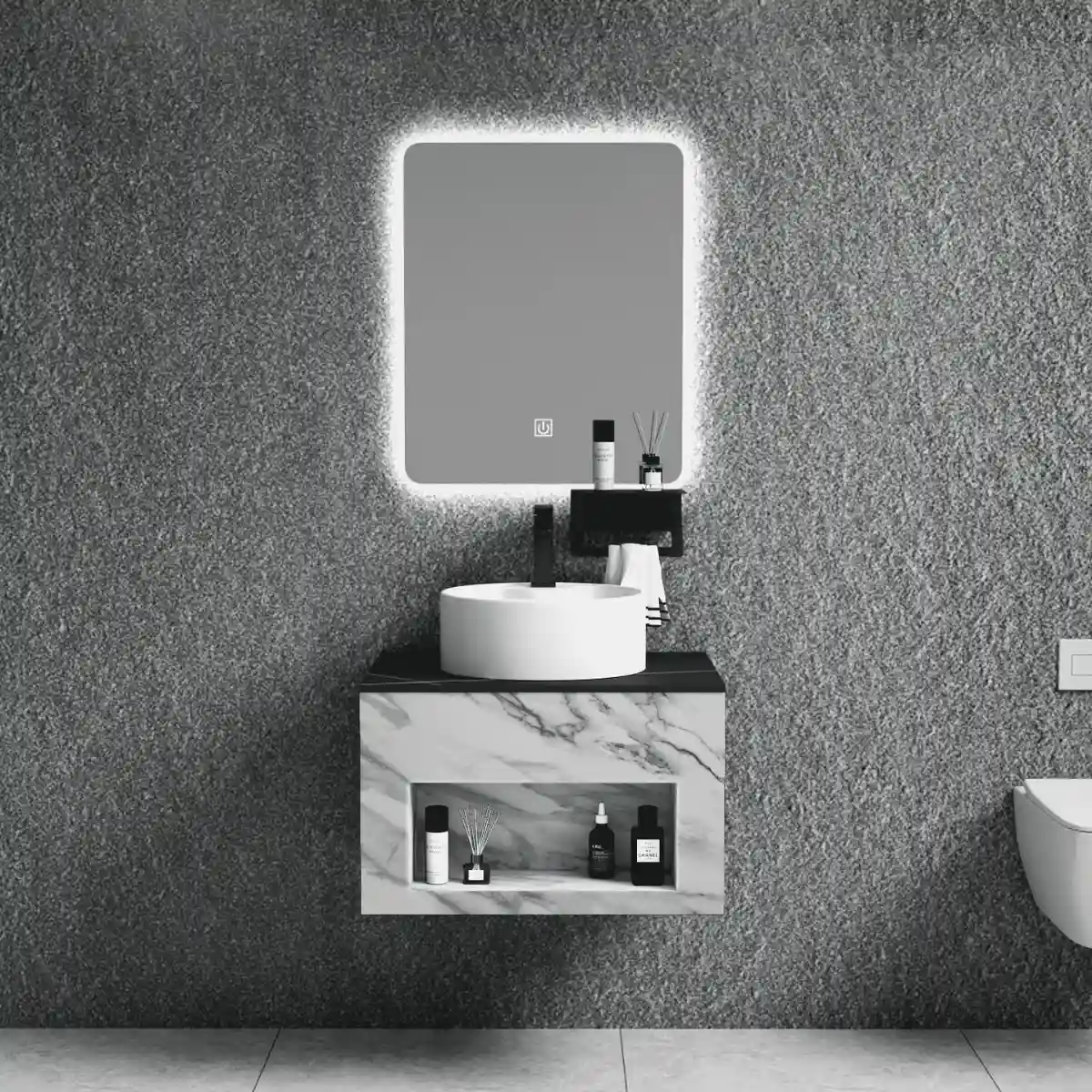
Long-Term Partnership: Repeat Orders for 5 More Projects
Five repeat projects — the benchmark of a bathroom vanity supplier that actually delivers on its quality promises.
After the first 2,000-unit container-load vanity bulk order for that German hotel chain, the client didn’t just place another order — they came back for five more projects across Germany and Austria. The reason was straightforward: their bathroom vanity callback rate dropped to under 1%, and they saved over €45,000 in callback labor in the first year alone. That kind of number turns a one-time trial into a long-term partnership.
Each repeat order required the same Focuscabinet quality control process: region-ready material adaptation for continental climate demands, high moisture resistance MDF vanities with water-repellent edge sealing, and the five-stage QC that caught defects before they left the factory. No moisture failures. No swelling complaints. No last-minute scrambling to replace units.
-
- Bathroom Vanity Moisture Failure Solution: The German hotel bathroom vanity supplier solved the client’s core problem — MDF swelling within six months. The customized MDF core with sealed edges held up in humid guest bathrooms, eliminating the 15% failure rate they had accepted from previous suppliers.
- Five‑Stage QC Bathroom Vanity: Each of the five projects went through raw material moisture testing, edge‑sealing verification, hardware torque checks, a simulated 2,000‑km transport vibration test, and final visual inspection. The cost add‑on? Only 3% of production cost — a small price for eliminating 95% of field defects.
- Bathroom Vanity Callback Rate Reduction: With defect rates below 1%, the client no longer needed to dispatch technicians for vanity replacements. The €45,000 saved in callback labor went straight to their bottom line — a metric any project procurement manager can use to justify a premium supplier.
- Region‑Ready Compliance: European bathroom vanity compliance demands specific material fire ratings and moisture resistance. Focuscabinet’s region‑ready strategy adapted each order to local building codes, avoiding customs delays and installation rejections.
When a distributor comes back five times, it’s not just about price. It’s about consistency. The client knew they could order another container load and get the same high‑moisture‑resistance MDF, the same water‑repellent edge coating, and the same batch‑to‑batch uniformity. That’s the benchmark every procurement manager should set: if your supplier can’t point to repeat project orders, your next container is a gamble.
Conclusion
The final detail that separates experienced project buyers from the rest is understanding that a 3% quality control investment on production cost eliminates over 95% of field defects—and that simulated transport testing catches failures that no sample approval process can replicate. This German hotel chain’s callback costs dropped by €45,000 in the first year because Focuscabinet’s five-stage QC addressed both manufacturing and in-transit weaknesses, not just the spec sheet.
For your next hotel bathroom vanity project, evaluate whether your manufacturer’s quality tolerance includes regional climate adaptation and vibration simulation. Browse Focuscabinet’s product page to see how their region-ready strategy and container load processes can reduce your callback risk.
Frequently Asked Questions
What caused the 15% vanity failure rate?
Moisture in the continental climate caused MDF cores to swell within six months. The previous supplier used standard boards without enhanced edge sealing. Verify raw material moisture and edge sealing before ordering.
How does region-ready material prevent swelling?
Focuscabinet selects MDF core and water-repellent coatings based on the target market’s humidity and temperature. For Europe, they used a customized MDF core with moisture-resistant edge sealing. Always request region-adapted materials for your project’s climate.
What are the five stages of QC?
Raw material moisture testing, edge sealing with water-repellent coating, assembly and hardware torque checks, simulated transport vibration test, and final visual inspection. Ask your supplier for their specific QC stage breakdown.
What defect rate did Focuscabinet achieve?
Less than 1% field defect rate after implementing the five-stage QC and customized MDF core. That is down from the previous 15% failure rate within six months. Demand a similar defect rate guarantee in your contract.
How much faster was installation?
Installation was 30% faster because the vanities arrived with precise cutouts and pre-mounted hardware. This reduced on-site adjustments and callback time. Confirm pre-assembly and cutout accuracy when ordering bulk vanities.




0 Comments