

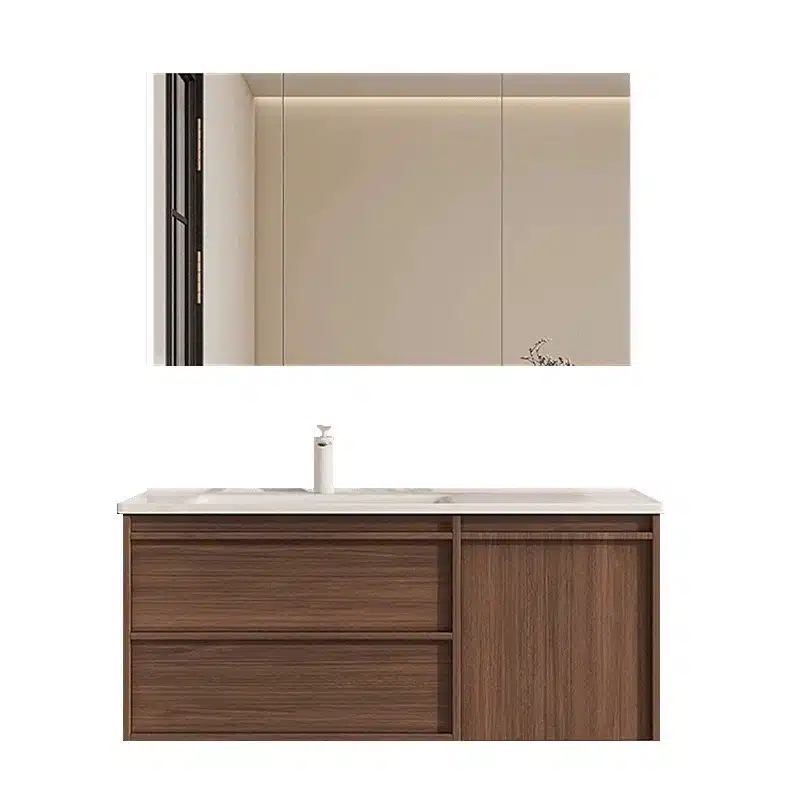
A bathroom vanity quality inspection before shipment is the only thing standing between a smooth hotel opening and a two-week delay while you source replacements locally. Most contractors skip it. They trust the sample, sign the contract, and hope for the best. That works until a container of 200 vanities arrives with drawer fronts that don’t close flush. Then the project manager is on the phone asking why floor 12 is stalled.
MFBATH operates a 10,000-square-meter factory in Changge, China, producing bathroom vanities for over 1,000 distributors across 20 countries. They run a five-stage quality control process — raw material check, in-production inspection, finished product review, packaging audit, and loading photos. That level of documentation is rare. Most Chinese factories give you a 2-to-5 day QC window before loading. If you don’t demand an AQL 2.5 standard and a full report in that window, you’re accepting whatever they ship, including units rejected from another buyer’s order.

Why Pre-Shipment Inspection Prevents Project Delays
One batch of misaligned drawers can delay a hotel floor by 2 weeks.
Most contractors calculate project risk based on unit price and lead time. They ignore the schedule impact of receiving defective goods. A single container of vanities with soft-close drawers that don’t align means every unit on that floor needs field adjustment or replacement. That’s not a one-day fix. You’re looking at re-scheduling electricians, plumbers, and finishing crews — easily a two-week delay on a 200-room floor.
The pre-shipment inspection (PSI) is the only point in the entire supply chain where you, the buyer, have leverage. Once goods leave the factory and hit the port, you lose control. Rejection at destination costs 15-25% of the order value in storage, return freight, and customs penalties. A $500 third-party inspection at the factory eliminates that risk entirely.
-
- Schedule overrun risk: A 5% defect rate on a 300-unit hotel order means 15 vanities need replacement. Each replacement takes 8-12 weeks lead time. You either delay the project or buy locally at 3x the cost.
- Control point: PSI is the only stage where you can reject non-conforming units before they’re containerized. After loading, the factory has no incentive to fix anything — their payment is secured.
- Verification window: Most factories have a 2-5 day QC window before loading. Require an AQL 2.5 inspection with photo evidence during that window. If you don’t, you’re accepting whatever they ship — including rejected units from another buyer’s order.
Real Cost Breakdown of Skipping QC
Skipping a $500 inspection can cost you $15,000 in replacement freight and penalties.
You’re managing a 300-unit hotel project. The vanities arrive from China, and 15 units have misaligned doors, chipped edges, or soft-close hinges that don’t engage. That’s a 5% defect rate — well within what many factories consider acceptable if you didn’t specify AQL 2.5 in your contract. Now you have three bad options: accept the defects and deal with complaints, force your contractor to buy locally at 3x the unit cost, or ship the defective units back.
Let’s run the math on option three. Return shipping for 15 vanities runs $2,000–$5,000 depending on your freight forwarder. Customs duties on re-import into China add roughly 25% of declared value. Then add storage fees at the port, rework labor at the factory, and the 8–12 week lead time for replacement production. Your total cost for skipping a $500 third-party inspection? Easily $15,000–$20,000 in hard costs — and that’s before you factor in project delay penalties, which in commercial construction can run $500–$2,000 per day.
The worst-case scenario isn’t a container full of garbage. It’s a container where 85% of units pass and 15% fail — because now you can’t reject the whole shipment without a fight, but you also can’t install the bad units. Your on-site crew discovers the defects during installation, which means you’re already paying for labor hours while you scramble for replacements. That’s the hidden cost that never shows up on the invoice.
-
- Inspection cost per unit: $8–$15 for a qualified third-party inspector (SGS, Bureau Veritas, or equivalent). For a 300-unit order, that’s $2,400–$4,500 — roughly 1–2% of the total container value.
- Return shipping per container: $2,000–$5,000 for a 40HQ container back to origin port, plus 25% customs duties on re-import, plus port storage fees that accumulate daily.
- Local replacement cost: When your supplier’s lead time is 8–12 weeks and you need vanities next week, local distributors charge 3x the factory price — and you still have to explain the budget overrun to your client.
- Project delay penalties: Commercial contracts often include liquidated damages of $500–$2,000 per day for missed completion dates. A two-week delay from defective vanities can wipe out your entire profit margin on the job.
The math is simple: a $500 pre-shipment inspection that catches a 5% defect rate before the container leaves the factory gives you leverage to demand rework or replacement before your project timeline is at risk. Without that inspection, you’re betting your project schedule on a supplier’s internal QC — and most suppliers have a 2–5 day loading window where they’re incentivized to ship, not to re-inspect.
| Cost Factor | Financial Impact | Hidden Risk |
|---|---|---|
| Rejected Container at Port | 15-25% of order value (storage + return fees) | Project delay penalties from client contracts |
| Third-Party Inspection (Pre-Shipment) | $500 per container | None — prevents all downstream costs |
| Emergency Local Replacement (per unit) | 3x the original factory price | 8-12 week lead time for factory replacements |
| Rework on 5% Defective Batch (300 units) | $5,000+ in rework + shipping | Loss of volume discount on rejected units |
| Warranty Claim Without QC Evidence | Full replacement cost (no leverage) | Supplier denies responsibility, no documentation |
Inspection Checklist: What to Check Before Loading
Skipping packaging inspection is the #1 cause of damage claims.
You’ve approved the sample. The factory has produced 200 units. Now, before they load the container, you need to verify that every vanity matches the spec you signed off on. Most damage and defect claims originate from this final window — not from poor manufacturing, but from a rushed or skipped inspection. Here is exactly what to check, in order of failure frequency.
-
- Visual finish & edge banding: Inspect under direct light at a 45° angle. Look for bubbles, delamination, or color inconsistency between the cabinet body and the door. Edge banding must be seamless — no lifting at corners. For PVC vanities, check that the foil wrap has no pinholes or blistering. For solid wood, verify grain direction matches the approved sample. Any mismatch here means the unit fails the sample approval contract.
- Hardware: hinge thickness & material: Hinges must be minimum 2.0mm cold-rolled steel. Use a caliper to verify. Anything under 1.8mm will sag within 18 months on a standard 18mm door. Confirm hinges are soft-close rated. Open the door to 45° and release — it should close silently within 3 seconds. If it slams or takes longer than 5 seconds, the damping mechanism is defective. For drawer slides, demand 304 stainless steel. A magnet test is insufficient; request the supplier’s material certificate or a third-party composition test.
- Drawer slide & soft-close function: Fully extend each drawer. Apply 15kg of downward pressure at the front edge while opening and closing. The slide should not deflect more than 2mm vertically. For soft-close, pull the drawer halfway and push gently — the mechanism should engage and retract smoothly. If the drawer wobbles laterally more than 3mm when fully extended, the slide is undersized or the mounting bracket is loose.
- Door gap tolerance & drawer alignment: Measure the gap between doors and between door and frame using a feeler gauge or 1.5mm spacer. Acceptable tolerance is ±1.5mm. A gap larger than 3mm on one side indicates warped door or misaligned hinges. For drawers, check that the front face is flush with the cabinet frame within 1mm. Use a straightedge across 3 adjacent drawer fronts — any deviation over 2mm means the drawer box is not square.
- Countertop load-bearing test: Place a 50kg weight (or equivalent sandbag) centered on the countertop for 5 minutes. Measure deflection at the front edge using a dial indicator. Maximum acceptable deflection is 2mm. After removing the weight, check for permanent deformation, cracking, or delamination of the edge banding. For sintered stone tops, also check for any hairline cracks around the sink cutout — these indicate stress fractures from poor CNC programming.
- Packaging: corrugated box strength: All export vanities must ship in double-wall corrugated boxes with a minimum burst strength of 32 ECT (edge crush test). Single-wall boxes will collapse under container stacking pressure. Verify the box stamp or request the factory’s box specification sheet. For mirror packaging, require at least 50mm expanded polyethylene foam on all four corners and a separate corrugated sleeve around the mirror face. Mirrors packed with only paper wrap have a 40% damage rate in cross-ocean shipping.
- Container loading density: For a 40HQ container, expect 60-70 single-sink vanity units. More than 70 means the factory is compressing packaging or using undersized boxes. Ask for a loading plan photo showing the first row and the last row. If the last row has visible gaps or unstable stacking, request re-packing before the container seals. Also verify that the container has a fumigation certificate (ISPM 15) — without it, customs in Australia, New Zealand, or the EU will hold the container for 2-3 weeks.
For hotel projects with 200+ identical vanities, you cannot rely on random sampling alone. Require 100% inspection of door alignment and drawer function — these two checkpoints account for 70% of field installation delays. For smaller orders (10-50 units), AQL 2.5 random sampling is acceptable, but demand photo evidence of the inspection for every 5th unit. If the factory cannot provide a signed QC report with photos at each of the five stages — raw material, in-production, finished product, packaging, loading — do not authorize shipment.
AQL Standards vs. Random Sampling: What Contractors Must Demand
Without AQL 2.5 in your contract, you’re accepting whatever your supplier decides to ship.
Most contractors know they should inspect before shipment. Few know how to define what ‘acceptable’ actually means. That’s where AQL — Acceptable Quality Limit — comes in. AQL is a statistical sampling standard (ANSI/ASQ Z1.4) that tells your supplier exactly how many defects are allowed in a batch. Without it, your inspection is just a visual walkthrough with no pass/fail threshold.
For bathroom vanities, the industry standard is AQL 2.5 for major defects. That means in a random sample of 200 units, you can accept up to 10 units with major defects — and the entire batch still passes. Critical defects (safety issues like a cracked countertop or exposed wiring) must be 0% — no tolerance. Minor defects (small scratches, slight color variation) are typically capped at 4.0%.
-
- Critical defects (0%): Structural cracks, exposed electrical components, broken hinges, missing hardware that prevents installation. Zero tolerance. Any critical defect = reject the entire lot.
- Major defects (AQL 2.5): Door gap > ±1.5mm, soft-close mechanism fails, drawer misalignment > 2mm, delaminated edge banding, countertop surface damage. Up to 2.5% of sampled units can have these and the batch passes.
- Minor defects (AQL 4.0): Small paint specks under 2mm, slight color mismatch within approved tolerance, minor packaging scuffs. Up to 4.0% allowed. These are cosmetic and usually acceptable for commercial projects.
Here’s where most contractors get burned: a factory using random sampling without a defined AQL may ship a batch with 10% minor defects and call it ‘normal variation.’ That’s 30 defective vanities on a 300-unit order — enough to delay an entire floor installation. You need to specify AQL 2.5 in your purchase contract and demand a QC report showing the actual defect count per category.
For hotel projects with 200+ identical vanities, don’t rely on random sampling alone. Require 100% inspection of door alignment and hinge function — those two failures cause the most on-site rework. For smaller orders (under 100 units), AQL 2.5 random sampling is sufficient, but make sure the sample size follows the ANSI standard table, not the factory’s ‘we checked 5 pieces’ shortcut.

How to Execute a PSI Without Leaving Your Office
A remote PSI with the right protocol catches 95% of defects before your container leaves the factory gate.
You don’t need to fly to China to run a pre-shipment inspection. Three methods work, and each gives you a different level of control. Pick the one that matches your order size and risk tolerance.
-
- Third-party inspection (SGS, Bureau Verista, TÜV): Costs $400–$700 per container for a standard AQL 2.5 inspection. Booking requires 5–7 working days advance notice. The inspector arrives unannounced, pulls a random sample per ANSI/ASQ Z1.4, and issues a pass/fail report within 48 hours. You get photos of defects, measurement data, and a certificate you can use for warranty claims. Best for orders over 100 units or when you have no existing relationship with the factory.
- Video call walkthrough with the factory QC manager: Free, but requires a cooperative supplier. Schedule a 30-minute call during the loading window. Ask the QC manager to show: (1) the edge banding on three random cabinets — look for gaps or bubbles, (2) the hinge stamp to confirm 2.0mm steel thickness, (3) the drawer slide brand and material (304 stainless steel only), (4) the door gap measurement using a feeler gauge — tolerance must be ±1.5mm, and (5) the packaging — double-wall corrugated box with 50mm foam corners. If the factory hesitates on any item, that’s a red flag.
- Factory’s own 5-stage QC report with photos: This is the lowest-cost option but only works if the factory has a documented process. Require timestamped photos at five stages: raw material (show board thickness and hinge batch), in-production (show CNC routing and edge banding), finished product (show full vanity assembled with countertop), packaging (show foam placement and box closure), and loading (show container condition and blocking). Cross-check the dimensions and finish against your sample approval document. If any photo is missing or looks staged, escalate to method 1 or 2.
Most Chinese factories have a 2–5 day QC window before the container is sealed. If you haven’t submitted your inspection request or video call time slot within that window, the goods ship without any third-party oversight. That’s how a batch with 10% misaligned doors ends up on your job site.
Conclusion
A pre-shipment inspection isn’t a formality—it’s the only control point you have before a container leaves the factory. A $500 third-party check using AQL 2.5 sampling can save you $5,000+ in rework, storage fees, and project penalties. The checklist we covered—hinge thickness, door gaps, packaging specs, and load-bearing tests—gives you a repeatable system to enforce quality across 50 or 500 units.
If your current supplier can’t provide a 5-stage QC report with loading photos, you’re accepting blind risk. Review the commercial vanity product line and factory QC process to see how documented inspection protocols protect your project timeline.
Frequently Asked Questions
Who makes the highest quality bathroom vanities?
Manufacturers with rigorous five-stage quality control and high-precision CNC facilities, like MFBATH, consistently produce the highest quality vanities. The best choice also depends on your target market’s specific climate and compliance needs. Verify the factory’s QC process and regional certifications before ordering.
Is ceramic or quartz better for a bathroom vanity?
Sintered stone, which is a more durable evolution of ceramic, is better for high-traffic bathrooms due to its non-porous, scratch-resistant, and heat-resistant properties. Quartz is also durable but can be more susceptible to. Choose sintered stone for maximum durability and low maintenance.
What is the best material for a bathroom vanity unit?
The best material depends on your climate: PVC is 100% waterproof for humid areas, while solid wood offers premium aesthetics for dry, controlled environments. For a balance of moisture resistance and cost. Match the material to your region’s humidity and temperature extremes.
Where can I find good quality bathroom vanities?
Direct manufacturers in China with a proven track record, like MFBATH which serves over 1,000 distributors globally, offer high quality with factory-direct pricing. Look for suppliers that provide a five-stage quality control process and. Always request a pre-shipment inspection report before loading.
What is the downside of ceramic coating?
Standard ceramic coatings can chip or crack under heavy impact, unlike sintered stone which is fused under extreme heat for superior durability. Additionally, cheaper ceramic basins may not withstand extreme temperature. Opt for sintered stone if impact and thermal resistance are critical.





0 Comments