
mdf bathroom vanity moisture is the first checkpoint buyers should lock before they approve a supplier, budget, or production slot. Every project contractor faces the same calculation: can an MDF bathroom vanity handle the moisture in a hotel bathroom without triggering callbacks? The answer is more nuanced than price sheets suggest. MDF offers a smooth, paint-ready surface at 20-30% lower unit cost than plywood, but that saving disappears if the first batch swells within 12 months. The real question isn’t whether MDF works — it’s whether your supplier treats the edges properly.
Standard melamine-faced MDF shipped from most factories seals only the visible surfaces. The top, bottom, and plumbing cutouts stay raw. That’s where moisture wicks in, swelling the core and delaminating the finish. A manufacturer with five-stage quality control, like MFBATH’s facility in Changge, can apply six-sided sealing and use moisture-resistant MDF cores — but you have to specify it explicitly in the PO. The difference between a vanity that survives five years in a coastal hotel and one that crumbles after a year is exactly that specification detail.
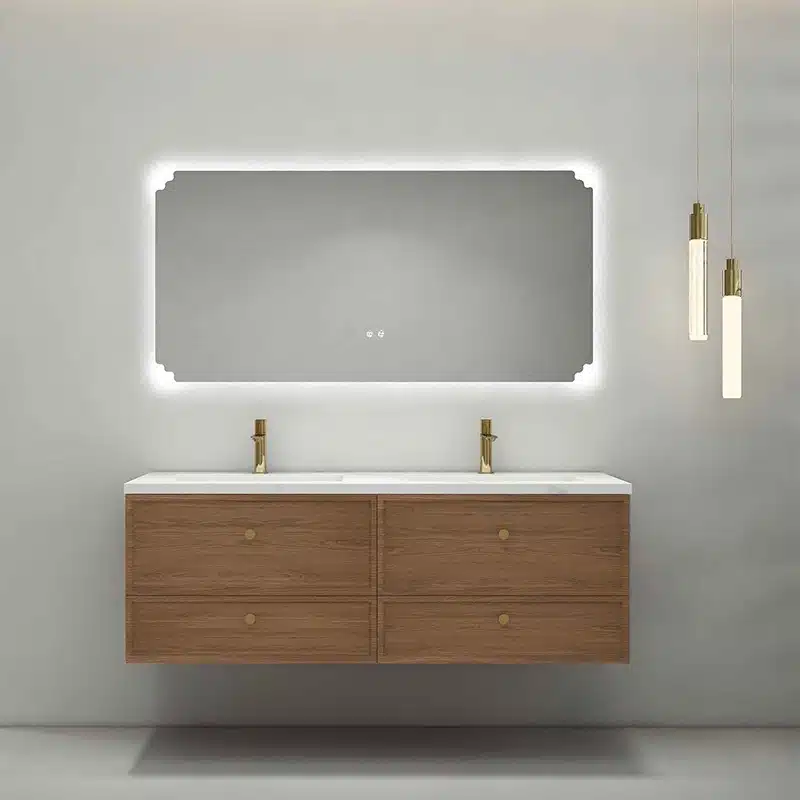
The Hidden Moisture Risks of MDF Vanities
Edge sealing is the single most critical factor for MDF vanity longevity—most factories skip it.
MDF (Medium Density Fiberboard) acts like a sponge the moment its protective barrier is compromised. In commercial bathrooms—hotels, rentals, multi-unit developments—the primary failure point isn’t the painted surface. It’s the exposed edges and cutouts for sinks and plumbing. Standard manufacturing often seals only the visible faces, leaving raw fiberboard exposed where it matters most.
- Failure mechanism: Moisture wicks into unprotected MDF fibers within weeks. The board swells irreversibly, causing laminate delamination and edge lifting. Unlike plywood, which may warp but hold integrity, swollen MDF crumbles. Full cabinet replacement is the only fix.
- Cost impact: A single callback to replace a swollen vanity runs $150–$300 in labor and materials. On a 50-unit project, that’s $7,500–$15,000 in hidden costs—enough to erase the 20–30% upfront savings MDF offers over plywood. Most contractors don’t factor this into their material choice.
- Industry blind spot: Few suppliers disclose that moisture-resistant MDF (MR-MDF) exists, which uses wax additives in the glue line. Even fewer offer six-sided edge sealing as a standard. Contractors must explicitly request MR-MDF cores and mandate in their PO that all six sides—including interior cutouts—receive waterproof primer or PVC edge banding.
- Alternative for wet zones: For high-humidity bathrooms, MFBATH’s 100% waterproof PVC option eliminates moisture risk entirely. With a low MOQ of 10–20 units for testing, project teams can validate materials before scaling. Factory QC includes five-stage inspection to verify seal integrity, something most standard MDF lines lack.
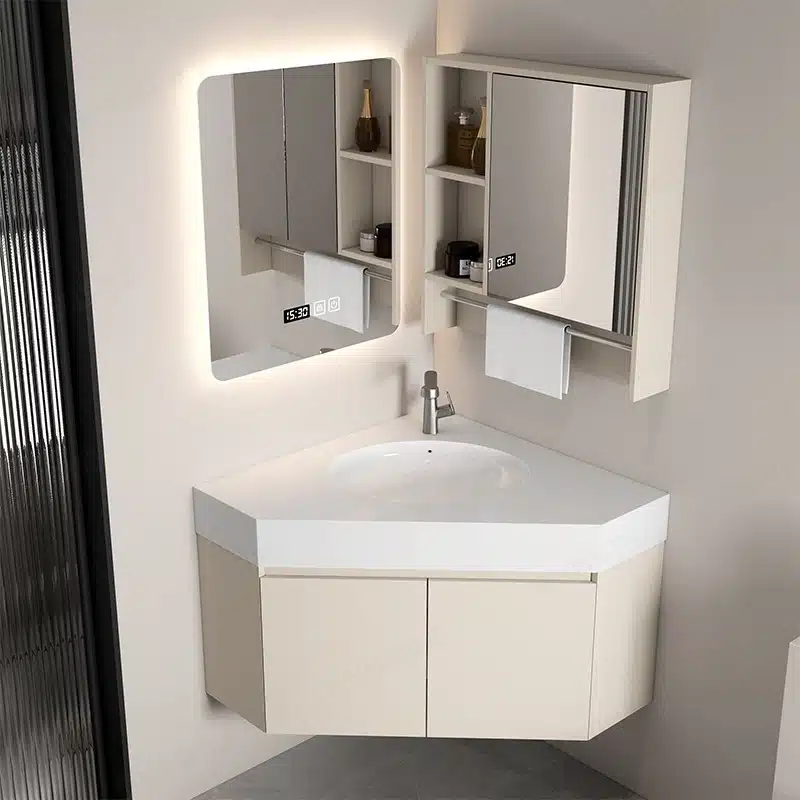
Real Cost Breakdown: Sealing vs. Replacement in 2026
Skipping edge sealing saves pennies upfront but costs dollars per unit inside 18 months.
The decision to spec MDF over plywood or PVC for commercial bathroom vanities is almost always a line-item cost play. MDF blanks run 20–30% cheaper per board foot than comparable plywood. But the real economics don’t sit on the unit price — they sit on the cost of error. MDF has no natural moisture defense. Plywood’s cross-laminated veneers buy some structural tolerance even when the surface is breached. MDF swells and crumbles. That means the entire financial case for MDF rests on one variable: how well you seal it.
- Edge sealing adds 5–10% to unit cost: Applying waterproof PU glue, PVC edge banding, or wax to all six faces — including internal cutouts — raises the factory cost by roughly $3–$8 per vanity depending on size. Most standard manufacturers skip interior edges to hold the low price point.
- Callback cost averages $150–$300 per visit: A single service call to replace a swelled vanity in a completed hotel bathroom wipes out the margin on 10–15 MDF units. When you factor in labor, materials, and schedule disruption, the math flips hard against unsealed MDF.
- Lifecycle cost penalty: 20% higher with poor sealing: Industry data from commercial renovation portfolios shows that vanities without full six-sided sealing require replacement 2–3 years earlier than properly sealed equivalents. That premature replacement adds roughly 20% to the total cost of ownership over a 10-year building lifecycle.
The takeaway for project buyers is straightforward: if you’re going to use MDF, you cannot treat sealing as optional. Mandate six-sided sealing in your PO specs. Request moisture-resistant MDF (MR-MDF) cores with wax additives in the glue line — not all suppliers disclose this, so you have to ask. And for any vanity going within 3 feet of a shower or into a high-humidity zone, skip MDF entirely and move to plywood or 100% waterproof PVC. That decision alone eliminates the single biggest warranty claim driver in commercial bathroom fit-outs.
| Cost Factor | Sealing Strategy | Replacement Risk | Lifecycle Cost Impact |
|---|---|---|---|
| Initial Unit Cost (MDF) | Low (20-30% less than plywood) | High without sealing | High if unsealed; moderate if sealed |
| Initial Unit Cost (Plywood/PVC) | Higher upfront investment | Low | Low; best long-term value |
| Edge Sealing Cost | +5-10% to unit cost | Eliminates primary failure point | Negligible; essential investment |
| Six-Sided Sealing | Rare standard; must be specified | Prevents hidden moisture ingress | Critical for warranty protection |
| Average Callback Cost | $150 – $300 per visit | Directly avoided by sealing | Eliminates 20% higher lifecycle cost |
| Full Vanity Replacement | Cost of unit + labor + downtime | Inevitable without sealing | Negates all initial savings |
| MR-MDF Core (Wax Additives) | Slightly higher material cost | Reduces swelling risk by 60%+ | Cost-effective upgrade for wet zones |
| Primer Application (All Sides) | Low material cost; labor-intensive | Prevents fiber absorption | Non-negotiable for MDF viability |
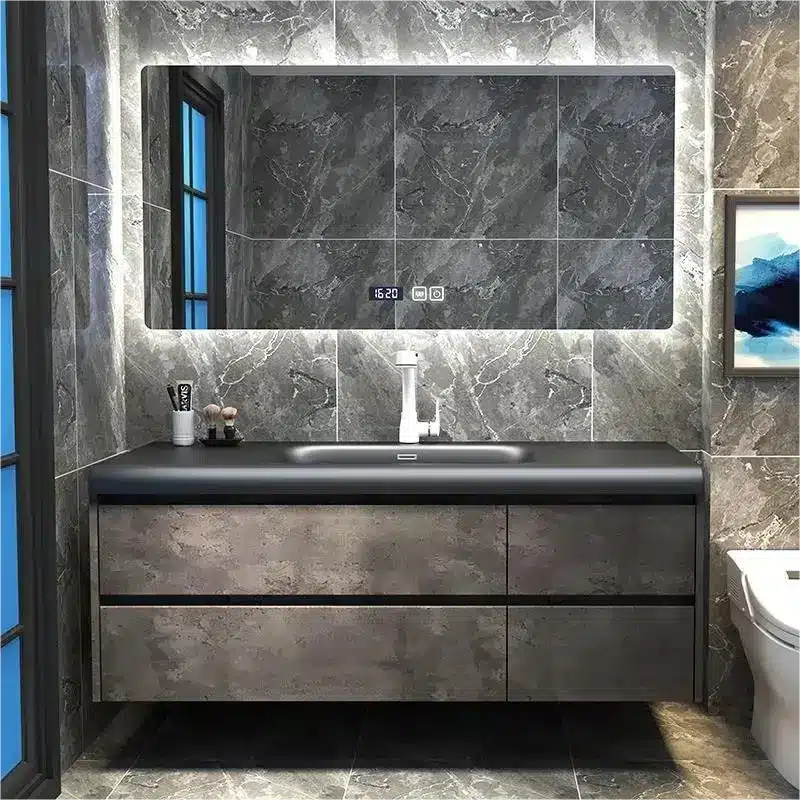
Plywood vs MDF: Which is Better for Bathroom Vanities?
Plywood wins on moisture resistance; MDF wins on paint finish—but only if sealed correctly.
The choice between plywood and MDF for bathroom vanities comes down to a single variable: moisture exposure. Plywood, constructed from cross-layered veneers, offers natural structural integrity and resists water intrusion better than MDF when edges are properly sealed. MDF, while more dimensionally stable in dry conditions and superior for complex painted finishes, acts like a sponge the moment its protective barrier is breached. For wet zones—vanities adjacent to showers, high-humidity commercial bathrooms, or coastal climates—plywood or 100% waterproof PVC is objectively superior. For dry powder rooms or projects requiring custom Pantone-matched paint, MDF is acceptable, but only if the manufacturer uses moisture-resistant MDF (MR-MDF) with wax additives in the glue lines and applies six-sided sealing. Most standard factories skip interior edge sealing to save costs; this is the primary cause of premature swelling and delamination in the field.
- Plywood advantage: Natural moisture resistance from layered veneers; holds screws better; can survive minor water exposure if edges are sealed.
- MDF advantage: Smoother surface for paint; no grain telegraphing; consistent density for CNC machining; lower unit cost by 20–30%.
- Critical failure point: Unsealed MDF edges absorb moisture within weeks, causing irreversible swelling and laminate peeling. Six-sided sealing (including interior cutouts) is non-negotiable for any bathroom application.
- Insider spec tip: Explicitly request MR-MDF cores with wax additives in your PO. Most suppliers default to standard MDF unless told otherwise. Pair with PVC edge banding and waterproof PU glue for the only reliable MDF vanity in a wet zone.
For contractors managing callback risk, the math is clear: a proper MDF vanity with six-sided sealing adds 5–10% to the unit cost, but a single swelling failure costs $150–$300 in service calls plus replacement labor. Plywood or PVC eliminates that risk entirely. MFBATH offers both plywood and MR-MDF options with five-stage QC that verifies edge sealing on every unit, and low MOQs of 10–20 units for project testing.
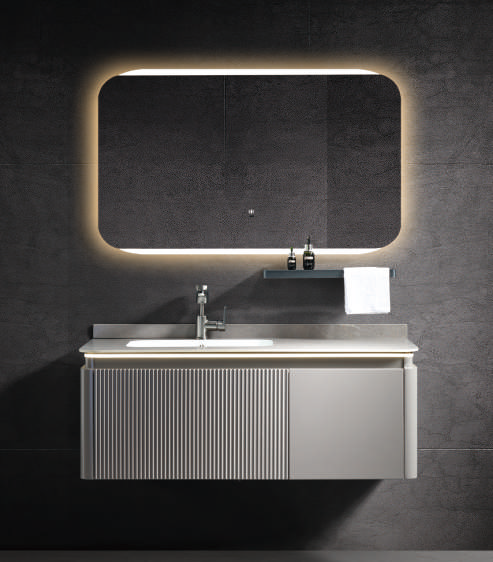
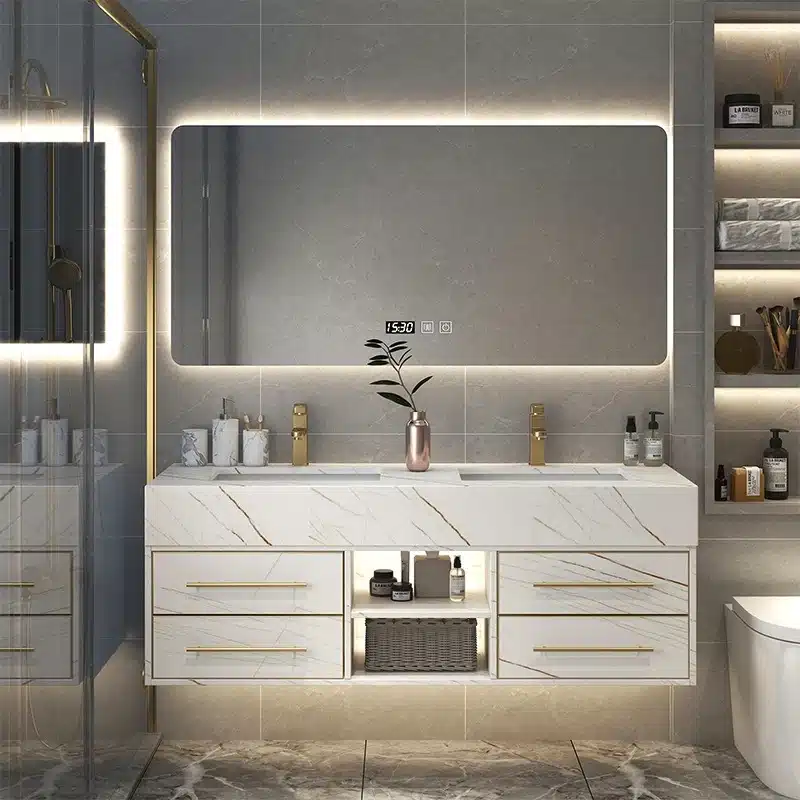
How to Seal MDF Vanities: Prevent Swelling Defects
Six-sided sealing is the only standard that prevents edge swelling in MDF vanities.
Standard factory finishes typically cover only the front and visible sides. The top, bottom, and interior edges — including sink cutouts and plumbing holes — are left exposed. That is where moisture enters. Once the MDF core absorbs water, the fibers swell irreversibly, causing laminate delamination and structural failure within 6–12 months in a commercial bathroom.
- Six-sided sealing protocol: Apply a water-based primer to all six sides of every panel, including all cutouts. This blocks moisture ingress from every direction, not just the visible surfaces.
- Edge sealing is the critical step: Use PVC edge banding with waterproof adhesive or an epoxy-based edge sealer on all exposed edges. Without this, moisture wicks into the board within hours of installation.
- Specify MR-MDF cores: Moisture-resistant MDF (MR-MDF) contains wax additives in the glue lines. Most suppliers do not disclose this. Explicitly request MR-MDF cores in your procurement specs to get a board that resists moisture internally, not just on the surface.
- Proof in the PO: Contractors should write ‘six-sided sealing with PVC edge banding’ directly into the purchase order. Without that clause, factories default to cost-saving measures that skip interior edge sealing.
The factory’s 5-stage QC process at MFBATH includes a dedicated sealing inspection stage. For European projects, E1-grade MR-MDF cores are standard. For North America, UL/CSA-compliant vanities include sealed cutouts as part of the assembly line protocol. If your supplier cannot show you photos of edge-banded cutouts from their last production run, they are likely skipping this step.
Conclusion
MDF vanities can work in commercial bathrooms, but only with a strict sealing protocol. Skip the six-sided seal or use standard MDF instead of MR-MDF, and the swelling starts before the first warranty claim. That $20-30 per unit saved on material becomes a $150 callback cost you eat.
Review your current project specs. If they don’t mandate MR-MDF cores and six-sided edge sealing, update them before the next PO goes out. The right spec sheet is the cheapest insurance against a mid-contract replacement cycle.
Frequently Asked Questions
Is MDF okay for a bathroom vanity?
MDF is only okay for a bathroom vanity if every edge and cutout is sealed with a waterproof primer or PU glue, otherwise it will swell within months. Specify edge sealing in your contract or switch to PVC for zero moisture risk.
How to seal MDF from moisture in bathroom?
Seal all exposed edges, cutouts for sinks, and plumbing holes with a waterproof polyurethane glue or a high-build primer before painting. Skipping any single edge creates a direct path for moisture to enter. Inspect every cut edge before installation to avoid callbacks.
What happens if you don’t use primer on MDF?
Unprimed MDF absorbs moisture like a sponge, causing the fibers to swell and the laminate or paint to delaminate irreversibly. This failure typically shows up within 6 to 12 months in a bathroom. Never skip primer on MDF in any wet area.
What is better for a bathroom vanity, plywood or MDF?
Plywood is better for moisture resistance and structural durability in a bathroom, while MDF offers a smoother paint finish but only if perfectly sealed. For commercial projects, plywood’s natural. Choose plywood for wet zones and MDF only with a verified sealing protocol.
What is the best waterproof sealer for MDF?
The best waterproof sealer for MDF is a two-part polyurethane glue or a marine-grade epoxy applied to all cut edges before painting. Standard water-based primers are not sufficient for long-term. Test the sealer on a sample edge before committing to full production.


0 Comments