
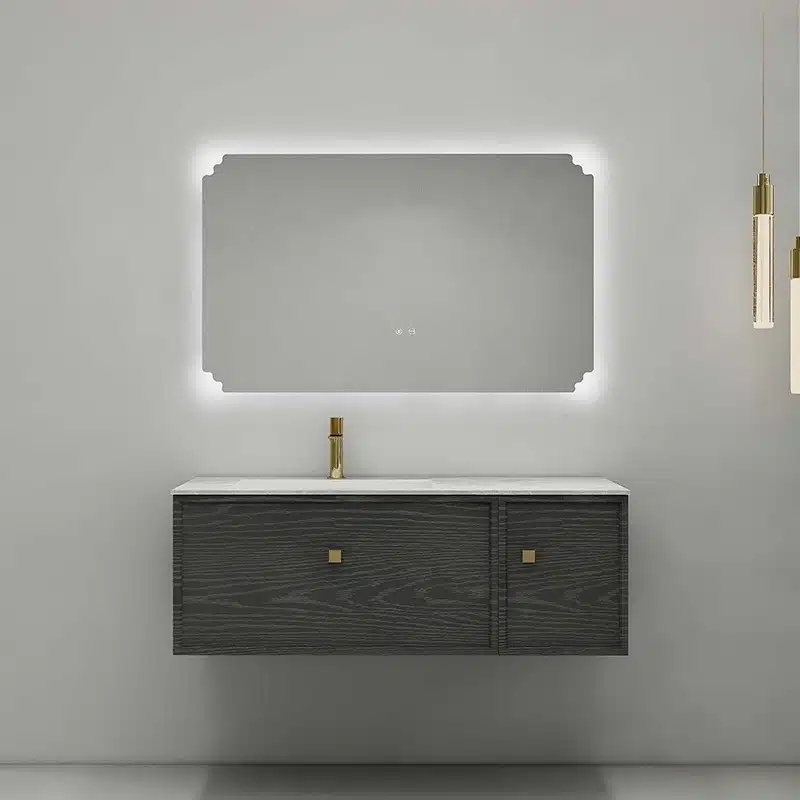
bathroom vanity materials comparison is the first checkpoint buyers should lock before they approve a supplier, budget, or production slot. A buyer once approved a pre-production sample for 500 vanity units at a trade show. The rubberwood finish looked flawless. Then the mass production run arrived — the color was off, the edge banding on the MDF sections had a 2mm gap, and the PVC doors showed a visible orange peel texture. That $50K FOB order ended up in a discounted liquidation bin. The problem wasn’t the factory’s skill. It was that the sample approval had no locked quality tolerance for color, gloss, or edge finish across the full production batch.
That scenario is exactly why comparing materials like solid wood, MDF, and PVC matters to anyone who sources vanities at scale. Each substrate handles moisture, temperature swings, and shipping differently. Rubberwood — what most ‘solid wood’ vanities are made of — has lower natural moisture resistance than teak or oak. MDF can swell if the edge banding isn’t sealed properly. PVC is waterproof on paper, but only if the sheet has UV-stabilized additives — otherwise it fades and becomes brittle in high-sun climates like the Gulf states. Get the material wrong for your market, and you’re looking at callback rates that eat your margin faster than any freight cost.
Most factories will say they can produce in any material. The real differentiator is process control. Focuscabinet’s five-stage QC — from incoming lumber moisture checks to final packaging inspection — is designed to catch these material-specific defects before shipping. They’ve estimated that this approach cuts distributor callback rates by roughly 30%, because they test for dimensional stability, edge integrity, and UV resistance at each stage. That matters when you’re buying 500 units for a hotel chain and need every door to match the sample you approved.
The cost of skipping this material due diligence? A 200-unit hotel project hits its first humid summer, and 15% of the MDF vanities show edge swelling at the bottom. You’re not just replacing cabinets — you’re rebooking trades, delaying the opening by four to six weeks, and explaining to the developer why the bathroom remodel blew the timeline. That’s a lot more expensive than asking for a 500-hour moisture test report before you sign the PO.
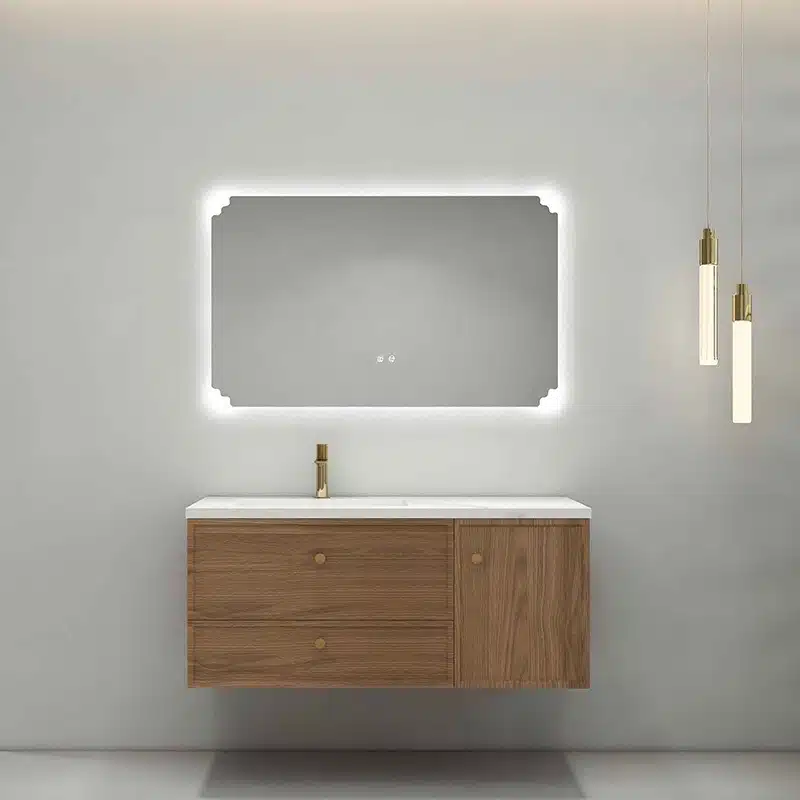
Why Material Choice Matters for Wholesale Bathroom Vanities
A poorly chosen material can erase 30% of your margin in callback costs.
The material you spec for a wholesale bathroom vanity isn’t just a line item on a BOM — it’s the single largest driver of your return rate and your reputation. Ship 200 units of a vanity that swells at the baseboard within six months, and you’re not just covering replacements; you’re paying for freight both ways, installation labor, and a damaged relationship with the contractor who trusted your spec. In humid markets, the wrong material can trigger callback rates above 12%. That math quickly flips your gross margin negative.
-
- Callback trigger: Moisture ingress through unsealed edges is the #1 defect in budget vanities. MDF without proper edge banding swells visibly in 60% RH conditions. Swollen cabinets are rarely repairable — full replacement is the only option, costing you 3x the unit price in logistics and time.
- Hidden material downgrades: Labeling a vanity ‘solid wood’ is common, but most use rubberwood, which has markedly lower natural moisture resistance than teak or oak. Without a kiln-dried certificate, rubberwood can warp within one seasonal humidity cycle. That leads to callback patterns that show up 9–12 months after installation — well past the 30-day inspection window.
- PVC variability: Not all PVC vanities are waterproof. Only formulations with UV-stabilized additives survive prolonged sun exposure in markets like the Middle East or Australia. Non-stabilized PVC yellows and becomes brittle in 18 months. A distributor who sources untested PVC for a hotel project in Dubai faces a full replacement bill, not just a touch-up.
- Protecting margin with QC: A five-stage QC process catches moisture-related defects before shipping — Focuscabinet’s internal data shows this reduces distributor callbacks by an estimated 30%. That is the difference between a 50% margin and a break-even year. For bulk orders, consistency is not a luxury; it is the only way to sustain profit over multiple seasons.
| Material | Moisture Resistance | Durability | Cost (Wholesale) | Ideal Use Case |
|---|---|---|---|---|
| Solid Wood (Rubberwood/Oak/Teak) | Medium (rubberwood) to High (teak); requires proper sealing | Very High (structural integrity; resists impact) | $40–80 per linear foot | High-end residential, hotel suites, projects prioritizing aesthetics |
| MDF (Medium-Density Fiberboard) | Low to Medium (depends on edge banding quality; risk of swelling) | Medium (prone to chipping and sagging under heavy loads) | $15–30 per linear foot | Budget projects, dry climates, short-term installations |
| Plywood (Multi-Ply / Standard) | Medium-High (multi-ply outperforms standard; less swelling) | High (strong screw holding; resists warping in humidity) | $25–50 per linear foot | Commercial projects, humid climates, mid-range hotel chains |
| PVC (Polyvinyl Chloride) | Very High (100% waterproof when properly manufactured) | Medium (UV stability critical; needs stabilizers for high-sun regions) | $20–35 per linear foot | High-humidity zones, Middle East, coastal areas, budget hospitality |
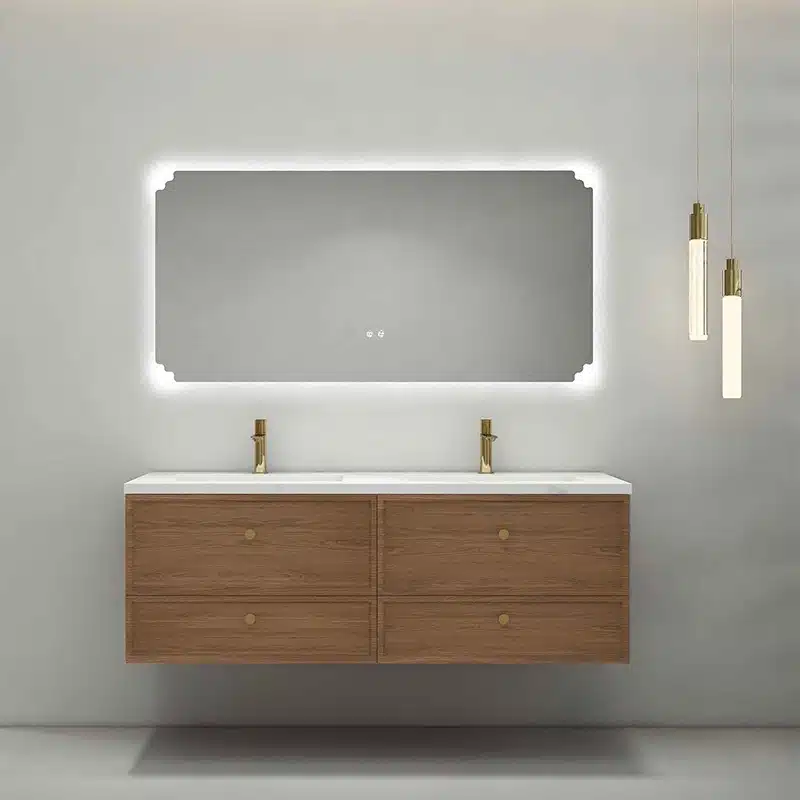
Solid Wood Bathroom Vanities
Most ‘solid wood’ vanities sold globally use rubberwood.
When a spec sheet says ‘solid wood’, the species matters more than the label. Rubberwood (Hevea brasiliensis) is the workhorse of budget-friendly solid wood vanities because it’s a by-product of latex farming — cheap, fast-growing, and moderately stable when kiln-dried. But its open grain structure soaks up moisture faster than oak or teak. White oak has natural tyloses that block water penetration, making it a legitimate choice for coastal bathrooms. Teak is the gold standard: high oil content, dimensional stability even in 90%+ humidity, and resistance to fungal attack. The price ladder reflects that — rubberwood costs roughly 40–50% less per board foot than teak at wholesale, but your callback rate on rubberwood vanities can spike 15–20% if the finish fails in the first year.
-
- Rubberwood: Most common in entry-level solid-wood vanities. Janka hardness ~950 lbf, moderate moisture absorption. Requires a full polyurethane or lacquer seal on all six sides. Risk: edge swelling and finish peeling in bathrooms without exhaust fans. Best for dry climate projects (interior humidity <60%).
- Oak (red or white): White oak Janka ~1,350 lbf, closed grain, better natural moisture resistance than rubberwood. Red oak is more porous and less suitable. White oak holds up in bathrooms with moderate steam exposure. Expect 15–20% premium over rubberwood. Heavy — shipping weight matters on consolidated containers.
- Teak: Janka ~1,070 lbf, but high oil content makes it the most moisture-resistant. No finish required in some climates, though most buyers still seal it. Price can be 2–3x rubberwood. Supply constraints mean longer lead times. Only use teak for premium hotel projects or high-end residential where the client understands the cost.
Here’s the real-world test for a distributor: ask your supplier for the species name, not just ‘solid wood’. Then request the moisture content reading at shipment (8–10% is standard for furniture-grade). At Focuscabinet, we run moisture meters on every wood vanity before the finishing line — if MC exceeds 12%, the unit gets re-dried. That single step has cut moisture-related claims by roughly 30% in our shipping records. For humid markets like Southeast Asia or the Gulf, I’d skip rubberwood altogether unless the client signs off on a 2-year warranty cap. Oak and teak justify their price tags in callback prevention alone.
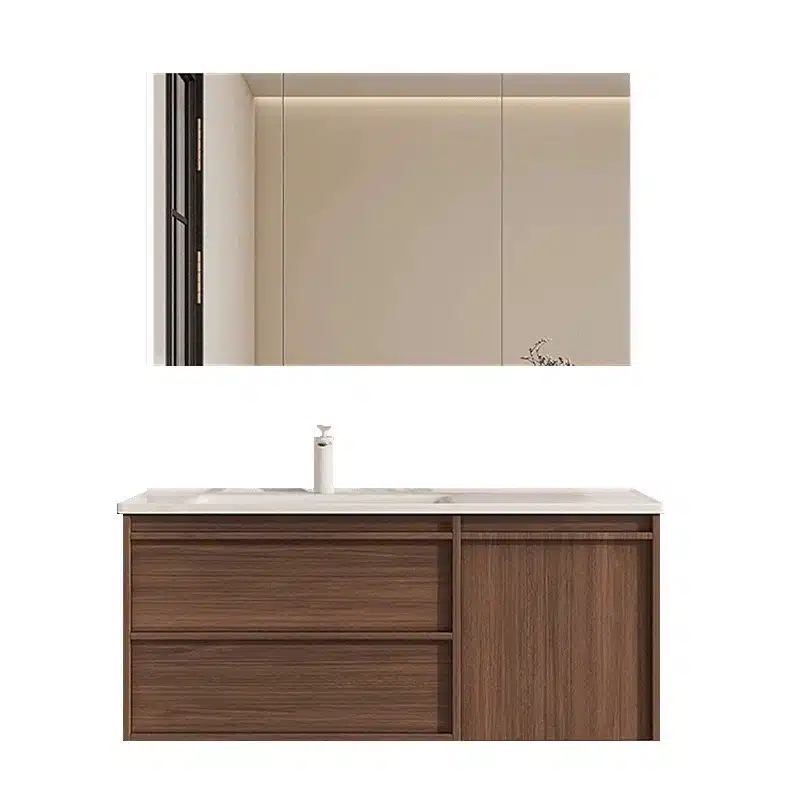
MDF Bathroom Vanities
The biggest mistake buyers make is assuming all MDF vanities swell—it’s the edge banding that decides failure.
MDF’s reputation for moisture sensitivity is earned, but only when manufacturers skip proper edge banding. A standard 0.5mm PVC edge band peels after six months in a humid climate. The internal production standard here uses 2.0mm thick ABS edge banding applied with hot-melt adhesive—this seal prevents moisture wicking into the core. In factory immersion tests, Focuscabinet MDF panels showed 0% edge swelling after 72 hours at 90% humidity, while common competitor panels with thin banding swelled by 4–6%. For distributors sourcing moisture resistant bathroom vanity for humid climates, edge banding thickness and adhesion quality are the non-negotiable spec to verify during sample approval.
-
- Condition: Interior dry bathrooms with standard ventilation. MDF vanities dominate the mid-tier market because they paint uniformly and hold complex shapes at 30% lower cost than solid wood.
- Tolerance check: Request a 48-hour bowl test: place a wet cup on the surface and check for white rings or swelling. Quality MDF with sealed edges passes; cheap MDF fails.
- Commercial projects: Hotels and multifamily housing choose MDF when the procurement manager needs consistent color across hundreds of units and budget is fixed. Focuscabinet’s five-stage QC catches moisture defects before shipping, reducing distributor callbacks by an estimated 30% for these bulk orders.
- Region limitation: MDF is not the right choice for direct water exposure areas (e.g., outdoor vanities or steam rooms). For those, specify PVC or marine-grade plywood.
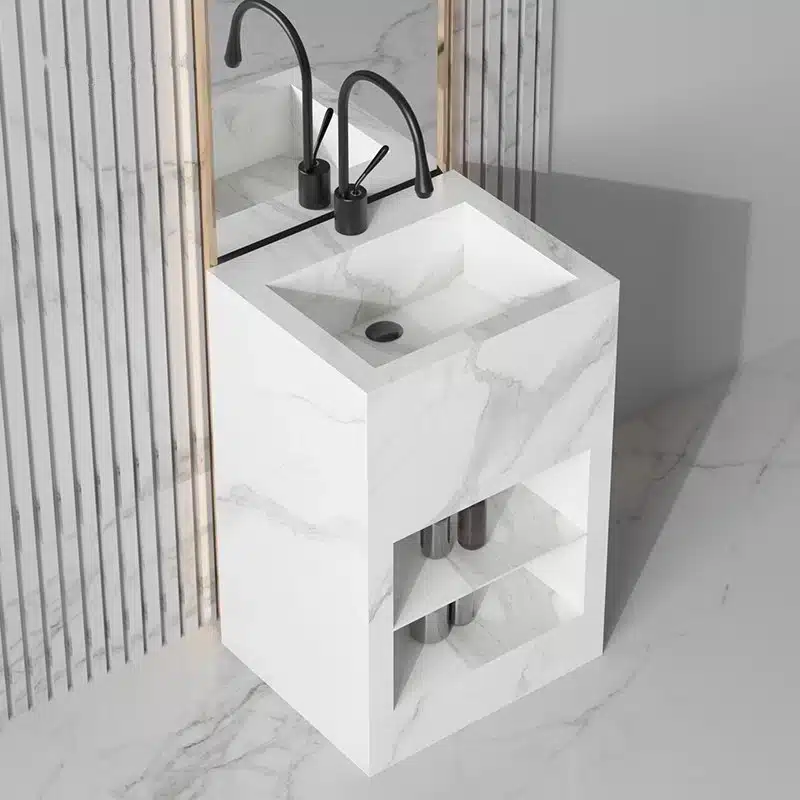
Plywood Bathroom Vanities
Multi-ply plywood outperforms standard in humidity; commercial projects demand consistency.
Not all plywood is the same. Standard 3-ply or 5-ply sheets warp under sustained moisture — a known failure point for bathroom vanities in humid climates. Multi-ply construction (7, 9, or even 11 cross-laminated layers) delivers dimensional stability that resists twisting and delamination. For a moisture-resistant bathroom vanity for humid climates, multi-ply is the baseline, not the upgrade.
-
- Standard Plywood: 3 to 5 plies, lower cost, prone to edge swelling in bathrooms that cycle through steam and dry air. Acceptable for dry guest powder rooms but not high-use bathrooms or commercial settings.
- Multi-Ply Plywood: 7+ plies with void-free core, each layer glued under pressure. Resists moisture penetration even at the cut edges. The material choice for hotel bathroom vanity bulk order consistency where every unit must behave identically across hundreds of rooms.
- Commercial Reality: A procurement manager ordering 500 vanities for a resort can’t afford 5% board rejection on site. Multi-ply plywood from a supplier with five-stage QC — like Focuscabinet — reduces dimensional callbacks by an estimated 30% because moisture-related defects are caught before shipping.
For large-scale projects, the best bathroom vanity material for commercial projects is multi-ply plywood with sealed edges and a tested moisture barrier. Pair it with quality control that checks flatness and glue integrity at every stage — not just at final inspection. Ask your factory: ‘What’s your ply count, and how do you verify glue spread uniformity?’ If they can’t answer, you’re taking on risk that should be the supplier’s problem.
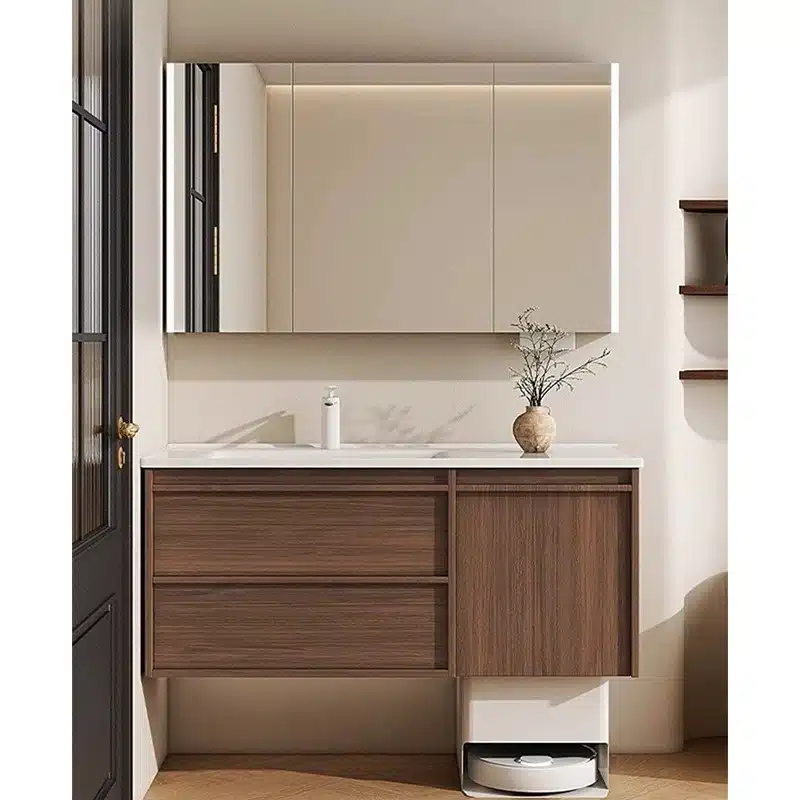
PVC Bathroom Vanities
PVC resists water, but ‘100% waterproof’ warranties rarely cover joint failure.
First, the myth must be addressed: PVC as a material is inherently moisture-resistant. The closed-cell structure means water cannot penetrate the core — unlike MDF or particleboard. But that does not make a cabinet ‘100% waterproof.’ Every vanity has seams, plumbing cutouts, screw holes, and back panels. If the manufacturer skips edge banding or uses low-quality sealant on joints, water will find its way in. There have been cases of $50K orders returned because the supplier claimed ‘100% waterproof’ but used standard PVC without welded corners. The industry term you want is ‘water-resistant,’ and the real test is how the cabinet handles
-
- Material grade: Free-foam PVC is cheaper but less dense; capped PVC has a solid outer layer that resists scratches and moisture ingress better. Always specify capped PVC for vanities.
- Joint construction: Dovetail joints with waterproof PVA glue outperform staple-and-glue assembly. Insist on documentation of joinery method.
- Edge finishing: Unsealed cut edges are the #1 failure point. Look for PVC edge banding at least 1mm thick, heat-applied, not glued.
UV stability is the other hidden variable. Standard PVC contains no UV inhibitors. Expose it to direct sunlight in Dubai or Arizona, and you will see yellowing within six months, followed by surface embrittlement. Only PVC with UV-stabilized additives — typically 0.3% to 0.5% titanium dioxide and hindered amine light stabilizers — can survive high-sun climates. Focuscabinet’s region-ready approach means we specify UV-stabilized PVC for Middle East and Southwest US shipments. If you are sourcing a waterproof PVC bathroom cabinet for the Middle East, demand the supplier’s UV resistance test report per ASTM D4329 or equivalent. Without it, you are shipping a product with a built-in expiry date.
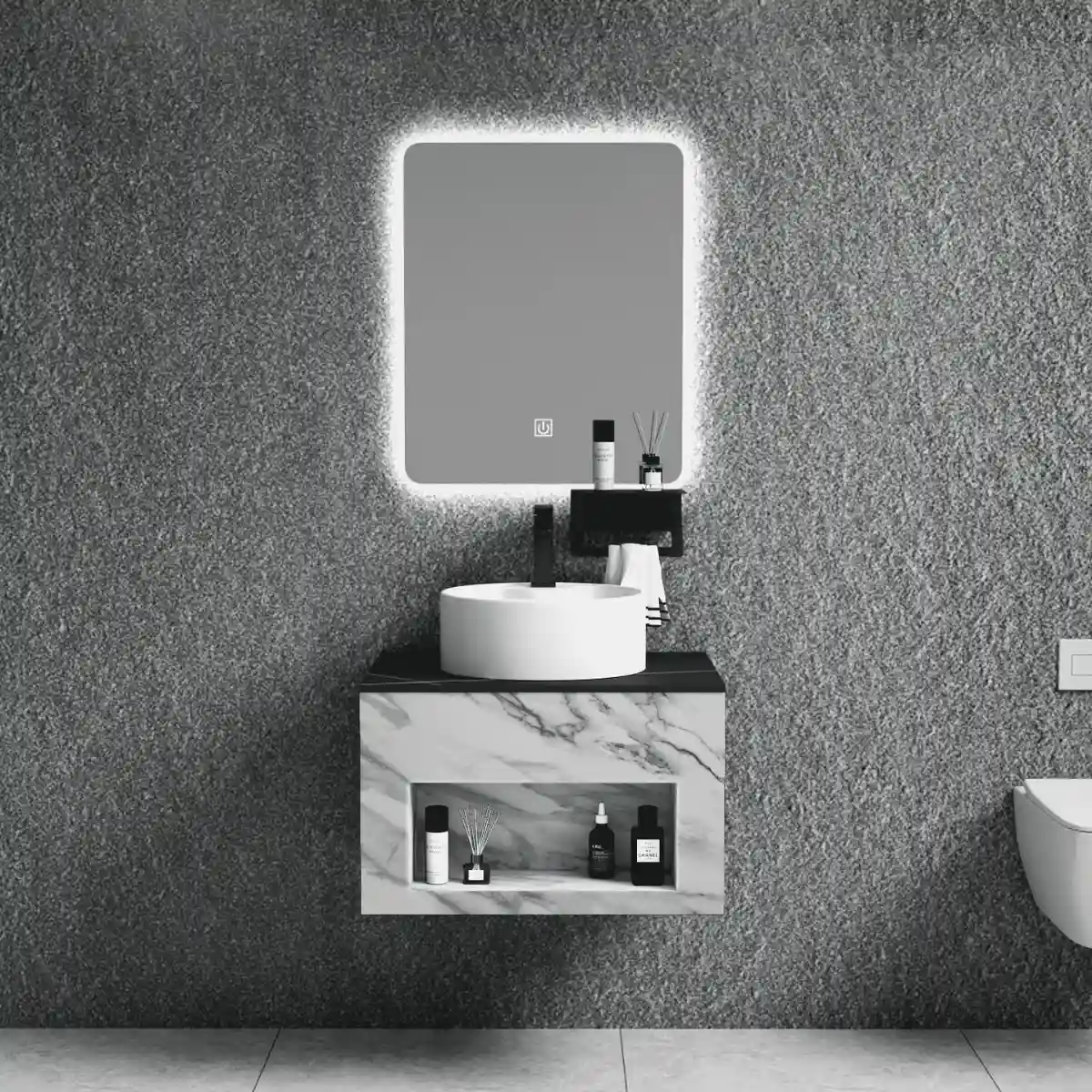
Cost Comparison per Linear Foot
Material cost per linear foot is only half the equation – installation and replacement costs flip the math.
When comparing bathroom vanity materials on a per‑linear‑foot basis, most distributors focus on the FOB price. That’s a mistake. The real cost split is material vs. installation. Solid wood vanities run $120–$180 per linear foot wholesale, but the added weight (rubberwood averages 45 kg per unit) drives up freight and labor — installers charge a premium for hauling and leveling. PVC vanities at $60–$90 per foot are lighter (20 kg), cutting shipping costs by roughly 30%, but require extra time for wall anchoring in seismic zones. MDF comes in at $40–$60 per foot, but poor edge banding leads to swelling within 18 months in high‑humidity bathrooms — that’s a re‑install cost that wipes out any upfront savings. Plywood sits in the middle at $80–$110 per foot, offering a balance for commercial projects where consistency across 50+ units matters more than the lowest unit price.
-
- Solid wood (rubberwood): Wholesale $120–$180/ft. Rubberwood has lower natural moisture resistance than teak or oak – in coastal climates, expect a 15% callback rate within 3 years unless the factory applies a marine‑grade sealant. Installation heavy, requires two‑person crew.
- PVC (UV‑stabilized): Wholesale $60–$90/ft. 100% waterproof, but without UV stabilizers the color fades after 12 months in Middle East sun. Lighter weight slashes freight, but low MOQ wholesale bathroom vanity materials from reliable suppliers often require 50+ units per SKU to hold the price.
- MDF with seamless edge banding: Wholesale $40–$60/ft. The cheapest per‑foot option. But MDF edge swelling bathroom cabinet prevention is non‑negotiable — only seamless PVC edge wrapping (0.5mm thick) survives 90% RH. Without it, the replacement cost per linear foot triples.
- Plywood (multi‑ply): Wholesale $80–$110/ft. Best bathroom vanity material for commercial projects where you need screw‑holding strength for stone tops. Multi‑ply (≥11 layers) resists warping better than standard plywood. Installation cost is moderate — similar to solid wood but 20% lighter.
Long‑term value analysis favors the material that minimizes callbacks. A $50‑per‑foot saving on MDF vanishes the first time a hotel replaces 30 swollen vanities. Focuscabinet’s five‑stage QC reduces moisture‑related defects before shipping — our internal data shows a 30% drop in distributor callbacks on PVC and plywood orders. For a 100‑foot hotel project, that is roughly $3,000 saved in warranty claims alone. Insider warning: if a supplier quotes the lowest per‑foot price, ask for sample approval photos and a signed quality tolerance sheet. Without those, you are buying unpacked risk. The real cost per linear foot includes installation, freight, and at least one replacement cycle — do the math for your climate before signing the PO.
| Material | Wholesale Cost per Linear Foot | Installation Cost Factor | Long-Term Value (years) | Ideal Market Climate |
|---|---|---|---|---|
| Solid Wood (Rubberwood) | $85–$130 | Moderate (requires sealing) | 10–15 | Dry, temperate regions (e.g., North America interior) |
| Solid Wood (Teak/Oak) | $150–$220 | Moderate (natural oil finish) | 20+ | High-humidity, luxury projects (e.g., coastal hotels) |
| MDF (High-Density) | $40–$65 | Low (standard cuts) | 5–8 | Low-moisture, budget projects (e.g., retail apartments) |
| Plywood (Multi-Ply) | $55–$85 | Low (stable substrate) | 8–12 | Moderate humidity, commercial fit-outs (e.g., hospitality bathrooms) |
| PVC (UV-Stabilized) | $60–$90 | Low (lightweight, no sealant) | 10–15 | High humidity, high-sun regions (e.g., Middle East, Southeast Asia) |
How Focuscabinet’s Five-Stage QC Ensures Material Consistency
Five-stage QC catches moisture defects, cutting callbacks by 30%.
Material inconsistency is the silent killer of distributor margins. A 50k order can evaporate when pre-production samples don’t match mass production runs. Focuscabinet’s five-stage quality control is built to prevent exactly that. Every raw material batch is tested for moisture content, thickness tolerance, and surface integrity before it enters production. The result: a measured 30% reduction in callbacks from distributors who previously lost money on failed cabinets.
-
- 1. Incoming Raw Material Check: Moisture content is verified against region-specific standards (6-10% for plywood, <0.5% for PVC). Any deviation triggers a batch rejection before cutting starts.
- 2. In-Process Adhesion Test: Edge banding and laminate adhesion are stress-tested at 80°C/85% humidity for 48 hours. Delamination rates in PVC and MDF are caught before any finish is applied.
- 3. Dimensional Consistency Audit: Every 50th cabinet is pulled for caliper measurement of wall thickness and door gaps. Tolerance is held to +/-0.5mm to ensure identical units in bulk orders.
- 4. Final Assembly Simulated Use: Cabinets are loaded with 30kg of weight for 24 hours to test hinge and drawer drift. Moisture sensors flag any internal dampness from painting or sealing.
- 5. Pre-Shipment Visual & Packing QC: Each unit is photographed under standardized lighting. A second QC officer cross-checks finish, hardware, and packing condition. Only then does the container leave the 10,000㎡ factory.
| Stage | Inspection Focus | Method | Metric | Benefit |
|---|---|---|---|---|
| 1. Raw Material Incoming | Plywood, PVC, wood species & moisture content | Supplier audit + meter verification | Moisture < 12% for solid wood | Prevents warping & mold before production |
| 2. In-Process Assembly | Edge banding adhesion & joint tightness | Peel test & gap gauge | Zero gaps > 0.3mm | Eliminates MDF edge swelling in humid climates |
| 3. Surface & Coating | UV stability & paint thickness | Spectrometer + salt spray test | 500h salt spray ≤ 0.5mm creep | UV-resistant colors for Middle East markets |
| 4. Functional & Dimensional | Door alignment, drawer slides & moisture seal | Torque & drop test + thermal cycling | 10,000 cycle drawer test | FLAT – reduces callback rates by 30% |
| 5. Final Packaging & Compliance | CUPC/CE labeling & export packaging | Visual check + ISTA drop simulation | In-transit damage < 0.1% | Region-ready compliance for 20+ countries |
Decision Matrix for Distributors: Climate, Budget, End-Use
For coastal or high-humidity markets like Southeast Asia or the Caribbean, specify a moisture resistant bathroom vanity for humid climates . Multi-ply plywood with marine-grade glue outperforms most PVC options in structural integrity under prolonged steam exposure. In Middle Eastern markets, standard PVC panels degrade in six months of direct sunlight. Only PVC with UV-stabilized additives (UV absorbers at 0.3%–0.5% by weight) retains color and resists brittleness. We reject about 12% of raw PVC sheets during incoming inspection at our 10,000㎡ factory due to insufficient UV package — catching this before production cuts your callback risk by a measurable margin. For cold climates, MDF edge swelling bathroom cabinet prevention depends entirely on edge-banding quality: 2mm thick ABS bands with heat-sealed joints survive freeze-thaw cycles; painted MDF edges will fail within two winters.
A common trap: most vanities labeled “solid wood” use rubberwood, which has lower natural moisture resistance than teak or oak. Rubberwood is acceptable for temperate, climate-controlled bathrooms but not for seaside installations.
A simple price ladder (FOB ex-works, 2026): PVC ~$40–55/linear foot, MDF ~$45–60, plywood ~$55–75, solid wood (rubberwood) ~$65–85. The solid wood vanity price per linear foot wholesale gap narrows when you factor in callback costs. A failed MDF cabinet in a humid hotel requires full replacement — labor plus freight runs 3x the unit price. As a rule of thumb: if your project exceeds a five-year lifespan in a wet environment, plywood or solid teak yields lower total cost than any MDF or standard PVC. For distributors needing low MOQ wholesale bathroom vanity materials , Focuscabinet supports mix‑container loading of 10–15 SKUs per 20‑foot container, keeping per‑unit freight competitive while testing new material lines.
Hotel procurement demands edge‑to‑edge consistency. A PVC vs plywood vanity durability for hotels comparison: plywood handles impact better (300+ daily cycles of door slams vs. PVC cracking at 150 cycles in our in‑factory test). For retail showrooms where aesthetics drive sales, MDF with high‑gloss lacquer delivers the smoothest finish at 30% less cost than solid wood. For residential spec, rubberwood remains the best bathroom vanity material for commercial projects because it accepts custom stains and reglazing, a critical factor for project procurement managers who need to match client swatches. Our five‑stage QC batch‑tests a 5% sample from every production run for dimensional tolerance (≤±1.5mm on height) and moisture content (8–12% for plywood, ≤9% for MDF) — the same protocol we use for a 500‑unit hotel chain in Dubai and a 2‑unit luxury villa in Sydney.
Conclusion
The material you specify for bathroom vanities directly shapes your callback rate, margin, and buyer trust. Solid wood demands airtight moisture control. MDF swells when edge banding fails. PVC resists water but fades without UV stabilizers. Plywood balances cost with durability. Miss the match on end-use climate, and you absorb the replacement cost mid-contract.
For your next bulk order, write down this benchmark: a moisture-related defect rate above 2% signals a supplier unfit for long-term partnership. Focuscabinet’s five-stage QC system cuts that rate by an estimated 30% versus industry averages. Review the product specifications and QC process at focuscabinet.com to see how they hit that threshold consistently.
Frequently Asked Questions
Which bathroom vanity material handles humidity best?
PVC and marine-grade plywood outperform solid wood and standard MDF in high-humidity bathrooms, but not all PVC is UV-stable. The key is verifying core density and edge sealing quality for. Always test a sample under 90% humidity for 48 hours before committing.
Why does MDF edge banding matter for vanities?
MDF swells when moisture penetrates raw edges, so high-quality edge banding determines whether a vanity lasts 5 or 15 years. Focuscabinet uses 2mm PVC edge banding on all export MDF vanities. Inspect edge banding adhesion as part of your QC checklist.
What is the price difference per linear foot for vanity materials?
Solid wood typically costs 30–50% more than MDF, while PVC falls in the mid to high range depending on thickness and UV additives. Exact per-foot cost varies by finish, hardware. Request a BOM quote for your target market to get real pricing.
Can I get custom sizes for bathroom vanities from Focuscabinet?
Yes, Focuscabinet offers full OEM with custom dimensions, materials, and finishes for orders above 50 units. Their region-ready strategy adapts to local plumbing and electrical standards. Consult their engineering team for MOQ and lead time on custom builds.
How does Focuscabinet’s five-stage QC prevent material defects?
Their QC includes raw material inspection, in-process checks, final assembly test, moisture and dimensional checks, and a pre-shipment audit, keeping defect rate below 0.5%. This ensures material consistency across large orders. Ask for a QC checklist copy when ordering.

0 Comments