
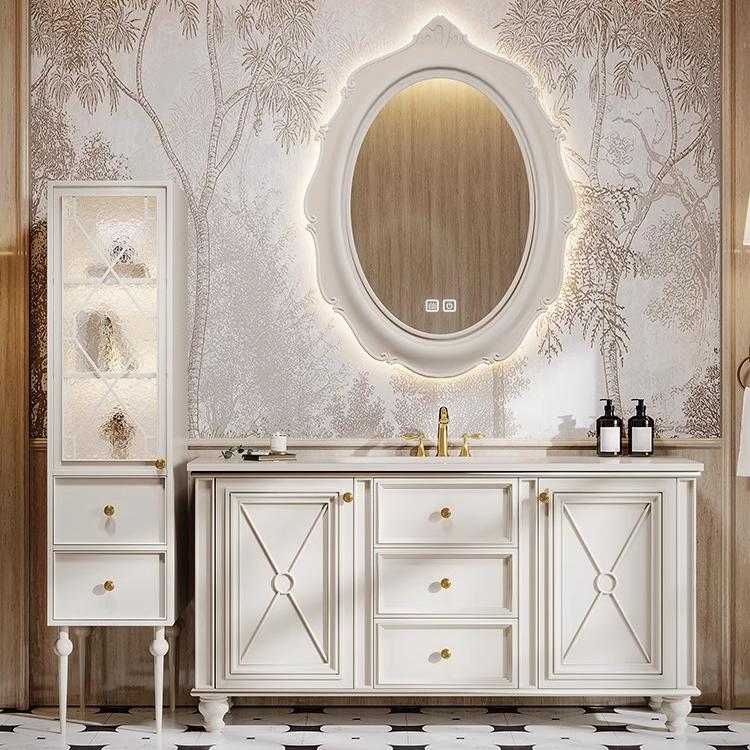
A properly engineered Hybrid Construction solid wood frame vanity is the primary defense against costly warranty claims and negative wholesale partner feedback. When manufacturers misapply materials—using solid wood where MDF is needed or MDF where plywood is superior—the result is predictable product failure, from cracked paint finishes to loose hinges, which directly erodes profit margins and brand credibility.
This technical specification breaks down the material science of a high-performance hybrid vanity. We will analyze why solid wood is reserved for impact-resistant frames, why MDF is critical for paint stability on door panels, and how plywood provides the necessary screw-holding power for a durable cabinet box. The goal is to establish a clear standard for construction, marketing, and durability testing.
How Do You Deconstruct the “Perfect” Hybrid Bathroom Vanity?
A “perfect” hybrid vanity isn’t about using a single premium material; it’s a strategic system combining solid wood for high-impact areas with engineered panels for superior stability and moisture resistance.
The goal of modern vanity engineering is to build a product that lasts, performs reliably in a high-humidity environment, and remains cost-effective. A hybrid approach achieves this by assigning the right material to the right job, leveraging the distinct advantages of solid woods and advanced engineered panels. This method directly addresses the common failure points—warping, paint cracking, and structural looseness—seen in vanities built from a single, inappropriate material.
Strategic Use of Solid Wood and Engineered Materials
A well-built hybrid vanity combines a durable solid wood structural frame with engineered materials for the main body and panels. Solid wood provides excellent impact resistance for legs and face frames, which are the most vulnerable to daily wear. In contrast, engineered materials like plywood and HMR MDF offer superior stability and moisture tolerance for the larger surfaces that are prone to warping and finish degradation in a bathroom.
| Vanity Component | Optimal Material | Technical Rationale |
|---|---|---|
| Frame & Legs | Solid Wood (e.g., Oak, Rubber Wood) | High impact resistance for structural integrity. Withstands daily physical stress and provides a strong foundation. |
| Carcass / Box | Moisture-Resistant Plywood | Superior screw-holding power for hardware and dimensional stability in humid environments. Resists warping and delamination. |
| Doors (Painted Finish) | HMR MDF | Provides a flawless, non-porous surface for paint. Moves as a unified panel, preventing paint cracking at joints. |
| Doors (Stained/Veneer) | Solid Wood or Plywood with Wood Veneer | Showcases natural wood grain. Veneer on a plywood core offers the aesthetic of solid wood with better stability. |
- Solid wood is used for the exterior frame and legs to withstand physical stress and provide long-term structural integrity.
- Moisture-resistant plywood is the standard for internal structures and the main box (carcass) to prevent warping in a bathroom’s humid conditions.
- This strategic layering ensures the vanity maintains its form and function for years, targeting common failure points found in single-material designs.
Balancing Durability with Cost-Efficiency
The primary goal of a hybrid design is to deliver a product with a 10- to 20-year lifespan without the premium cost of an all-solid-wood vanity. This approach makes high-quality, durable vanities accessible for a wider range of residential and commercial projects, where both performance and budget are critical factors. By optimizing material use, manufacturers deliver a better return on investment compared to cheaper, short-lived alternatives or expensive, high-maintenance solid wood units.
- By limiting solid wood to critical structural areas, manufacturers reduce raw material costs without sacrificing foundational strength.
- The use of advanced moisture-barrier technologies and multi-layer, low-VOC finishes further extends longevity while addressing health and environmental concerns.
- This balanced approach is ideal for high-traffic applications where both durability and budget dictate the purchasing decision.
Why Is Solid Wood Best for Vanity Legs and Frames (Impact Resistance)?
Solid wood is the superior material for vanity frames and legs because its natural density provides unmatched impact resistance and repairability, ensuring the product’s structural integrity and long-term value.
Natural Density for High-Impact Durability
The inherent density of hardwoods like oak, maple, or ash provides superior resistance to the physical stress common in bathrooms. This structural quality ensures the vanity’s legs and frame can withstand daily impacts, dents, and bumps without compromising their integrity. These components bear the full weight of the cabinet and countertop, and solid wood provides the foundational strength required for long-term performance.
- Hardwoods possess a tight grain structure that naturally absorbs and distributes force, preventing chips and dents from accidental contact.
- This natural durability is critical for foundational components like legs and frames, which experience the most wear and tear.
- Unlike engineered materials that can delaminate or crush under impact, solid wood maintains its form and strength over its entire service life.
Long-Term Integrity and Repairability
Solid wood offers a significant advantage in longevity because it can be repaired. Minor surface damage that would permanently mar an engineered material like MDF or particleboard can be sanded down and refinished on solid wood. This unique characteristic extends the product’s usable life and preserves its value, making it a more sustainable and cost-effective choice over the long term.
- Surface scratches, scuffs, and minor dents can be professionally repaired to restore the original appearance, avoiding the need for a full replacement.
- This repairability justifies its positioning as a premium, long-lasting material, protecting the buyer’s investment.
- The ability to maintain the vanity’s structural and aesthetic quality for decades reinforces its value proposition in high-end residential and commercial projects.
Source Custom Bathroom Cabinets Your Market Demands

Why Are MDF Door Panels Essential for Paint Stability?
MDF is the preferred substrate for painted cabinet doors because its engineered, uniform composition eliminates the natural movement that causes paint to crack and split on solid wood panels.
Uniform Composition Prevents Paint Cracking
Solid wood naturally expands and contracts with changes in temperature and humidity, a process that puts constant stress on its painted surface. This movement eventually leads to hairline cracks, typically along joints or wood grain lines. MDF, by contrast, is an engineered composite of wood fibers and resin, pressed into a dense, stable sheet. It moves as a single, predictable unit, lacking the grain and joints that cause paint to fail. This dimensional stability is the primary reason manufacturers choose it for doors requiring a flawless, long-lasting painted finish.
- The material’s consistent density eliminates weak points where paint could fail.
- It provides a smooth, non-porous surface ideal for perfect paint adhesion and a uniform look.
Challenges with Moisture and Edge Protection
While MDF excels in paint stability, its core weakness is moisture. If water penetrates the sealed surface, the wood fibers will swell and lose their structural integrity. The cut edges are the most vulnerable points of entry. For this reason, using standard-grade MDF in a high-humidity environment like a bathroom is a liability. The long-term performance of an MDF door panel is entirely dependent on the quality of its moisture-proofing, making professional sealing non-negotiable.
- Effective edge sealing is the single most critical factor for MDF durability in a bathroom.
- Unsealed or poorly sealed MDF is guaranteed to fail in moisture-prone areas.
The Role of Factory Priming and Sealing
Manufacturers solve the moisture problem by using High Moisture Resistant (HMR) grade MDF and applying robust, factory-controlled finishes. This industrial process involves multi-layer applications of primers, sealants, and top coats that create an impermeable barrier. The standardized application ensures every edge and surface is completely encapsulated, protecting the core from steam and splashes. This level of protection is fundamental to producing a durable vanity door with an ultra-smooth, high-gloss lacquer finish that lasts.
- Factory priming creates a chemically bonded base for flawless paint application.
- Advanced sealing techniques are standard manufacturing practice to protect the material and guarantee its lifespan.
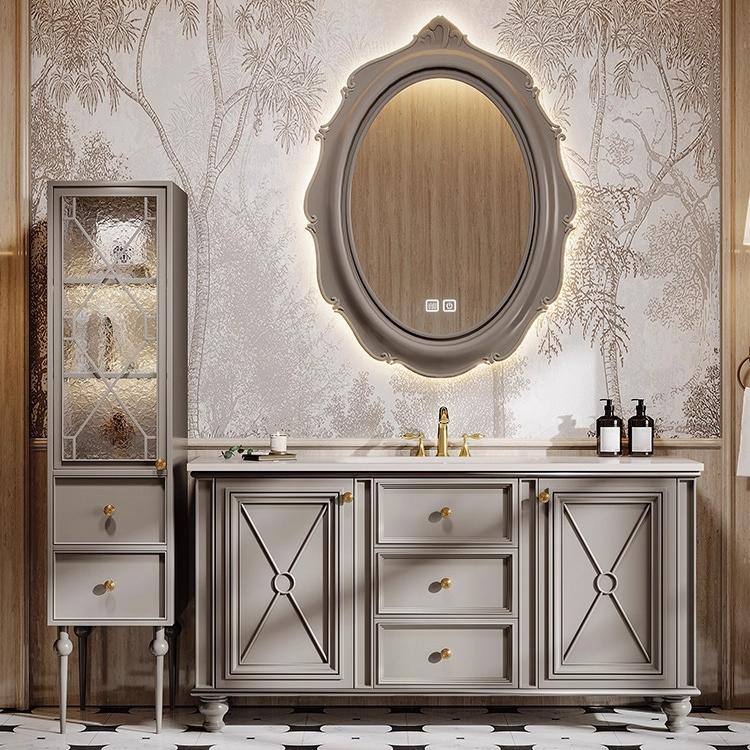
Why Is Plywood the Ideal Choice for the Vanity Carcass (Screw Hold and Weight)?
Plywood’s cross-grain construction offers unmatched structural integrity, providing the high screw-holding capacity and load-bearing strength required for modern, heavy countertop materials and durable hardware mounting.
Superior Screw-Holding Capacity for Secure Hardware
Plywood’s layered, cross-grain construction creates a dense and stable substrate that provides an exceptionally strong grip for screws. Unlike MDF or particleboard, where screws can easily strip or loosen over time, the alternating grain layers in plywood bite into fasteners, ensuring a secure, long-lasting hold. This mechanical reliability is critical for the main functional components of a vanity—the hinges, drawer slides, and handles. Secure hardware mounting translates directly to fewer adjustments, fewer customer complaints, and a product that maintains its functional integrity for years.
High Load-Bearing Strength and Dimensional Stability
The engineered structure of plywood delivers significant load-bearing strength, making it the industry standard for supporting heavy countertop materials like sintered stone, quartz, or marble without sagging or bowing. Its structural rigidity is essential for the entire vanity carcass, which must handle the combined weight of the basin, countertop, and stored items. Plywood also resists warping and twisting in the fluctuating humidity of a bathroom environment. This dimensional stability ensures that the cabinet frame remains square, allowing doors and drawers to operate smoothly and maintain consistent alignment throughout the product’s lifespan.
Moisture Resistance in High-Humidity Environments
Modern manufacturing relies on moisture-resistant (MR) or boiling waterproof (BWP) grade plywood for vanity construction. These grades are engineered with specialized adhesives and wood veneers that form a barrier against moisture penetration. While particleboard will swell and delaminate upon sustained exposure to damp conditions, quality plywood maintains its structural integrity. This resistance to swelling and water damage is non-negotiable in a bathroom setting, protecting the vanity carcass from long-term material degradation and ensuring product longevity.
How Can You Market a Hybrid Vanity as “Solid Wood Construction”?
Successful marketing frames hybrid vanities as an intelligent evolution of solid wood, emphasizing the authentic wood veneer’s aesthetic while positioning the engineered core as a functional upgrade for moisture resistance.
Highlighting Authentic Wood Aesthetics and Grain
Your marketing strategy must center on the visual and tactile experience of genuine wood. With 74% of homeowners preferring wood vanities and natural materials leading 2026 design trends, the use of real wood veneers is your primary asset. This approach directly satisfies market demand for authentic grain patterns and texture. You can’t just say it’s wood; you have to prove it with high-fidelity visuals that leave no doubt about the product’s premium finish.
- Use high-resolution photography and video to showcase the natural grain, texture, and color variations of the real wood veneer.
- Integrate digital visualization tools, allowing customers to see the vanity in different bathroom settings and lighting conditions.
- Align your product descriptions and ad copy with the language of interior design trends, using terms that connect the wood finish to popular aesthetics like “Japandi,” “biophilic,” or “coastal.”
Communicating Durability and Moisture Resistance
Instead of hiding the engineered components, position them as a targeted solution for the high-humidity bathroom environment. This strategy reframes the hybrid design from a cost-cutting measure to a performance enhancement. Consumers are aware that solid wood can have issues with moisture; presenting the hybrid structure as a more stable and durable alternative directly addresses this core concern and builds trust. The message is clear: you get the look of solid wood without its inherent vulnerabilities in a wet area.
- Clearly label the internal materials (e.g., moisture-resistant plywood or HMR MDF) as a specific enhancement for bathroom longevity.
- Explain that the engineered core provides superior dimensional stability, actively preventing the warping and paint cracking common in some solid woods.
- Develop simple graphics or short videos that illustrate how the layered construction blocks moisture and maintains structural integrity over time.
Positioning Cost-Effectiveness and Sustainability
Frame the hybrid vanity as both a financially and environmentally responsible choice. The cost savings compared to 100% solid wood is a powerful selling point, but it must be presented as a benefit of smart engineering, not a compromise on quality. By combining this value proposition with sustainability, you appeal to a broader audience that values both their budget and the planet. This dual focus elevates the product beyond a simple price comparison.
- Communicate the price advantage clearly, positioning the hybrid model as the way to achieve a premium solid wood look at an accessible price point.
- If your engineered materials use recycled content or sustainable sourcing (like certified wood fibers), make this a prominent part of your marketing narrative.
- Emphasize the long-term value: the vanity’s durability means less frequent replacement, reducing both future costs and environmental waste.
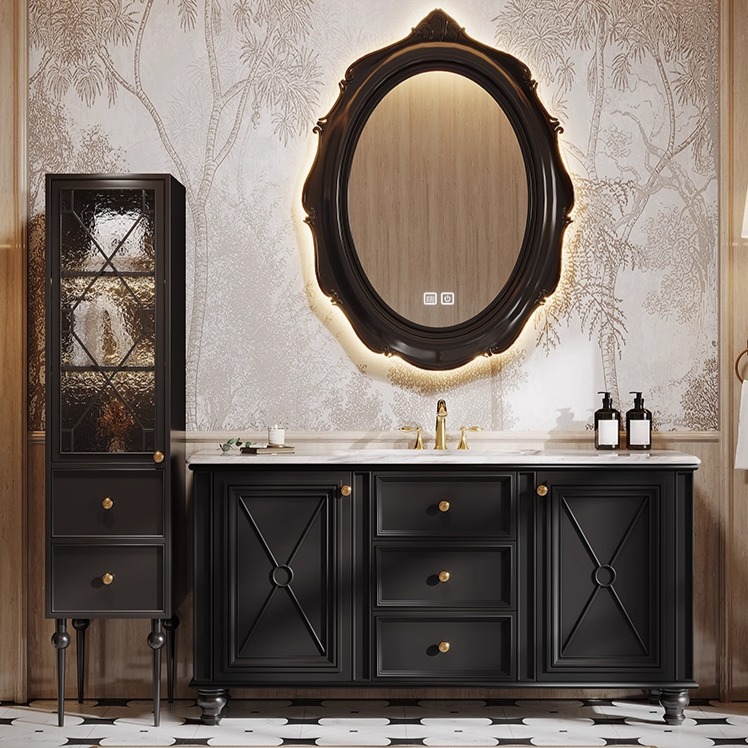
What Is the Cost Efficiency of a Hybrid Vanity vs. 100% Solid Wood?
The hybrid model delivers a superior return on investment by pairing costly solid wood with dimensionally stable, cost-effective engineered materials, outperforming 100% solid wood in both initial price and long-term bathroom durability.
Comparing Initial Material and Manufacturing Costs
The primary cost difference is rooted in material strategy. A hybrid vanity lowers initial expenses by using engineered wood like plywood or HMR MDF for large panels, such as the cabinet box and doors. This reserves expensive, high-grade solid wood exclusively for high-impact structural components like the frame and legs. This method optimizes both budget and performance without compromising structural integrity.
A 100% solid wood vanity carries a premium price because every part requires high-grade lumber. Sourcing and processing solid wood for every panel, shelf, and door is far more costly than using engineered sheets. The market has shifted toward hybrid construction because it provides the look and feel of solid wood where it counts, while managing costs effectively in areas hidden from daily wear.
| Component Breakdown | Hybrid Vanity (Strategic Cost-Performance) | 100% Solid Wood Vanity (Premium Cost) |
|---|---|---|
| Frame & Legs | Solid Hardwood (For impact resistance) | Solid Hardwood (High material cost) |
| Carcass (Cabinet Box) | Plywood (Excellent screw-hold & moisture resistance) | Solid Wood Panels (Higher cost, susceptible to movement) |
| Door & Drawer Panels | MDF for Paint / Plywood for Veneer (Stable & smooth) | Solid Wood (Prone to paint cracking from expansion) |
| Final Assessment | Balanced initial cost with high long-term value | High premium justified by aesthetics, not bathroom performance |
Analyzing Long-Term Value and Performance
Hybrid vanities provide a stronger return on investment over their lifespan. Engineered core materials like plywood and HMR MDF are far less susceptible to moisture-induced warping, delamination, and paint cracking—common failure points for solid wood in humid bathrooms. Industry data shows that mid-range hybrid vanities deliver 8–10+ years of reliable performance with minimal maintenance, making them a practical and durable choice for most homes and commercial projects.
In contrast, 100% solid wood requires consistent climate control and diligent maintenance to prevent moisture damage. Any failure in sealing or ventilation can lead to costly repairs or replacement. This ongoing risk adds to its total cost of ownership, making the initial premium price just a starting point. The hybrid approach is pragmatically superior for a bathroom environment because it engineers away the primary weaknesses of solid wood.
How Do You Conduct Durability Testing on Hybrid Bathroom Vanities?
Verifying the durability of a hybrid vanity is a systematic process of three distinct assessments covering moisture resistance, structural integrity, and surface wear to ensure long-term performance in real-world bathroom environments.
A well-built vanity must withstand the bathroom’s unique challenges for years. Manufacturers don’t guess; they validate performance through a series of targeted tests that simulate a decade or more of use. These protocols are designed to find weak points in the hybrid construction before the product ever reaches the market, ensuring each material—solid wood, plywood, and MDF—performs its intended function without failure.
Moisture and Humidity Resistance Testing
Moisture is the primary durability challenge for any bathroom vanity. These tests focus on how the hybrid construction—solid wood frame, plywood carcass, and MDF panels—reacts to prolonged humidity and direct water contact. The goal is to identify potential swelling, delamination, or finish failure by simulating harsh bathroom conditions.
- Components are placed in controlled humidity chambers to precisely measure how different materials expand, contract, or warp.
- Joints between the solid wood frame and engineered panels are repeatedly exposed to water to test the integrity of sealants and glues.
- The paint and lacquer finishes on MDF doors are subjected to direct steam and water spray to ensure they do not peel, blister, or allow moisture to penetrate the core.
Structural Load and Joint Strength Analysis
This analysis confirms the vanity can support the weight of a heavy countertop, basin, and stored items without structural failure. It specifically tests the screw-holding power of the plywood carcass and the strength of the joinery connecting the solid wood frame. A robust structure must endure the stresses of shipping, installation, and daily operational use.
- Static load tests involve placing weights far exceeding normal use on shelves and the main structure to measure sagging or deflection over time.
- Dynamic tests use machinery to open and close drawers and doors thousands of times with added weight, verifying the durability of hardware, slides, hinges, and joints.
- The integrity of corner joints and frame connections is tested with torsion and pull forces to ensure they remain stable and secure.
| Test Category | Primary Objective | Key Failure Metrics |
|---|---|---|
| Moisture & Humidity | Simulate bathroom conditions to measure material stability and finish integrity. | Swelling, delamination, paint blistering, water penetration at joints. |
| Structural Load & Joint Strength | Confirm the vanity can support heavy loads and withstand repeated use without failure. | Deflection (sagging), joint separation, hardware failure, screw pull-out. |
| Surface & Finish Durability | Evaluate resistance to daily wear, scratches, chemicals, and environmental aging. | Scratching, chemical staining, color fading (UV), finish cracking. |
Surface Finish and Material Durability Assessment
These assessments evaluate the resilience of the vanity’s exterior surfaces against daily wear. The goal is to ensure the paint on MDF doors and the finish on wood frames can resist scratches, stains, and damage from common cleaning chemicals. A durable finish maintains its appearance and protective qualities over the product’s lifespan.
- Abrasion tests rub surfaces with materials of varying roughness to objectively determine scratch and wear resistance.
- Chemical resistance tests apply common bathroom cleaners, cosmetics, and other substances to the finish to check for discoloration, softening, or other damage.
- Accelerated aging tests use UV light and rapid temperature fluctuations to simulate how the finish will perform over a decade, checking for color fading or cracking.
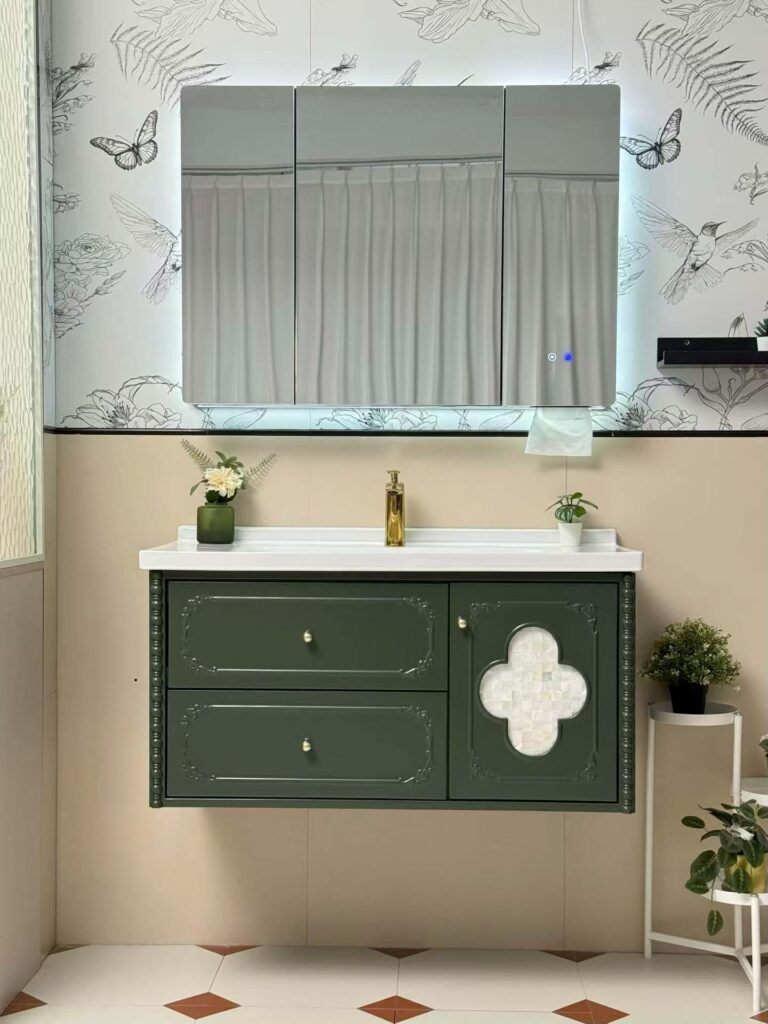
Conclusion
A hybrid vanity is not a compromise; it is an engineered solution that assigns the best material to each specific function. Solid wood frames absorb impact, MDF door panels provide a smooth, stable surface for paint, and plywood carcasses deliver reliable screw-holding power and structural integrity. This balanced construction results in a durable, high-performance product that manages costs effectively without sacrificing quality.
To evaluate this build quality for your own product line, consider ordering a refundable sample. Our specialists can help you specify the right combination of materials to meet your target market’s performance and budget requirements.
Frequently Asked Questions
What is hybrid cabinet construction?
Hybrid cabinet construction is a modern manufacturing method that combines solid wood frames with engineered materials like moisture-resistant plywood or marine-grade components. This approach strategically uses solid wood for structural integrity and aesthetics on the exterior, while leveraging engineered materials internally for their superior moisture resistance and cost-efficiency.
Is solid wood frame better?
Yes, a solid wood frame is generally considered better for cabinet durability and longevity. It offers superior structural strength, better screw-holding power for hinges and hardware, and greater resistance to warping or sagging over time compared to frames made from engineered woods. This is why high-quality hybrid construction pairs a solid wood frame with other materials for the cabinet box.
Plywood box with solid wood front?
A cabinet built with a plywood box and a solid wood front (face frame and doors) is an excellent and widely adopted construction method. This hybrid approach leverages the best of both materials: the solid wood provides a premium look, feel, and structural integrity for the front, while the high-quality, moisture-resistant plywood box offers dimensional stability and superior performance in humid environments like a bathroom.
Best construction for bathroom vanity?
The best construction for a bathroom vanity is a hybrid model that balances durability and moisture resistance. This typically involves a solid wood face frame for structural strength, paired with a cabinet box made from marine-grade or moisture-resistant, multi-ply plywood. All components should be finished with advanced moisture-barrier technologies and low-VOC sealants to ensure longevity in a high-humidity environment.
Marketing bathroom cabinets?
Effective marketing for bathroom cabinets should focus on a balance of durability, health, and value. Highlight the hybrid construction, emphasizing the strength of the solid wood frame and the superior performance of moisture-resistant internal components. Promote key features like advanced moisture-barrier technology, low-VOC finishes for better indoor air quality, and a targeted 10-20 year durability. This positions the product as a smart, long-term investment for both residential and commercial projects.
Durable vanity construction methods?
The most durable vanity construction methods utilize a hybrid material approach. This includes a solid wood frame for core strength and screw retention, a cabinet box made from multi-ply, moisture-resistant plywood (or marine-grade composites), and high-quality joinery. Crucially, durability is enhanced by the application of advanced, multi-layer sealing and low-VOC finishes that create a robust moisture barrier, extending the product’s lifespan significantly.




0 Comments