

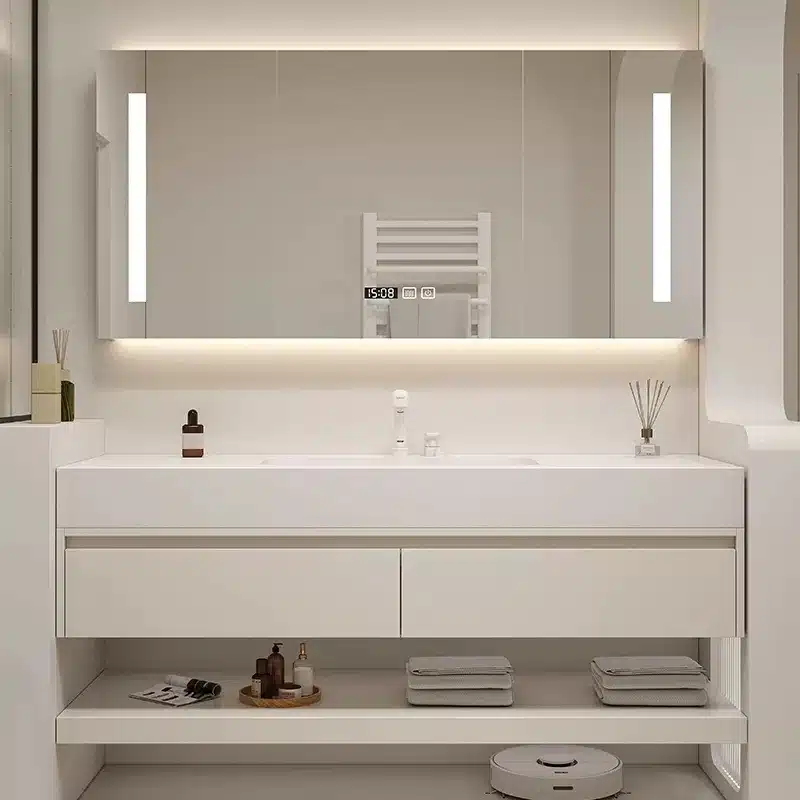
 Developing a truly eco friendly vanity line is the critical process that separates a credible green brand from a business facing costly greenwashing accusations. Customer demand for non-toxic, sustainable home goods is surging, yet simply labeling a product “eco-friendly” is no longer sufficient. Buyers are sophisticated and demand verification, scrutinizing everything from material sourcing to the chemical composition of adhesives and finishes. A misstep in your supply chain or a poorly substantiated marketing claim can quickly erode consumer trust and damage your brand’s position in the market.
This guide provides a technical framework for building a defensible sustainable product line. We will examine the operational details of key certifications, including the FSC chain of custody for wood and NAF standards for formaldehyde-free adhesives. You will learn the practical differences between standard paints and low-VOC water-based finishes, and explore how to implement recycled packaging effectively. Think of this as the standard operating procedure for turning abstract sustainability goals into a tangible, verifiable, and marketable product strategy.
The “Healthy Home”: What Is Driving the Market Demand?
Market demand for healthy homes is driven by a dual focus: long-term cost reduction through energy and water efficiency, and a growing consumer emphasis on personal well-being via improved indoor air quality and comfort.
Focus on Energy Efficiency and Cost Reduction
Homebuyers are increasingly motivated by the long-term financial benefits of sustainable features. As household expenses continue to rise, any component that reduces operational costs becomes a major selling point. This is a practical decision, not just an environmental one. Buyers are looking at the total cost of ownership, and energy-saving technologies offer a clear return on investment.
- Lower Utility Costs: The primary driver is the desire to reduce monthly energy bills through more efficient systems.
- Energy Independence: The integration of solar power systems and whole-home batteries is becoming more common as a way to gain resilience against grid outages and price volatility.
- EV Integration: With electric vehicles becoming mainstream, built-in charging stations are transitioning from a luxury perk to a standard expectation.
Increased Awareness of Health and Wellness
The concept of a “healthy home” has moved beyond basic safety and now encompasses the overall well-being of its occupants. Consumers are more educated about how their environment affects their health and are actively seeking homes that promote a better quality of life. This reflects a broader cultural shift toward prioritizing wellness in all aspects of daily living.
- Improved Air Quality: There is a strong demand for materials with low or no volatile organic compounds (VOCs), such as specific paints and adhesives, to reduce indoor air pollution.
- Comfort-Oriented Design: Home designs that maximize natural light are highly sought after, along with features that improve acoustic comfort by reducing noise transmission.
- Smart Climate Control: Advanced HVAC systems that regulate temperature, humidity, and air filtration contribute directly to a healthier and more comfortable indoor environment.
Growing Importance of Water Conservation
Driven by a combination of environmental consciousness and the practical need to manage rising utility costs, water conservation is no longer a niche feature. Homebuyers now expect new properties to be equipped with technologies that minimize water waste. This expectation aligns with a general consumer value of responsible resource management, making it a key factor in purchasing decisions.
- Efficient Fixtures: The installation of low-flow fixtures, including toilets and showerheads, is now standard practice.
- Automated Systems: Sensor-activated taps, once common only in commercial settings, are being adopted in residential homes to prevent unnecessary water use.
- Value Alignment: Offering water-saving features demonstrates a commitment to sustainability that resonates with the values of modern consumers.
FSC Certified Wood: How Does the Chain of Custody Work?
FSC’s Chain of Custody isn’t just a label; it’s a verifiable system of audits and documentation that tracks wood from the forest floor to the finished product, ensuring accountability at every step of the supply chain.

Material Tracking from Procurement to Final Sale
The foundation of FSC Chain of Custody (CoC) certification is its rigorous tracking system. This process follows wood and paper materials from their origin in the forest, through every stage of manufacturing and distribution, and ends with the final sale. This guarantees the product’s source is verified and not mixed with non-certified materials. The process to achieve certification has been streamlined to approximately 6-8 weeks, but it includes enhanced documentation requirements to strengthen traceability across today’s complex international supply networks.
Accountability through Audits and Certification Cycles
To maintain integrity, the FSC framework relies on consistent verification. Certified organizations must adhere to strict standards, which are regularly checked to ensure ongoing compliance. Companies are subject to annual surveillance audits to confirm their systems remain effective. A full certification cycle lasts for five years, after which the entire system must be re-evaluated for renewal to maintain active FSC status.
| Stage | Typical Timeline | Key Requirement |
|---|---|---|
| Initial Certification | 6–8 Weeks | Full system audit and documentation review to establish the Chain of Custody. |
| Annual Surveillance Audits | Years 1, 2, 3, 4 | Verification of ongoing compliance, transaction records, and material handling procedures. |
| Full Recertification | Year 5 | Comprehensive re-evaluation of the entire CoC system to renew the 5-year certificate. |
Integration with Other Green Building Standards
FSC certification is not a standalone credential; it integrates with other key environmental and quality management frameworks. This allows businesses to meet multi-standard compliance requirements for projects that prioritize sustainability. For instance, it complements certifications like the ISO 14001 environmental management standard. Using FSC-certified materials also directly contributes credits in prominent green building rating systems like LEED (Leadership in Energy and Environmental Design), making it a critical component for developers and architects.
Create Standout Bathroom Collections For Your Market

Low-VOC Water-Based Paints: Why Are They Considered the Future?
The dominance of low-VOC, water-based paints is cemented by a convergence of strict emissions regulations, consumer demand for healthier indoor air, and technological advances that have eliminated their historical performance trade-offs.
The shift to low-VOC (Volatile Organic Compound) water-based paints is no longer a niche trend; it’s a market-wide standard. This change is fueled by three primary forces: government regulation, consumer health awareness, and proven technological maturity. Stricter global emissions standards make compliance non-negotiable for manufacturers, while both commercial and residential clients now prioritize materials that don’t compromise indoor air quality. This combination of regulatory push and market pull makes these advanced coatings a fundamental component of modern manufacturing.
Key Drivers: Health, Regulation, and Consumer Demand
The adoption rate of water-based paints is accelerating because they solve critical business and consumer problems simultaneously. For manufacturers, using low-VOC coatings is a direct path to meeting increasingly stringent environmental regulations on emissions. For end-users, the benefits are even more tangible. Health-conscious consumers are actively seeking products that contribute to a “healthy home” environment, free from the harmful off-gassing associated with traditional paints. This demand for better indoor air quality has become a significant purchasing driver, pushing manufacturers to standardize on safer, more sustainable finishing options.
- Governments are tightening emission standards, making low-VOC options essential for regulatory compliance.
- Health-conscious consumers and commercial clients prioritize paints that improve indoor air quality.
- A rising preference for sustainable and eco-friendly building materials accelerates market adoption.
Performance Improvements and Technological Advances
Early concerns about the durability and application quality of water-based paints are now obsolete. Modern formulations have achieved, and in some cases surpassed, the performance of traditional solvent-based options. Advanced resin and polymer technology has dramatically improved hardness, washability, and resistance to wear. These paints now offer smooth application and a high-quality finish, resolving the performance gaps that once limited their use. This has expanded their application from architectural coatings into demanding industrial sectors that require high resilience.
| Performance Attribute | Traditional Solvent-Based Paint | Modern Low-VOC Water-Based Paint |
|---|---|---|
| Durability & Flexibility | Becomes hard and brittle, prone to cracking over time. | Remains flexible, expanding and contracting to resist cracking. |
| Health & Air Quality | High VOC emissions, negatively impacts indoor air quality. | Low to zero VOCs, protecting indoor air quality. |
| Color & Sheen Retention | Prone to yellowing and chalking from UV exposure. | Excellent UV resistance, maintains color and finish long-term. |
| Maintenance | Difficult to touch up seamlessly without repainting full sections. | Easy to repair and touch up, blending invisibly with the old coat. |
Market Outlook and Growth in 2026
The market for low-VOC paints is set for continued expansion through 2026 and beyond, driven by new construction and renovation projects worldwide. This growth is not confined to the architectural sector; industrial and commercial applications in areas like automotive and packaging are also increasing as the technology proves its versatility and reliability. For manufacturers like FocusCabinet, using these paints is a strategic decision. We use low-VOC, water-based paints across our vanity lines to meet strict European E1 formaldehyde standards, ensuring our products are safe, compliant, and built for long-term resilience.
Formaldehyde-Free Adhesives: Why Are NAF Standards Critical?
Meeting No-Added Formaldehyde (NAF) standards is no longer optional; it’s a mandatory compliance checkpoint for accessing regulated markets and ensuring better indoor air quality for consumers.
The shift toward healthier building materials is fundamentally reshaping the adhesives market for composite wood products. For bathroom vanity manufacturers, understanding the technical and regulatory landscape of formaldehyde-free adhesives is critical for product development, compliance, and market positioning. Adhesives are the binding agent in materials like HMR MDF and Plywood, and their chemical composition directly impacts the final product’s emissions profile.
The Regulatory Push for NAF Adhesives
Environmental regulations are the primary force behind the adoption of No-Added Formaldehyde (NAF) standards. Government bodies like the California Air Resources Board (CARB) and the Environmental Protection Agency (EPA) have established strict rules for composite wood products, compelling manufacturers to seek safer adhesive solutions. These standards mandate low or zero formaldehyde emissions, making NAF designation a key compliance requirement to access regulated markets. Ultimately, these rules protect consumer health by reducing harmful off-gassing and improving indoor air quality.
| Adhesive Type | Key Characteristics | Compliance Status |
|---|---|---|
| Traditional Urea-Formaldehyde (UF) | Low cost and historically common, but emits formaldehyde gas, impacting indoor air quality. | Fails to meet modern CARB Phase 2 and EPA TSCA Title VI standards. Not NAF compliant. |
| NAF Alternatives (MDI, Soy-Based) | No added formaldehyde results in ultra-low emissions for healthier indoor environments. | Meets or exceeds all current CARB and EPA standards, qualifying for reduced testing requirements. |
Key Alternative Adhesive Technologies
The industry is moving away from traditional urea formaldehyde resins toward innovative, healthier alternatives. These new technologies must meet regulatory standards without compromising performance, bond strength, or water resistance—all essential qualities for bathroom furniture. The challenge for manufacturers is to select an adhesive that balances compliance, cost, and long-term durability.
- Common alternatives include MDI-based binders, soy-based adhesives, and water-soluble thermosetting resins.
- Bio-based adhesives are gaining traction as a sustainable option, though they must still prove their performance in high-moisture environments.
- Adopting these emerging technologies requires rigorous quality control and third-party verification to maintain NAF certification and ensure product integrity.
Recycled Packaging: What Sustainable Materials Are Available?
The shift toward a circular economy is accelerating, with recycled cardboard and compostable polymers becoming the new standards for packaging as brands respond to regulatory pressure and consumer demand for sustainability.
Choosing the right packaging is no longer just about protection; it’s a statement about your brand’s commitment to the environment. The market has matured beyond basic options, offering specialized materials that balance performance, cost, and ecological impact. For any business shipping physical products, understanding these materials is essential for both compliance and marketing.
Recycled Paper and Cardboard Solutions
As the most established sustainable packaging option, recycled paper and cardboard dominate the market. Corrugated cardboard stands out as the most recycled packaging material globally, supporting a robust circular economy where materials are reused multiple times. For businesses, especially in e-commerce, this isn’t just about environmental responsibility; it’s about operational reliability. High-quality recycled cartons are essential for passing transit tests like the ISTA 3A standard, directly reducing damage rates and protecting profit margins.
- These materials are sourced from sustainably managed forests or post-consumer waste streams, providing a clear chain of custody for environmental claims.
- Their high recyclability rate makes them a straightforward choice for companies looking to reduce their environmental footprint without complex material science.
Compostable and Plant-Based Polymers
Innovation is leading to advanced polymers like polylactic acid (PLA) and polybutylene adipate terephthalate (PBAT), which are designed to biodegrade without leaving toxic residue. These materials directly address the long-standing problem of single-use plastics and are gaining significant market traction, driven by both strong consumer demand and mounting regulatory pressures.
These polymers are critical for shifting the industry from a linear model (use and dispose) to a truly circular one (use and return to nature). While PLA and PBAT are becoming more common, the market is also seeing novel alternatives derived from sources like seaweed and mushrooms. These materials offer new pathways for specialized packaging solutions and represent the next frontier in biodegradable technology.
The Cost Impact: How Does “Going Green” Affect Pricing?
While sustainable materials increase upfront costs by 20-40%, this premium is justified by superior product longevity, reduced lifecycle expenses, and strong market demand from consumers willing to pay for verified eco-credentials.

Initial Investment for Sustainable Materials
Eco-friendly bathroom vanities carry an initial price premium of 20-40% compared to conventional models. This is not arbitrary; it’s a direct result of using higher-cost certified materials, specialized low-VOC coatings, and recycled composites that require more complex sourcing and manufacturing protocols. The investment ensures compliance and superior quality, but it directly impacts the base cost of the product.
- The use of certified woods like FSC-grade plywood and recycled composites drives up raw material costs.
- Low-VOC and non-toxic finishes are more expensive to formulate and apply than traditional chemical-based coatings.
- Manufacturing processes engineered to minimize waste and energy consumption often require more advanced, costly machinery.
Long-Term Value and Market Justification
The upfront cost is balanced by tangible long-term benefits and powerful market drivers. These vanities are engineered for superior durability, with lifespans potentially 3-4 times longer than standard units, which significantly lowers maintenance and replacement expenses over the product’s lifecycle. With market data showing nearly 80% of consumers are willing to pay more for verified eco-friendly products, this pricing strategy aligns directly with market expectations and creates a clear value proposition.
- Enhanced durability and robust construction lead to lower lifecycle costs and fewer warranty claims for distributors and project managers.
- Reduced maintenance needs provide ongoing operational savings for homeowners and commercial property managers.
- Strong consumer preference for sustainable goods allows brands to position themselves in a premium segment, justifying the price point through clear benefits.
Marketing Strategy: How Should You Promote Your “Eco-Friendly” Line?
Effective marketing for an eco-friendly product line requires transparent storytelling, a focus on digital channels, and tangible proof of sustainability at the point of sale.
Authenticity and Transparent Communication
Building trust with eco-conscious consumers is non-negotiable. With data showing 67% of consumers are willing to pay more for sustainable products, your marketing must create a genuine connection. This isn’t about broad claims; it’s about sharing the real story behind your brand’s commitment to sustainable practices.
- Share the narrative behind your material sourcing and manufacturing. Explain how using FSC-certified plywood or NAF adhesives benefits the end-user and the environment.
- Lead with specific benefits in all messaging. Instead of saying “eco-friendly,” say “finished with low-VOC water-based paints for healthier indoor air.”
- Demonstrate your commitment through community partnerships or verifiable actions. Document these efforts on social media to build brand credibility.
Strategic Promotional Channels and Tactics
Your promotional channels must align with your eco-friendly message. Digital marketing is inherently more sustainable than print and allows for precise targeting. It’s a direct line to audiences already searching for sustainable solutions and offers a strong return, with email marketing alone generating up to $42 for every dollar spent when focused on sustainability.
- Focus on digital platforms like your website, blog, and social media channels to communicate your efforts efficiently and transparently.
- Use email marketing to send targeted content about new eco-friendly features, material upgrades, and promotions directly to interested B2B clients and end-users.
- Partner with micro-influencers in the sustainability and interior design niches. Their engaged audiences trust their recommendations far more than traditional advertising.
Product Presentation and Packaging
The physical presentation of your product is a final, critical marketing tool. For many buyers, seeing sustainable packaging reinforces their purchasing decision at the point of sale. Clear labeling and certifications serve as immediate proof of your brand’s commitment to environmental standards.
- Use sustainable packaging materials like recycled cardboard. For e-commerce clients, highlight your ISTA 3A certified packaging as both damage-resistant and eco-conscious.
- Display eco-labels and certifications like FSC or GREENGUARD prominently on the product and its packaging to quickly communicate environmental value.
- Consider creating incentive programs that reward customers for making environmentally responsible choices, such as a discount on future orders for recycling packaging.
Conclusion
Building a credible green brand goes beyond surface-level claims. It hinges on using certified materials like FSC wood, low-VOC finishes, and formaldehyde-free adhesives. These choices provide the technical proof needed to meet consumer demand for healthier, more sustainable home products.
We can help you integrate these sustainable materials into your vanity collections to match your specific market and price point. Contact our specialists to discuss your project or request material samples to see the quality firsthand.
Frequently Asked Questions
What makes a vanity eco-friendly?
An eco-friendly vanity is defined by its materials, finishes, and water efficiency. Key features include being constructed from sustainable or recycled materials like FSC-certified wood, bamboo, or reclaimed timber. The finishes and adhesives used must be low-VOC or zero-VOC to protect indoor air quality. Finally, it should be designed to support water conservation by integrating low-flow fixtures and sensor taps, directly contributing to a healthier and more cost-efficient home.
Difference between low VOC and zero VOC?
The primary difference is the quantity of Volatile Organic Compounds (VOCs)—solvents that off-gas into the air—that a product contains. Low-VOC products have a significantly reduced amount of VOCs compared to traditional formulas, adhering to strict regulatory limits (e.g., under 50 g/L for paint). Zero-VOC is a marketing term for products with trace amounts, typically below 5 g/L. While not literally zero, they are the superior choice for maximizing indoor air quality and occupant health.
Is bamboo better than wood for environment?
Not necessarily; the environmental impact depends on the entire lifecycle. Bamboo is a rapidly renewable grass, but its benefits can be offset by chemical-intensive processing (using formaldehyde-based glues) and high transportation emissions from Asia. Conversely, locally sourced wood from a well-managed, FSC-certified forest can be a more sustainable choice. The best option is always a material with a transparent supply chain, minimal processing chemicals, and a low transportation footprint.
Cost of FSC certified furniture?
FSC-certified furniture typically costs 10-30% more than non-certified alternatives. This premium covers the costs of responsible forest management, rigorous chain-of-custody tracking, and third-party audits required for certification. While the upfront cost is higher, consumers see it as an investment in a durable, high-quality product that protects forests, supports ethical labor, and contributes to a healthier home environment, aligning with the trend of reducing long-term costs through sustainable choices.
How to market sustainable furniture?
Effective marketing for sustainable furniture should focus on two core consumer drivers: improving personal well-being and reducing long-term costs. Highlight health benefits like better indoor air quality from low-VOC finishes. Frame the purchase as a smart investment in durable, long-lasting quality that avoids replacement expenses. Use transparent storytelling, leveraging certifications like FSC to build trust, and educate customers on the tangible value of sustainable materials and ethical production for both their home and the planet.
Are water based paints durable?
Yes, modern water-based paints (acrylics) are exceptionally durable. Technological advancements have surpassed the performance of older oil-based paints. Today’s high-quality water-based formulas offer superior flexibility to prevent cracking and peeling, excellent color retention without yellowing over time, and a hard, resilient finish suitable for high-traffic areas. They are now the industry standard for combining top-tier durability with the significant health benefits of low-VOC content.





0 Comments