


A complaint arrives eight months after a container lands: vanities in a hotel project show edge lifting near the sink cutout. What decides your cost is whether anyone can say which lot those units came from, which panel and hinge batches went into that lot, and which inspection records covered it. Vanity factory production batch traceability is what makes that answer possible. This guide uses Main Focus Cabinet (MFBATH), a bathroom vanity manufacturer in Changge, Henan, as the running example.
You get a method rather than a slogan: how to fix a lot boundary before production starts, what has to travel with the cabinet through the plant, which material batch numbers belong on the batch card, and what paperwork should arrive with the container. The example plant runs 95 employees across a 10,000-square-meter facility, ships 5,000 sets per month, and records five inspection checks on every cabinet.
Key Takeaways
- A lot is a defined population, not a shipment. Agree in writing that it means purchase order plus model plus color plus size, and every later dispute gains a boundary.
- Traceability has three parts that order documents commonly address in a different order than they should: identification of the lot, retention of the record, and linkage back to material batches.
- Put material batch numbers for panel, edge band, coating, and hardware on the batch card. Start the investigation upstream, at the input batch, before looking at the assembly line.
- Require batch inspection records to ship with the container and name that requirement in the proforma invoice, alongside a pre-shipment inspection (PSI) booked in advance.
- A two-year whole-cabinet warranty and a return rate below 1% only mean something when a claim can be tied to a lot, a date, and a signature.
Table of Contents
- What Batch Traceability Actually Means
- Defining the Lot Boundary Before Production Starts
- The Paper Trail Behind Every Cabinet
- Linking Material Lots to a Field Defect
- QC Records That Should Ship With Every Order
- Turning Traceability Into Warranty and Recall Control
- Frequently Asked Questions
- The Bottom Line
What Batch Traceability Actually Means
Traceability is one word doing three jobs, and a supplier conversation that treats it as a single request will fail. The first job is identification: every finished cabinet carries a mark that resolves to one defined group of units produced under the same conditions, on the same schedule, from the same inputs. The second is record retention: the paperwork describing that group must survive long enough to be produced when a claim arrives, which is a contract term rather than a factory habit. The third is linkage: the lot must connect backward to the panel batch, edge-band reel, coating batch, and hardware carton actually consumed, and forward to the container, the packing list line, and the job site that received it.
The traceability literature defines it as the ability to verify the history, application, and location of an item by means of recorded identifications. History means when a unit was made and under what controls. Application means which materials and settings went into it. Location means where the rest of that population sits today, in your warehouse, in transit, or installed. A plant that answers only the last question runs inventory control, not traceability.
Now price the failure. A distributor resells one container of vanities across a hotel program, and the project reports finish discoloration on a handful of units. Without a lot boundary, the only honest answer is that every unit in that container is suspect. That costs you three ways: the whole shipment becomes a recall or price-down candidate instead of a defined subset, your downstream customer has no evidence to argue with so you absorb a commercial settlement, and a warranty claim cannot be attributed to a date, a shift, or a material batch, so the factory treats it as an accommodation request rather than a documented defect. Each outcome is a scope problem, and scope is what a record gives you.
Traceability is also not a certificate or a photo folder. A management-system certificate says a system exists; it does not say the records for your order can be retrieved on demand. MFBATH records five inspection checks on every cabinet and runs a 10,000-square-meter plant at 5,000 sets per month, which is precisely the volume band where uncontrolled paperwork becomes unretrievable. Capacity without a lot record is a factory busy today and silent eight months later.
Defining the Lot Boundary Before Production Starts
A lot boundary is an agreement, and it should be signed before the first panel is cut. The definition that works for vanities is purchase order plus model plus color plus size. That unit matches how a plant already schedules work: MFBATH states a minimum order quantity (MOQ) of 15 sets per model, per color, and per size, so the order line already is the production line. Ask for one lot code per order line, on the batch card, the carton marks, and the packing list, and you have a population you can reason about.
The code format is easy to propose in the purchase order. Buyer abbreviation, purchase order number, SKU, and a sequence suffix keeps a re-run or a split shipment from inheriting the identity of the first lot. What you are avoiding is one lot that silently covers two production weeks, two resin batches, and a mid-run tooling adjustment.
Cross-order mixing is where traceability usually breaks down, and it tends to look like efficiency at the time. Three purchase orders for the same model are open at once, so the cutting table nests panels for all of them and the units converge on one packing station. Nothing is wrong with the cabinets and everything is wrong with the record. A defect found in the third order now implicates the first two, and a concession negotiated for one customer becomes a precedent for the others. The countermeasure is kitting and sequencing: panel sheets issued against a lot code, units moved in labeled rack groups, and one lot closed before the next opens. With bulk production at 20-30 days, the schedule can absorb that discipline; what it cannot absorb is a plant that treats the request as unusual.
Mixed-container loading adds a second axis, and it deserves written treatment because it is how smaller distributors build a balanced order. MFBATH supports mixed containers across models and sizes, so one consignment holds several SKUs and one SKU can spread across several cartons. The fix is not to abandon mixed loading but to require a lot column on the packing list, each line reading SKU, quantity, carton range, and lot code. Then a claim from one project narrows to the cartons that went to that project instead of the whole container.
Custom programs raise the stakes. A factory offering 40,000+ custom combinations across Pantone color, material, basin shape, and branded hardware runs lots that a product name will not distinguish. Specify the lot by the approved sample and the drawing revision, and require the batch card to carry the same revision as the signed sample.
The Paper Trail Behind Every Cabinet
Inside a vanity plant, a lot acquires its history one station at a time, and each station should leave a mark that outlives the shift. At the nesting and panel saw, the record is which sheet batch entered the cut and who released it. At edge banding, it is the reel or batch number, the adhesive setting, and the first-article check. At painting and assembly, it is the coating batch, the specified cure conditions, and the hardware batch for soft-close hinges and drawer slides. At packing, it is the carton mark, the lot code, and the final sign-off. A batch card that collects those entries is the document you will ask for a year later.
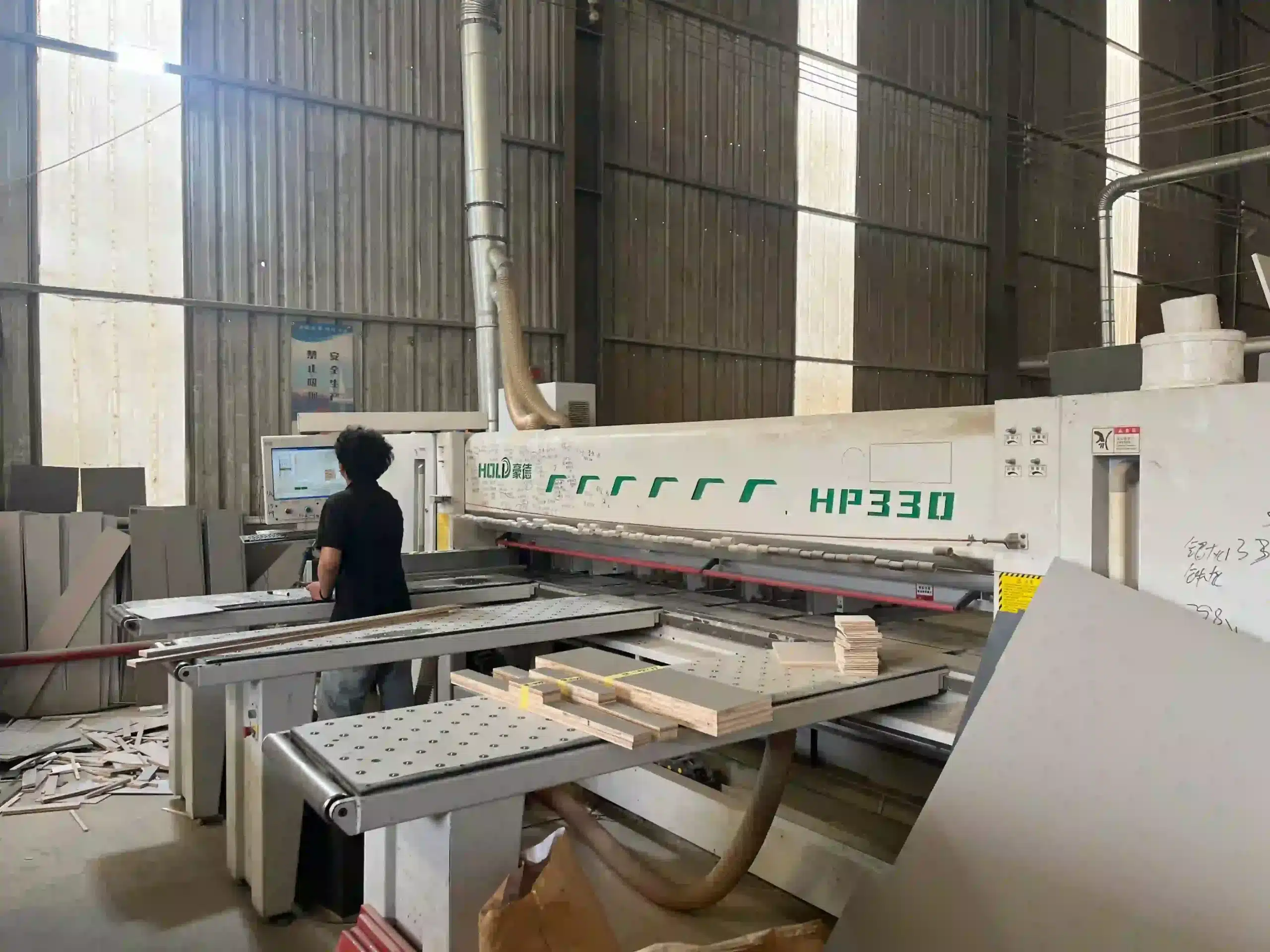
Ask what that card physically is and where the copies go. A workable arrangement is a printed router that travels with the lot, a completed copy filed by the quality department, and a scan sent to the buyer with the shipping documents. Signatures matter as much as entries: a card initialed at each station lets you reconstruct who released the work, the difference between a named process and a guess. If the answer is a spreadsheet on one machine that nobody backs up, you have learned what retrieval will cost you.
A quality management system is what makes those answers routine instead of heroic. The ISO 9001 quality management framework is built around identifying outputs, controlling production conditions, and retaining documented information as evidence of conformity, which is why a live certificate is a fair precondition for asking. MFBATH has held ISO 9001 and ISO 14001 since 2017, with both confirmed current in 2025. Certification does not prove your lot can be reconstructed, but it means an auditor has examined a system that says it should be.
Then close the loop with two sentences in the contract. The first fixes how long records must be kept; the wording that holds is a retention period covering the warranty term plus a claim-filing buffer, not a bare number that expires the week your project finishes snagging. The second fixes the format: name the batch card, the inspection sheet, and the material batch list as deliverables. Loading photographs extend that chain past the factory gate, and our guide to photo documentation at container loading is the container-side extension of the same record.
Linking Material Lots to a Field Defect
When a vanity fails in service, the cause usually sits upstream of the assembly line, in a material batch that arrived weeks earlier and went into many lots. Linkage means your lot record must reach a supplier lot of its own. Panel comes first, and formaldehyde grade is the clearest illustration. A plant may state that it works to E1, with formaldehyde emission at or below 0.1 ppm, or to CARB Phase 2 and TSCA Title VI for regulated markets. Those grades attach to a delivered board batch and its paperwork, not to a building. Record the board supplier and batch on the card, and a grade question becomes a document instead of a debate.
Edge band, finish, and hardware behave the same way. Edge-band reels come from separate extrusion runs, and a run slightly off in thickness or primer coating lifts at the joint only after heat and humidity cycles it. Coating batches vary in resin ratio and pigment load, which is where tone drift and slow cure appear months later. Hardware arrives in cartons carrying a supplier batch and a manufacture date, and a soft-close failure is frequently a batch event rather than a random one. Every input deserves a field on the card, because a defect tied to a material lot is a claim you can direct to the party that caused it.
| Field Failure | Most Likely Upstream Lot | Record to Demand |
|---|---|---|
| Edge lifting or seam opening at the front edge | Edge-band reel batch, panel batch, adhesive setting at the banding station | Cutting and banding entries on the batch card, first-article check, material batch list |
| Tone or sheen drift between units in one shipment | Coating batch, pigment lot, cure conditions on the paint line | Coating batch numbers, paint-line inspection sheet, sample comparison photos |
| Board swelling or surface staining in a wet zone | Core grade and sealing batch | Panel supplier declaration with grade documentation, per-lot sealing entry |
| Soft-close hinge or slide failure across several units | Hardware supplier batch and assembly station setting | Hardware delivery note with the batch, assembly sign-off, function-check result |
| Odor inside cartons after transit | Adhesive and finishing batches, dwell time before closure | Cure log before packing, packing-station release entry, PSI report notes on packaging |
| Chip or visible seam at a basin joint | Slab batch and the machining setup that cut it | Basin batch number, machining first-article check, assembly inspection line |
Read that table as a containment exercise rather than a catalog of disasters. A field report reaches you with a photograph and a location. Your job is to convert it into a lot, turn the lot into the material batches on its card, then count the units still in your warehouse, in transit, or installed. Most of those conversions depend on records you did not create, which is why they must be demanded before the deposit, while you still hold leverage. A material batch list shipped with the container is a map of your own exposure.
Explore Vanities Backed by Five-Point Inspection Records
Browse this product, solution, or service page to explore relevant offerings.

QC Records That Should Ship With Every Order
Records only become yours when they leave the plant in your hands. A five-point inspection program, the standard MFBATH applies to every cabinet, is worth translating into buyer terms, because it tells you what to request. Each checkpoint should produce a line: the point inspected against your approved sample and drawing, the method used, the accept or reject criterion, the result, the inspector initials, and the shift. Dimensional checks, hardware function, finish appearance, and packaging integrity are the usual families; how the five points are divided is a factory question, and the answer should be a document you can read.
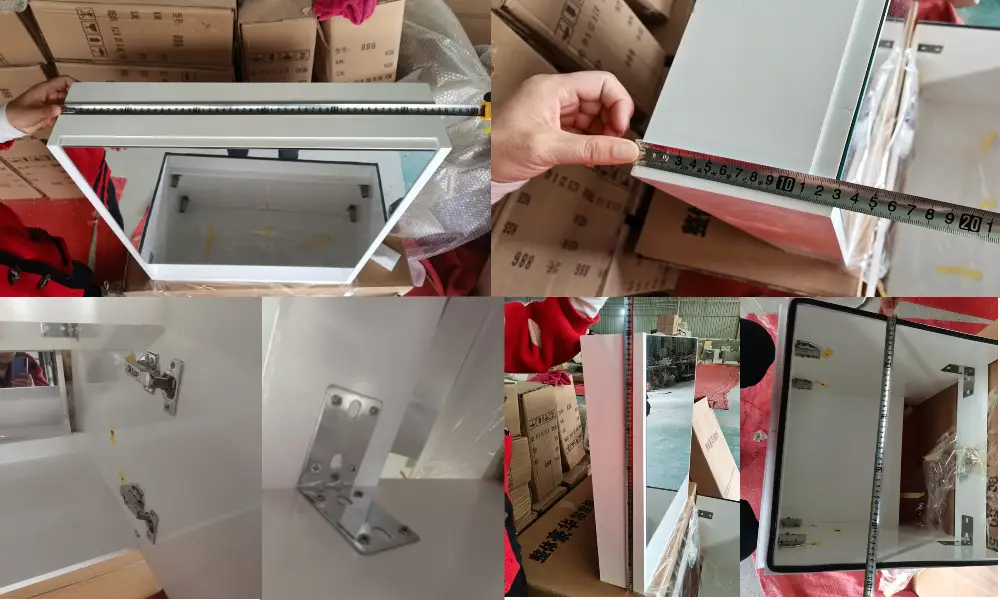
Then ask what happens to a unit that fails a checkpoint. Three dispositions exist in any quality system, and the record should say which one applied: rework followed by re-inspection, use-as-is acceptance under a concession signed by a named authority, or scrap. Paperwork reporting no nonconformities at all is not automatically clean; it may mean findings were resolved off-record, the version that resurfaces later as a claim nobody can date. Rework and concession entries are usually the most informative lines on an inspection sheet.
Third-party verification is where your record and the factory record meet. Pre-shipment inspection (PSI) by an independent firm such as SGS or TÜV is arranged in advance and reported by the inspection company rather than the plant. Insist that the PSI report cite factory lot codes, that sampling be drawn by lot instead of by the nearest convenient pile, and that the report reach you before the balance is authorized. Photographs and video belong in the same file, keyed to their lot. For the checkpoint logic behind staged verification, see a three-stage factory inspection checklist.
Put delivery of these records into the proforma invoice and the purchase contract rather than an email thread: the batch inspection record per lot, the material batch list, the packing list with a lot column, and the PSI report wherever one was booked. The reason to be picky is arithmetic. A two-year whole-cabinet warranty and a recorded return rate below 1% are population statements, usable only when individual claims can be assigned to a lot. Traceability turns those figures from marketing language into something you can plan stock and customer credits against, and the manufacturing excellence guides here cover the audits behind them.
Turning Traceability Into Warranty and Recall Control
The commercial value of traceability appears in documents. It turns two ordinary questions into answerable ones: how wide is this problem, and who pays for it. Everything below belongs in the purchase contract before a deposit moves, because a clause negotiated after a defect is found is a favor rather than a term.

Five Clauses Worth Adding
- Lot definition: one lot equals one purchase order, model, color, and size, with the lot code on the batch card, the carton marks, and the packing list.
- Record retention: batch cards, inspection sheets, and material batch lists are kept for a period covering the warranty term plus a claim-filing buffer, with copies delivered per shipment.
- Documents shipped with the container, named as deliverables, with a stated consequence if a shipment arrives without them.
- Material batch numbers for panel, edge band, coating, and hardware recorded per lot, with supplier declarations available on request.
- Containment and response: a response window defined in the contract by milestone, plus a duty to identify affected lot ranges rather than negotiating unit by unit.
Set the response window by milestone inside the contract: acknowledgment of a claim, delivery of the affected lot range, a disposition proposal, and a spare-parts release. Take those numbers from your own project schedule and the lead time you are quoted. At the example plant, samples take 10 working days and bulk production 20-30 days, which bounds how long a replacement lot takes to build and reach a port such as Qingdao, with 4-6 weeks total delivery to the United States, Canada, or Mexico. A response window shorter than physical reality is one you will waive.
Next, run returns by lot rather than by customer. A return authorization keyed to a purchase order and lot code shows whether a claim is isolated or a pattern inside one batch, and it stops five customers each calling the same edge-band failure a one-off. Spare-parts planning follows the same key, because hardware stock ordered against a lot stays useful only while that lot is in the field; that is the practical content of warranty math and spare-parts planning. Hospitality and healthcare projects make this concrete, since one handover concentrates exposure in a single delivery date and a few lots.
Then test the system while the order is still small. A 15-set trial line is enough to show whether a supplier can send a batch card and a material batch list with the shipping documents, and a paperwork gap is far cheaper to find at that scale than across a program. When the records arrive as agreed, browse the full product range knowing each new SKU inherits the same documentation discipline, and extend the clause set to every order line instead of renegotiating it container by container.
Frequently Asked Questions
What counts as a batch, and how does it differ from a purchase order number?
A purchase order is a commercial document; a batch, or lot, is a production population. The definition that holds in practice is purchase order plus model plus color plus size, so one order covering two models in two sizes is four lots with four separate records. The distinction matters because a defect travels through a lot, not through paperwork, and because mixed orders need lot labels line by line.
Does an order at the 15-set MOQ still need batch traceability?
Yes. The cost of traceability sits in how records are organized, not in how many units a lot contains, so a 15-set lot requires about the same paperwork as a full container. MFBATH is already set up for it, since the MOQ of 15 sets per model, color, and size is the same boundary as the lot. A small order is precisely when one defective batch is hardest to absorb commercially.
Which records should a buyer receive with every container?
Four: the batch inspection record per lot, the material batch list covering panel, edge band, coating, and hardware, a packing list with a lot column, and the pre-shipment inspection report where one was arranged. If any is missing, request it before the balance is authorized and put the omission in writing. A shipment that arrives without records shifts the burden of proof onto you.
If a factory will not provide traceability records, whose risk is it?
Yours, because an unverifiable claim is settled by discount instead of by evidence. Without records you cannot bound how many units are affected, cannot attribute a defect to a material batch, and cannot pass the claim to the supplier that caused it. A two-year whole-cabinet warranty and a return rate below 1% only carry meaning when a claim can be tied back to a lot, a date, and a signature.
The Bottom Line
Traceability is the difference between a warranty you own and a warranty you hope someone honors. Before your next deposit, ask the factory to state its lot definition, show you a batch card, and name the records that ship with the container, then put all three in the contract. Test it on a 15-set trial line and judge by what arrives, not by what is promised. A plant that can reconstruct a lot eight months later is a plant you can safely scale orders with.





0 Comments