
unique resale bathroom vanities is the first checkpoint buyers should lock before they approve a supplier, budget, or production slot. The math on a container of generic vanities just doesn’t add up anymore. You’re competing with a dozen other importers on the exact same white or gray box, and the only lever left to pull is price. Sourcing unique resale bathroom vanities has stopped being a luxury for distributors; it’s now a direct strategy for reclaiming margins before they completely disappear. The problem isn’t a lack of good ideas. The problem is the perceived risk of ordering a full container of an untested design.
Most importers get stuck here, assuming ‘custom’ means committing to 100+ units per SKU. That’s the old model. The real leverage today comes from partnering with a direct manufacturer whose factory is engineered for flexible, small-batch runs of just 10 to 20 units. This approach lets you test multiple private-label designs in a single shipment, find a winner, and scale from there. It shifts your business from being a price-taker on generic goods to a brand-builder with defensible products that are already certified for your specific market, whether it’s UL for North America or CE for Europe.
Why Most Resale Vanities Look Alike
If you’re a veteran distributor, you’ve walked into a competitor’s showroom and seen your own products staring back at you. This isn’t a coincidence; it’s the predictable outcome of a broken sourcing model. Most importers are fishing from the same small pond: the standard, public-facing catalogs of large-scale factories. This instantly commoditizes your inventory before it even leaves the port.
When you and five other distributors in your region are selling the exact same SKU, you surrender all pricing power. The customer’s decision is no longer about design or quality—it’s about who is willing to slash their margin the most. This isn’t competition; it’s a race to the bottom. Relying on a standard catalog forces you to compete on price alone, a game where profitability is always the first casualty.
You cannot build a defensible brand by selling a product that is, by definition, not yours. Without a unique offering, you are simply a logistics channel for the manufacturer. There’s no reason for a customer to seek you out or remain loyal. The moment a competitor offers the same generic vanity for less, you lose the sale. Importing high-margin bathroom cabinets is impossible without product differentiation that gives customers a reason to choose you specifically.
The MOQ Trap: Capital at Risk Analysis
Most importers incorrectly view MOQ as a simple order minimum, not as a direct measure of capital risk on untested designs.
For any veteran importer, the Minimum Order Quantity (MOQ) is the single biggest barrier to introducing unique products. The industry standard for custom bathroom vanities often requires a commitment of 100+ units per SKU. This forces you to place a substantial bet on a design that has zero sales data in your market, tying up capital that could be used elsewhere.
When an untested, high-MOQ design fails to resonate with customers, it becomes dead stock. This isn’t just a minor inconvenience; it’s a direct financial drain. Each unsold unit represents frozen capital, wasted warehouse space, and eventual losses from liquidation. A single bad call on a 100-unit order can easily erase the profits from your best-selling items, pushing you back toward the low-margin safety of generic products.
The solution isn’t to stop innovating; it’s to change your sourcing strategy. By partnering with a factory whose processes are built for flexibility, you can flip the script. Instead of the typical 100+ unit requirement, our OEM model is structured to support small-batch custom orders with an MOQ of just 10 to 20 units. This fundamentally changes the risk equation.
-
- High-MOQ Sourcing (Industry Standard): You commit enough capital for one container of a single, high-risk design. If it fails, the loss is significant.
- Low-MOQ Sourcing (MFBATH Model): You use the same capital to test 5-10 different custom designs simultaneously. You let the market validate the winners, then scale up production on proven sellers. This transforms sourcing from a gamble into a calculated market-testing operation.
OEM vs. Wholesale vs. Surplus: A Comparison
The goal isn’t finding a cheaper supplier; it’s becoming a brand-builder with defensible margins through a direct factory relationship.
For a distributor, choosing how to source is the single most important decision you’ll make. It dictates your margins, brand, and inventory risk. Let’s cut through the noise and look at the three real options on the table, evaluating them not by their definition, but by their impact on your bottom line.
Standard wholesale is the default path. You get product fast from a catalog, but you’re also buying into a price war against competitors selling the exact same generic items. This leads to inevitable margin erosion. Worse, you’re often forced into MOQs of 100+ units per SKU, tying up significant capital in inventory that has no unique selling proposition.
Sourcing surplus or auction stock is a high-stakes gamble. The per-unit cost looks great, but it’s a trap for anyone building a reputable brand. Supply is inconsistent, quality is a lottery, and you have zero control. The biggest hidden cost is non-compliance—a container of cheap vanities without the required UL, CSA, or CE certification is a 100% loss at customs.
Direct OEM/ODM (Original Equipment/Design Manufacturer) is the strategic path to brand control and higher margins. This is how you create a private-label product that can’t be price-shopped. The old assumption was that this required massive orders, but the market has changed. A modern factory partner makes this accessible.
-
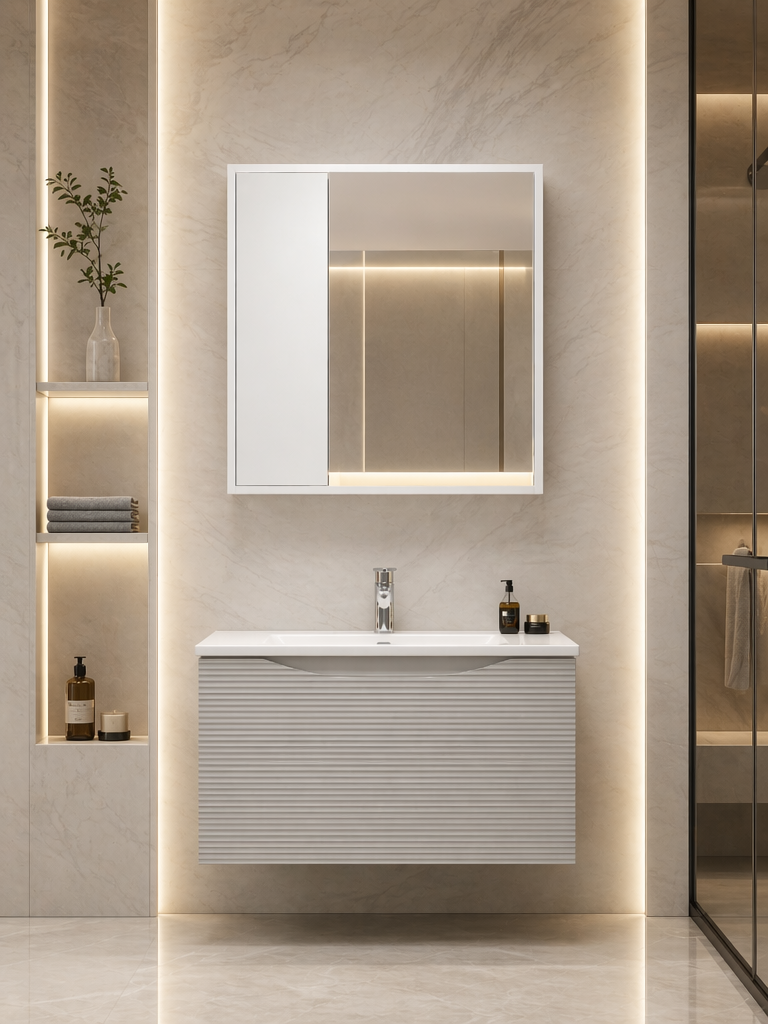
- Strategic Differentiation: You define the materials, Pantone colors, and hardware from over 40,000 combinations to create a product exclusive to your brand.
- Capital Efficiency: The right factory offers custom orders with an MOQ of just 10-20 units. This allows you to test multiple unique designs for the same capital risk as one large, generic wholesale order.
- De-Risked Importing: A professional OEM partner engineers products to meet your region’s standards from the start, providing the certified documentation needed to clear customs without issue.
| Sourcing Model | Product Uniqueness | MOQ & Capital Risk | Margin & Brand Control | Quality & Compliance |
|---|---|---|---|---|
| Direct OEM/ODM (e.g., MFBATH) | Fully Customizable. Create a private-label product with unique designs, materials, and branding. | Low (10-20 units). Enables market testing with minimal capital outlay, reducing risk of unsold inventory. | High. You set the price for a unique product, building brand equity and defending margins. | High & Verifiable. Direct factory oversight, 5-stage QC, and pre-engineered for regional compliance (UL, CE, AS/NZS). |
| Standard Wholesale | Generic. Limited to a fixed catalog, forcing competition on price for identical products. | High (100+ units per SKU). Locks in significant capital and carries a high risk of dead stock if a design fails. | Low to Moderate. Shrinking margins due to price wars. You are a reseller, not a brand owner. | Variable. Compliance is not guaranteed for your specific market, creating potential customs and liability issues. |
| Surplus / Liquidation | Inconsistent. One-time lots with no ability to reorder successful SKUs, preventing brand building. | Varies. Seemingly low risk, but often involves damaged goods or incomplete lots. High risk of total loss. | Unpredictable. Potentially high margins on a single lot, but zero brand control or long-term strategy. | Extremely Risky. Sold ‘as-is’ with no quality guarantees or compliance documentation. High risk of customs seizure. |
Your Small-Batch Sourcing Action Plan
Shifting from a price-taker to a brand-builder requires a disciplined process. Sourcing unique, small-batch vanities isn’t about finding a secret catalog; it’s about executing a direct OEM/ODM partnership. This action plan puts you in control of the final product, from material grade to the logo on the box, even with a low MOQ of just 10-20 units.
Your leverage begins with clarity. Vague requests lead to generic products. Provide the factory with a technical pack that leaves no room for interpretation. This includes CAD drawings with precise dimensions, material callouts (e.g., E1 grade moisture-resistant plywood vs. standard), desired hardware finishes, and specific Pantone color codes. This is how you start creating a private label bathroom furniture product instead of just buying one.
Never approve mass production based on photos alone. A physical sample is your only true safeguard. This is your chance to physically validate every decision you made in the specification stage. It’s the most critical checkpoint for any importer sourcing custom bathroom vanities with a low MOQ.
-
- Material Verification: Confirm the specified material was used—is it 100% waterproof PVC for a humid climate design, or the premium solid oak you requested?
- Finish & Color: Hold the sample under different lights. Does the paint finish match your Pantone chip? Is the wood grain consistent?
- Functional Test: Open and close every drawer. Test the soft-close mechanism. Check the fit and finish of all hardware and branded elements.
- Compliance Check: Ensure any specified electrical components, like on a smart mirror, carry the correct markings for your region (e.g., a UL/CSA sticker for North America).
Once you sign off on the PPS, the factory begins your small-batch run. A professional manufacturer will follow a multi-stage quality control process. Our internal standard mandates a five-stage inspection, covering everything from raw material verification to pre-shipment checks. This ensures the 20th unit has the same quality as the approved sample, protecting your investment and brand reputation.
Conclusion
Relying on standard wholesale catalogs forces distributors into price wars over identical products. The strategic alternative is to partner with a direct manufacturer for small-batch custom orders, typically 10-20 units. This approach shifts your business from reselling commodities to building a brand with defensible margins and less risk of dead stock.
Review the available material options, hardware choices, and past custom projects to see what’s possible. This is the starting point for building a unique vanity line that your competitors cannot easily copy.
Frequently Asked Questions
Who makes the best quality bathroom vanities?
The best quality vanities come from direct manufacturers who control the entire production process, from material sourcing to final inspection. Look for factories with documented multi-stage quality control and advanced. Always verify their quality control process and certifications before placing an order.
What color bathroom has the highest resale value?
Bathrooms with adaptable, neutral palettes like natural wood tones, warm whites, or sophisticated muted colors typically have the broadest resale appeal. These palettes allow new owners to easily personalize the. Consider your target market’s aesthetic preferences before committing to a specific color.
Who is the best supplier for bathroom vanities?
The best supplier is a direct manufacturer offering low MOQs for custom orders and providing region-specific regulatory compliance. This combination allows you to test unique designs with minimal risk while ensuring. Prioritize suppliers who can provide compliance documentation for your specific region.
What are the most regretted bathroom upgrades?
The most regretted upgrades are often those using materials unsuitable for the local climate or choosing trendy designs with poor long-term durability. For example, a non-waterproof vanity in a humid region. Always match material specifications to the intended climate and use case.
What color is replacing gray in 2026?
For 2026, the market is shifting from cool grays to warmer, natural materials like rich wood finishes and earthy tones. Sintered stone vanities with natural-looking patterns are also gaining. Leverage a supplier’s custom color matching to test emerging palettes in small batches.


0 Comments