

Sourcing a solid wood vs MDF bathroom vanity requires looking past the unit price to see the actual warranty costs and replacement cycles. As a direct manufacturer serving over 1,000 distributors across 20+ countries, the manufacturer sees buyers lose margin on hidden failures—whether it is an MDF unit delaminating after a single leak or solid wood warping due to improper kiln drying. The choice dictates the buyer’s retail positioning, compliance paperwork, and long-term liability.
Factory QC data exposes the real difference between these materials. MDF can swell over 20% in thickness after just 24 hours of direct water exposure, while solid wood stays under 5%. Conversely, solid wood is not immune to failure; without pre-stabilization to 7-9% moisture content, the wood expands and cracks paint at the joints. Understanding these specific engineering constraints allows you to select the right material for your target market’s humidity and your own profit margins.
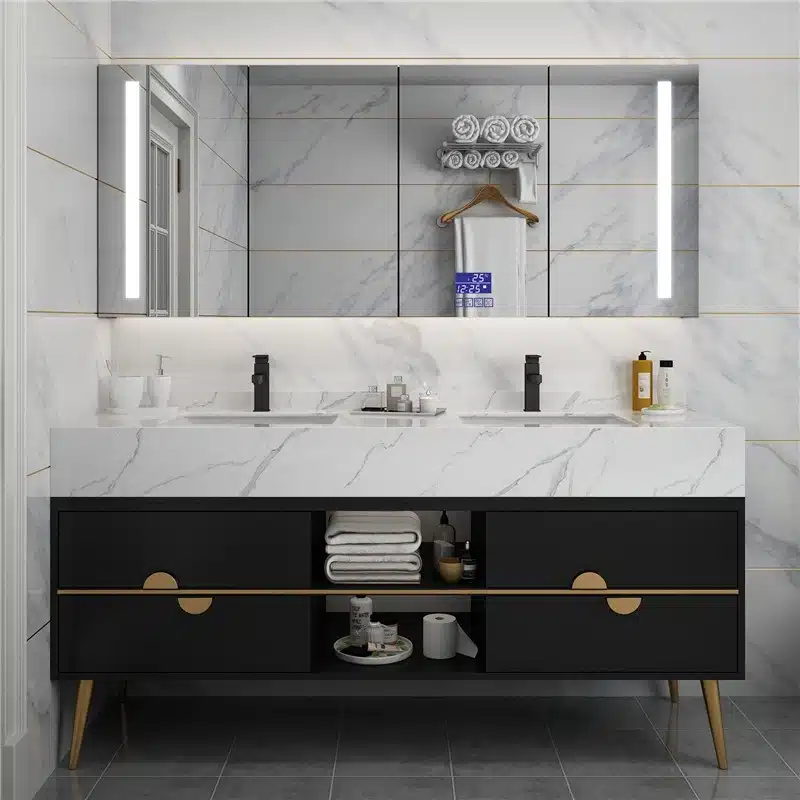
Real Cost Breakdown: MDF vs Solid Wood for Bulk Imports
MDF’s 40-60% upfront savings vanishes when replacement costs and warranty claims exceed solid wood’s lifecycle value.
A 60-inch double-sink vanity costs $80-$120 FOB in MDF, compared to $200-$350 FOB for solid oak. While the per-unit margin looks significantly higher on MDF, the shipping density is deceptive. MDF vanities are thicker and heavier (600-800 kg/m³), allowing only 130-140 units per 40HQ container versus 160+ units for lighter solid wood frames. This increases your landed freight cost per unit by roughly 15-20%, eroding the initial price advantage.
-
- Hidden Finishing Costs: MDF is a sponge for moisture. To pass basic humidity tests, you must seal every cut face, not just the visible edges. Our internal data shows that full edge banding plus a 2-coat PU sealant on all CNC cutouts adds $5-$15 per unit in labor and material, a cost rarely factored into initial FOB quotes.
- The CNC Cutout Risk: Standard MDF fails catastrophically at the sink basin cutout. A single unsanded route can wick water 50cm into the board within hours. Competitors often skip sealing these internal cutouts to save time, leading to immediate structural failure. We mandate PVC edge banding on all cut faces to prevent this specific failure mode.
- Certification & Compliance: For North American imports, CARB Phase 2 compliance (0.09ppm formaldehyde) is mandatory. While achievable with MR-MDF, it requires strict resin control. Solid wood naturally exceeds these limits, but the glue joints in plywood-core MDF must be verified. Request the specific CARB test report from the resin supplier, not just the final assembly certificate.
- Warranty & Lifespan Reality: MDF vanities average a 5-7 year lifespan before structural delamination in primary bathrooms. Solid wood, properly kiln-dried to 9% moisture content, lasts 15-25 years. If your retail warranty is 2 years, MDF is viable; if you offer 5+ years, the replacement cost of water-damaged MDF will destroy your margins.
| Feature | Specification | Advantage |
|---|---|---|
| Upfront Cost (60″ Unit) | MDF: $110 FOB | Solid Oak: $300 FOB | MDF offers 40-60% lower initial investment |
| Moisture Resistance | MDF: 20%+ swell in 24h | Solid Wood: <5% swell | Solid wood survives flooding; MDF requires perfect sealing |
| Lifespan & ROI | MDF: 5-7 years | Solid Wood: 15-25 years | Solid wood is cheaper over 20+ years due to fewer replacements |
| Shipping Efficiency | MDF: 160 units/40HQ | Solid Wood: 130 units/40HQ | MDF allows higher container density, lowering per-unit freight |
| Quality Control Focus | MDF: Edge sealing critical | Solid Wood: MC stabilization | Prevents hidden warranty costs from warping or edge delamination |
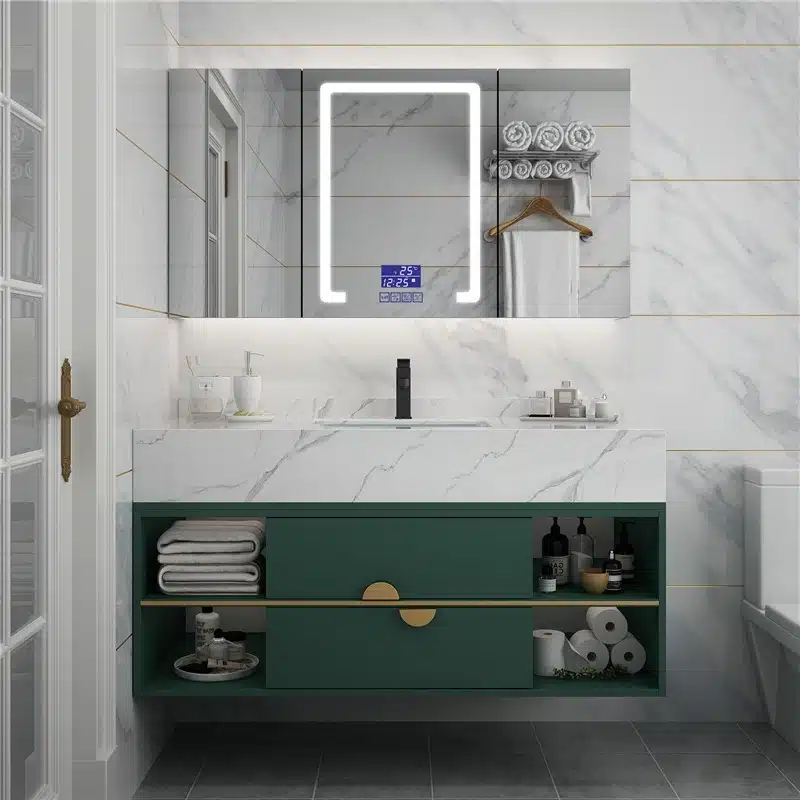
Moisture Showdown: Which Material Survives Bathroom Humidity?
MDF fails at the edges; solid wood fails at the joints.
The industry myth that solid wood is inherently superior for bathrooms ignores the physics of wood expansion. While MDF (Medium Density Fiberboard) is vulnerable to water ingress, solid wood’s cellular structure absorbs and releases moisture naturally, causing seasonal expansion of up to 4% in width. Without proper stabilization, this movement inevitably cracks the paint at the joinery seams, triggering the highest volume of warranty claims for luxury imports.
At our 10,000㎡ facility in Henan, we solve this by pre-stabilizing solid wood (oak, walnut) to a strict 9% Moisture Content (MC) before assembly. We then apply a full marine-grade PU finish consisting of six coats. This engineering approach completely seals the wood grain, allowing the vanity to withstand 40°C shower steam and survive the -30°C temperature shock of transoceanic shipping to North America without warping or delaminating.
Conversely, MDF’s biggest killer is not steam, but unsealed edges. A single unsanded CNC cutout around a sink basin can wick water 50cm into the board, causing irreversible swelling. Standard moisture-resistant (MR-MDF) is often insufficient for high-humidity zones. The industry standard for durability is High-Density MDF (HDF) at 900 kg/m³, which offers 60% less water absorption than standard boards.
To protect your margin, we enforce a stricter protocol than the industry norm. While competitors only band visible edges, we apply PVC edge banding to ALL cut faces. Furthermore, every sink cutout receives a mandatory two-coat PU sealant. This prevents the ‘sponge effect’ that destroys standard MDF vanities within 18 months of installation in humid climates.
-
- Thickness Swell (24h Water Immersion): Standard MDF swells 20%+ and crumbles; Solid Wood (stabilized) swells <5% and retains structural integrity.
- Density and Absorption: Standard MR-MDF (720-800 kg/m³) absorbs moisture rapidly. Our HDF core (900 kg/m³) reduces water absorption by 60%, matching plywood durability at a smoother finish.
- Joint Stability: Standard solid wood fails at dovetail joints due to humidity swings. Our 9% MC pre-stabilization and 6-coat marine PU finish eliminate expansion-induced paint cracking.
- Edge Protection Protocol: Competitors leave sink cutouts raw. We utilize edge banding on all cut faces plus a 2-coat PU sealant on sink cutouts, directly blocking water wicking.
| Material | Moisture Resistance | Thickness Swell (24h Water) | Lifespan | Best For |
|---|---|---|---|---|
| Solid Wood (Oak/Walnut) | High (Cellular structure absorbs/releases humidity) | <5% | 15-25 years | Luxury markets, dry climates, refinishable surfaces |
| MR-MDF (High Density) | Medium (Requires full edge sealing) | 20%+ (if edges exposed) | 5-7 years | Budget projects, ventilated bathrooms, painted finishes |
| PVC Foam Board | 100% Waterproof | 0% | 10-15 years | Coastal regions, high-humidity zones (e.g., Dubai, Florida) |
| Plywood (Birch Core) | High (Moisture-resistant glue) | <10% | 10-20 years | Hybrid builds, European markets, cost-effective durability |
Solid Wood or MDF: How to Choose the Right Material for Your Project
Solid wood offers a 15-25 year lifespan; MDF averages 5-7 years, but correct-grade MDF is viable in ventilated spaces.
The choice between solid wood and MDF for bathroom vanities is not just about aesthetics; it is a decision that dictates your warranty claim rates and long-term ROI. While solid wood (oak, walnut, ash) commands a premium retail price, it requires strict moisture control. MDF offers a smooth, paint-ready surface for modern designs but fails catastrophically if water penetrates its edges.
Most importers mistakenly believe MDF’s weakness is general steam. The real failure mode is unsealed CNC cutouts. A single unsanded route around a sink basin can wick water 50cm into the board, turning it into a sponge. We solve this by applying PVC edge banding on ALL cut faces and a 2-coat PU sealant on sink cutouts, not just visible edges.
-
- Moisture Resistance: Internal QC tests show MDF thickness swells 20%+ in 24 hours of direct water exposure, whereas solid wood swells less than 5% under the same conditions.
- Cost & Logistics: A 60-inch double sink MDF unit costs ~$110 FOB versus ~$300 FOB for solid oak. However, MDF packs 160 units per container compared to 130 units for solid wood due to thickness differences.
- Lifespan & Warranty: Warranty claims data indicates MDF vanities average 5-7 years before structural failure in primary bathrooms. Solid wood vanities last 15-25 years and can be refinished.
- Hybrid Advantage: For the best of both worlds, use a plywood core with an MDF face. This provides the moisture resistance of plywood with the smooth, paint-grade finish of MDF, minimizing edge-absorption risks.
| Feature | Specification | Advantage |
|---|---|---|
| Moisture Resistance | Solid Wood: <5% swell (24h water); MDF: 20%+ swell | Solid wood survives flooding; MDF delaminates with single leak |
| Lifespan & ROI | Solid Wood: 15-25 years; MDF: 5-7 years | Lower lifecycle cost for solid wood; MDF requires frequent replacement |
| Cost Efficiency | MDF: ~$110 FOB; Solid Wood: ~$300 FOB | MDF offers 40-60% lower upfront cost per unit |
| Edge & Joint Integrity | MDF: Unsealed edges wick water; Wood: Joints crack if MC >9% | Requires full edge banding for MDF; kiln-drying (9% MC) critical for wood |
| Best Application | MDF: Ventilated modern baths; Wood: Luxury/Humid climates | MDF for budget/painted finishes; Wood for high-end/refinishable surfaces |
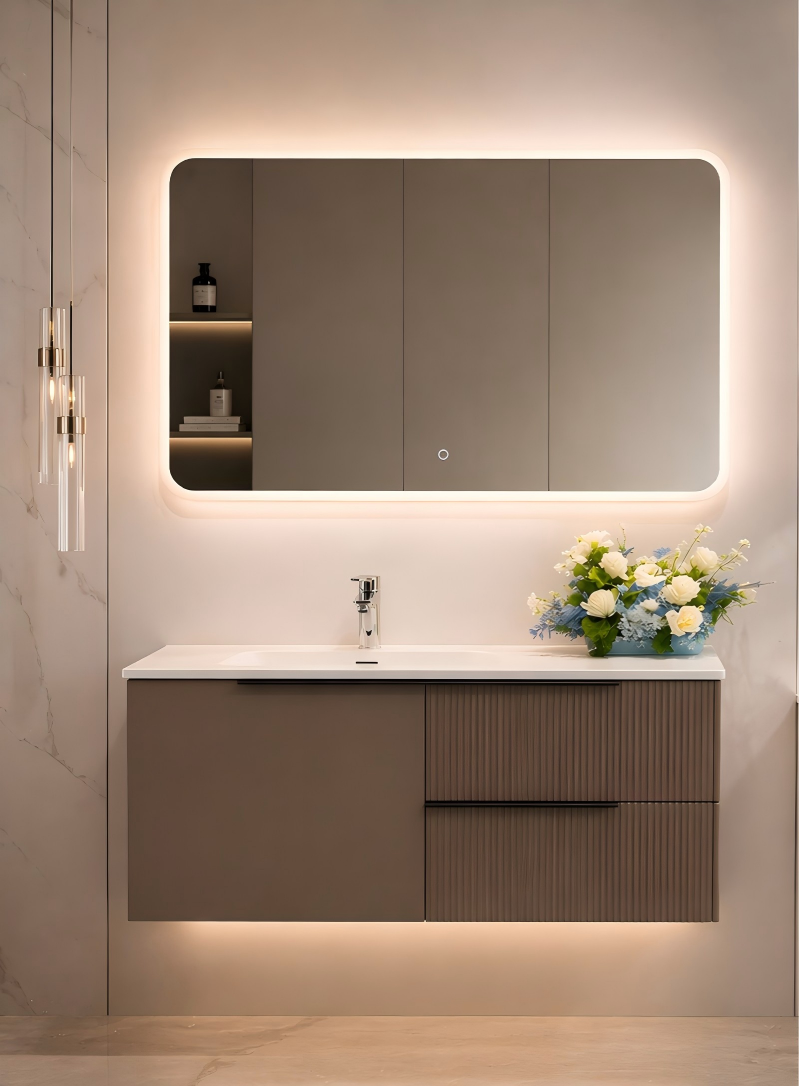
How to Spot Substandard MDF or Solid Wood Before You Buy
Verify moisture content and edge sealing before paying the deposit to avoid 100% container loss.
Importers often lose money because they assume ‘moisture-resistant MDF’ is a universal standard. It is not. A single unsealed CNC cutout around a sink basin can wick water 50cm into the board, turning a structural panel into a sponge within weeks. Containers have been recovered where the exterior looked pristine, but the internal swelling destroyed the drawer slides and hinges.
The real failure point for solid wood isn’t the wood itself, but the joinery. If the kiln-drying process is rushed, the wood will expand and contract with humidity, cracking the paint at the seams. We enforce a strict 9% Moisture Content (MC) pre-stabilization for all solid oak and walnut exports, ensuring the wood is locked into a stable state before assembly.
-
- The Water Submersion Test: Request a 30cm x 30cm sample block from your supplier. Submerge 1cm of the raw edge in water for 4 hours. High-quality MR-MDF will show less than 2% thickness swell. Substandard MDF will swell over 20% and begin to crumble at the edges, indicating cheap binders and poor density.
- Solid Wood Moisture Content (MC): Demand a kiln-drying certificate. The MC must be between 6% and 9% for export. If the MC is above 12%, the wood retains too much internal tension and will almost certainly warp or cause dovetail joints to separate once installed in a humid bathroom environment.
- End Grain Inspection: Examine the end grain of the wood panels. Genuine solid wood should show continuous, natural growth rings. If you see a checkerboard pattern of tiny, finger-jointed blocks, the supplier is using low-grade scrap wood glued together. This material has significantly lower structural integrity and is prone to delamination.
- The Sink Cutout Seal: Most competitors only band the visible outer edges of the vanity. Our protocol requires PVC edge banding on ALL cut faces, plus a 2-coat PU sealant specifically on the sink cutouts. This prevents the ‘wicking’ effect that causes 80% of MDF warranty claims in North American and European markets.
Conclusion
The choice between solid wood and MDF bathroom vanities ultimately hinges on your target market’s climate and your tolerance for warranty claims. Solid oak offers a 15-25 year lifespan with superior structural integrity, but requires strict moisture content stabilization to prevent joint failure. MDF provides a lower entry price and smoother finish, yet demands rigorous edge-sealing protocols to survive high-humidity environments without delaminating.
Frequently Asked Questions
Is MDF or solid wood better for a bathroom vanity?
Solid wood is better for long-term durability and resale value, offering a 15-25 year lifespan compared to MDF’s 5-7 years. MDF is only viable in well-ventilated spaces with moisture-resistant. Choose solid wood for luxury longevity and MDF only for budget, dry-climate projects.
What are 5 disadvantages of MDF?
MDF suffers from poor moisture resistance, heavy weight, limited repairability, lower perceived value, and susceptibility to edge swelling. A single unsealed cutout can turn the board into a sponge, leading. Avoid MDF in high-humidity zones or where heavy hardware mounting is required.
Which wood is best for a bathroom vanity?
Premium hardwoods like oak or walnut are best for bathroom vanities due to their natural density and aesthetic appeal. These materials withstand humidity better than softwoods and support higher price. Select dense hardwoods for premium projects and ensure proper sealing for longevity.
What is the best material for a bathroom vanity unit?
The best material depends on your target market: solid wood for luxury, PVC for 100% waterproofing in humid climates, or sintered stone for modern scratch resistance. MDF is generally discouraged for primary. Match the material to your region’s climate and customer segment.
What type of material is best for a bathroom vanity?
For bulk imports, solid wood offers the best balance of durability and brand prestige, while PVC is ideal for extreme humidity. Avoid standard MDF unless using specialized moisture-resistant grades for. Prioritize solid wood or PVC based on your specific regional climate needs.


0 Comments