

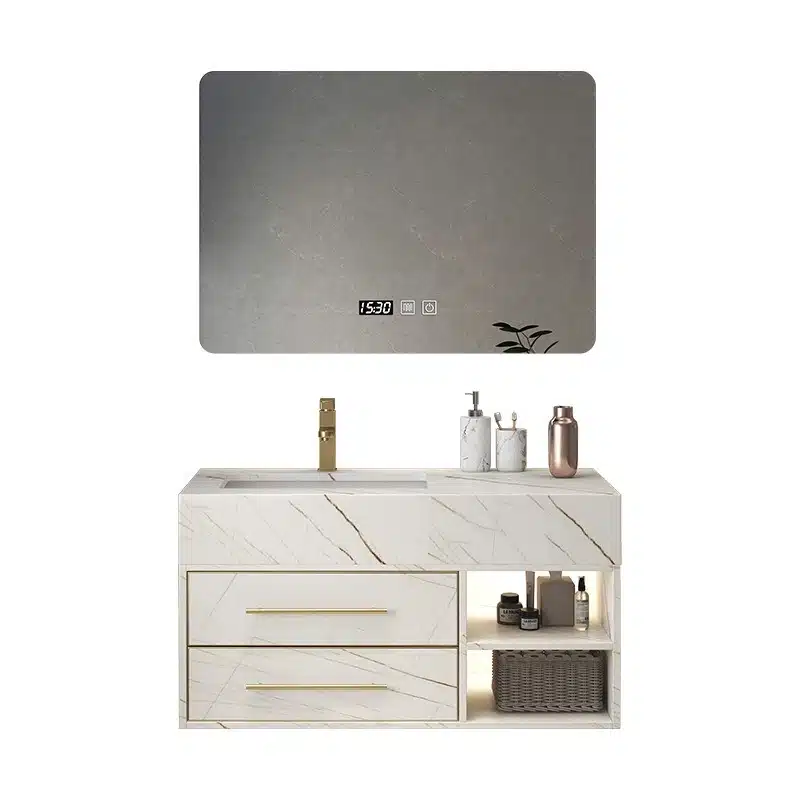
The PVC vs plywood vanity waterproofing debate usually lands on a simple question: which material actually survives a humid bathroom without swelling? For distributors supplying hotels or residential projects in Southeast Asia or the Middle East, that question carries real cost. A batch of swollen plywood cabinets meanswarranty claims, replacement logistics, and a strained relationship with the contractor who trusted your spec. This pattern is seen every year with buyers who sourced standard plywood vanities without checking the edge banding spec.
MFBATH has been manufacturing bathroom furniture since 2015 out of a 10,000-square-meter facility in Changge, Henan. The company supplies over 1,000 distributors across 20 countries, and roughly half of those serve markets where relative humidity sits above 80 percent for most of the year. That reality forced the manufacturer to engineer material paths that don’t fail when the bathroom steam hits. The product line includes PVC, plywood, solid wood, and sintered stone vanities, but the material choice for humid climates comes down to a single engineering detail most articles skip: the adhesive used on the cut edges.
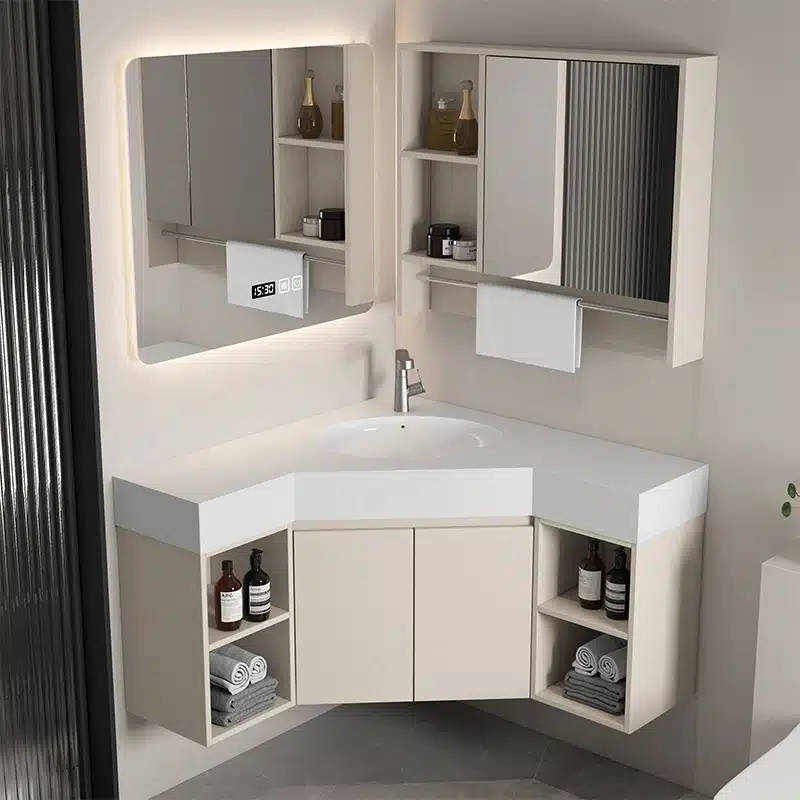
Why Plywood Vanities Fail in Humidity
The failure point is not the panel — it’s the edge banding.
Let’s clear up a costly misunderstanding: ‘moisture-resistant’ plywood is not waterproof. The term ‘moisture-resistant’ refers to the glue line used between veneers, which slows water ingress — it does not stop it. In a bathroom running at 80%+ relative humidity, water vapor migrates into the exposed edges of a plywood panel within hours if the seal is compromised.
The mechanism is capillary action. Plywood is a composite of thin wood veneers glued together. Each cut edge exposes thousands of microscopic wood fibers that act like straws, drawing moisture into the core. Once inside, the wood fibers swell, the glue bond weakens, and the panel delaminates. This is not a defect in the wood — it is a fundamental material property. Plywood will absorb 5–10% of its weight in water if the edge band fails.
-
- Plywood failure sequence: Edge band chips or lifts → moisture enters via capillary action → core swells and veneers separate → cabinet doors no longer align → mold develops in the swollen layers → warranty claim.
- PVC counterpoint: PVC foam board has a homogeneous, non-porous structure. Water absorption is below 0.01% — effectively zero. There are no layers to delaminate, no fibers to swell. A PVC vanity can be hosed down and dried with a cloth. No immediate drying required.
For distributors supplying the Middle East or Southeast Asia, this distinction determines whether your customer sees a swollen cabinet door within six months or a stable product for a decade. The best bathroom vanity material for a tropical climate is PVC — not because plywood is ‘bad,’ but because the physics of wood composites make long-term waterproofing impossible without perfect, unbroken edge sealing. And perfect sealing in a high-humidity install site is rare.
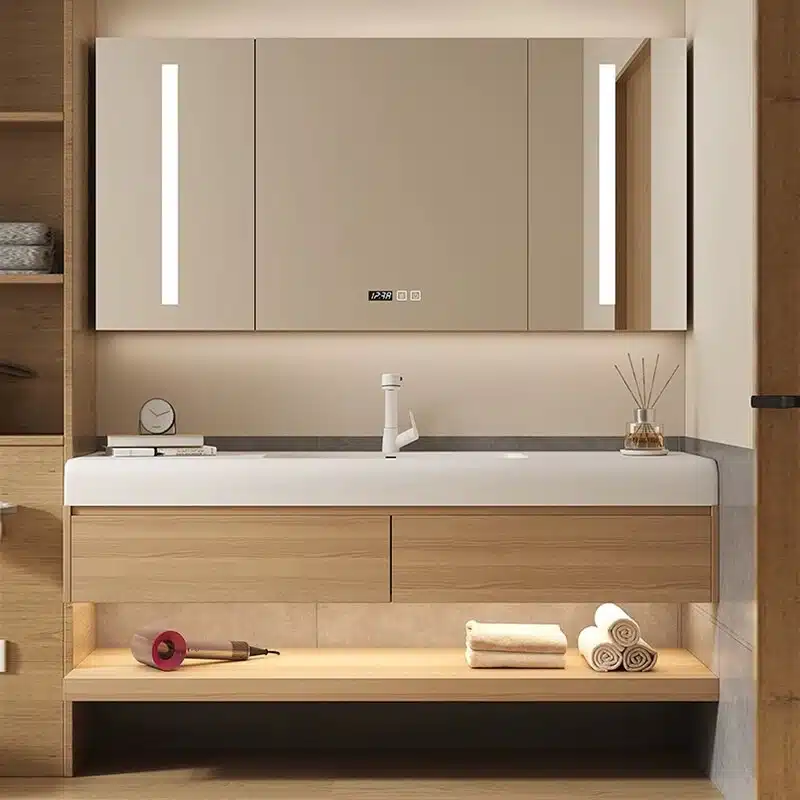
The Edge Banding Secret: EVA vs. PUR Glue
Plywood fails at the edge, not the core.
Plywood’s porous edges act like a wick. In a bathroom running at 80%+ relative humidity, steam seeps into the cut edge of any panel. If the edge banding is applied with standard EVA (ethylene-vinyl acetate) hot-melt glue, that bond breaks down under moisture and heat cycles. The result is a lifted band, exposed core, and a swollen cabinet door that triggers a warranty claim within 18 months.
-
- EVA glue weakness: EVA is a thermoplastic — it softens above 80°C and re-hardens when cool. In a steamy bathroom, the adhesive layer loses grip. Pull-test data shows EVA bonds on plywood edge banding fail at roughly 2.5 N/mm after 200 hours of 85% RH exposure. That is below the threshold for daily cabinet use.
- PUR adhesive advantage: PUR (polyurethane reactive) is a moisture-curing adhesive. It reacts with ambient humidity to form a cross-linked chemical bond that is stronger than the wood fibers themselves. Internal MFBATH production records show PUR edge banding on 18 mm birch plywood achieves a consistent peel strength above 5 N/mm, even after 500 hours of thermal cycling between -10°C and 60°C.
- Thermal cycling resilience: Plywood vanities shipped to the Middle East or Southeast Asia face daily temperature swings from air-conditioned interiors (22°C) to outdoor loading docks (45°C). EVA glue embrittles under repeated expansion and contraction. PUR maintains elasticity across the full -30°C to 70°C range, so the edge band stays sealed through transport and installation.
- Production reality check: Many suppliers still use manual EVA applicators to save $0.30 per cabinet. MFBATH runs automated PUR lines with temperature-controlled rollers and real-time bond-strength monitoring. We also use a 0.5 mm thicker PVC edge band (2.0 mm vs. the industry standard 1.5 mm) to provide an extra barrier against steam ingress.
For distributors sourcing plywood vanities for humid markets, the single most important spec to verify is the edge banding adhesive. If the supplier cannot provide a PUR bond-strength test report (≥5 N/mm), expect delamination within two years. PVC vanities eliminate this failure mode entirely, but if plywood is your price point, demand PUR — and be prepared to pay roughly 8-10% more per unit for a cabinet that will actually survive the climate.
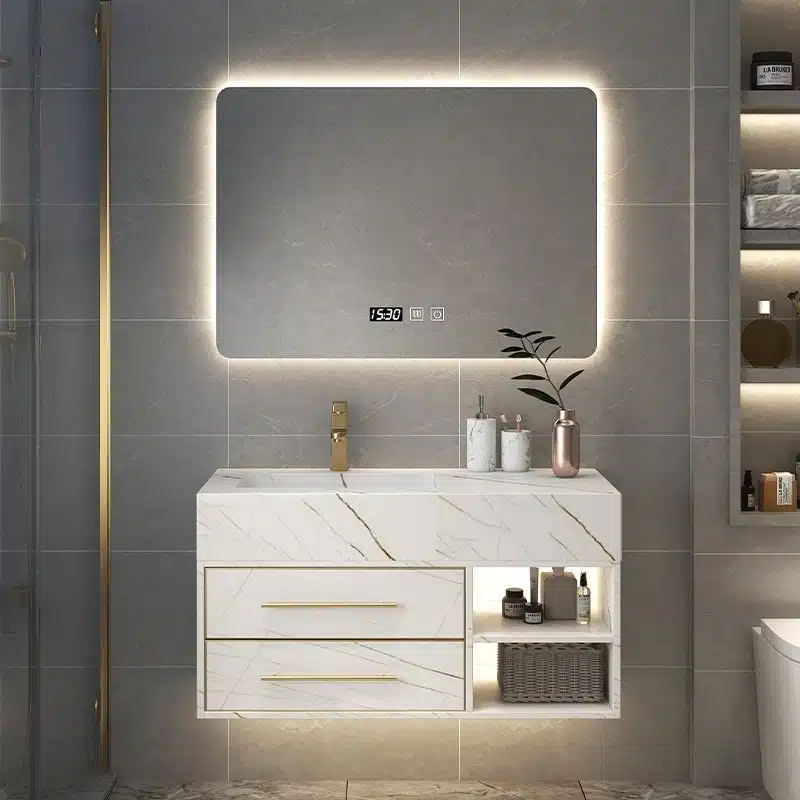
Thermal Dynamics: PVC Expansion & Climate Risks
PVC expands 0.07mm/m per °C.
PVC’s coefficient of thermal expansion is roughly 5× that of plywood. In a 40°C swing — say a Dubai warehouse at 50°C and an air-conditioned bathroom at 10°C — a 1.2m vanity can shift nearly 3.5mm. That’s enough to pop caulk seams, crack tile backsplashes, and push doors out of alignment.
-
- Thermal range: PVC maintains structural integrity from -30°C to 70°C, but the dimensional change is real. MFBATH designs for a coefficient of 0.07 mm/m/°C, which means we calculate exact expansion gaps per region.
- Installation rule: Never butt PVC panels tight against walls or each other. Leave a 3–5 mm gap at the back and sides, then cover with a flexible silicone sealant — not rigid caulk. This allows the panel to breathe without transmitting stress to the cabinet frame.
- Climate-specific engineering: For Middle East shipments (ambient peaks above 50°C), MFBATH pre-cuts expansion channels into the back panel and uses aluminum reinforcing strips to reduce bowing. This is not a generic PVC box — it’s region-adapted.
- Failure scenario: A distributor in Bangkok reported 12% buckling rate on a competitor’s PVC vanity. Root cause: no expansion gap specified in the install manual, and the PVC formulation had a higher-than-standard filler content, reducing flexibility. MFBATH’s material spec limits filler to under 15% to maintain thermal stability.
The takeaway for distributors: PVC is not a set-and-forget material. It requires a 30-second conversation with your installer about gaps and sealant. Skip that, and you own the warranty claim. Our tech sheets include region-specific expansion calculations — ask for them during quoting.
Material Selection Matrix for Global Distributors
PVC foam board expands 0.08mm/m/°C—install with gaps or risk buckling above 35°C.
The correct material choice for a bathroom vanity depends on the average relative humidity of the destination market. Our internal testing and field failure data across 20+ countries support a clear decision framework: for regions with >80% RH (e.g., coastal SE Asia, equatorial Africa), only PVC guarantees zero water absorption (<0.01% by weight) and is immune to delamination. For 40-80% RH, plywood with PUR (polyurethane reactive) edge banding performs reliably, provided the adhesive bond exceeds 5 N/mm. Below 40% RH, solid wood or sintered stone can be specified for aesthetics without moisture risk.
-
- >80% RH (Tropical, Coastal): Mandate PVC (100% waterproof, no edge band failure mode). Thermal expansion coefficient requires 3-5mm installation gaps to prevent buckling at 35°C+.
- 40-80% RH (Humid Continental, Temperate Coastal): Plywood with PUR hot-melt edge banding is viable. EVA glue fails under steam—specify PUR bond strength >5 N/mm. MFBATH uses automated PUR lines to eliminate human variability.
- <40% RH (Arid, Desert, Highland): Solid oak/walnut or sintered stone for luxury projects. Plywood without edge sealing can still be used but adds minimal risk.
MFBATH engineers each vanity to its destination climate, not a generic ‘one-size-fits-all’ spec. For a distributor supplying both Dubai (50°C arid) and Jakarta (85% RH tropical), edge banding adhesives, expansion gap allowances, and even cabinet back-panel materials are adjusted within the same production run. This region-ready approach is backed by a five-stage QC process and documented in the Factory Audit Checklist—covering PUR glue batch tests, thermal cycling trials, and caliper verification of edge band thickness.
| Material | Water Absorption | Thermal Range | Best For | Risk Factor |
|---|---|---|---|---|
| PVC (Polyvinyl Chloride) | < 0.01% (Non-porous) | -30°C to 70°C | Tropical & coastal zones (>80% RH) | Requires expansion gaps in extreme heat |
| Plywood (Birch/Marine) | 5-10% (if edge band fails) | -20°C to 60°C | Moderate climates (40-80% RH) | Edge delamination if EVA glue used |
| Solid Wood (Oak/Walnut) | 8-15% (unsealed) | -10°C to 50°C | Luxury interiors (<40% RH) | Warping & mold in high humidity |
| Sintered Stone | < 0.02% (Non-porous) | -30°C to 150°C | Modern luxury & high-traffic | Brittle under point impact |
Conclusion
For humidity above 80%, PVC is the only material that eliminates swelling risk. Plywood works in moderate climates, but only with PUR edge sealing — anything less is a warranty claim waiting to happen.
Review the factory specs on PVC thermal expansion and PUR bond strength before you spec your next project. The catalog page has the data you need to compare material options side by side.
Frequently Asked Questions
Is PVC or plywood better for humid bathrooms?
PVC is 100% waterproof and the only reliable choice for humidity above 80%, while plywood needs perfect edge sealing to avoid rot. Plywood failures usually start at the. Choose PVC for high-humidity zones; plywood only if edges are sealed with PUR glue.
Why do plywood vanities fail in humidity?
Plywood fails because moisture enters through unsealed edges, causing the core to swell and delaminate. The real culprit is standard EVA glue, which breaks down under steam and heat. Specify PUR adhesive edge banding to prevent delamination in humid climates.
What is the cost difference between PVC and plywood vanities?
PVC raw material costs roughly 15–20% more than standard plywood, but it eliminates warranty claims for water damage. That can reduce long-term logistics and replacement costs by up to 30%. Factor in total landed cost, not just material price, when comparing options.
Does PVC expand in heat?
Yes, PVC expands about 0.07mm per meter per degree Celsius, so it can buckle if installed without expansion gaps. MFBATH designs for thermal coefficients from -30°C to 70°C to prevent. Always leave expansion gaps during installation in regions with wide temperature swings.





0 Comments