
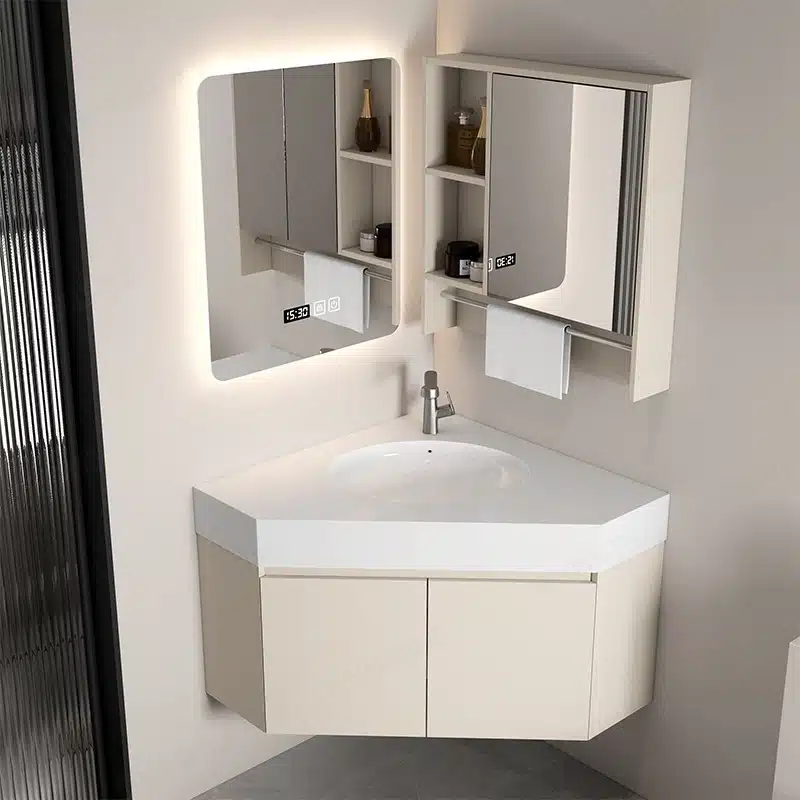
Selecting the right material for your inventory is a daily calculation between upfront cost and long-term liability. When evaluating pvc vs plywood vanity options for high-humidity markets, the decision moves beyond simple aesthetics and into structural integrity. MFBATH, a direct manufacturer in Changge, Henan, serves over 1,000 distributors across 20+ countries by engineering products that survive specific regional climates, from the coastal humidity of Europe to the arid heat of the Middle East.
The real failure point is rarely the base material itself; it is the hardware interface and edge-banding seal. Plywood relies on perfect E1-grade resin seals to resist moisture, meaning a single broken seam leads to irreversible swelling and delamination. PVC offers a single-molecule, non-porous structure where water has no path to penetrate, effectively eliminating warranty claims caused by sink-cutout swelling in humid zones.
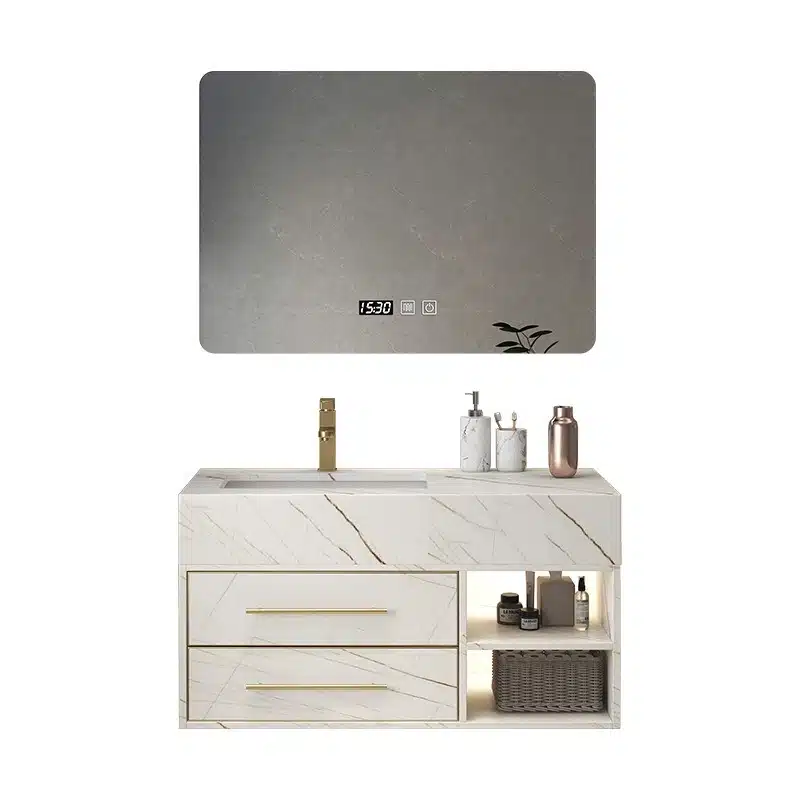
PVC vs Plywood: Core Structural Reality
PVC is structurally immune to water ingress, whereas plywood’s durability is entirely dependent on the integrity of its edge-banding seal.
The fundamental difference between PVC and plywood vanities is not just material composition, but how they interact with moisture at a molecular level. PVC is a single-molecule, non-porous structure. It offers 100% waterproof immunity, meaning it handles 100% ambient humidity without absorbing water, swelling, or providing a substrate for mold and mildew to take root.
Plywood, by contrast, is a porous, organic material. While marine-grade plywood is moisture-resistant, it is not waterproof. Its structural integrity relies entirely on the cross-grain density and the perfection of the edge-banding seal. If that seal breaks—even by a fraction of a millimeter—water ingress occurs, causing irreversible core swelling and delamination.
For B2B buyers in high-humidity regions (SE Asia, Middle East, Coastal Europe), this mechanical difference dictates your warranty liability. Plywood requires rigorous, high-grade E1 sealants and perfect edge-banding to survive. If the hardware interface (sink cutout, hinge drill points) is compromised during installation, the vanity fails. PVC eliminates this failure mode entirely, as water has no path to penetrate the material.
-
- PVC Structural Reality: Closed-cell foam injection creates a single-molecule barrier. Zero water absorption rate. Immune to rot, mold, and delamination regardless of humidity levels.
- Plywood Structural Reality: Relies on BWP (Boiling Water Proof) phenolic resin for water resistance. Requires flawless edge-banding; any breach in the seal leads to immediate core swelling and structural failure.
- Hardware Interface Risk: Plywood is susceptible to screw-holding degradation if water penetrates the core. PVC maintains consistent density and screw-holding power even when exposed to constant moisture.
True Cost Breakdown: Upfront vs. Lifecycle
PVC commands a 15-20% FOB premium but eliminates the 60% warranty costs associated with plywood delamination in high-humidity markets.
For international distributors, the ‘cheaper’ unit price of plywood is often a false economy. While BWP (Boiling Water Proof) plywood offers a lower initial cost, its structural integrity is entirely dependent on the integrity of its edge-banding and E1-grade sealants. In high-humidity regions like Southeast Asia or coastal Europe, a single compromised seal leads to irreversible core swelling and delamination.
PVC vanities operate on a different financial logic. Because the material is a single-molecule, non-porous structure, it is immune to water ingress at the hardware interface. For B2B buyers, this eliminates the ‘swelling at the sink cutout’—the most common and expensive warranty claim in the industry. The 15-20% FOB premium is effectively an insurance policy against post-sale liability.
-
- Initial Unit Cost: Plywood is 20-40% cheaper on FOB initially, but requires rigorous QC on edge-sealing. PVC commands a premium but offers 100% waterproof immunity for >70% humidity zones.
- Lifecycle Maintenance: Plywood in coastal climates demands annual resealing to prevent moisture wicking. PVC requires zero maintenance, as it is inherently immune to mold, mildew, and rot.
- Defect Rate Impact: Poorly sourced plywood has a higher defect rate due to core density inconsistencies. MFBATH’s 5-stage QC ensures marine-grade phenolic resin is used, drastically reducing return rates.
- 5-Year Replacement: PVC vanities typically last 7-15 years in commercial settings without degradation. Plywood requires replacement or major repair if edge-banding fails, typically within 3-5 years in uncontrolled humidity.
| Feature | Specification | Advantage |
|---|---|---|
| Upfront FOB Cost | Plywood: Lower | PVC: +15-20% Premium | Plywood offers lower initial capital outlay; PVC justifies premium via durability. |
| Lifecycle Warranty Cost | Plywood: High (60% higher) | PVC: Low | PVC eliminates swelling/delamination claims in humid zones, reducing long-term liability. |
| Structural Integrity | Plywood: 3-5x Screw Hold | PVC: Single-Molecule | Plywood excels in heavy-load/dry climates; PVC ensures zero water ingress in wet climates. |
| Maintenance Requirements | Plywood: Annual Resealing | PVC: Zero Maintenance | PVC reduces operational overhead and extends asset life without intervention. |
| Regional Suitability | Plywood: NA/Oceania | PVC: SE Asia/Middle East | Aligns material choice with local climate stressors to maximize ROI and compliance. |
Regional Material Matrix: Match to Market
Match material to climate: PVC for high-humidity zones, BWP Plywood for HVAC-controlled markets.
The most common sourcing error is deploying standard plywood in high-humidity environments like the Middle East or coastal Europe. While plywood is cost-effective, it is porous and susceptible to irreversible swelling if the edge-banding seal fails. For regions with humidity levels consistently exceeding 70%, 100% waterproof PVC is the only material that eliminates the risk of mold, mildew, and structural delamination.
Conversely, for North American and Oceania markets where HVAC systems maintain controlled indoor environments, BWP (Boiling Water Proof) marine-grade plywood remains the structural standard. Its cross-grain construction offers superior screw-holding power—3 to 5 times stronger than PVC—making it the superior choice for supporting heavy sintered stone or quartz countertops without sagging over time.
-
- Structural Load-Bearing: Heavy stone tops require the mechanical strength of marine-grade plywood. PVC cabinets often require reinforced internal metal frames to support equivalent weights without flexing.
- Regional Compliance Strategy: MFBATH’s region-ready approach ensures PVC units meet AS/NZS and WELS standards for coastal humidity, while plywood units are pre-certified for UL/CSA and CE compliance in dry markets.
- Eliminating Guesswork: By aligning material selection with local climate stressors, distributors avoid over-engineering in dry zones and under-engineering in humid zones, significantly reducing lifecycle warranty claims.
| Feature | Specification | Advantage |
|---|---|---|
| Material Type | PVC / Marine-Grade Plywood / Sintered Stone | 100% waterproof immunity vs. superior structural load-bearing for heavy countertops |
| Climate Adaptation | Humidity-Resistant / Heat-Resistant (up to 50°C) / Cold-Tested (-30°C) | Prevents delamination and swelling in high-humidity zones like SE Asia and Coastal Europe |
| Regional Compliance | UL/CSA (NA), CE/E1 (EU), AS/NZS (Oceania) | Eliminates import barriers and ensures local regulatory safety standards are met |
| Manufacturing Precision | CNC Automated Cutting / 5-Stage QC Inspection | Ensures component interchangeability and reduces on-site installation errors |
| Customization Flexibility | 40,000+ Combinations / Low MOQ (10-20 Units) | Allows distributors to test new markets risk-free with branded Pantone matching |
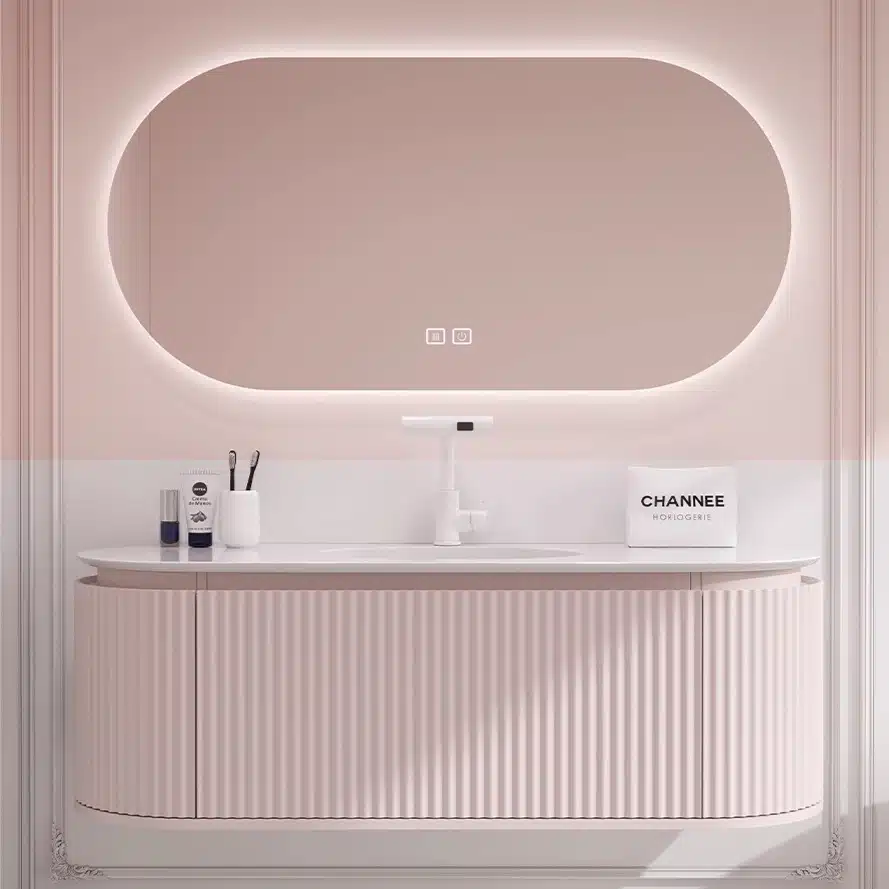
QC Checkpoints: Avoiding Supplier Scams
The sample is a seduction.
Every distributor I’ve met who got burned on a plywood vanity order shares one mistake: they approved a visual sample and skipped the material spec. The sample board is always perfect — selected from the top of the stack, hand-finished, edge-banded under ideal shop conditions. The container you receive is a different story. The gap between MR (Moisture Resistant) and BWP (Boiling Water Proof) plywood is where your margin disappears. MR grade uses urea-formaldehyde glue that dissolves under sustained humidity above 70%. BWP grade requires phenolic resin that survives a 72-hour boil test per ISO 12465. If your supplier cannot produce a third-party lab certificate showing the glue line class, you are buying MR and paying for BWP.
-
- Moisture content check: Incoming plywood must measure 8–12% moisture content with a pin-type meter. Above 14% means the core will shrink and crack within six months after installation in an air-conditioned space. MFBATH logs every batch at receiving and rejects anything above 12%.
- Core density verification: BWP plywood requires a minimum of 7 veneer plies for 18mm board, each cross-laminated. A quick field test: weigh a 300mm x 300mm sample. BWP at 18mm should weigh 1.8–2.1 kg. Below 1.6 kg indicates voids or poplar filler — the board will sag under a stone countertop.
- Edge-banding pressure test: PVC edge banding is only as good as the hot-melt adhesive bond. Request a peel test: the banding should not separate under a 90-degree pull at 5 kg force. MFBATH uses a 3mm thick ABS edge banding applied at 180°C with 0.6 MPa pressure — standard in our five-stage QC log.
- Formaldehyde emission report: For European and Oceania markets, demand an E1 (≤0.124 mg/m³) or E0 (≤0.05 mg/m³) certificate from a CNAS-accredited lab. A supplier who offers only a factory self-declaration is hiding the real numbers. We test each production batch via the 1m³ chamber method per EN 717-1.
- Water absorption rate: Plywood should show less than 5% thickness swelling after 24-hour water immersion (ASTM D1037). PVC should show 0% — that is the whole point of closed-cell extrusion. If a PVC sample gains weight after a water soak, the foam structure is open-cell and will harbor mold. MFBATH’s PVC formula uses a 0.85 g/cm³ closed-cell density, verified quarterly by SGS.
The hard truth: a visual sample tells you nothing about glue durability, core density, or formaldehyde load. The only document that matters is the third-party lab report dated within six months of your order. If the supplier hesitates to provide one, you are not buying a material — you are buying a gamble.
Conclusion
The choice between PVC and plywood is not about which material is better in a vacuum. It is about matching the material to the specific climate stress your project will face. PVC eliminates the single biggest warranty risk in humid markets — water ingress at the sink cutout and seams. Plywood, when built with marine-grade phenolic resin and flawless edge-banding, remains the structural standard for dry, climate-controlled environments where screw-holding power matters.
Review your target region’s humidity profile and load requirements. Then check the material specs against the five-stage QC process used in the factory. That is how you avoid the hidden costs of mid-contract replacements.
Frequently Asked Questions
Which lasts longer: PVC or plywood vanity?
PVC lasts longer in high-humidity environments because it is 100% waterproof and structurally immune to water ingress. In HVAC-controlled markets, BWP plywood can match PVC’s lifespan if the edge-sealing is properly maintained. Choose PVC for humid zones, BWP plywood for dry climates.
Is PVC or plywood cheaper for bathroom vanities?
Plywood is typically 20-40% cheaper per unit on FOB cost, but PVC’s 15-20% upfront premium eliminates up to 60% of warranty claims in humid markets. The lifecycle cost of plywood often exceeds. Calculate total cost over 5 years, not just unit price.
What is the best material for coastal bathroom vanities?
PVC is the best material for coastal bathroom vanities because it is 100% waterproof and requires no annual resealing against salt air and humidity. Plywood in coastal zones demands rigorous edge-sealing and marine-grade phenolic. Specify PVC for any coastal or high-humidity project.
Does plywood or PVC hold screws better?
Plywood offers 3-5 times better screw-holding power than PVC, making it the preferred choice for heavy hardware and commercial drawer glides. PVC requires specialized inserts or closed-cell foam injection to achieve adequate fastener. Use plywood for high-use commercial vanities with heavy hardware.




0 Comments