
The OEM vs ODM bathroom vanity decision looks like a procurement formality until the day a $50K order lands with drawer fronts that don’t match the approved pre-production sample. That scenario plays out more often than you’d think: the factory signs off on a sample, confirms FOB pricing, and then the mass production run drifts because a material substitution or a rushed production step slipped past quality tolerance. The buyer doesn’t catch it at the factory gate. They catch it weeks later, when the first online reviews start mentioning warped door alignments.
This is why the OEM vs ODM bathroom vanity question matters beyond definitions. With OEM, you own the design and the factory builds to your drawings. The risk sits on process calibration: new tooling, new measurements, new finishing parameters. With ODM, the factory builds from a design it has already produced, sometimes hundreds of times. The sample approval step carries far less risk because the production team already knows how to build that cabinet in volume.
For an e-commerce brand owner, the choice shows up in unit economics and listing health. A fully custom design gives you something unique to photograph and protect. A proven ODM platform gets you to market faster, often with a lower MOQ and a faster sampling cycle. If you’re launching on Amazon and need to test a new style without committing to a full container, a low-MOQ ODM bathroom vanity is often the only sane starting point. You get a private-label product without the design risk of a first-run OEM project.
But the decision isn’t permanent, and the best operators treat it as a ladder rather than a fork. Start with an ODM base, layer your own dimensions, hardware, or finish, and you’ve built a private label product without paying for full tooling at day one. Focuscabinet, for example, runs both OEM and ODM from the same 10,000-square-meter factory and takes ODM orders as low as 50 units. Their region-ready designs are already validated for humidity, plumbing codes, and size standards across 20+ countries, so the first shipment doesn’t fail on a compliance technicality.
The rest of this comparison covers the true cost difference, how quality assurance changes between the two models, and what a hybrid route looks like in practice. Keep one thing in mind as you read: the supplier’s real skill shows in the gap between sample approval and the mass production run. That’s where orders either stay consistent or quietly fall apart.
OEM vs. ODM: Defining the Two Models
OEM is your design, your IP, your risk.
Every comparison article frames OEM and ODM as opposites. In bathroom vanity sourcing, they are different phases of the same brand. OEM means you hand the factory a spec file — dimensions, material grades, quality tolerance — and it builds exactly to your drawing. You own the design IP, but you also own the cost of every revision and delay.
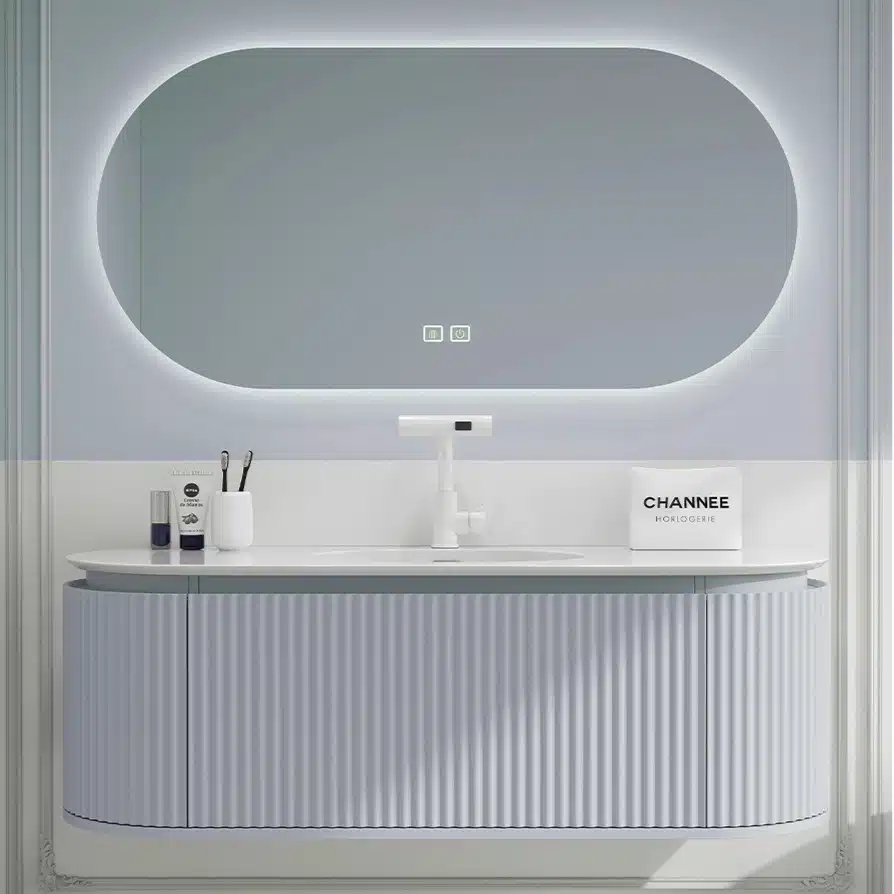
ODM flips that. The factory’s design team already engineered the cabinet, sintered stone basin, and LED mirror as a working system. You pick the platform, customize finishes and hardware, and sell it under your brand. At Focuscabinet, ODM designs come pre-validated for humidity, plumbing codes, and size standards across 20+ countries — the guesswork is gone before your first sample order.
-
- MOQ reality: ODM starts at 50 units per SKU at Focuscabinet, which fits a test campaign or trial container. OEM typically demands far larger commitments because the factory builds a brand-new product structure — new tooling, new jigs, new QC checkpoints — just for you.
- Speed to market: A pre-validated ODM vanity moves through sample approval in days, not weeks. OEM sample rounds take longer because every dimension and joint is unproven; a single error in your file pushes the FOB date and eats margin.
- Risk location: With OEM, a mistake in your specification is your liability. With ODM, the factory owns the structural design risk, and the five-stage QC process verifies that the mass production run matches the approved sample — not just the first carton.
When OEM Makes Sense for Your Brand
OEM rewards brands that own their design files and can commit to volume.
OEM makes sense the moment you approve a pre-production sample and know, with certainty, that this exact vanity is the one your brand will sell for the next two years. That confidence is the price of admission. Without it, you are paying a heavy premium for control you don’t yet need.
With OEM, you own the design: cabinet depth, countertop overhang, hinge placement, LED mirror diffuser, quality tolerance. The factory builds your spec and does not sell that design to another buyer. If you’re comparing OEM vs ODM bathroom vanity for ecommerce brand, this is the real difference. But the ownership only exists if the contract says who holds the CAD files and tooling. A supplier that says ‘we support OEM’ in a brochure will not automatically hand over IP. Make design file transfer and tooling ownership written deliverables before you pay any tooling fee.
The hard trade-off is MOQ and lead time. Focuscabinet’s ODM floor is 50 units, but OEM runs are set higher because the factory needs to amortize tooling, fixtures, and dedicated line setup. If you’re launching an unproven SKU and need 20 units to test a trend, OEM is the wrong tool. That is a one-way door.
-
- MOQ reality: You are committing to a batch that covers tooling and line changeover. If sales data says otherwise, this inventory cannot be repurposed or relabeled.
- Lead time risk: Tooling design, sample iterations, and line setup add weeks to the calendar. The first batch will not arrive in time for a fast-moving trend window.
- IP protection: Without a written ownership clause, a factory can legally run your design for another buyer after your production window ends.
For most ecommerce brands, OEM is not the correct first step. Start with ODM, prove the SKU with real sales data, then move to OEM once the design has market evidence. That hybrid route protects cash flow and still gets you to a private label product.
When ODM Accelerates Your Market Entry
ODM gets you to market in weeks, not months, with MOQs starting at 50 units.
ODM starts with a base design that has already been produced and shipped. You’re not paying for tooling or a ground-up engineering cycle. You select a frame style, finish, countertop profile, and mirror treatment, then your brand goes on the door.
At Focuscabinet, the ODM catalog is region-sorted. Designs are pre-validated for humidity, plumbing codes, and size standards in 20+ countries. You’re not adapting a generic cabinet to a new market; you’re choosing a design that already fits the regulatory and climate realities of your target audience.
The sample stage is where ODM proves itself. Because the base design already passed the factory’s five-stage quality control, the sample you approve will match the mass production run—not a hand-built one-off. The risk is concentrated on your cosmetic changes, and the factory’s quality tolerance stays consistent from sample to container.
-
- Finish and hardware: matte black, brushed nickel, or wood-grain laminates; handles and hinges can be swapped without redesigning the cabinet box.
- Countertop and basin: sintered stone or ceramic tops with different color options; the sink cutout is already tested.
- Mirror and lighting: LED mirror size, frame profile, and switch configuration are adjustable to match your market’s wiring preferences.
- What stays fixed: the internal frame, hinge boring pattern, and LED driver board remain batch-approved to keep unit cost and defect rate predictable.
The financial difference is the point. An OEM bathroom vanity customization cost can run thousands of dollars in sampling and tooling. An ODM project typically starts with a sample from existing stock, and Focuscabinet’s ODM MOQ is 50 units. For an Amazon seller testing a private label ODM bathroom furniture line, that changes the risk calculation entirely.
Start with ODM, validate sell-through, then revisit OEM once your volume justifies dedicated tooling. That staged approach is how most e-commerce brands move from private label to full design ownership.
Cost Comparison: Upfront Tooling vs. Per-Unit Savings
For most new e-commerce brands, the break-even point on custom tooling exceeds first-year sales.
The OEM pitch is straightforward: better per-unit pricing at volume. What never appears in the quote is the upfront tooling bill — mold charges for a sintered stone basin, CNC re-programming for a new cabinet dimension, custom packaging inserts, and sample iterations before the pre-production run clears. In an OEM program, every one of those costs lands on you before the first container is packed.
ODM flips that model. The per-unit price runs a few percent higher because the factory’s development expense sits inside a proven design. You pay a small premium to skip the tooling cycle entirely. That is exactly why Focuscabinet’s ODM MOQ drops to 50 units while a fully custom OEM program on the same production line needs substantially larger volume to absorb setup costs.
-
- Break-even test: Add every OEM customization cost — mold, engineering, sampling, compliance checks. Divide that figure by the per-unit saving versus an equivalent ODM vanity. If the quotient is higher than realistic first-year demand, the mold is a liability, not a saving.
- Risk allocation: ODM puts design risk on the factory; OEM puts it on you. The per-unit premium is the price of transferring that risk, not an arbitrary markup.
- Hybrid sequencing: Many e-commerce brand owners begin with 50-unit ODM orders to validate a design, then move to OEM once reorder volume confirms the tooling expenditure will pay back.
The region-ready factor shifts the comparison further. Focuscabinet’s ODM line is pre-validated against humidity tolerance, plumbing connection standards, and cabinet sizing conventions for the specific export market. A custom OEM vanity carries hidden compliance risk — drain positioning, water resistance, load ratings — that surfaces only after installation. One failed field test costs more than the per-unit saving on an entire production run.
| Cost Factor | OEM Model | ODM Model | Best-Value Scenario |
|---|---|---|---|
| Upfront Tooling & Molds | Custom NRE fees (typical $3,000–$15,000+ per SKU) for proprietary molds, jigs, and test fixtures | Near-zero tooling cost; proven designs already in production on existing lines | ODM for first market test; OEM only after a design proves demand |
| Per-Unit Price | Unit cost drops 15–30% once volume passes ~300 units; tooling amortized across the order | Slightly higher per-unit margin at low volume; nears OEM parity beyond 100+ units | OEM wins for committed repeat orders; ODM preserves margin on small launches |
| Minimum Order Quantity | Higher MOQs (typically 200–500 units) to justify line changeover and custom parts | MOQs as low as 50 units — ideal for Amazon FBA and e-commerce SKU testing | Low-MOQ ODM bathroom vanity Amazon strategy: validate demand before scaling |
| Sampling & Lead Time | Paid samples plus tooling trials; 3–6 week iteration cycles before production approval | Existing stock samples shipped in 1–2 weeks; minor finish or dimension tweaks cut sampling time by half | ODM when a seasonal collection must hit market before a product-launch deadline |
| Design Ownership & IP | You own the mold, engineering files, and exclusivity; competitor lockout guaranteed by contract | Factory retains base design IP; exclusivity requires higher volume or a custom-design modification fee | Private-label ODM bathroom furniture to launch fast; convert to OEM once top sellers justify IP investment |
| Break-Even Analysis | Break-even typically at 300+ units, then the lowest landed cost per cabinet over lifetime | Positive gross margin from the first 50-unit order; slight premium paid for speed and flexibility | How to start ODM then OEM bathroom brand: begin with ODM, graduate when demand becomes predictable |
Quality Assurance Differences
Sample approval proves a design can be built.
The real difference between OEM and ODM quality isn’t the first article — it’s who owns the risk after approval. With an OEM bathroom vanity, you set the specification and sign off on the sample. If the mass production run fails in the field, that failure sits on your side of the contract. With an ODM design, the factory has already produced that cabinet for real orders, so the classic problems — humidity swelling, plumbing interference, size mismatches — have been solved.
-
- OEM failure mode: A pre-production sample gets signed off, then the factory quietly substitutes a cheaper hinge or thinner board to protect its margin. Unless your spec names exact materials and you have incoming inspection rights, the container ships anyway.
- ODM failure mode: You request a “minor customization” on a proven design. If that changes the door weight or hinge load, quality shifts. A factory that lacks region-ready pre-validation won’t catch it until the batch is in stock.
That’s why Focuscabinet treats quality assurance as a separate deliverable from sample approval. Every order runs through the same five-stage quality control process in the 10,000㎡ factory, and ODM designs are pre-validated against humidity, plumbing codes, and size standards across 20+ countries. For an e-commerce brand, the practical upshot is simple: a 50-unit ODM trial run gets the same production discipline as a 500-unit OEM order — and you don’t pay OEM customization cost just to find problems the factory should already know about.
How a Hybrid Approach Works
The hybrid model isn’t a compromise — it’s a sequence: validate with ODM, then own the design with OEM.
The hybrid approach is a sequencing strategy, not a compromise. You start with ODM because the entry barrier is low — Focuscabinet’s ODM MOQ starts at 50 units — and use that runway to validate which vanities actually convert in your market. Once a SKU proves itself, you convert it to OEM so the design, tooling, and spec belong to your brand.
The sequence works because production data carries over. The approved ODM samples, quality tolerance ranges, and packaging specs from your initial runs become reference points for the OEM version. You’re not starting from zero — you’re upgrading ownership of a design that already sells. For e-commerce brand owners, this avoids the classic trap: paying custom tooling costs for a product that never meets a minimum viable sales threshold.
-
- ODM validation phase: Run the first batch at the 50-unit MOQ, test across two or three marketplace listings, and document return rates and customer feedback. You get market research and sellable inventory at the same time.
- OEM conversion trigger: When a single SKU reorders consistently, that’s the signal to lock in mold ownership, custom branding, and exclusive dimensions. Wait for volume proof, not a hunch.
- Region-ready baseline: Focuscabinet pre-validates designs for humidity, plumbing codes, and size standards across 20+ countries, so the ODM-to-OEM switch doesn’t force you to re-certify from scratch in your target market.
The hybrid model also protects your margin trajectory. ODM gets you to market fast; OEM raises the barrier for competitors trying to copy your listing. You can run both in parallel across different SKUs — speed on new products, ownership on proven ones.
Focuscabinet’s Dual Capabilities: OEM, ODM, and Everything In Between
Start with ODM at 50 units, validate your market, then move to full OEM as your SKUs scale.
Most e-commerce brand owners treat OEM and ODM as a locked-in choice: pay for exclusive tooling with a high MOQ, or accept a generic catalog design that any Amazon seller can list. The production reality is less binary. At Focuscabinet, the same 10,000㎡ factory supports both models and everything between them, which means a brand can enter with private label ODM bathroom furniture at an MOQ of 50 units per SKU, validate demand, then transition into OEM once the sales data justifies proprietary molds.
-
- Start with ODM: Choose a proven frame from the catalog, change the color, hardware, logo, and dimensions where the structure allows. Sample approval locks the quality tolerance before bulk production begins.
- Scale into OEM: Move to proprietary designs and own the bathroom vanity design ownership IP. The same five-stage quality control and factory team supports both tracks, so the supplier relationship does not reset when you switch.
The practical difference is risk staging. A veteran e-commerce seller hunting for a low MOQ ODM bathroom vanity for Amazon can test 50 units and iterate. A project buyer with confirmed volume can go straight to OEM with full design control. Focuscabinet’s region-ready strategy pre-validates designs against humidity, plumbing codes, and size standards in 20+ countries, which removes the classic failure point of shipping an EU-bound cabinet with US plumbing rough-in dimensions. FOB pricing and sampling terms remain consistent, and the hybrid OEM/ODM manufacturing path is how to start ODM then OEM bathroom brand without betting an entire container on a first order.
When you are sourcing bathroom vanities from China, the OEM vs ODM MOQ conversation should come after one question: what happens when your 50-unit test sells out in three weeks? If the supplier can hold the same quality and turn a reorder fast, the hybrid model works. If not, you are just postponing the tooling risk.
Conclusion
Before approving the next quote, put three yes/no questions to the supplier: does the contract assign you the tooling and design files, can the supplier hold a 50-unit minimum order quantity on the first ODM run and freeze the spec before mass production, and is the quality tolerance written into the spec sheet and rechecked at each QC gate? Those answers settle bathroom vanity design ownership IP, launch timing, and whether sample approval holds up in the production container.
Run the same questions past every factory on your shortlist, then compare their answers against the configurations in the product catalog. Browse the Focuscabinet product page to match the OEM, ODM, or hybrid path to your budget, lead time, and design control needs — and use the resulting shortlist to request FOB pricing.
Frequently Asked Questions
What is the difference between OEM and ODM vanities?
OEM means we build to your design and IP; ODM means you adapt a proven factory design with minor changes. OEM requires your own files and volume commitment, while ODM gets you. Define your design ownership and volume before choosing a model.
Which fits my brand, OEM or ODM?
Choose OEM if you own the design files and can commit to volume; choose ODM if you want faster entry with lower MOQs. For a first collection, ODM is the lower-risk route. Match the model to your design files, volume, and timeline.
What is the MOQ for ODM bathroom vanities?
ODM bathroom vanities start at about 50 units for proven designs. Minor customizations usually raise the minimum depending on material, finish, and packaging setup. Ask for the exact MOQ once your ODM spec is locked.
Can I mix OEM and ODM in one order?
Yes, a hybrid approach is common: take an ODM base cabinet and apply your branding, finish, or hardware specs. A dual-capability factory can run both OEM and ODM models under one order. Confirm both models can be quoted on the same order.
How does OEM vs ODM affect quality control?
OEM shifts QC focus to your spec compliance upfront, while ODM relies on the factory’s tested production line. In both cases, a five-stage quality control process protects batch consistency. Clarify the inspection points before signing the order.


0 Comments