

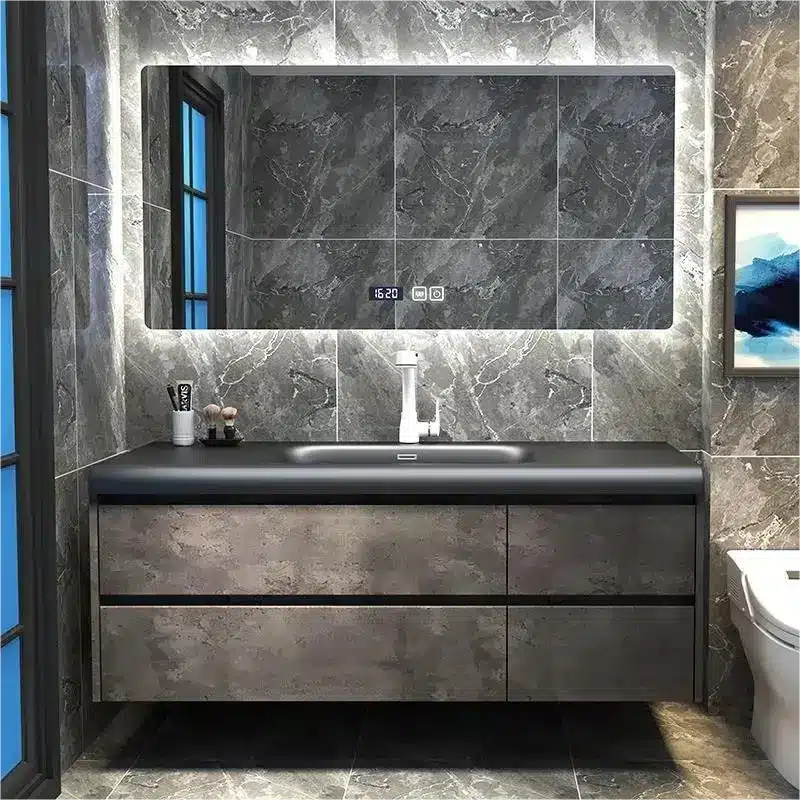
most durable bathroom vanity is the first checkpoint buyers should lock before they approve a supplier, budget, or production slot. The container landed in Rotterdam on a Tuesday. Sixty bathroom vanities, FOB pricing locked in at $285 per unit. The pre-production sample had passed in March—clean edge-banding, consistent lacquer, drawers gliding on soft-close runners. But the mass production run told a different story. The drawer fronts had swollen at the joints, and the PVC-wrapped doors were peeling at the bottom corners. The sample approval stage had been flawless. The quality tolerance on the line was wide enough to drive a forklift through. That importer ate $17,000 in rework and lost the hotel contract.
This pattern repeats because buyers conflate a single hand-finished sample with 200 units coming off an assembly line in August humidity. Finding the most durable bathroom vanity is not about comparing material labels in a brochure. It is about knowing how the substrate behaves when the bathroom hits 90% humidity and the housekeeping staff wipes the cabinet base with an ammonia-based cleaner every morning. The difference between a five-year cabinet and a fifteen-year cabinet lives in the ply count, the edge-seal method, and the countertop porosity. Nothing else.
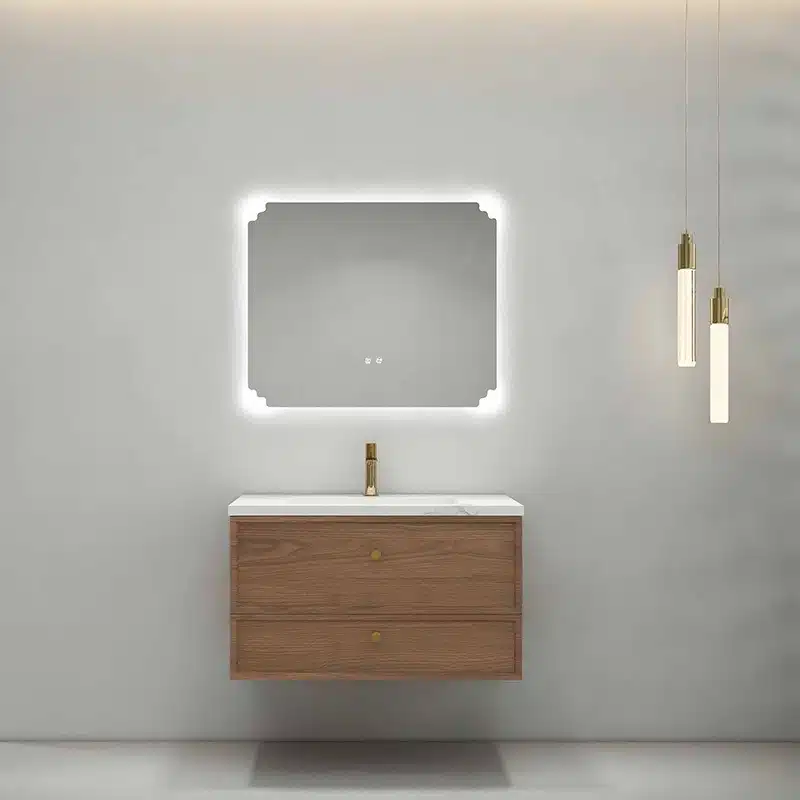
Solid Wood: Timeless but High-Maintenance
A pre-production sample only proves one box, not the container.
Every procurement guide tells you to approve a pre-production sample before the mass run. That advice cost a buyer I know $50,000. The sample was flawless—tight joinery, even stain, solid feel. The 180 units that landed three months later had swollen door panels, uneven gaps, and a finish that bloomed white in weeks. The problem wasn’t the design. It was wood moisture. That sample was kiln-dried to 8% MC (moisture content), then finished in a dry workshop. The bulk order came from a different lumber batch rushed through drying. By the time the container crossed the equator, the cabinets hit 14% MC and started warping.
Solid wood is the right call only when two conditions are true. One, the final destination has low relative humidity—think inland California, Colorado, or the Middle East. Two, the project can absorb a higher per-unit FOB and a 12–18% replacement buffer for natural defects. If you’re shipping into Houston, Singapore, or Lagos, don’t even negotiate solid wood. You’ll lose money on claims.
For luxury projects, solid wood still carries a margin advantage. A teak or American oak vanity in a hotel suite justifies an 80–100% markup over plywood, and end clients perceive it as premium. The key is locking the supplier to a documented quality tolerance. Write into the sales contract not just the sample approval, but the acceptable MC range for every production batch. At Focuscabinet, the standard is 8–10% MC at the time of packing, verified with a pin-type meter and logged against each crate number. If the factory won’t show you the log, assume the wood isn’t ready.
-
- MC ceiling: Ask for 8–10% at packing. Above 12%, reject the lot.
- Species clarity: Acacia, oak, and teak each move differently. Confirm the exact lumber, not ‘hardwood’.
- Finish warranty: Solid wood in dry climates needs a flexible topcoat. UV-cured lacquer outperforms standard PU on crack resistance.
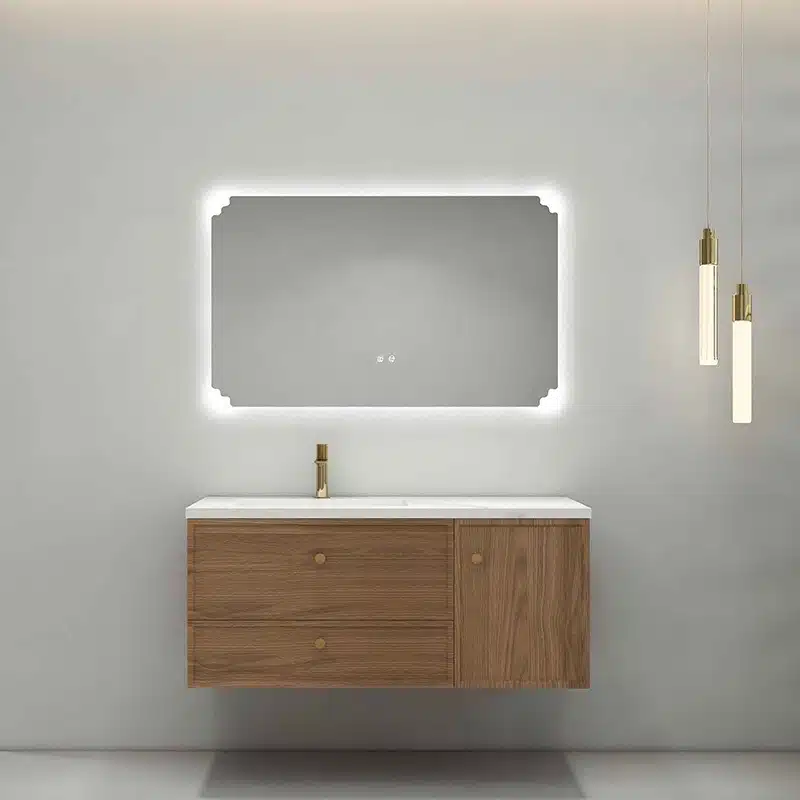
Plywood: The Workhorse of Wholesale Vanities
The layer count – not the origin – determines if your vanity survives humidity.
Have you ever had a pre-production sample approved and then watched a $50K container of vanities arrive looking three grades lower? I’ve seen it happen when a supplier swapped the core material but kept the exterior veneer identical. The sample felt solid – the production run swelled at every joint. That’s when you learn: not all plywood is built equal.
Baltic birch plywood sits at the top of the food chain. Genuine Baltic birch – typically from Russia or Baltic states – uses all-birch veneers, cross-banded with waterproof phenolic glue. It’s dense, stable, and resists warping better than almost anything. But it’s also expensive, subject to supply chain shocks, and overkill for most bathroom cabinets unless you’re building for a Finnish sauna. For wholesale vanities destined for hotels or condos, Chinese multi-ply is often the smarter commercial choice – if you specify it correctly.
Here’s the problem: many imported bathroom vanities use a 5-ply core. Five layers might hold up in a dry bedroom closet, but in a bathroom with 80%+ relative humidity cycles, the thin outer veneers can delaminate within two years. At Focuscabinet, the standard is 9-ply construction – the extra layers distribute moisture stress more evenly and create a thicker, more dimensionally stable slab. It’s not just about adding veneers; it’s using a urea-formaldehyde-free E1 grade adhesive that won’t off-gas or weaken in damp air.
-
- Layer count: Insist on a minimum 7-ply construction for bathroom vanities. Nine-ply is better for sink counters.
- Core species: Poplar or eucalyptus cores are harder than paulownia, which can dent under a heavy stone top.
- Adhesive standard: Demand E1 or CARB2 certification for formaldehyde emissions. Write it into your purchase contract.
Next time you’re on a supplier call, ask: ‘What’s the exact ply count and what wood species make up the core?’ If they can’t answer without checking, you’re gambling with your quality tolerance. The industry benchmark is clear: anything less than 7-ply for a bathroom vanity is a risk you’re passing straight to your end customer.
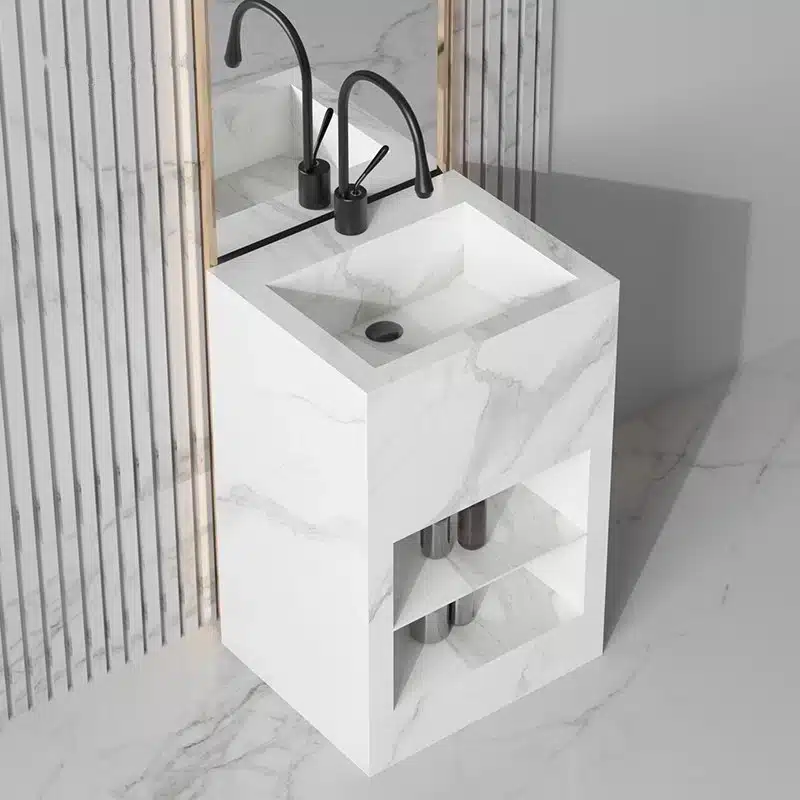
PVC: The Waterproof Champion
PVC excels in moisture resistance but fails under UV and heavy loads.
A distributor I audited in Manila once showed me a warehouse corner stacked with 48 returned PVC vanities—all from a single 2-container order. The pre-production sample had passed visual inspection flawlessly. The mass production units? Identical foam-wrapped boxes, but the internal frame thickness had been quietly downgraded from 1.2mm to 0.8mm without notification. The countertop was a 22kg engineered stone slab. Within four months, mid-span sagging appeared in over 30% of units, and the distributor ate $50,000 in chargebacks. That’s when they learned that PVC vanities demand a reinforced base frame whenever stone tops are specified.
PVC board itself is virtually immune to water absorption. It does not swell, delaminate, or rot, making it the go-to material for high-humidity commercial bathrooms—especially in Southeast Asian and coastal resort projects where ambient moisture destroys MDF and plywood within two seasons. The problem is not water; it’s the combination of heat, UV light, and point loads.
On UV exposure: unpainted PVC contains only minimal UV stabilizers. Continuous direct sunlight—even filtered through frosted bathroom glass—will cause surface chalking and embrittlement of the extrusion within 12–18 months. In a Dubai hotel project, vanities placed near east-facing windows began showing visible micro-cracks along the door edges after the first summer. The supplier had warranted the material for indoor use only, but the specification sheet never explicitly flagged sunlight adjacency as a risk. For any project with ambient daylight, insist on co-extruded UV-shielded PVC or a full-coverage paint finish with a documented QUV aging test report.
On load-bearing: Standard PVC sheet constructions—typically 15–18mm thick hollow-chamber boards with a 1.0mm skin—are designed for distributed loads under 15kg. Place a sintered stone or natural stone countertop (18–30kg depending on dimensions) directly on an unreinforced PVC cabinet, and you’ll get visible creep deformation along the front rail within 90 days, especially under warm, humid conditions that soften the polymer matrix. The fix is not thicker sheets; it’s a metal or aluminum internal support frame that transfers the countertop weight directly to the floor or wall bracket. In my Quality Control protocol, any PVC vanity order paired with a stone top automatically triggers a random sample load test: 25kg static load over 72 hours, with a deflection limit of 2mm. If the supplier can’t confirm that test, you’re gambling with structural integrity.
-
- Spec: Minimum PVC skin thickness for stone-top applications should be 1.2mm, with internal web spacing no wider than 40mm. Prefer vacuum-formed or co-extruded panels with ASA cap layers for UV-prone bathrooms.
- Risk: A 0.8mm skin PVC cabinet with a marble top in a semi-outdoor washroom will show door misalignment and drawer binding within a single monsoon season. Warranty claims on this failure mode can exceed 8% of container value.
HDF: The Budget-Friendly High-Density Option
HDF’s density advantage means nothing without sealed edges.
Most sourcing guides lump HDF and MDF together. That mistake cost a Dubai hotel buyer $50,000 when his pre-production sample looked perfect, but the mass production run ballooned after one monsoon season. The failure wasn’t the core material—it was the edge banding. HDF (high-density fiberboard) packs fibers tighter, giving it better screw-holding and dent resistance. The spec sheets say 800-900 kg/m³ versus 600-700 for MDF. That matters when hinge screws get torqued daily in a commercial bathroom.
The tipping point for choosing HDF over MDF is not moisture resistance—it’s structural strength under repeated assembly. In RTA vanities shipped flat-pack across continents, MDF cam-lock points degrade after two or three install cycles. HDF holds its grip. But here’s what most importers miss: weight. An HDF 60-inch vanity panel adds roughly 6–8 kg compared to MDF. Over a container-load, that adds $400–$600 to the FOB freight. If your customer’s project is a 200-room hotel, the logistics hits the margin hard unless the product stays assembled for a decade.
I’ve audited factories in Changge, Henan. The ones with real quality control run a 48-hour soak test on edge-banded HDF samples—not just a quick-spray. If your supplier can’t provide video proof of that test, assume the waterproof claims won’t hold beyond the sample approval stage. A reliable quality tolerance clause is straightforward: reject the shipment if more than 3% of edge banding shows peeling or delamination upon destination inspection.
-
- When HDF wins: High-traffic bathrooms where hinges and drawer slides face constant stress. Hotels, gyms, airports. Not residential.
- When MDF suffices: Floating vanities with light loads and low moisture exposure. No need to pay the FOB weight penalty.
- Non-negotiable check: Before signing off on a batch, request a cross-section cut photo of an edge-sealed panel. The PVC film must bond at least 1.5 mm into the fiber core.
Sintered Stone: The New Standard for Countertops
Sintered stone is the only countertop material that doesn’t lie to you.
Every veteran distributor has that one horror story. A container lands at port, you pop open a random carton, and the stone top looks completely different from the approved pre-production sample. Grain is off, color is inconsistent, or worse—hairline cracks at the sink cutout. That’s a $50K write-down waiting to happen. The root cause is usually quality tolerance drift in natural stone or quartz, where veins and resin ratios vary from block to block. Sintered stone eliminates that variability at the material level.
We source sintered stone slabs that are manufactured by compacting pure minerals—clays, feldspars, and silica—under 30,000 tons of pressure, then firing them at 1,200°C. The result is a fully vitrified surface. No resins, no binders, no pores. That single fact changes everything for a B2B bulk buyer: a 7 on the Mohs hardness scale. Harder than granite, on par with engineered quartz in scratch resistance, but without the Achilles’ heel of polymer degradation. Even a red wine spill left overnight won’t stain, because there’s nothing to absorb it. For hotel projects or high-traffic commercial bathrooms, that means effectively zero warranty claims due to surface damage.
-
- Material Spec: 100% sintered mineral body, non-porous, 7 Mohs hardness. No resin filler.
- Performance Data: Internal QC load tests show consistent edge integrity at 12mm thickness. No spalling after 200 thermal shock cycles.
- Procurement Reality: Pre-production sample approval becomes a one-time gate. Because the material is uniform slab-to-slab, the mass production run matches the approved sample with zero cosmetic drift. FOB pricing is stable compared to quarried stone, which fluctuates with block availability.
For a distributor supplying sinks and vanities into North America, the conversation with building inspectors stays simple. Sintered stone is non-combustible and requires no sealing. When you’re negotiating FOB pricing with a factory, ask to see the digital caliper verification logs from their edge-profiling stage. If they don’t have that, walk away. The real standard isn’t just the stone; it’s the quality tolerance the factory enforces before it ever leaves the loading bay.
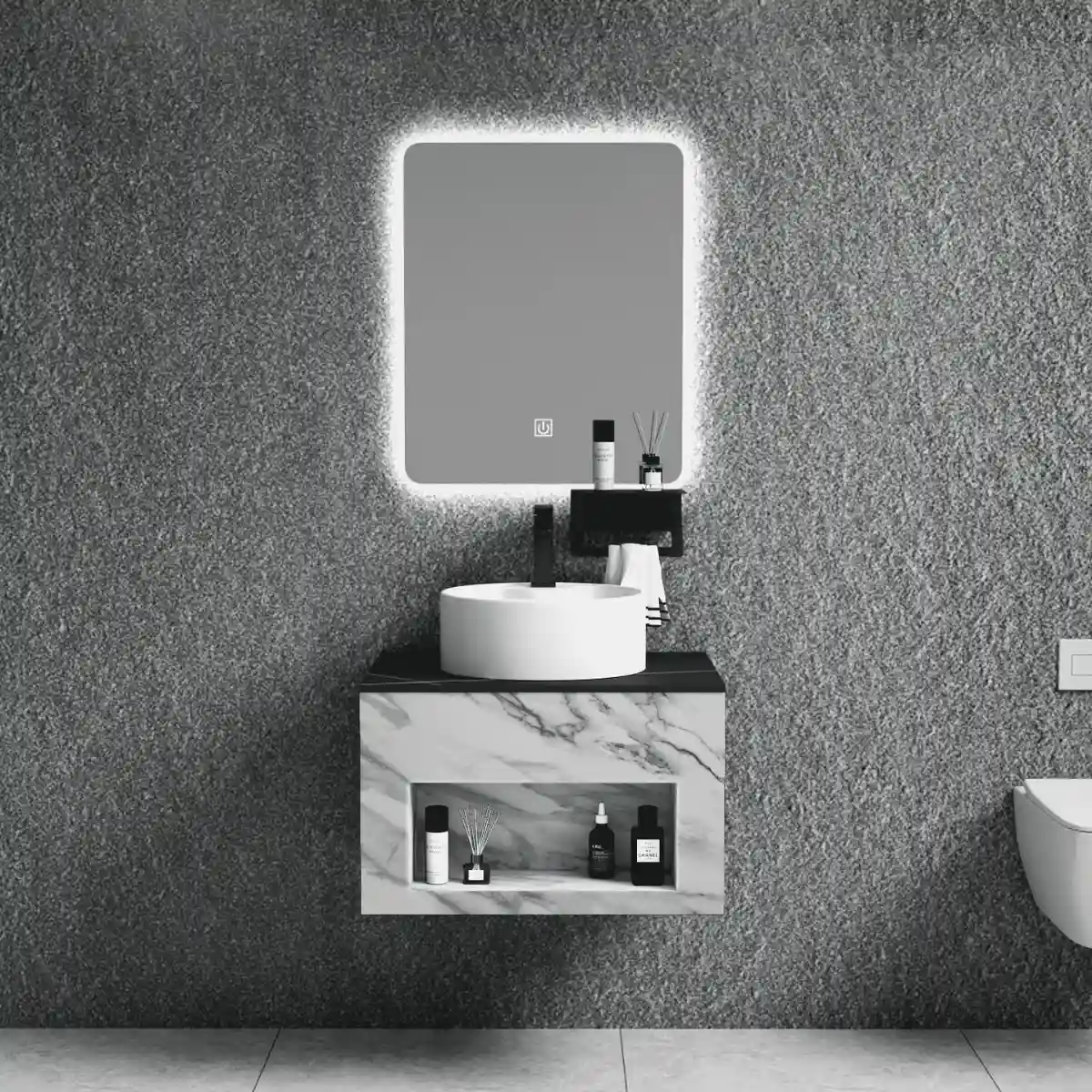
Durability Scorecard: Each Material Rated by Weight, Moisture, Scratch, and Impact
Sintered stone scores a perfect 10 on scratch resistance—7 Mohs beats granite.
When you’re ordering by the container-load, durability isn’t a brochure buzzword—it’s the difference between a 2% warranty claim rate and a 15% one. This scorecard rates the five core vanity materials across the four failure points that actually trigger distributor returns: dead-load weight on the cabinet box, moisture swelling in transit, surface scratch visibility, and impact from clumsy hotel guests or installers.
-
- Solid Wood (Rubberwood/Oak): Weight: Heavy, base frame must support 35–45 lbs/ft³. Moisture: Poor—expect edge swell above 8% after 72h at 90% RH unless sealed on all six sides. Scratch: Moderate, Janka 900–1,300. Impact: Good. Best wall-hung but only in climate-controlled builds.
- 9-Ply Birch/Multi-Ply (Focuscabinet Standard): Weight: Medium, 9-ply construction resists racking better than 5-ply competitors. Moisture: Very good—passes 24h boil test without delamination. Scratch: Moderate, veneer face. Impact: Excellent cross-band strength. This is the wholesale workhorse for high-humidity hotels.
- PVC (Hollow/Reinforced Core): Weight: Lightest—ideal for RTA flat-pack shipping. Moisture: Perfect 10—zero water absorption. Scratch: Good, no grain to highlight scuffs. Impact: Weak point. Standard PVC cabinets sag under >50 lbs top-load. Requires a reinforced aluminum or steel subframe for sintered stone tops.
- HDF (High-Density Fiberboard): Weight: Medium-heavy, denser than MDF (55–65 lbs/ft³). Moisture: Fair—coating-dependent; edge-banding failure leads to core blow-out in 6–12 months. Scratch: Good with UV-cured lacquer. Impact: Moderate. Acceptable for budget projects with upgraded edge seal.
- Sintered Stone (Basin/Countertop): Weight: Heavy, requires solid base cabinet. Moisture: Non-porous, <0.05% absorption. Scratch: Maximum—Mohs 7, a knife blade won’t mark it. Impact: Very high—withstands 1 kg steel ball drop from 1.5 m without fracture. The premium choice for 24/7 hospitality. Note: Always pair with a reinforced cabinet box.
A veteran buyer’s shortcut: if your destination market has average bathroom RH above 70%, drop solid wood from the spec. For hotel chains with maintenance-free mandates, the 9-ply plywood box plus sintered stone top is the low-claim-rate combination that project procurement managers keep circling back to. No single material wins every category; what wins is matching the material to the abuse it’s going to take.
| Material | Weight Rating | Moisture Resistance | Scratch Resistance | Impact Durability |
|---|---|---|---|---|
| Solid Wood (Oak/Teak) | Heavy (5/5) | Poor (2/5) – Sealed only; high risk of warp in >60% humidity | Good (4/5) – Refinishable but surface mars easily | Excellent (5/5) – Dense grain withstands heavy traffic |
| Plywood (9-Ply Birch) | Medium-Heavy (4/5) | Excellent (5/5) – WBP glue + cross-grain resists delamination | Good (4/5) – UV-cured lacquer faces stand up to daily use | Very Good (4/5) – 9-ply core absorbs shock; outperforms 5-ply competitors |
| PVC (Reinforced Frame) | Light (2/5) | Excellent (5/5) – 100% waterproof; ideal for high-humidity hotel baths | Moderate (3/5) – Prone to micro-scratches on gloss finishes | Moderate (2/5) – Requires steel sub-frame for heavy sintered stone tops |
| HDF (High-Density Fiberboard) | Medium (3/5) | Moderate (3/5) – Moisture-resistant edge band required; better than standard MDF | Very Good (4/5) – Hard, uniform surface takes paint well | Moderate (3/5) – High density reduces cracking vs MDF; not impact-proof |
| Sintered Stone (Countertop) | Medium-Heavy (4/5) | Excellent (5/5) – Non-porous; <0.05% absorption rate | Excellent (5/5) – Mohs 7 hardness; impervious to keys and knives | Very Good (4/5) – Superior to granite, but requires reinforced cabinet carcass |
Focuscabinet’s Recommendation by Project Type
Material choice isn’t a preference—it’s a warranty liability calculation per project type.
I’ve seen a distributor lose $62,000 on a single hospitality contract because they spec’d solid wood vanities for a coastal hotel in Southeast Asia. The container arrived, and within six months, doors swelled, joints separated, and the end client demanded a full replacement. The real cost wasn’t just the refund—it was the 14 weeks of re-manufacturing, the air freight to avoid liquidated damages, and the permanent loss of that hotel chain’s business. That’s why I don’t ask clients what they like; I ask what their project’s humidity, traffic, and load-bearing demands actually require.
For high-traffic hotel chains, where housekeeping wipes down cabinets three times a day, a waterproof bathroom vanity for hotels is non-negotiable. PVC boards with a density exceeding 550 kg/m³ are
-
- Multi-family residential (dry markets): 9-ply plywood vanities deliver the best margin-to-durability ratio. Confirm the supplier uses E0 or CARB Phase 2 compliant glue—focus on the glue bond, not just the ply count. A 9-ply box with poor adhesive will delaminate faster than a 5-ply with phenolic resin.
- Luxury hospitality (high humidity): PVC body with reinforced sintered stone top. Demand a 7 Mohs hardness stone—anything less is microporous calcite and will stain from hair dye and cleaning chemicals within 18 months.
- E-commerce resellers (flat-pack RTA): HDF with thermofoil is unbeatable on FOB pricing, but set a 0.3% quality tolerance for pin-holes in the foil. One viral unboxing video showing a defect can crater the listing.
When importing bathroom vanities from China for project specs, I always align the material with the destination climate. A Baltic birch plywood vanity wholesale order heading to Arizona performs flawlessly, but ship that same container to a resort project in Cartagena, and you’re buying back the entire batch. The spec sheet must precede the purchase order, or you’re gambling, not sourcing.
| Project Type | Recommended Material | Key Durability Advantage | Sourcing & Compliance Note |
|---|---|---|---|
| High-Traffic Hotel & Resort | 9-Ply Birch Plywood + Sintered Stone Top | Warp-resistant multi-ply core; Countertop rated 7 Mohs (harder than granite, non-porous) | CE/UL-certifiable; 5-stage QC ensures batch-to-batch consistency for bulk supply across 20+ countries |
| Coastal & High-Humidity Developments | Reinforced PVC Cabinet Base + Solid Surface Basin | 100% waterproof substrate; Load-bearing steel frame prevents sagging under heavy countertops | Engineered for Asia & Oceania climates; anti-UV formulation available to prevent yellowing in direct sunlight |
| Luxury Residential & Dry Climates | Solid Wood (White Oak/Teak) + Sintered Stone | Timeless grain aesthetic with high residual value; Stone top resists scratches and acid etching | Region-ready moisture content control (8-12%) to prevent cracking in European and North American central heating environments |
| E-Commerce Ready-to-Assemble (RTA) | High-Density HDF or Smooth-Finish Plywood | High screw-holding strength for repeated assembly; Photogenic, laminate-finish surface ideal for online retail | Low MOQ support with flat-pack shipping optimization; Henan factory-direct pricing preserves reseller margins |
| Budget-Conscious Multi-Unit Housing | Standard Multi-Ply with PVC Foil / Melamine Finish | Balanced impact resistance and moisture barrier at lowest cost-per-unit; Avoids the swelling issues of standard MDF | Container-direct full-load shipping available; Focuscabinet 10,000㎡ factory maintains lead times under strict deadlines |
Conclusion
Skipping the material evaluation step is a high-stakes guessing game. A container of PVC vanities looks great on the FOB price sheet—until they sit through a single rainy season in a humid hotel bathroom. Doors stop aligning. Edges swell. The cost of fixing that across three hotel floors doesn’t just erase the margin on that one deal; it makes you look unreliable on the next bid. The real pain of inaction shows up 12 to 18 months later, when the warranty claims start landing and you’re on the hook for replacements that eat into six containers’ worth of profit.
Before you lock in sample approval and load a container, pin down the quality tolerance that matters: moisture absorption rates, load-bearing capacity under stone tops, and ply count. If you’re sourcing for a commercial project, stack a 9-ply construction against the standard 5-ply alternative and watch the long-term warranty math shift in your favor. Browse the sintered stone and plywood lines to see what a water-proof, high-hardness spec actually looks like when it’s built for high-traffic bathrooms.
Frequently Asked Questions
What is the most durable bathroom vanity material?
Sintered stone countertops paired with PVC or marine-ply cabinet boxes offer the best all-around durability. PVC resists moisture completely, while sintered stone handles scratches and heat better than quartz. Always prioritize water resistance for cabinets and impact resistance for tops.
Is plywood more durable than solid wood for bathrooms?
Yes, high-quality multi-ply plywood outperforms solid wood in moisture-prone bathrooms because it resists warping and cracking. The number of layers and waterproof glue are critical—marine-grade ply with 13+ layers survives repeated humidity cycling. Specify layer count and glue type, not just ‘plywood’.
Can PVC vanities handle heavy countertops?
Standard PVC vanities have lower load-bearing capacity than plywood, so they require reinforcement for heavy stone tops. PVC cabinet frames need internal aluminum brackets or thicker honeycomb panels to prevent sag over time. Request load-tested structural specs if using PVC with stone.
What material is best for a rental property bathroom vanity?
PVC vanities are ideal for rental properties because they are waterproof, scratch-resistant, and maintenance-free. They hold up against tenant use and cleaning chemicals, but avoid direct sun exposure that can. Select matte or wood-look PVC for better UV resistance in bright bathrooms.
How to choose a vanity for humid climates like Florida?
PVC or fully sealed marine-grade plywood vanities are the only reliable choices for consistently humid environments. Solid wood and standard MDF will inevitably swell and delaminate, even with vent fans. Insist on waterproof edge-banding and 360-degree sealing on all six sides.





0 Comments