
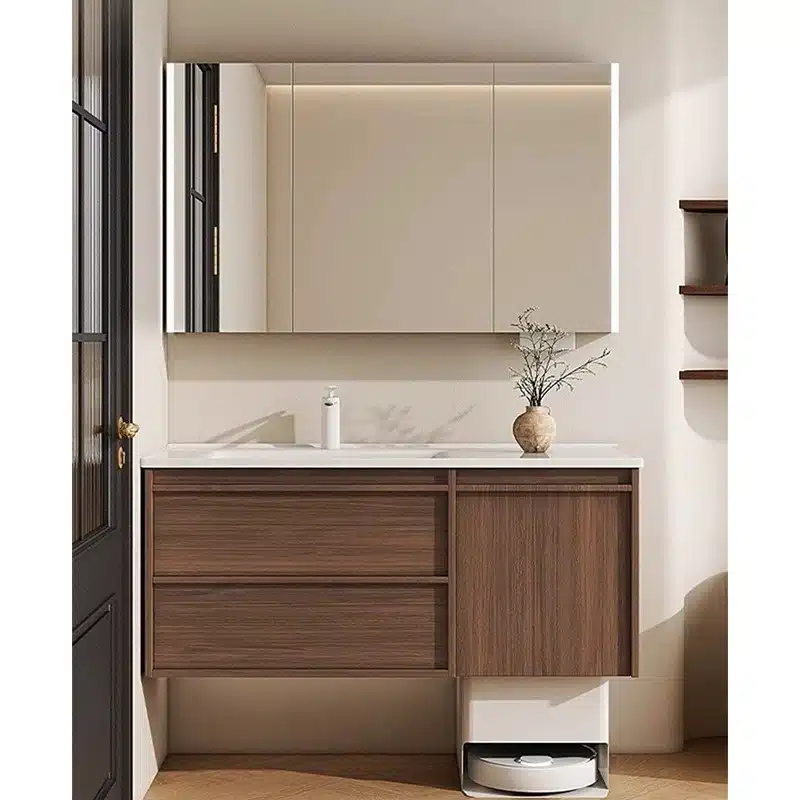
The factory vs trading company LED mirrors decision starts biting well before the container arrives—it bites when someone compares the pre-production sample to the 300 units stacked in the warehouse. A $50,000 order can unravel the moment the mass production run relaxes the quality tolerance that sample approval supposedly locked in. The FOB pricing looked tight, the glass edge finishing passed with a glowing green light, yet the actual shipment arrived with frame gaps twice the accepted margin. That gap between what the spec sheet promises and what lands on the pallet is the daily reality of a sourcing channel nobody audited past a glossy catalog shot.
Over 60% of companies claiming to be LED mirror factories are really trading companies layering a margin on top of a real manufacturer’s output—some with nothing more than a rented office and a shared Alibaba account. The difference shows up in everything from LED driver consistency to wall-mount bracket tolerances, and for an e-commerce brand, a mismatched batch means clearing poor reviews off a listing for six months. A real manufacturer—like Focuscabinet with its 10,000㎡ facility and five-stage QC documentation—gives you factory tour videos, batch-level test reports, and a supply chain where custom branding doesn’t get lost in translation between three middlemen. This guide walks through how to tell the real deal from the showroom fakes, what the cost difference actually is on FOB terms, and when a trading company might still make sense for a small trial order.
Why the Factory vs Trading Company Debate Matters
A hidden intermediary can silently erase 12-18% of your gross margin before you even unpack the container.
Ask any e-commerce brand owner who has scaled past $500K in annual revenue: the factory-versus-trader question is not philosophical. It hits two things your accountant and your customer reviews care about most—unit economics and product consistency. When a trading company sits between you and the production line, their margin has to come from somewhere. Usually, it comes from your landed cost or from corners cut on materials you’ll never see. I’ve audited supplier chains where a brand was paying 22% above the ex-factory price simply because they never verified who actually owned the silvering line for the LED mirror glass.
The margin erosion is rarely transparent. A trading company might quote you an FOB rate that looks competitive because they benchmark against other traders, not against the true factory-gate cost. If you don’t have access to the real bill of materials—the millimeter thickness of the copper-free silver nitrate layer, the LED driver brand, the density of the MDF backing—you end up paying a 15% markup for a product that may have already been downgraded. That double hit is what kills profitability on high-volume ASINs.
-
- Factory-direct transparency: You see the raw glass procurement logs, the LED batch testing reports, and the final assembly QC sheets. This data lets you calculate your true landed cost down to the cent and negotiate FOB pricing based on real input costs, not a trader’s padded spreadsheet.
- Trading company opacity: You receive a single invoice with no cost breakdown. When you request a sample approval for a specific LED driver brand, the trader forwards the request to a factory they may not even control, and the spec quietly shifts. That inconsistency snowballs into negative reviews when your third shipment of 200 units doesn’t match the first.
Brand consistency is the silent victim here. A factory’s quality tolerance is a living document—they adjust the curing time for moisture-resistant sealant based on humidity logs, recalibrate the CNC edge polishing when the glass supplier changes, and track defect rates per shift. A trading company has no seat at that production meeting. When your pre-production gold sample shows a crisp 1mm bevel and your mass production run arrives with a soft 2mm edge, the trading company’s only remedy is a discount on the next order. That won’t help you with the 47 product returns sitting in your FBA inventory.
What Defines a Real LED Mirror Factory
An assembly table and a logo do not make you a factory.
Most sourcing guides tell you to ask for factory photos. That is useless advice in 2026. Any trading company with a smartphone can pose six workers in a rented bay and label it a production line. The real test: who owns the glass cutting table, the silvering line, the edge-sealing workstation? If the answer is a subcontractor 40 km away, you are dealing with a reseller, not a manufacturer — and you will pay an invisible 12–18% markup buried in the FOB price every time.
A genuine LED mirror factory runs three core production stages in-house: glass processing (cutting, polishing, hole drilling), silver mirror coating, and LED assembly with controlled soldering. Subcontractors introduce variable quality tolerances that sample approval can never fully bridge. I have seen a batch where the subcontractor swapped the specified 3M VHB tape for a local alternative to save $0.11 per unit. The mirrors started delaminating in Florida humidity within six weeks. When the factory owns the line, the material traceability is in a single ERP, not spread across six workshops.
-
- Forced in-house line checks: Ask for a live video call showing the glass cutting CNC machine, not the finished products shelf. Request the serial number on the edge-sealing machine — it should appear in your pre-production sample photos too.
- Quality tolerance enforcement: In-house labs run LED lumen depreciation tests (L70 rating) and condensation cycling for anti-fog films. A trading company accepts whatever test sheet the subcontractor sends. A factory like Focuscabinet subjects every mirror to a five-stage QC gate before packing, with documentation you can audit.
- Custom OEM without the mirror tax: A factory can adjust the LED layout, dimming protocol, or mirror shape to match your brand identity. A trading company will push you toward an existing mold because retooling a subcontractor costs them margin. If the MOQ for a custom shape is quoted at 500 pcs by a ‘factory’ but 150 pcs by a direct line, the first guy is a middleman fronting a batch volume requirement.
In-house R&D separates a parts replacer from a problem solver. Real LED mirror engineers own the light guide plate optics, driver efficiency curves, and color rendering index (CRI) targets. They maintain a test lab where 72-hour salt spray chambers verify coastal market durability. Focuscabinet’s 10,000 sqm facility, for example, runs region-specific validation — CE/UL drivers for Europe and North America, anti-mist films calibrated for Southeast Asian monsoon bathrooms — rather than shipping a ‘universal’ mirror that fails local code.
Use this benchmark on your next supplier call: request the L80/B10 lifetime report for the LED strip at 45°C ambient, not the datasheet promise. If the contact cannot forward an engineering test report within 48 hours, you are not speaking to a factory.
Advantages of Working with a Factory
Direct factory pricing often shaves 15-25% off landed cost compared to a trading company quote.
When you place a bulk order with a real factory, you are negotiating with the entity that owns the production lines, raw material contracts, and labor force. A trading company, even one posing as a manufacturer, builds its margin on top of the actual factory’s FOB price. For a standard LED mirror with a custom logo and color temperature option, that intermediary layer typically adds 12-20% before shipping. On a 500-unit order at $80 FOB per unit from the source, that’s an extra $6,400–$12,800 handed to a middleman—money that could instead fund better packaging or a larger marketing push. The difference compounds quickly with repeat orders.
-
-
- Factory FOB Price: Covers materials, labor, factory margin, and export packing. No hidden third-party commissions.
- Trading Company Quote: Includes the factory price plus 10–20% markup, often layered with a separate ‘service fee’ disguised as quality control or documentation handling.
- Cost Transparency: With a real factory, you can request a bill of materials breakdown to identify where to save without sacrificing quality.
-
Customization control is where the true advantage lies. When you deal with a factory, your design file goes straight to the engineering team. You set the quality tolerance—for example, LED strip CRI must stay above 90, and the defogger pad must pass a 72-hour continuous test. Sample approval happens within 14–20 days because no one is forwarding your feedback through WeChat to an unknown third party. Lead time predictability is also superior: a factory runs its own production schedule; a trading company’s subcontracted line may suddenly reprioritize a larger client, pushing your 45-day promise to 70 days. You avoid the costly gap between the pre-production sample and the mass production run because the same team builds both.
-
- Direct Engineering Access: Video calls with the production manager reduce misinterpretation of CAD files and finish specifications.
- Batch-Level Quality Tolerance: Agree on thresholds—no more than 2% of units can have anodizing color variance—and that gets written into the QC checklist, not left to hope.
- Real Production Lead Time: A factory can commit to 25–35 days for a 300-unit run because it controls material staging. A middleman adds a buffer for uncertainty, often quoting 40–50 days.
Potential Risks When Factories Are Inexperienced
An inexperienced factory’s price advantage evaporates the moment your container gets flagged at port.
Most first-time buyers obsess over the FOB price per unit and completely miss the compliance trap. I’ve watched a $50,000 shipment of LED mirrors sit in a Rotterdam warehouse for six weeks because the factory used a CE mark they downloaded from a template site — not one backed by an actual Notified Body test report. The mirrors had the sticker. They didn’t have the paperwork trail. Customs doesn’t care about your launch timeline.
Region-specific compliance isn’t a checkbox. It’s an entire knowledge layer that inexperienced factories simply don’t possess. North America requires ETL or UL listing on the integrated LED driver, not just the mirror housing. Australia demands SAA certification with specific insulation resistance thresholds. The European Union’s EMC Directive means your mirror’s touch sensor and anti-fog heating pad need separate emissions testing. A factory that ships the same unit to Germany and Dubai is a factory that hasn’t been audited by either market’s regulators.
-
-
- Driver certification: UL 8750 for North America — if your factory is using a generic CE-marked driver and shipping to California, the entire product is non-compliant regardless of what the mirror housing label says.
- Glass safety standard: EN 12150-1 for tempered glass in the EU versus ANSI Z97.1 for the US. Different impact test protocols. One factory used the wrong tempering profile for a Florida distributor and had three mirrors spider-crack within 72 hours of installation in humid bathrooms.
- IP rating documentation: An IP44 rating on the spec sheet means nothing without the IEC 60529 test certificate. Bathroom zones near water sources require verifiable ingress protection, and customs authorities in Australia and the UK are increasingly requesting lab reports at the border.
-
The second risk that e-commerce brand owners consistently underestimate is MOQ rigidity. A factory that requires 300 units per SKU isn’t being unreasonable — they’re being honest about their production economics. The problem is when you’re launching six mirror styles on your Shopify store and three of them are unproven designs. You don’t need 300 units of the round-backlit-with-bronze-frame variant. You need 50 to test demand. An inexperienced factory won’t flex on this because they lack the material staging flexibility that comes from managing multiple concurrent production lines.
The math gets ugly fast. At a $95 FOB per unit on 300 mirrors you’re not sure will sell, you’re parking $8,550 in dead inventory before factoring in freight, warehousing, and Amazon storage fees. Brands have been known to burn through their entire first-year margin on storage costs for mirrors that sold 4 units a month. The factories that understand e-commerce —
-
- Split-order structure: Negotiate a master PO that combines 200 units of a proven SKU with 50 units of a new design. The aggregate volume satisfies the production minimum while capping your risk on untested inventory.
- Sample-to-production alignment: Request a documented quality tolerance range in writing — usually ±2mm on frame dimensions and ±100 lumens on light output. If the pre-production sample is outside tolerance compared to mass production, you reject the batch before it ships, not after it lands in your 3PL.
When a Trading Company Makes Sense
Trading companies earn their margin by absorbing the chaos of multi-factory logistics.
Last March, I watched an e-commerce brand owner try to order 15 units each of five different LED mirror styles — backlit round, frameless rectangular, a smart defogger model, an arched Hollywood-style, and a compact 16×20 for powder rooms. He contacted six factories directly. Four rejected the order outright because he didn’t meet the per-SKU MOQ. One quoted FOB pricing that looked reasonable until he calculated freight on five separate carton sizes from three different loading ports. The sixth factory accepted, then delivered three of the five styles with LED color temperatures that didn’t match the approved samples. He lost $8,400 and six weeks.
This is where a competent trading company justifies its markup. They consolidate production across multiple factories under a single commercial invoice, absorb the quality tolerance discrepancies between different production lines, and deliver a unified shipment. For trial orders under $20,000, this consolidation capability alone often saves more than the factory-direct price difference.
-
- Per-SKU MOQ bypass: A factory making frameless mirrors may require 50 units per style. A trading company with relationships across five factories can pull 10 units from each, hitting your exact assortment need without dead inventory.
- Single inspection window: Instead of scheduling sample approval calls with four different factories across different time zones, you review one consolidated shipment at the trading company’s warehouse. One QC report. One set of photos. One decision.
- Mixed-container logistics: A factory ships what it makes. A trading company ships what you need. That means one 20GP container with mirrors, basin cabinets, and hardware — all from different manufacturers — arriving under one bill of lading.
The sample sourcing speed advantage is equally practical. A trading company with existing supplier networks can pull physical samples from three aluminum-frame factories and two glass processors within 72 hours, photograph them side-by-side under consistent lighting, and courier the winners to you in one package. Going factory-direct, you’d negotiate sampling terms with each manufacturer separately, pay five courier fees, and wait two to three weeks for staggered arrivals. For an e-commerce brand testing which mirror aesthetic converts on a product page, that delay costs real revenue.
Red Flags to Identify Fake Factories
Over 60% of ‘factory’ claims in LED mirrors are trading companies in disguise.
I’ve walked through factory gates in a dozen countries. The gap between a real production floor and a trading company’s rented showroom becomes obvious within 90 seconds—if you know what to look for. Most buyers don’t. E-commerce brand owners wiring deposit payments to an unverified supplier learn this distinction the hard way: through container arrivals that don’t match the sample approval photos, lead times that stretch from 30 days to 90, and pricing that mysteriously climbs when the order hits production.
Two red flags catch 90% of fake factories before you lose a dollar. Master these and you’ll filter out the middlemen who currently dominate Alibaba and trade show directories under borrowed factory credentials.
A real factory with in-house glass cutting tables, aluminum extrusion frames, and LED assembly stations has nothing to hide. When a supplier refuses a live video walkthrough, deflects with ‘our factory is in
The second dead giveaway is a catalog full of inconsistent photography styles, no internal model codes, and products spanning 15 unrelated categories. A real LED mirror factory assigns model numbers tied to specific aluminum extrusion dies, glass cutting templates, and component BOMs. When you see a PDF with 200 mirrors—each photographed in different bathrooms with different lighting, none carrying a manufacturer-specific SKU—you’re looking at a product aggregator, not a producer. Ask for the factory’s internal production codes for their three best-selling mirrors. A trading company pauses. A factory answers instantly.
-
- Live video refusal: Any hesitation on a real-time walkthrough means the production floor doesn’t exist. Real factories show you active lines, not empty rooms.
- No internal model codes: Trading companies use supplier catalog numbers. A manufacturer’s SKU system ties directly to tooling, dies, and assembly instructions.
- Cross-category sprawl: If the same company sells LED mirrors, massage chairs, and pet bowls, you’re browsing a trader’s aggregated listings.
- Zero QC documentation: Request a sample of their quality inspection checklist from the last export order. A factory has dated, signed QC sheets. A middleman sends a blank template.
The 60% figure isn’t speculation. It’s what emerges when you audit supplier claims against actual production assets. For an e-commerce brand staking its reputation on consistent product quality, the cost of skipping supplier verification far exceeds the effort of a 45-minute video call and a pointed question about model number logic.
Focuscabinet’s Factory-Direct Model
A pre-production sample that matches your mass production run is the only proof that matters.
A colleague in Miami learned this the hard way in 2026. He approved a backlit mirror sample—flawless edge polishing, uniform 6000K color temperature, smooth 10%-100% dimming curve. Three months later, 200 units arrived. Adhesive residue bled around the edges on 40% of units. LEDs flickered below 70% brightness. The sample came from a dedicated prototyping bench. Mass production got outsourced to a third workshop the ‘factory’ didn’t own. He lost $52,000 and his Q4 launch window. That’s the difference between a real factory and a trading company with a showroom.
This is why walking a production floor matters more than any Alibaba Gold Supplier badge. Focuscabinet operates from a single 10,000㎡ facility in Changge, Henan—one roof, one production team, one quality system. The dedicated R&D wing handles mold development, LED driver compatibility testing, and finish prototyping on the same lines that run container orders. When you request a custom mirror with a specific CRI≥90 rating or a non-standard dimension like 36″×60″, the sample gets produced on production tooling, not a separate bench. You approve what the line actually builds. No bait-and-switch. No subcontracting surprises.
-
- North America: ETL/cETL certified LED drivers pre-installed. Mirror construction meets ASTM humidity resistance thresholds for bathrooms without mechanical ventilation. FOB pricing includes compliance documentation in the shipment packet.
- Southeast Asia: Anti-condensation coating on mirror backing prevents silver layer corrosion in 85%+ humidity. Electrical components sealed to IP44 minimum. Packaging upgraded with VCI film for ocean freight.
- European Union: CE-marked drivers with full EMC test reports. RoHS and REACH compliance documentation supplied before sample approval. Defogger pads sized for 220-240V without step-down transformers.
Skip factory verification and you’re gambling your brand on someone else’s supply chain. One bad container with non-compliant electrical components doesn’t just cost you the order—it triggers chargebacks, platform delisting, and a 6-month rebuild of customer trust. The 60% of ‘factories’ that are actually trading companies won’t show you a live production line because they don’t have one. Request a video walkthrough of the full facility. If the tour stops at the showroom and skips the assembly floor, you already have your answer.
Conclusion
The gap between a real factory and a trading company reseller shows up months after the sample approval, not during the quoting stage. A container lands at Long Beach. The LED drivers are missing UL marks. The mirrored glass thickness is 3mm, not the specified 4mm. The quality tolerance you signed off on—gone—because the entity that took your order had no authority over the production floor. For an ecommerce brand, that single incident erases the margin on the next three restock cycles.
Do nothing, and you leave that risk in every purchase order. Verify a factory’s in-house production capability, its QC documentation, and its region-specific compliance track record, and you turn sourcing into a durable cost advantage. Start by browsing a factory-direct mirror catalog where you can compare actual specs, custom options, and certifications up front.
Frequently Asked Questions
How can I tell a real factory from a trading company?
A real factory owns its glass processing line and has an in-house R&D lab. Ask for a live video tour of the production floor, not just a showroom, to verify. Always request a date-stamped video walkthrough of the actual work floor.
Are factory prices always lower than trading company quotes?
In bulk orders, direct factory pricing typically reduces landed cost by 15-25%. For small quantities, a trading company’s consolidation may be more cost-effective. Compare total landed cost, not just FOB unit price.
What red flags suggest a fake LED mirror factory?
Red flags include refusal to share a live factory video tour and generic catalogs without unique model numbers. These often indicate a middleman with no production capability. Insist on a real-time video call with the production manager.
When is a trading company the smarter sourcing choice?
A trading company is better when you need small trial orders or a mix of products from different specialist factories. They consolidate shipments and source samples faster than one factory’s. Use a trading company for multi-product sampling before you commit to volume.
How does Focuscabinet’s direct model ensure quality?
Focuscabinet operates a 10,000㎡ factory with dedicated R&D and a five-stage QC process. They engineer LED mirrors for region-specific humidity, electrical standards, and design tastes. Confirm region-specific compliance documentation before finalizing your order.




0 Comments