
Jargon costs importers real money long before a container sails. Buyers who misread minimum order quantity (MOQ) sign for stock they cannot sell. Buyers who guess at free on board (FOB) discover freight cost only after the proforma invoice lands. Vocabulary errors look small at contract time. They surface as demurrage, rejected lots, and payment delays.
This glossary fixes that gap by collecting the bathroom vanity sourcing terms that move your money – all 30 – grouped by the stage where they matter. Each entry carries a plain definition and the reason it moves your cost or risk. The final section walks one order from sample request to port arrival.
Key Takeaways
- The minimum order quantity (MOQ) is 15 sets per model, color, and size across the full product line. Mixed containers let you combine models and sizes in one shipment.
- Payment runs 30% deposit at order placement. The balance is due within one week after the draft bill of lading (draft BL) is issued.
- Sample approval takes 10 working days. Production lead time runs 20–30 days, so total delivery to the US, Canada, and Mexico lands in 4–6 weeks.
- Every cabinet passes five quality checks. Third-party inspectors such as SGS and TÜV can audit before loading when arranged in advance.
- Trade terms are free on board (FOB) Qingdao Port. Your freight cost then depends on container choice: less than container load (LCL), full container load (FCL), or a 40-foot high-cube (40HQ) container.
- A 2-year whole-cabinet warranty backs every unit. The return rate sits below 1%.
- Plywood options meet the E1 formaldehyde emission class at or below 0.1 ppm. CARB Phase 2 (California Air Resources Board) and FSC (Forest Stewardship Council) choices cover regulated markets.
Table of Contents
- How to Use This Glossary
- Order & MOQ: The Terms That Set Your Minimums
- Pricing & Payment: Deposit, Balance, and Invoices
- Shipping & Logistics: Ports, Containers, and Freight Terms
- Quality & Inspection: Checks Before the Container Locks
- Materials & Construction: Boards, Cores, and Surfaces
- Compliance & Documents: Paperwork That Clears the Border
- A Real Order Walkthrough
- Frequently Asked Questions
- The Bottom Line
How to Use This Glossary
Treat this as a working document, not a reading assignment. The 30 terms sit in six categories that mirror a purchase: ordering, pricing, shipping, inspection, materials, and paperwork. Each table defines five terms in a single line. Read the category that matches your current negotiation, then check the walkthrough to see how the terms chain together.
Three habits pay off fastest. Flag every term you cannot explain to a colleague. Ask the factory to confirm each number on your quote, including MOQ, lead time, and payment split, in writing. Never sign a proforma invoice until you understand the trade term it names.
Order & MOQ: The Terms That Set Your Minimums
Every factory conversation starts with one number: the MOQ. Our minimum order quantity runs 15 sets per model, color, and size across the entire line. That structure matters more than the number itself. Mixed containers let you combine models and sizes in one shipment as long as the total reaches MOQ, so a 15-set test can cover three designs.
OEM and ODM describe who owns the design. With original equipment manufacturer (OEM) terms, you provide the drawings and the factory builds to them. With original design manufacturer (ODM) terms, the factory brings the design and you adapt it. The mode decides who fixes a defect when one appears.
White label and private label describe branding. White label means a ready-made product ships in your packaging with minimal changes. Private label means your brand, your specifications, and your quality expectations drive production. Know which mode you are buying before you approve a sample.
Five Terms That Define Your Order
| Term | What It Means | Why It Matters |
|---|---|---|
| MOQ | Minimum order quantity: fewest units per model | Sets trial size, cash, and warehouse commitment |
| OEM | Original equipment manufacturer: builds to your design | You own the design, so you own the quality risk |
| ODM | Original design manufacturer: supplies design and build | Faster launch without hiring designers |
| White label | Ready-made product sold under your brand | Quickest shelf entry; limited customization |
| Private label | Your brand with your specs on production | Brand equity without factory ownership |
The order form should state all five answers: model, MOQ per model and color, OEM or ODM mode, and brand format. Vague orders produce vague pricing. Our custom program covers 40,000+ combinations across Pantone colors, materials, and hardware, and every combination still starts at the 15-set floor. Our bathroom vanity MOQ guide walks through the mixed-container math in detail.
Pricing & Payment: Deposit, Balance, and Invoices
Payment structure is where new importers lose the most negotiating power. The standard split is a 30% deposit at order placement, with the balance after production. Our balance is due within one week after the draft bill of lading (draft BL) is issued. That timing protects both sides: the factory is paid against proof of loading, and you keep control until goods are on the vessel.
Two invoices bookend the deal. The proforma invoice is the quotation sent before you commit, listing price, trade term, MOQ, and delivery window. The commercial invoice is the final document used for customs clearance and payment. When the two disagree on price or quantity, customs flags the shipment and your bank questions the transfer. Check both line by line against our commercial invoice requirements before anything ships.
One rule beats every payment trick. Never pay the full amount before loading evidence exists. The draft BL is the carrier’s draft shipping document, and the final bill of lading issues after the container is aboard. Paying against a draft BL is standard practice; paying against a promise is not.
Five Terms That Govern Your Payment
| Term | What It Means | Why It Matters |
|---|---|---|
| Deposit | Up-front payment when you place the order | 30% here; funds materials and locks your slot |
| Balance payment | Final payment after production completes | Due within one week after the draft BL |
| Draft BL | Draft bill of lading issued before final release | Your loading evidence; the balance pays against it |
| Proforma invoice | Pre-order quotation with price and terms | Locks numbers before you commit funds |
| Commercial invoice | Final invoice for customs and payment | Errors here stall customs and banks |
A payment calendar prevents most disputes. Mark three dates the day the proforma invoice arrives: deposit due, production complete, and balance deadline after the draft BL. If the factory asks for a different sequence, ask why in writing. Payment terms are negotiable at quote stage, not after production starts.
Shipping & Logistics: Ports, Containers, and Freight Terms
Trade terms decide who owns the freight risk at every mile. Our standard quote is free on board (FOB) Qingdao Port: the factory’s cost and risk end when goods are loaded on board, and you control the ocean leg from there. Cost, insurance, and freight (CIF) shifts the burden further, with the seller paying freight and insurance to the destination port. The official ICC Incoterms rules are the reference text, and our furniture Incoterms breakdown compares them for cabinet buyers. Compare both against your own freight contracts, because the cheaper-looking quote is not always the cheaper landed cost.
Container choice drives the second big cost. Less than container load (LCL) shares space with other shippers and bills by cubic meter. Full container load (FCL) gives you the whole box at a flat rate. For vanities, a 40-foot high-cube (40HQ) container holds the most volume and delivers the lowest per-unit freight.
Routes change the math too. Qingdao to North America runs 4–6 weeks door-to-door with tracking included. Our logistics program can trim freight to the US, Canada, and Mexico by roughly 15% versus ad hoc booking. Ask for the mixed-container option when your order spans several models, so you pay one container rate instead of several LCL rates.
Five Terms That Set Your Freight Cost
| Term | What It Means | Why It Matters |
|---|---|---|
| FOB | Free on board: seller loads goods at the port | You own freight risk after Qingdao loading |
| CIF | Cost, insurance, freight to the destination port | Quote includes freight; compare with FOB |
| LCL | Less than container load in shared space | Pay by cubic meter; fine for trial orders |
| FCL | Full container load with exclusive space | Flat rate; lowest per-unit freight at volume |
| 40HQ | 40-foot high-cube container, tall and long | Standard vanity box; about 68 m³ usable |
Ask for the loading plan before you book freight. A factory that has measured carton cube can tell you how many sets fit in a 40HQ container within the first email. A factory that guesses leaves the math to your forwarder. The difference shows up as per-unit freight cost on the final invoice.
Quality & Inspection: Checks Before the Container Locks
Inspection is a schedule, not a hope. The acceptable quality limit (AQL) is the sampling standard both sides agree to before production. It states how many defects per lot you will accept; AQL 2.5 for major defects is a common furniture benchmark. We run five quality checks per piece in-house, and third-party inspectors such as SGS and TÜV can audit before loading when arranged in advance. Our vanity quality control checklist lists every point to verify.
Pre-shipment inspection (PSI) happens after production and before the container closes. The inspector opens cartons at random, compares units against the approved sample, and records findings in a QC report. Keep that report; it is your evidence if a claim appears later. Without PSI, a defect found at your warehouse becomes a dispute instead of a rework.
Sample approval and lead time run the calendar. Samples ship within 10 working days, and you approve the physical unit before bulk production starts. Production lead time runs 20–30 days from approval. Book the inspection inside that window; a late inspection costs more than the inspection itself.
Five Terms That Protect Your Lot
| Term | What It Means | Why It Matters |
|---|---|---|
| AQL | Acceptable quality limit sampling standard | Sets the defect level you accept per lot |
| Pre-shipment inspection | Third-party check before the container loads | Catches faults while the factory can fix them |
| QC report | Written record of inspection results | Your proof if a defect dispute arises |
| Sample approval | Buyer sign-off on the physical sample | The baseline every bulk unit is compared to |
| Lead time | Days from order to shipment-ready goods | 20–30 days here; plan cash and stock around it |
Treat the QC report as a contract document, not a courtesy copy. File it with the proforma invoice, the commercial invoice, and the packing list. If a claim surfaces at your warehouse, that folder decides the outcome. Inspection records turn a dispute into a replacement.
Put These Terms to Work with a Real Factory
Browse this product, solution, or service page to explore relevant offerings.
Materials & Construction: Boards, Cores, and Surfaces
Material terms decide how a cabinet behaves in a wet room. Ready to assemble (RTA) describes flat-pack construction: the unit ships knocked down and the buyer assembles it. That cuts freight cost and warehouse footprint, which often turns an e-commerce SKU profitable. For showroom channels, pre-assembled units still win on convenience.
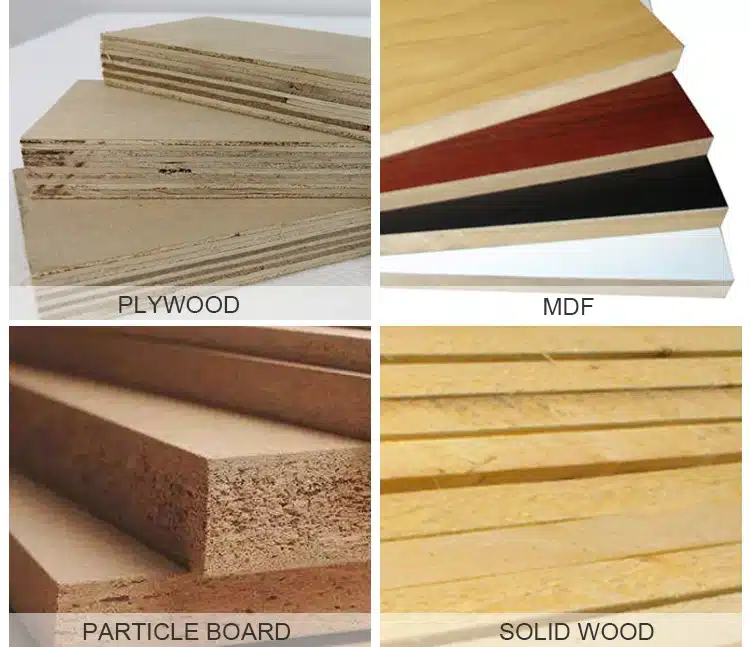
Plywood buyers face a three-tier core choice. Standard plywood serves dry climates. Boil-water-resistant (BWR) plywood adds a moisture-proof glue line that survives humidity. Marine-grade plywood carries the highest moisture protection for wet zones; our PVC line goes further and is 100% waterproof, with no water absorption and no warping.
Surface and emission terms close the spec. E1 is the formaldehyde emission class used across Europe, and our boards test at or below 0.1 ppm. Sintered stone, natural minerals such as quartz, feldspar, and silica pressed and fired with no resin, rates 7–8 on the Mohs scale and resists heat to 300°C. Its non-porous surface blocks stains. Browse our full product line to see each material in finished form.
Five Terms That Describe the Build
| Term | What It Means | Why It Matters |
|---|---|---|
| RTA | Ready to assemble; ships flat-packed | Cuts freight cost and warehouse footprint |
| BWR | Boil-water-resistant plywood core | Survives humid bathrooms without delamination |
| Marine-grade | Highest moisture-proof plywood class | Longest life in wet and coastal markets |
| E1 | Formaldehyde emission class, ≤0.1 ppm | Meets strict European emission limits |
| Sintered stone | Mineral slab pressed and fired, no resin | Non-porous, scratch- and heat-resistant top |
Match the core to the buyer’s bathroom, not the showroom. Marine-grade and BWR plywood justify a price premium in humid markets; standard plywood keeps entry pricing lean in dry ones. Our custom plywood color program starts from 50+ units, while PVC and solid wood custom orders start at 15 sets. Write the core and the finish into the PO so the factory cannot swap materials later.
Compliance & Documents: Paperwork That Clears the Border
Documents decide whether your container clears customs in hours or weeks. The Harmonized System (HS) code classifies the product for duty calculation, and a wrong code means a wrong duty rate plus a customs hold. Furniture HS codes vary by material and function. Our furniture HS code guide maps the common vanity categories before you print anything.
Two documents sit inside every shipment file. The packing list itemizes cartons, weights, and dimensions, and the commercial invoice states value and parties; customs matches them line by line, so any discrepancy stalls clearance. The certificate of origin proves where the goods were manufactured and can qualify your shipment for preferential tariff treatment. The US CBP import and export basics guide covers the border-side rules in plain language.
Emission compliance sells into regulated markets. California Air Resources Board (CARB) Phase 2 sets formaldehyde limits for plywood and MDF sold in the US, and our boards are compliant; TSCA Title VI follows the same standard. Forest Stewardship Council (FSC) certified wood is available for projects that require it. The factory holds ISO 9001 quality and ISO 14001 environmental certifications, both obtained in 2017 and confirmed current in 2025.
Five Terms That Clear the Border
| Term | What It Means | Why It Matters |
|---|---|---|
| HS code | Harmonized System customs classification | Wrong code means wrong duty and a customs hold |
| Packing list | Itemized carton, weight, dimension record | Customs matches it line by line; keep it exact |
| Certificate of origin | Proof of manufacturing country | Can unlock preferential tariff treatment |
| CARB Phase 2 | California Air Resources Board emission rule | Required for plywood and MDF sold in the US |
| FSC | Forest Stewardship Council certified wood | Qualifies for green-spec projects and retailers |
Request the document set with the draft BL, not after arrival. HS code, packing list, certificate of origin, and commercial invoice should reach your forwarder before the vessel departs. A missing certificate at destination can mean storage charges while the paperwork catches up. Paperwork is cheap; waiting is not.
A Real Order Walkthrough
Here is how the 30 terms behave inside one order. A distributor in Texas wants 60 vanities across three models, and each model clears the 15-set minimum order quantity (MOQ). The factory replies with a proforma invoice quoting free on board (FOB) Qingdao, a 30% deposit, and a 20–30 day production lead time. The buyer asks for samples before committing.
Sample approval starts the clock. The factory ships two physical samples within 10 working days. The buyer checks dimensions against a tape measure, not a catalog, and signs the sample approval form. That signed unit becomes the baseline for every inspection that follows.
The buyer pays the 30% deposit, and production starts. Around day 25, the factory sends photos plus a QC report from its five in-house checks. The buyer has booked a pre-shipment inspection with a third-party agency in advance. The inspector pulls cartons at random against the agreed AQL sampling plan, compares each unit to the approved sample, and clears the lot.
Loading follows. The order fills about half a 40-foot high-cube (40HQ) container, so the buyer books less than container load (LCL) space. The factory shares its container loading plan for carton placement, and the cargo loads at Qingdao under FOB terms. The carrier issues the draft bill of lading (draft BL).
Payment closes the loop. The buyer wires the balance within one week of the draft BL, as agreed. The final bill of lading releases and the vessel sails; door-to-door delivery to the US runs 4–6 weeks with tracking. The units carry a 2-year whole-cabinet warranty, the return rate sits below 1%, and the buyer reorders with every term already familiar.
Frequently Asked Questions
What does MOQ mean for a bathroom vanity order?
Minimum order quantity (MOQ) is the fewest units a factory will produce per model, color, and size. Our MOQ is 15 sets per model, color, and size across the line. Mixed containers let you combine different models and sizes in one shipment once the total reaches MOQ.
When is the balance payment due on a factory order?
The standard split is 30% deposit at order placement, with the balance due within one week after the draft bill of lading (draft BL) is issued. The draft BL proves the goods are loaded, so you pay against evidence rather than promises. Full prepayment is not the norm with established factories.
What is the difference between LCL and FCL shipping for vanities?
Less than container load (LCL) shares container space with other shippers and bills by cubic meter, which suits trial orders. Full container load (FCL) gives you exclusive use of the box at a flat rate, which lowers per-unit freight at volume. For large orders, a 40-foot high-cube (40HQ) container is the standard choice.
Do vanities need CARB Phase 2 compliance for the US market?
Plywood and MDF components sold in the US fall under California Air Resources Board (CARB) Phase 2 and TSCA Title VI formaldehyde limits. Our boards meet the E1 class at or below 0.1 ppm and are compliant with CARB Phase 2. FSC certified wood is available for projects that require it.
The Bottom Line
Run this checklist before you sign any proforma invoice: verify MOQ per model, color, and size; confirm the FOB port and container type. Lock the 30% deposit and the balance-after-draft-BL split; book sample approval and pre-shipment inspection against the 20–30 day lead time. Gather the HS code, packing list, and certificate of origin before loading. Master these 30 terms and you negotiate from the same information as the factory; buyers who speak the language pay for product, not confusion.




0 Comments