

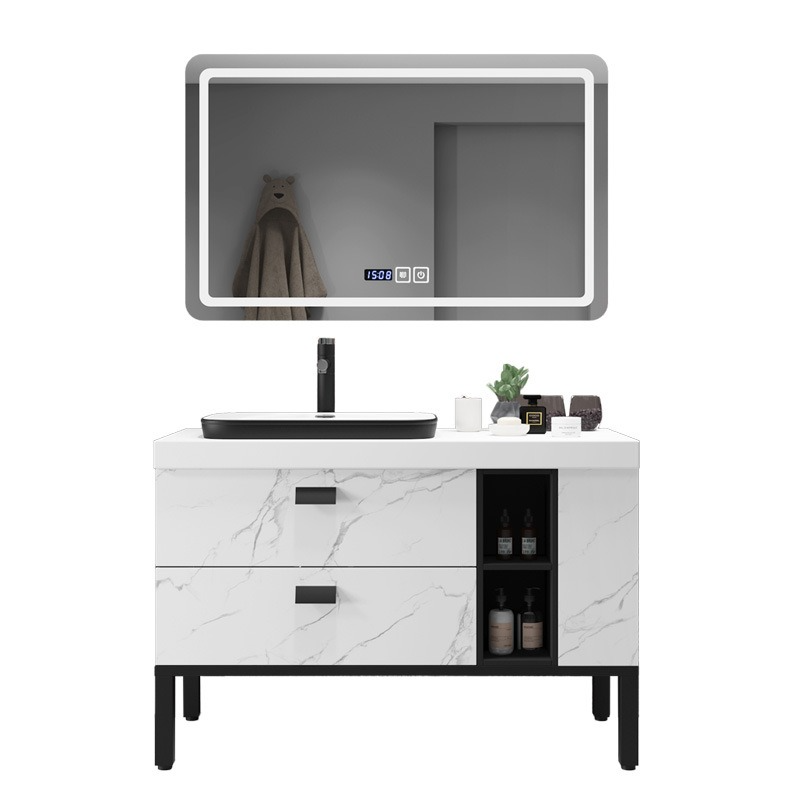
A school washroom is the hardest lab a bathroom vanity can run through: dozens of students cycle through it daily, cleaning crews hit the unit with bleach and disinfectant on a fixed schedule, wet equipment slams into doors, keys scrape the surfaces, and markers reach everything within arm’s length. Every vendor calls every cabinet durable. This guide turns that adjective into four verifiable spec lines — material, hardware, finish, and warranty evidence — with Main Focus Cabinet (MFBATH) as the running example of a manufacturer built for heavy-use school orders.
Each section below ends in a question you can paste into a spec sheet or a purchase order, not in background reading. You will see which cabinet body resists water and disinfectant, which hardware specs survive repeated impact, which finishes tolerate daily cleaning, and which factory-side records — inspection, warranty, and reference orders — prove a cabinet is built for a school environment. MFBATH appears throughout as the reference case: its PVC line is 100% waterproof, and its plywood line offers standard, BWR, and marine-grade options, which gives a district’s spec writer concrete choices instead of adjectives.
Key Takeaways
- School washrooms fail cabinets through third-party use, harsh cleaning chemicals, humidity, and impact; durability has to be written into the spec, not assumed.
- Water resistance starts in the cabinet body: a 100% waterproof PVC line for high-humidity, high-cleaning zones, or plywood with waterproof edge banding and BWR or marine-grade options.
- Hardware grade, not the cabinet’s face, decides how long a door or drawer holds up; spec soft-close hinges and slides, name the required features, and request salt spray reports.
- Finishes must survive bleach and disinfectant contact while using low-VOC coatings that protect school indoor air.
- Verify durability with records before scaling: a 5-point inspection per cabinet, a 2-year whole-cabinet warranty, a return rate below 1%, and a small mixed-container trial order first.
Table of Contents
- Why School Washrooms Destroy Vanities Differently
- Choosing the Cabinet Body: PVC vs Plywood
- Hardware Specs That Survive Students
- Finishes and Cleanability Under Constant Cleaning
- Evidence of Durability: QC, Warranty, and References
- Scoping a School District Order: Volumes and Phasing
- Frequently Asked Questions
- The Bottom Line
Why School Washrooms Destroy Vanities Differently
A residential vanity faces one owner who fixes small problems early and closes the door between uses. A school vanity faces nobody who owns it. Students bang doors, hang weight off them, jam drawers, and walk away; custodial staff wipe the whole unit with disinfectant on a schedule; condensation, splashback, and mopped water hit the same panels every day. On top of that constant load, the room sits empty over winter and summer breaks and restarts abruptly when the building wakes up, so the cabinet’s seals and finishes take repeated dry-and-wet cycles a home never produces.
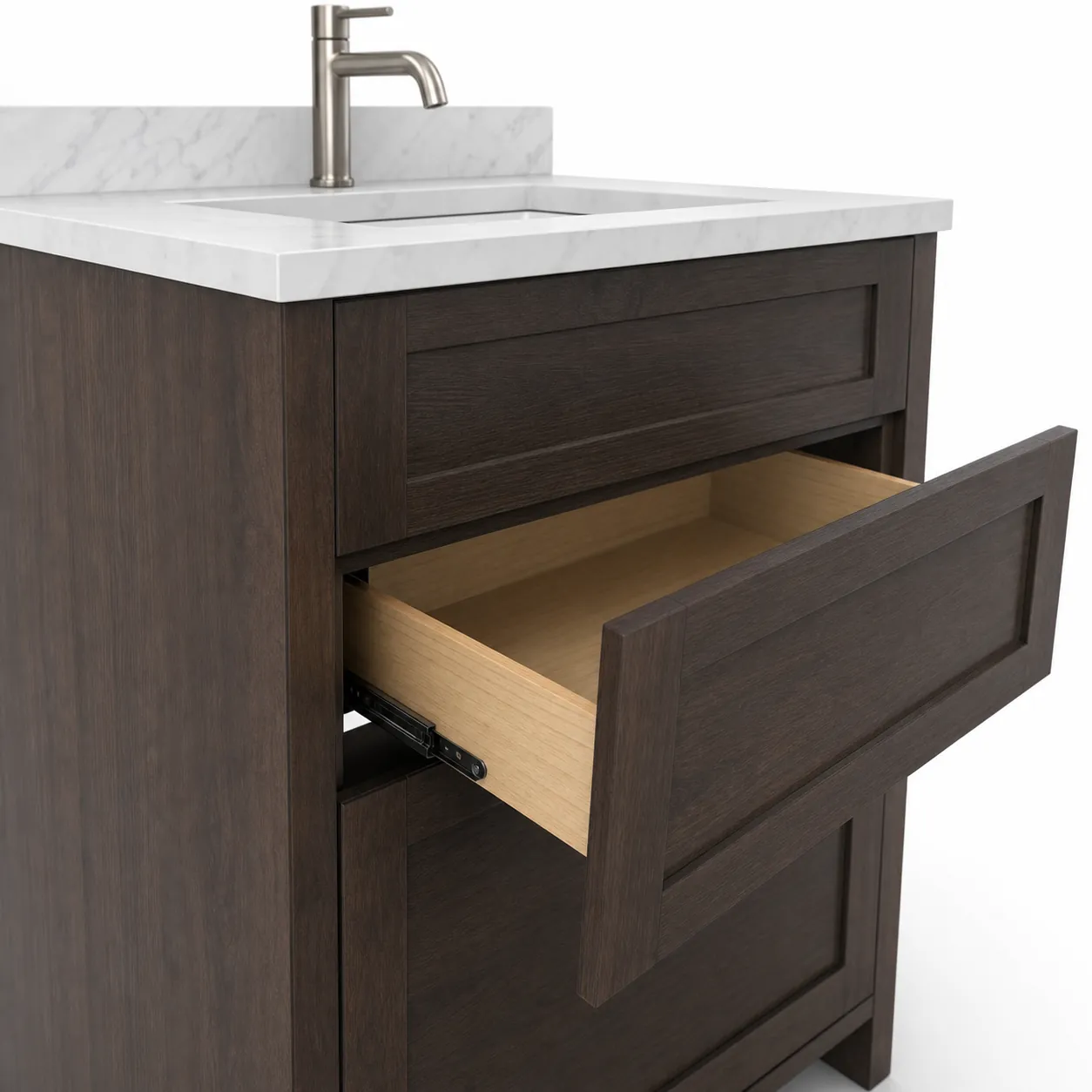
That combination explains the damage list facilities teams know by heart: water-swollen panels at the floor, rust bleeding from hinge cups, edges lifting where bleach pooled, doors off track after students sat on them, marker and sticker residue baked into the finish. None of these failures comes from one dramatic event. They come from hundreds of ordinary interactions repeated daily, which is why a cabinet built for a home will not simply hold up in a school — nobody maintained it, and nothing was specified for that load. The next sections turn each failure into a specification answer, starting with the cabinet body, because water at the base usually ends a cabinet long before the door does.
Accessibility shapes the layout of public school washrooms before the durability debate starts. Vanity heights, knee space, and clear floor area are commonly figured to meet accessibility guidance, so the project’s cabinets should be designed to meet the relevant ADA accessibility requirements, and a manufacturer’s spec sheet should state its compliance posture explicitly. That language belongs in the request for proposal, not in a later email. The ADA accessibility resources page is the neutral reference for the current technical requirements, while the sections below cover what happens to those countertops and cabinets once students actually use them.
Manufacturers who build for the commercial channel price this difference into the product instead of hiding it in a brochure. MFBATH makes its cabinet bodies from either a 100% waterproof PVC line or plywood with sealed edges, reports a 5-point inspection on every cabinet, and stands behind the build with a 2-year whole-cabinet warranty. Those four categories — material, hardware, finish, and records — structure the rest of this article.
Choosing the Cabinet Body: PVC vs Plywood
The cabinet body takes the worst of the room: mopped water at the toe, splashback at the sink, bleach drips on the top edge. Start the spec there. For heavy-use washrooms, choose between two construction lines instead of one vague “commercial grade” label. The PVC line is 100% waterproof — the panels do not absorb water and do not warp — and the surface wipes clean in one pass and resists scratching. It ships in standard widths of 24-60 in and depths of 18-24 in, and the factory keeps a finish library of 1,000+ options, which matters when a district wants one look across several buildings. For the fuller picture of buying this line at volume, our guide on commercial PVC vanity sourcing walks the same decision with the logistics added.
The plywood line answers a different question: when the project wants a wood-grain look and the cabinet still has to resist moisture. Multilayer plywood resists warping better than particleboard, waterproof edge banding protects the cut edges, and the line is cost-effective at district volume. The board is offered in three grades — standard, BWR (boiling-water-resistant), and marine-grade — with E1 formaldehyde levels of ≤0.1 ppm, plus CARB (California Air Resources Board) Phase 2 and FSC-certified wood options where the spec demands documented sourcing. In a room that gets cleaned with bleach every night, the edges matter as much as the panel: specify waterproof edge banding on every cut edge and ask the factory to confirm it in the order sheet.
The decision rule is short. If the cabinet sits in a toilet area with daily disinfectant cleaning and humidity that never drops, choose the 100% waterproof PVC line. If the room is a staff lounge or a half-bath where looks carry weight and cleaners are milder, a plywood body in marine grade with BWR glue lines gives the wood look with a defensible moisture story. When a district cannot decide, ask the factory to quote both lines at identical dimensions; the paper comparison usually settles the room-by-room split.
| Cabinet Body Option | Behavior in a School Washroom | What to Write in the Spec |
|---|---|---|
| PVC, 100% waterproof line | Panels do not absorb water or warp under constant moisture and bleach contact; the surface wipes clean and resists scratching | State widths of 24-60 in and depths of 18-24 in; confirm waterproof construction on every panel face |
| Plywood, standard grade | Multilayer core resists warping; moisture can still enter through unsealed edges after repeated cleaning | Require waterproof edge banding on all cut edges; confirm the board’s formaldehyde level |
| Plywood, BWR grade | Boiling-water-resistant glue line holds up where hot water and steam cycle daily | Name BWR (boiling-water-resistant) construction in the purchase order |
| Plywood, marine grade | Highest moisture tolerance in the plywood family for sink zones and unvented rooms | Specify marine-grade veneers where panels sit inside the wet zone; pair with BWR glue |
| Finish layer, all lines | Sealed coatings and low-VOC finishes decide how long the face survives chemical contact | Write a low-VOC finish; choose E1 ≤0.1 ppm or CARB Phase 2 board options where indoor air matters |
Notice what the table does not contain: a promise of a specific number of school years. No factory can promise how many seasons a cabinet survives, because that depends on cleaning frequency, abuse, and ventilation. The honest spec lists materials and grades and lets the warranty cover the rest. MFBATH’s whole-cabinet warranty runs 2 years — a fixed term in writing, which is more useful for a district’s capital planning than a marketing claim about lifespan.
Hardware Specs That Survive Students
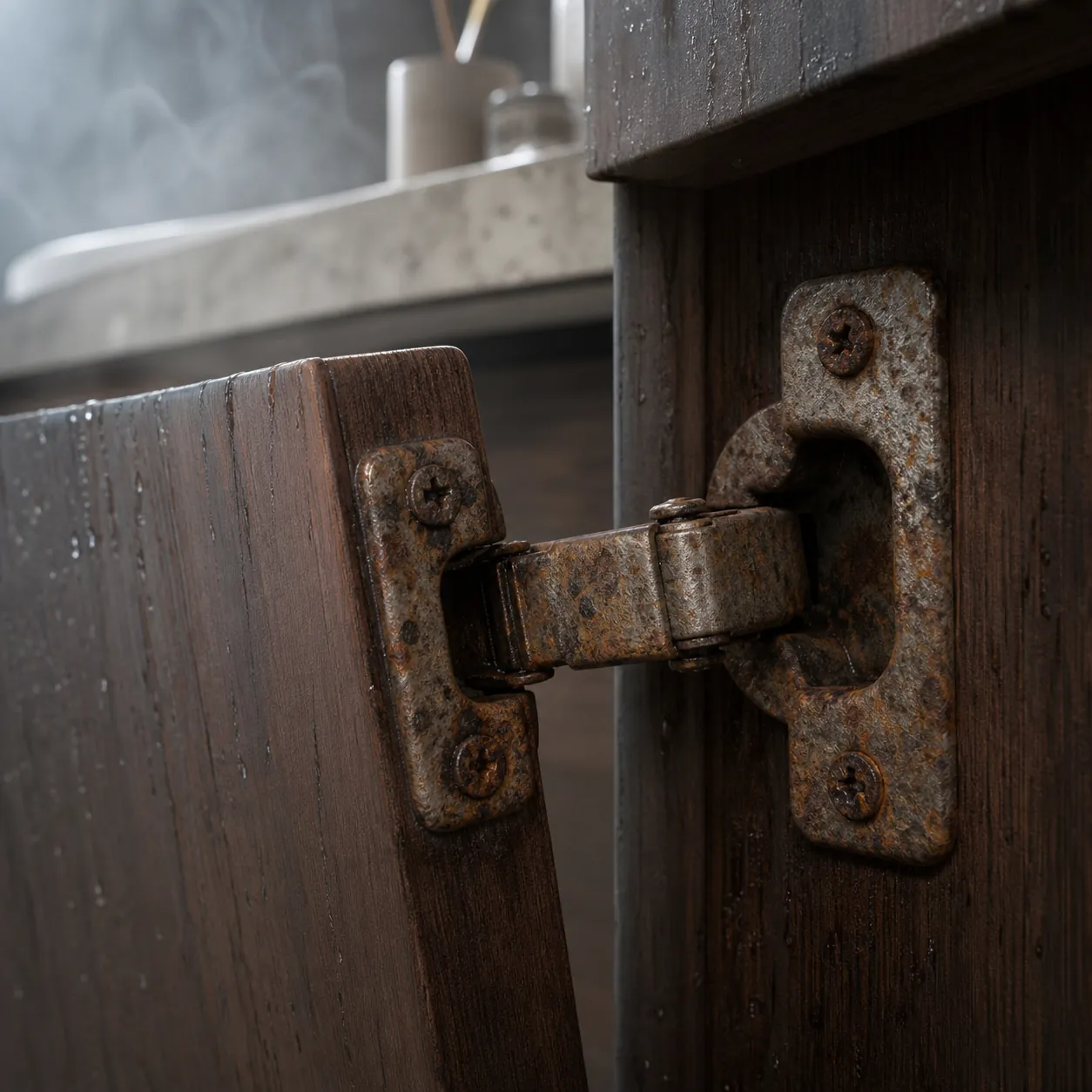
In a school washroom, hardware fails before panels do. A hinge corrodes, the door sags and starts catching, the drawer slide wears, and within a season the unit looks broken even though the box is fine. The photo below is the failure mode maintenance teams know by heart: a rusted hinge on a plywood door, the result of humidity and cleaning chemicals working on an under-spec component.
Spec soft-close hinges and soft-close drawer slides as a baseline. Slamming is a daily event in a school, and damped closing mechanisms absorb the impact that would otherwise pound the hinge cup and the panel face while keeping the room quieter. Decide drawers against open shelves by how the fixture will be used: a small-needs sink with soap and paper refills works fine with a shelf or a cabinet door, while a sink zone that carries cleaning supplies wants drawers rated for weight. Whatever the layout, doors and panels should fix to the body with mechanical fasteners through a reinforcement, not staples, and high-use rooms should use cup hinges with concealed fixings so students cannot pry components loose.
Put the hardware line in writing. A spec that says “quality hinges” is a spec that invites under-spec components. Name the required features: corrosion-resistant finish, damped closing, rated cycle counts. Ask the factory for the salt spray test reports that back its hardware claim — a standard corrosion test for coated metal parts that a serious manufacturer keeps on file. Our rundown of salt spray testing for cabinet hardware explains how to read one, and the assisted living vanity specs guide covers the same abuse-threshold questions for another public-use building type.
Finally, plan spare parts instead of trusting a sales promise. Schools do not wait for a container to fix a hinge; they fix it now and replace it later. Order a service stock of hinges, slides, door catches, and edge seals with the batch — even a handful per site — and confirm the factory will keep the same hardware available across future orders. MFBATH writes the hardware set into the order sheet so a replacement order matches the original build, which turns a one-off cabinet into a system the district can maintain after the installer leaves.
Finishes and Cleanability Under Constant Cleaning
The finish is the cabinet’s first line of defense, because it is the surface the cleaners touch every night. School cleaning involves bleach, disinfectant sprays, and alcohol wipes; a finish that tolerates those chemicals keeps its color and sheen, and one that does not dulls, peels at the edges, and starts harboring stains. Ask the factory how its doors and panels hold up to bleach and general cleaner contact, and look for a sealed coating system. In furniture production, finish quality starts in the spray booth, where temperature, humidity, and dust control decide whether a coating lays flat and adheres, so a supplier that talks about its process at that level of detail is a better sign than one selling “durable paint.”
Easy cleaning is a design decision, not a luxury. Smooth faces with minimal seams give custodial staff fewer grooves for grime; a cleanable corner radius and a wipe-down top edge beat sharp inside corners where residue collects; doors that close flush and drawers without exposed tracks reduce the surfaces students can soil. Simpler geometry translates into faster cleaning, and that is the maintenance argument to put in front of the school board, because the labor repeats every night while the geometry itself costs the same as a worse one in the mold.
Color changes how the finish reads over its service life. Light finishes show soil quickly, which keeps them looking maintained if staff keep up; dark finishes hide grime but show scratches and hard-water marks more readily in direct light. For a school, mid-tone or lightly textured faces are the practical middle: they delay the “needs refinishing” look without hiding real damage, and they photograph consistently for the district’s capital-planning files. There is no universal right answer, so choose the color with the room’s traffic in mind and say the trade-off out loud in the review meeting.
Indoor air is part of the durability story, because students and staff occupy the room for hours a day. Low-VOC finishes help keep airborne emissions down, and MFBATH offers low-VOC finishes as a standard first-party option across its cabinet lines, alongside the E1 ≤0.1 ppm and CARB Phase 2 board options covered earlier and FSC-certified wood where procurement rules demand documented sourcing. The EPA resources for healthy schools page is the neutral citation when the board asks why the spec controls these inputs.
Spec Vanities Built for Commercial Use
Browse this product, solution, or service page to explore relevant offerings.
Evidence of Durability: QC, Warranty, and References
Material and hardware claims matter, but the records a factory keeps are the closest thing to proof. Ask which quality checks run on every cabinet before it ships. MFBATH runs a 5-point inspection on each piece — the checkpoints cover the body, finish, hardware, assembly, and packaging — and the record exists per cabinet, which is different from a random final check. A factory that points to a fixed inspection regimen can also point to what it found last month.
Then read the warranty and the returns number. MFBATH’s terms are a 2-year whole-cabinet warranty, covering the cabinet as a unit rather than a long list of exclusions, and its recorded return rate is below 1%. Those two numbers carry real meaning for a district: a below-1% return rate at commercial volume means defect-batch risk is managed, and a stated 2-year term gives maintenance staff a written window to file claims instead of an oral promise. When you evaluate a competing quote, demand the same two numbers in writing — warranty term and return rate — and treat a refusal as an answer.
Reference orders close the loop. Ask the factory for contacts from completed education or public-facility projects — districts, contractors, or distributors that received comparable cabinets — and call them. MFBATH’s customer base of 1,000+ dealers across 20+ countries gives it a wide pool to choose from, and the factory arranges third-party inspection or factory audits by firms such as SGS and TÜV when they are scheduled in advance. Book the inspection before production starts; an inspector who holds the approved sample, the purchase order, and the packaging spec catches deviations while the line can still correct them.
When the container lands, run the acceptance list instead of uncrating everything at once: compare carton counts and markings against the packing list, open the marked sample cartons first, and check the finish, hardware, and joints against the approved sample before the truck leaves. Photograph any damage at the gate. Then add the district’s own checks to the factory’s: level the cabinet on its feet, load the drawers, and swing each door through a full cycle before the installation crews sign off. Written acceptance criteria at the dock save both sides from the “it looked fine when it left China” argument later.
Scoping a School District Order: Volumes and Phasing
School districts buy differently from homeowners: dozens of nearly identical vanities across several buildings, one budget line, and a construction window that closes before students return. That pattern actually helps the buyer, because a repeatable unit is exactly what a factory prices accurately and produces predictably. MFBATH’s MOQ (minimum order quantity) is 15 sets per model, color, and size, with mixed-container loading supported — a district can combine several models in one container as long as each combination meets the 15-set floor. That makes a pilot possible: one school, one spec, one small order, instead of a district-wide rollout bought on faith.
The PVC bathroom vanity product line is the reference page for starting a trial spec, because it lists the dimensions, finish options, and configurations a spec writer needs to fill in an order form. Pair it with the process in our multi-family vanity specs guide, another procurement pattern where one unit repeats across many doors. The pilot teaches the district how quoting, sampling, and inspection feel before the big order commits the budget.
Back-Scheduling the Summer Install Window
The calendar drives district procurement, so count backward from the install window. At MFBATH, a sample ships within 10 working days, bulk production runs 20-30 days after sample approval and deposit, and total delivery to the United States, Canada, or Mexico runs 4-6 weeks including ocean transit, with real-time logistics tracking throughout. If the crew wants cabinets on-site by the first week of July, work backward: lock the spec in February, order the sample in March, approve it, place the bulk order by April, and let production and transit run through May and June. A district that waits until the bid is approved to place the order finds the container arriving after school starts.
Write the operating pieces into the same order. A full shipment should include an operation and maintenance document, installation instructions, and the service parts the maintenance team will need, and the purchase order should name who answers a defect claim and on what schedule. MFBATH’s 2-year whole-cabinet warranty and per-cabinet 5-point inspection records give the facilities director a paper trail, and the payment structure — a 30% deposit with the balance due within one week of the draft bill of lading (draft BL) — keeps the district’s cash exposure tied to shipping evidence rather than trust. For more scenarios like this one, our commercial project guides cover other public-use building types with the same spec-first method.
Frequently Asked Questions
Should a school washroom spec a PVC or plywood cabinet?
Start with the cleaning routine and the humidity level. Zones with daily disinfectant cleaning and heavy moisture are well served by the 100% waterproof PVC line, whose panels do not absorb water or warp. Where the project wants a wood-grain look, choose the plywood line in BWR or marine grade with waterproof edge banding, and hold the board to E1 ≤0.1 ppm formaldehyde with CARB Phase 2 available. Ask the factory to quote both lines at the same dimensions; the paper comparison usually settles each room’s choice.
How do you spec hardware so a school vanity stays serviceable season after season?
Write soft-close hinges and soft-close drawer slides as the baseline, name the required features instead of a brand, and request the factory’s salt spray test reports on the coated parts. Corrosion is the main killer in a washroom, so confirm the hinge and slide finishes in the order sheet. Then order a service stock of hinges, slides, and seals with the batch, and confirm the same hardware remains available for future orders.
How should a school district structure its first order?
Use the MOQ (minimum order quantity) of 15 sets per model, color, and size with mixed-container loading to run a small pilot. MFBATH ships samples within 10 working days, runs bulk production in 20-30 days, and totals 4-6 weeks to the United States, Canada, or Mexico. Back-schedule from the summer install window: sample in hand by spring, bulk order placed early, container on site before the crews arrive.
What should a school project verify at delivery?
Compare carton counts to the packing list, open the marked sample cartons first, and check the finish, hardware, and joints against the approved sample before the truck leaves. Ask the factory for the per-cabinet 5-point inspection records, and arrange a third-party pre-shipment inspection by a firm such as SGS or TÜV in advance. Put the acceptance criteria in writing before the container sails.
The Bottom Line
Spec a school vanity the way you would spec a piece of equipment: body material and grade, hardware features with corrosion reports, finish with a low-VOC coating, plus a written warranty and inspection records — then validate the whole package on one small mixed-container order before scaling it across the district. MFBATH is a working example of that package: a 100% waterproof PVC line, BWR and marine-grade plywood options, a 5-point inspection on every cabinet, and a 2-year whole-cabinet warranty. Hold every competing quote to the same four lines.





0 Comments