
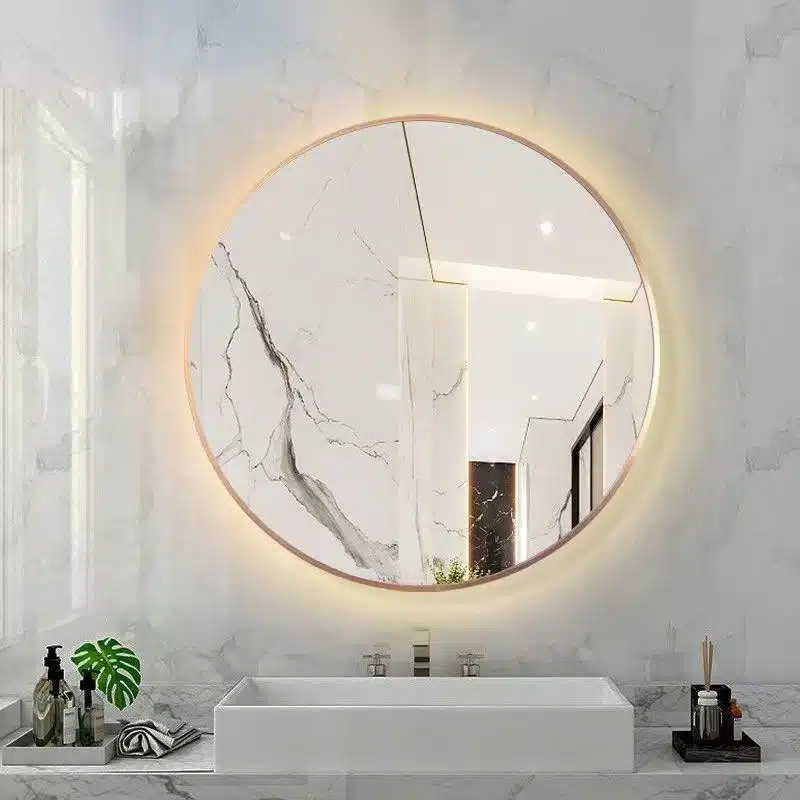
A hotel bathroom mirror can look flawless in a supplier photo and still be the first thing maintenance replaces. In most premature failures the glass is not the problem; the frame is. A plastic rim yellows above the sink line, a painted aluminum edge pits where cleaner spray lands, or a corner joint opens and lets condensation work behind the mirror. That is why frame material deserves its own line in your spec sheet. This guide walks wholesale buyers and hotel project teams through the bathroom mirror aluminum frame vs plastic decision in factory terms: how extruded aluminum and molded PVC or PS behave in a humid commercial bathroom, a side-by-side rating of both options, the questions to put to a supplier, and a project-by-project recommendation. Product context comes from MFBATH, the bathroom furniture manufacturer behind focuscabinet.com, which supplies rectangular, round, and oval mirrors from 24×36 to 48×72 inches (61×91 to 122×183 cm) with wood, metal, or PVC frame options and an optional anti-fog coating. The framework below applies to any supplier, not only to MFBATH.
Key Takeaways
- The frame sees the harshest conditions of any mirror component, and a failed frame usually means a full mirror replacement.
- An aluminum frame is only as good as its alloy grade, wall thickness, finish, and corner sealing; never accept “aluminum frame” as a line item without details.
- PVC frames resist moisture well and deliver molded color and shape at a lower cost tier, but UV, heat, and low-grade compounds age them fastest.
- Require material-standard references such as ASTM B221 for extruded aluminum profiles and ASTM D1784 for rigid PVC compounds, plus a stated finish and written warranty.
- Match frame to project: anodized or powder-coated aluminum for design-led and heavy-duty sites, PVC for budget programs with short renovation cycles.
Table of Contents
- Why the Mirror Frame Fails First
- Aluminum Frames: Extrusion Quality and Finishes
- Plastic Frames: Where They Earn Their Place
- Side-by-Side: Aluminum vs Plastic in Commercial Use
- What to Ask Your Supplier
- Matching Frame Material to Project Type
- Frequently Asked Questions
- The Bottom Line
Why the Mirror Frame Fails First
Walk into a bathroom in commercial use for eighteen months and check the mirror before anything else. The glass is usually fine, because it is a fired silicate that shrugs off moisture. The frame is different: it sits at the boundary where the warm, humid air of a shower meets the cooler wall, so it collects the first condensation. It is also wiped with whatever cleaner the housekeeping cart carries and clipped by luggage carts in tight corridors. A frame in a busy hotel bathroom absorbs more abuse in two years than most buyers imagine.

Each material fails in a characteristic way, and recognizing the mode helps you write a better spec. A painted edge blisters where the coating is thin, a poorly anodized surface pits in coastal air, a molded frame yellows in direct sun, and low-grade polystyrene cracks at the corners. None of these defects destroys the glass, but all force a full mirror replacement, because nobody hangs a discolored frame around a new sheet of glass in a guest bathroom.
The second reason frames fail first is structural: the frame is where water finds a route behind the glass. If a corner joint opens or the back panel is not sealed, condensation reaches the mirror backing and permanent damage starts there. Buyers sourcing for humid climates increasingly specify copper-free backing for exactly this reason; the reasoning appears in our article on copper-free mirror advantages. The same logic applies to the frame: a sealed assembly is the minimum spec in saturated air.
One clarification buyers often need: an optional anti-fog coating on the glass, which MFBATH offers across its classic mirror line, stops fogging on the viewing surface but does nothing for the frame, which still absorbs moisture through every joint and edge.
Aluminum Frames: Extrusion Quality and Finishes
An aluminum mirror frame is normally an extruded profile: alloy pressed through a die into the frame cross-section, then cut, joined at the corners, and finished. Extrusion gives aluminum two commercial advantages over plastic. The profile is rigid, so the long side of a 48×72 inch mirror stays straight instead of bowing, and the frame can be slim without flexing. The material also reads as metal, a look molded plastic rarely matches in hospitality interiors.
“Aluminum frame” is not a spec. The alloy grade determines how the profile behaves in humid, chloride-tinged air, and the industry has a reference standard for it: ASTM B221, the standard specification for extruded aluminum-alloy bar, rod, wire, profile, and tube. A serious supplier names the alloy it extrudes, answers “6063” or “6061” plus a wall thickness in millimeters, and produces a material certificate referencing the standard. If the answer is “aluminum, like other mirrors,” keep digging.
The finish does the environmental work. Anodizing grows the oxide layer out of the aluminum itself, so protection is part of the metal rather than a coating on top, and it tolerates routine cleaners without flaking. Powder coating applies a colored, oven-cured layer matched to a Pantone reference when the designer hands you a color code. Both are legitimate; the question is whether the supplier can name the finish and show process documentation. Be wary of the vague middle ground: a thin painted profile at a discount price usually blisters first.
Joinery is the third quality gate. Rectangles are typically mitered at 45 degrees with hidden brackets or welded joints; rounds and ovals need bent or segmented profiles, and every join is a moisture path. Ask how corners are joined and sealed and whether the back panel is water-sealed. Wall thickness should appear in millimeters on the shop drawing; it separates a profile that survives years of housekeeping from one that dents when a cart clips it.
Aluminum is also recyclable, so frames replaced at renovation keep scrap value instead of going to landfill. MFBATH supplies aluminum-framed mirrors in its classic line and smart LED range; current options, sizes, and finishes are listed on the bathroom mirror product page. Whatever the source, demand the alloy, the finish, and the wall thickness in writing before comparing quotes; otherwise you are comparing adjectives.
Plastic Frames: Where They Earn Their Place
Plastic mirror frames are usually injection-molded from PVC or PS and joined around the glass. They earn their place through three structural advantages. Color is mixed into the resin rather than applied as a topcoat, so there is no paint film to peel. Molding allows complex profiles, curved corners, and decorative details that would be expensive in extruded metal. They are also light, cutting freight weight and simplifying wall mounting. Those properties make plastic the default for high-volume, cost-sensitive mirror programs in a way aluminum cannot match.

Material science matters more than the word “plastic,” because PVC and PS behave differently. Rigid PVC is inherently tolerant of moisture, which is why it appears in plumbing and cladding; the plastics industry references ASTM D1784, the standard specification for rigid PVC compounds, when a compound grade must be defined. PS is cheaper, lighter, more brittle, and weathers less gracefully, so when a supplier quotes a plastic-framed mirror, ask which resin family the frame uses and expect a one-sentence answer.
Plastic frames have three known weak points, and knowing them tells you where to inspect. UV light is first: prolonged direct sun yellows PVC and makes the surface chalky, so a mirror opposite a west-facing window ages faster than one on an interior wall. Heat is second: lamps or hot LED backlighting can soften thin sections, so check the area near any heat source at goods-in. Solvent cleaners are third: chemicals harmless to an anodized surface can dull a glossy molded frame after years of wiping. None is disqualifying; each is an environmental condition that should drive the material choice.
On cost and customization, the bathroom mirror aluminum frame vs plastic trade-off becomes clear. A molded frame sits in a lower unit-cost tier than an extruded, finished profile, and at high volume the mold amortizes into a negligible per-unit figure. Plastic also takes color well, with pigment compounded into the resin, and decorative shapes are limited by mold design rather than bending constraints. Where plastic loses ground is long spans and heavy use: a 48-inch side needs adequate wall thickness to resist warping, and the cart abuse that dents aluminum can crack a thin molded corner. Plastic is usually the wrong answer when the project demands a metal look or a long presentation life, and often the right one when it demands a specific color at a controlled budget with a short renovation cycle.
Side-by-Side: Aluminum vs Plastic in Commercial Use
The table below rates both frame families for continuous commercial bathroom duty. Ratings are qualitative grades of high, medium, and low, not laboratory measurements, and they steer the conversation toward the right material for the environment.
| Property | Aluminum frame | PVC/PS plastic frame |
|---|---|---|
| Moisture resistance | High. Anodized or powder-coated surfaces seal the profile; performance depends on sealed corners and back panel. | Medium-high. Rigid PVC tolerates moisture well; PS grades and open joints are the weak points. |
| Resistance to cleaning chemicals | High. Quality anodizing and cured powder coats handle routine hotel cleaners without flaking. | Medium. Everyday cleaners are fine; harsh solvents can dull glossy surfaces over time. |
| Impact and scuff resistance | Medium-high. Profiles dent or bend on hard impact rather than shatter, and dents can often be touched up. | Medium. Thin molded corners can crack on sharp impact, especially in cold conditions. |
| UV and heat stability | High. Anodized finishes hold tone in sun; structural aging is minimal. | Low-medium. Prolonged UV yellows PVC and embrittles PS; heat from lamps can soften thin sections. |
| Cost position | Higher. Extrusion, finishing, and joining cost more per frame, with a visible premium at small volumes. | Lower. Molded frames cost less per unit, and the mold amortizes heavily at volume. |
| Custom color and shape | Medium-high. Powder coat and anodizing match Pantone references. | High. Pigment is molded into the resin, and profiles are limited by the mold rather than bending. |
| End-of-life position | High. Aluminum frames are recyclable and retain scrap value at renovation. | Low. Molded frames are generally disposed of rather than recovered. |
Read the table with lifecycle cost in mind, not unit price. A balanced bathroom mirror aluminum frame vs plastic evaluation rarely produces the same answer for a design hotel and a midscale chain, because the deciding variable is what happens at replacement time. If a frame fails inside the expected service cycle, you pay for the new mirror, freight, installer time, and a room offline, often far more than the frame price difference. If the program renovates every few years, the lower-cost molded frame is simply consumed as planned and the economics flip.
Two practical notes before comparing quotes. Keep the comparison within the same mirror specification, since glass, backing, and mounting all affect service life; and remember that suppliers such as MFBATH offer frame materials as options on the same mirror bodies, so you can compare PVC-framed and aluminum-framed versions of one model. Our product knowledge guides cover adjacent components such as glass and backing, so you can evaluate the whole assembly.
Specify a Mirror Frame That Survives the Building’s Humidity
Browse this product, solution, or service page to explore relevant offerings.
What to Ask Your Supplier
Frame quality is verifiable at the quotation stage if you ask six questions and demand written answers. Add this list to your RFQ template for every framed mirror order, aluminum or plastic:
- What exactly is the frame material, and can you name the grade or compound family?
- What are the frame width and profile wall thickness in millimeters, shown on the shop drawing?
- What finish is applied, and can you share process documentation or an optional salt-spray result sheet?
- How are the corners joined and sealed, and is the back panel water-sealed?
- What does the written warranty cover, including frame finish, deformation, and backing, and for how long?
- What are the MOQ and lead time per model, color, and size, stated in writing?
The first question moves the supplier from marketing language to engineering language: on the aluminum side, an alloy family and a material certificate referencing a recognized standard such as ASTM B221; on the plastic side, a resin family and ideally a reference to ASTM D1784. If the salesperson cannot name the material without checking, the factory has no written spec, and that is a future claim dispute. The second and third questions work the same way: a millimeter dimension and a finish name are checkable at goods-in, while “good quality frame” is not. Salt-spray testing is an option you request and pay for, not a certification to assume; ask whether the report can travel with the shipment.
The fourth question targets water finding a route behind the glass. Ask about corner construction on the shape you are ordering, since rectangles, rounds, and ovals each join differently, and how the frame back is sealed. If you source the glass in the same order, the assembly spec matters as much as the frame; our guide to bathroom mirror glass thickness explains how sheet and frame interact.
The fifth and sixth questions carry the commercial terms. Warranty language differs meaningfully: a term covering frame finish against peeling or yellowing is more useful than one covering only transit breakage. As a benchmark, MFBATH’s written terms give a two-year warranty on the complete vanity package, and its reported return rate across shipments sits below 1 percent. When you evaluate the bathroom mirror aluminum frame vs plastic quotes in front of you, ask each supplier to state a frame warranty in writing and compare terms with prices. MFBATH produces custom frame colors, sizes, functions, and logos from a 15-set MOQ per model, color, and size, so a pilot order can verify frame quality before you scale.
Supplier due diligence belongs in the same pass. MFBATH has held ISO 9001 and ISO 14001 certification since 2017, reconfirmed as current in 2025, and holds CE and UL certifications relevant to its powered product lines, so certificates are available on request. Ask any factory you evaluate for the same: certificate number, issuing body, and scope. A factory that cannot produce current certificates will usually struggle with material certificates for its frames too.
Matching Frame Material to Project Type
Frame material should follow the project profile. Three inputs drive the decision: the environment the mirror lives in, the aesthetic the designer has committed to, and the service cycle before renovation; rank them and the choice usually settles itself.
Design-led hotels and boutique properties are aluminum territory. The architect has specified a metal look, the frame is a visible design element, and the room rate justifies a component that still presents well at the end of the cycle. Specify anodized or powder-coated profiles, confirm wall thickness on the drawing, and use Pantone matching so the finish aligns with the room palette. Where the mirror carries powered features, frame style and electronics are separate decisions; buyers who want the full customization picture should read our guide to custom LED mirror frame options before finalizing the spec.
Midscale and economy chains, and large apartment or rental programs, are where plastic frames earn their keep: volume is high, colors are standardized, renovation cycles are short, and the budget controls the decision. Order PVC-framed mirrors in standard sizes within the 24×36 to 48×72 inch band, verify the compound grade, and confirm corners and back panel are sealed, because a PVC frame with sloppy assembly fails as fast as a cheap aluminum one. At high volume the molded frame’s cost advantage is real, and planned replacement at renovation keeps the risk inside the budget.
Medical buildings and assisted-living facilities shift the calculus back toward aluminum for reasons unrelated to looks. Healthcare housekeeping uses stronger disinfectants and cleans mirrors several times a day. An anodized aluminum frame tolerates that chemistry better than a molded polymer surface and shrugs off the occasional bump from a cart or wheelchair. Choose smooth, sealed profiles with minimal crevices, and confirm finish documentation before ordering.
Coastal and high-humidity regions deserve their own rule. In chloride-laden marine air, finish quality is the entire game: specify anodized aluminum or a fully sealed profile, request the optional salt-spray result sheet rather than assuming one, and pair the frame with copper-free backing so both components resist the same aggressive air. In coastal and tropical builds, the bathroom mirror aluminum frame vs plastic call usually flips toward metal with documented finishing, while plastic frames are reserved for interiors with no direct sun exposure.
Finally, keep mirror shapes in mind when you translate the recommendation into an order. MFBATH’s classic line includes rectangular, round, and oval mirrors across the 24×36 to 48×72 inch range (61×91 to 122×183 cm) with metal and PVC frame options, plus wood frames where cabinetry calls for a matching timber look. Frame color, size, function, and logo customization are quoted from the same 15-set MOQ per model, color, and size, keeping pilots small enough to validate the frame on real samples first.
Frequently Asked Questions
Will an aluminum mirror frame oxidize over time?
Aluminum does not rust like steel, and an anodized finish grows a protective oxide layer that is part of the metal. Problems appear when the finish is thin, the alloy unspecified, or corners unsealed, especially in coastal air. Ask for the alloy, finish type, and optional salt-spray sheet so the risk is documented, not assumed.
How many years will a plastic-framed mirror last?
Service life depends on the resin family, the environment, and build quality rather than on a fixed number of years. Rigid PVC in an interior bathroom with no direct sun can serve a standard renovation cycle; PS, thin walls, and UV shorten that window. Verify the compound, wall thickness, and warranty term, and inspect a pilot order before committing to volume.
Can mirror frames be matched to custom Pantone colors?
Yes. Aluminum frames accept Pantone-matched powder coating or anodized tones, and plastic frames have pigment compounded directly into the resin, so both families can hit a color reference. At MFBATH, frame color, size, function, and logo customization are produced from a 15-set MOQ per model, color, and size, allowing a small pilot batch for color approval before mass production.
Which frame is cheaper: aluminum or plastic?
In price tiers rather than dollar figures: a molded PVC frame sits in a lower tier than an extruded, finished profile, and the gap grows with volume. Compare lifecycle cost as well as unit price, since replacement labor and downtime often exceed the frame price difference when a frame fails early. A written warranty is the practical insurance either way.
The Bottom Line
There is no universal winner in the bathroom mirror aluminum frame vs plastic discussion, and any supplier who tells you otherwise is selling a default rather than a decision. Aluminum wins where humidity, cleaner chemistry, coastal air, and design presentation dominate; plastic wins where volume, color, and controlled cost decide, and where the renovation cycle is short enough to consume the frame as planned. In both cases, material grade, finish, wall thickness, corner sealing, warranty term, MOQ, and lead time belong in writing before production; MFBATH has built classic and smart LED mirrors with wood, metal, and PVC frame options since 2015, and it will quote every one of those variables against your project. If you are in the middle of that frame decision now, put the six questions from this guide to your current supplier and to MFBATH, compare the written answers, and verify the frame with a small pilot batch in your own building before the container ships.


0 Comments