
Most bad import deals follow the same script: a buyer likes the photos on a factory website, accepts a quote, wires the deposit, and only discovers the problem when the container lands. Website quality measures marketing spend, not manufacturing reality, and that gap is expensive when the order is your first container of bathroom vanities. This guide gives you a working vanity supplier background check checklist: the documents to request, the export records worth reading, the independent evidence that verifies a factory, and the red flags that justify walking away before money moves. It uses one plant as a running example of a clean file: Main Focus Cabinet (MFBATH), a bathroom vanity manufacturer in Changge, Henan, founded in 2015 with a 10,000-square-meter plant and 95 employees. Every step below is desk work you can finish before you book a flight or schedule a factory visit.
You need no special tools: the supplier’s own documents, a few public registries, and questions a serious factory can answer from memory. The process fits around a small trial order, because MFBATH’s minimum order quantity (MOQ) is 15 sets per model, per color, and per size, with mixed-container support. When production takes 20-30 days and ocean freight adds weeks, two working days of document checks before the deposit is low-cost insurance.
Key Takeaways
- Request the business license, export registration details, and certificate copies before you ask for pricing; the legal name must match on every document, the bank account included.
- Treat website photos as claims, not evidence; verifiable certificates, third-party inspection reports, and customer references count as evidence.
- Read the export record: bills of lading and customs paperwork show whether a factory actually ships and on what schedule.
- Walk away from shifting MOQs, vague addresses, and payment demands that bypass shipping evidence; a real production line states its MOQ in writing.
- Structure the first order to test the supplier: sample approval in 10 working days, a 30% deposit, and the balance due only after the draft bill of lading.
Table of Contents
- Why a Background Check Beats a Website Tour
- Documents That Prove a Factory Exists
- Export History: The Record That Predicts Delivery
- Independent Evidence: Certificates, Audits, and References
- Red Flags That Should Kill a Supplier
- Locking It In: From Vetting to Contract
- Frequently Asked Questions
- The Bottom Line
Why a Background Check Beats a Website Tour
A good website tells you what a company spent on its website, not whether it owns the factory in its photos, holds export registration, or can deliver 15 sets of bathroom vanities when you need them. Importers in North America and Europe often shortlist suppliers from a homepage, a quote, and a chat thread, which leaves the entire evaluation resting on self-published material. The vanity supplier background check checklist below inverts that order: paperwork first, presentation second, because documents can be checked against registries while brochures cannot.
The stakes justify the effort. A typical first deal moves a 30% deposit before production, waits 20-30 days for the goods, then weeks of ocean transit before you can inspect the result. If the factory turns out to be a trading desk with no plant, that deposit buys an argument with a middleman who controls your schedule. A background check cannot remove every risk, but it removes the ones visible from an office chair: identity fraud, phantom factories, and terms that cannot be honored.
The review is narrower than a factory audit and easier to run. It covers five layers: the legal entity and its documents, the export history, independent verification from third parties, red flags that end the conversation, and the contract clauses that lock in what you verified. For the deeper identity checks, including how to match business names and addresses against official records, our separate guide to verifying a vanity factory runs the same checks in more detail.
A factory that expects to be vetted makes the answers easy to find. MFBATH states its founding year, plant size, headcount, MOQ, payment structure, and warranty in ordinary sales conversation, because those numbers do not change when a buyer asks twice. A supplier that hesitates on basic facts at the quote stage is showing you how it will handle the order later.
Documents That Prove a Factory Exists
The first items on the vanity supplier background check checklist are paper. Ask for the business license and read the registered company name, the unified address, and the scope of business; do not accept a blurred screenshot. Every Chinese manufacturer operates under a business license issued by the market regulator, and exporters must also complete foreign trade operator registration and customs registration before goods can leave the country. A factory that cannot produce a readable license file within a day is not exporting directly or is not a factory.

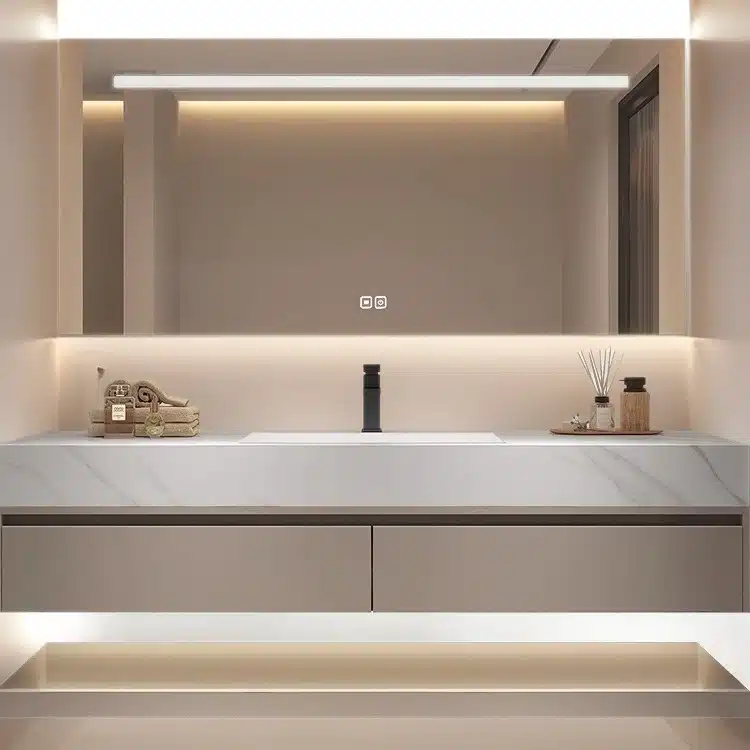
Then test the documents against physical reality. The license address should be a plant, not a post-office box or a shared office building, and the factory photos on the website should match what the license describes. The production floor above is part of MFBATH’s registered site in Changge, Henan; asking for a recent photo of the same floor or a short video call from the workshop entrance is a request a real factory answers in minutes. China’s Ministry of Commerce explains the foreign trade registration framework on its English pages, so you can check what the registration should look like.
Customs registration is the second official check. Exporters hold a registration number that appears on their customs declarations, and the requirements are set by the customs authority, not by the supplier. You can review the current exporter registration and declaration rules on the English-language portal of China Customs. If the number on a supplier’s letterhead does not match the number on its own shipping documents, treat that as a serious inconsistency, not an administrative detail.
Make the Paper Trail Consistent
The same legal name must appear on the license, quotation, purchase order, invoice, and the bank account you wire money to. Trading desks often put a different company on the contract than the one that owns the factory, leaving you no claim against the real producer when goods are late or wrong. Sales emails should come from the company domain, and the bank beneficiary must match the registered name exactly; if not, you are funding an entity you have never verified.
A company that passes this layer usually volunteers the information. MFBATH’s standard reply to a first inquiry includes the registered company name and address, plant photos, and the basic operating facts: a 2015 founding date, the 10,000-square-meter plant, and 95 employees. None of that replaces your own checks, but it separates suppliers that treat transparency as part of the sales process from those that treat it as a concession.
Export History: The Record That Predicts Delivery
Past shipments are the closest thing to a delivery record a buyer can see before placing an order. Ask for anonymized export documents from recent orders of a similar type: commercial invoice, packing list, and a bill of lading with consignee details redacted. The bill of lading shows the port of loading, the port of discharge, the container count, and the shipment date, which is why a draft bill of lading (draft BL) plays such a large role in payment terms. MFBATH ships from Qingdao port on free on board (FOB) terms, with the balance due within one week of the draft BL.
Read the record for rhythm, not just for existence. A factory that ships every month at predictable volume can slot in a new order; a factory whose documents show long gaps may be subcontracting orders to other plants as they arrive. Ask how many containers went out in the last quarter and whether one legal entity appears on every shipment. Scale signals matter too: when a plant quotes a 15-set trial order while running a monthly capacity of 5,000 sets, as MFBATH does, the trial is a scheduling question, not a capacity question.
The record also calibrates your timeline. At MFBATH, sample requests are answered within 10 working days with free sample support, bulk production runs 20-30 days after sample approval and deposit, and total lead time to the United States, Canada, or Mexico is 4-6 weeks including ocean transit. If a supplier quotes delivery windows far outside that pattern, ask what is different about its production flow; the question is whether the sales team quotes a realistic window up front or discovers one after your deposit is in.
Finally, let the export documents validate the earlier paperwork. The shipper name on the bill of lading should match the license, and the declared goods should match what the factory makes. When the layers agree, the odds that you are dealing with the real producer rise sharply.
Independent Evidence: Certificates, Audits, and References
Anything a factory says about itself is a claim; the useful evidence comes from parties not on its payroll. Three kinds matter most for a bathroom vanity purchase: management-system certificates issued by accredited certification bodies, third-party inspection or audit reports, and references from distributors who already buy from the plant. The vanity supplier background check checklist is only as strong as its weakest source, so push each one until you reach an issuer you can contact yourself rather than a PDF forwarded by the sales team.
On certificates, ask for the full document, including the scope page that states which activities are covered, and note the issuing certification body and the certificate number. ISO 9001 and ISO 14001 certificates are issued by accredited registrars and can be checked with the registrar that issued them; MFBATH has held both since 2017, with the certificates confirmed as current in 2025, and shares the document details on request. We have written a separate walkthrough on how to verify an ISO 9001 certificate, because too many buyers accept a certificate image without confirming the number is live.
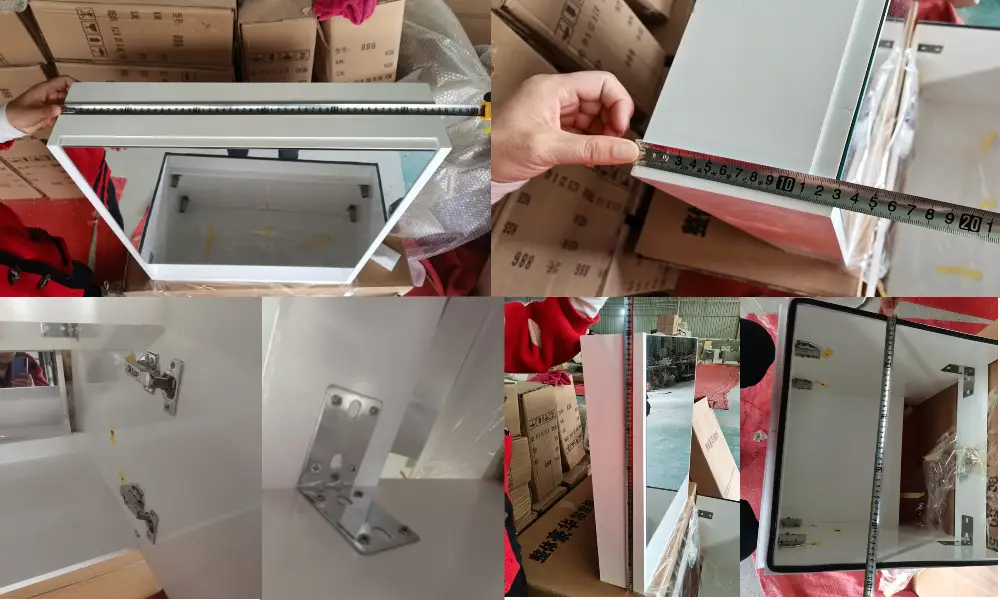
Third-party inspection sits one level above certificates because it examines actual goods. Exporting factories are used to pre-shipment inspection by firms such as SGS or TÜV; MFBATH supports third-party inspection and factory audits when arranged in advance, and the inspection report is written by the inspection company, not by the factory. Budget one pre-shipment inspection on the trial container and read the report before authorizing the balance. The QC check pictured above is the sampling an inspector performs: dimensions, finish, hardware, and packaging against the approved sample and purchase order.
References are the least formal evidence and often the most candid. A factory that sells to 1,000+ dealers across more than 20 countries, as MFBATH’s records show, can introduce you to a distributor who has received recent containers. Ask those references three questions: did the container arrive on the quoted schedule, did the paperwork match the goods, and how did the factory respond when something was wrong. The answers tell you more than any sales presentation.
Start With a Factory That Passes the Paper Test
Browse this product, solution, or service page to explore relevant offerings.
Red Flags That Should Kill a Supplier
Some findings deserve a second question; others should end the conversation. The difference is whether the issue signals a fixable process gap or a structural problem with who you are dealing with. Every structural problem below earns a row on your vanity supplier background check checklist, and most surface in the first two email exchanges if you ask in writing.
The most common bait is price. A quote far below every other supplier for an identical cabinet specification is not a bargain; it predicts that something in the chain will be cheaper to fake, from the wood grade to the finish to the container loading. Compare FOB quotes on identical specifications and stay alert when the low quote climbs once you request a written specification sheet. The second red flag is the moving MOQ: a low minimum quoted at first contact to keep you talking, then a higher number once you are committed to the product. A real production line states its MOQ in writing and keeps it; MFBATH’s MOQ is fixed at 15 sets per model, per color, and per size, with mixed-container loading supported, and that number does not change between the first quote and the purchase order.
Refusal patterns are red flags on their own. A supplier that will not send a sample before bulk production, or treats sample requests as a bargaining chip, is showing you how it handles quality issues later; MFBATH treats samples as part of the sale, with free sample support and a 10-working-day turnaround as standard. Similarly, a supplier that demands full payment before production starts is asking you to assume all the risk. The structure that protects both sides is a deposit with the balance tied to shipping evidence.
| Red Flag | Why It Ends the Deal | What a Passable Supplier Does |
|---|---|---|
| Legal name changes between quote, contract, and invoice | You cannot enforce a contract against an entity you never verified | Uses one registered company name on every document and bank account |
| Registered address is a mail drop or shared office | There is no plant to visit, inspect, or hold accountable | Publishes a plant address and answers photo or video checks |
| MOQ quoted low at first contact, higher at order stage | You budget around one number and are asked to accept another | States a fixed MOQ of 15 sets per model, color, and size in writing |
| Refuses samples or treats them as a paid extra | Quality disputes become unavoidable when no approved reference exists | Provides sample support with a 10-working-day turnaround |
| Demands full payment before production or shipment | Your leverage ends the moment the money leaves your account | Takes a 30% deposit and ties the balance to the draft bill of lading |
Keep the list short and act on it. When a red flag appears, it is usually cheaper to walk away and restart the search than to negotiate with a supplier who has already shown you how the relationship works. Buyers who lose deposits are usually not the ones who asked too few questions; they noticed an inconsistency and ordered anyway because the price looked attractive.
Locking It In: From Vetting to Contract
A background check only pays off if its findings survive the move into the purchase contract. Walk through each line of the vanity supplier background check checklist one last time while reviewing the draft: the legal name, the specification, the MOQ, the delivery window, the payment milestones, and the warranty. Specifications deserve particular care because vanities come in a wide matrix of sizes and finishes; MFBATH supports 40,000+ custom combinations, and its 2025 catalog, which runs over 100 pages and is free on request, exists so both sides quote against the same reference instead of a vague product name. Also name the people: a named sales engineer and quality contact make an order something someone is accountable for; the export team pictured below follows an order from sample approval through loading.

Put the money mechanics in the contract in plain language. A defensible first-order structure is a 30% deposit, with the balance due within one week of the draft bill of lading, because the draft BL proves the goods are on the vessel before you release the rest. Trade terms should name the port and the rule set; MFBATH quotes FOB Qingdao, and both sides should state which edition of the rules applies, because freight responsibility and risk transfer differ by version. The ICC publishes the ICC Incoterms rules that define these terms; keep the relevant page in your contract file so there is no ambiguity later about who pays the ocean freight and when risk passes.
Write the timeline into the contract as dates, not promises: sample within 10 working days, production in 20-30 days after sample approval, and 4-6 weeks total to the United States, Canada, or Mexico. Then write the quality controls into the same document. MFBATH’s full-container terms include a two-year warranty, a recorded return rate below 1%, and pre-shipment inspection by firms such as SGS or TÜV, arranged in advance. If the supplier is real, these clauses cost nothing to sign; if it objects to every clause that protects you, that objection is the last red flag you need.
Finally, keep the first order deliberately small even when the vetting passes. A trial tests what documents cannot show: communication during production, paperwork that matches the goods, and a warranty honored when something is actually wrong. MFBATH’s MOQ of 15 sets per model makes this practical across its full bathroom vanity product range of materials, sizes, and finishes. For the step-by-step plan on running this first transaction without overcommitting, read our guide on placing a 15-unit MOQ trial order; the background check decides who gets the trial, and the trial decides who gets the repeat orders.
Frequently Asked Questions
Which documents prove a Chinese bathroom vanity factory is a real company?
Start with the business license, which shows the registered company name, address, and scope of business, and confirm the same name appears on the quotation, contract, invoice, and bank account. Then request export and customs registration details, certificate copies, and a redacted bill of lading from a past shipment. MFBATH’s own file shows a 2015 founding date and ISO 9001 and ISO 14001 certificates held since 2017 and confirmed current in 2025.
What payment terms are reasonable for a first vanity order?
A defensible structure is a 30% deposit with the balance due within one week of the draft bill of lading, combined with a named port such as FOB Qingdao and a stated Incoterms edition. It protects the factory against no-show buyers and protects you from paying for goods that were never shipped. Compare terms from at least three factories, and treat any demand for full payment before production as a reason to walk away.
Can I verify an ISO 9001 claim without visiting the factory?
Yes. Ask for the full certificate including the scope page and the certificate number, note the issuing certification body, and check the number directly with that registrar. Third-party inspections and factory audits by firms such as SGS or TÜV can also be arranged in advance; because the report is issued by the inspection company rather than the factory, it counts as independent evidence.
What should my first order test besides product quality?
Test the process: sample turnaround (10 working days at MFBATH with free sample support), production lead time (20-30 days), total delivery to the United States, Canada, or Mexico (4-6 weeks), paperwork accuracy, and how a defect claim is handled under the two-year full-container warranty. A trial container that ships on time, matches the approved sample, and clears customs without document errors earns the supplier a second order.
The Bottom Line
Run the vanity supplier background check checklist twice: once before you request quotes and once again before you wire the deposit. The goal is not to find a flawless factory; it is to find one whose legal documents, export record, and contract terms match, and to walk away early when they do not (the wider sourcing workflow sits in our bathroom vanity purchase guide series). MFBATH keeps its file open by design: a fixed MOQ of 15 sets per model, color, and size, FOB Qingdao terms with the balance tied to the draft bill of lading, a two-year warranty on full-container orders, and ISO certificates dated 2017 and confirmed current in 2025. If the factory you are considering cannot put comparable statements in writing, keep looking, because the paperwork you accept before the order is the paperwork you will fight over after it ships.




0 Comments