

Africa’s most interesting bathroom vanity market is not where most buyers first look. It is Lagos, the commercial anchor of West Africa’s largest consumer economy. Roughly 3.5 million people join Nigeria’s labor force every year, and hotel and residential construction keeps converting new households into buyers of finished bathroom fixtures.
For anyone planning africa bathroom vanity sourcing, Nigeria is the entry point, and the region around it decides how orders actually move. This guide covers where demand concentrates, how goods clear Lagos ports, which payment terms cut risk, what specs survive the climate, and how a first container comes together. It ends with a checklist you can hand directly to your sourcing team.
Key Takeaways
The numbers below come from verified factory terms and official sources. They are the same figures our sales desk quotes every day. Carry them into a first conversation with a supplier and watch how quickly the discussion turns practical.
- Lagos Port Complex at Apapa and Tin Can Island Port Complex handle the container volume behind most Nigerian vanity imports, per the Nigerian Ports Authority.
- A first trial order can start at 15 sets per model, color, and size, with mixed container loading allowed across the line.
- The payment structure is a 30% deposit at order placement, with the balance due within one week of the draft bill of lading (draft BL).
- Samples leave the factory within 10 working days, bulk production runs 20 to 30 days, and goods ship free on board (FOB) from Qingdao.
- PVC vanities are 100% waterproof, span 24 to 60 inches in width, and come in more than 1,000 standard finishes for humid climates.
- Every unit passes five in-house quality checks, and SGS or TÜV third-party inspection can be arranged with advance notice.
- Full cabinets carry a 2-year warranty, and the factory return rate stays below 1%.
Table of Contents
- Key Takeaways
- Where African Vanity Demand Is Actually Growing
- Nigeria: Ports, Duties and the Path to Lagos
- Payment Risk and Terms That Work
- Product Specs for African Conditions
- Container Math for First Orders
- Documentation and QC Before Shipment
- Regional Patterns Beyond Nigeria
- Your Africa Sourcing Decision Checklist
- Frequently Asked Questions
- The Bottom Line
Where African Vanity Demand Is Actually Growing
Demand for bathroom vanities in Africa concentrates in port cities, not in the regions that dominate travel brochures. Lagos, Nairobi, Dar es Salaam, and Johannesburg anchor the buying patterns that matter. Each one pulls imports through its own gateway, and each behaves differently on price and specification.
Nigeria is the largest single story. Its consumer market is the biggest in West Africa, and the World Bank Nigeria overview reports that roughly 3.5 million people enter the labor force every year. New households need bathrooms, and bathrooms need cabinets. Local furniture production is thin, so most of that volume lands as imports.
Hotel construction adds a second demand layer. International and regional brands keep opening properties in Lagos, Abuja, and the port cities, and every guest bathroom needs a vanity that survives heavy use. Renovation cycles in older properties feed the same pipeline with repeat orders.
Secondary demand comes from smaller developers and renovation contractors who buy in dozens rather than hundreds. These buyers care about delivery speed and spare-part availability, because a stalled bathroom stops a rental unit from earning. A supplier with a documented 2-year warranty and a return rate below 1% answers that concern before it becomes a problem.
East Africa runs on a different engine. Nairobi is the hub for Kenya and the corridor into Uganda, Rwanda, and eastern Congo, while Dar es Salaam serves inland Tanzania. Apartment projects and small business hotels buy compact units in volume. Kenya also re-exports into the wider region, which makes Mombasa a gateway rather than a final destination. Buyers there routinely ask about knock-down formats that lower freight per unit, and the same cabinet engineered for Lagos can ship flat for Nairobi and assemble on site.
Southern Africa is the mature outlier. South Africa’s retail structure is developed, buyers expect documented compliance, and specifications matter more than price alone. The practical read for africa bathroom vanity sourcing: follow the containers, not the headlines.
Nigeria: Ports, Duties and the Path to Lagos
Two port complexes carry the weight of Nigeria’s import trade. The Lagos Port Complex at Apapa and the Tin Can Island Port Complex handle the container volume that feeds the country’s commercial capital, per the Nigerian Ports Authority. Lekki Deep Sea Port adds newer capacity, but Apapa and Tin Can remain the names that matter in practice.
The clearance chain runs through the Nigeria Customs Service. Duties are assessed at the border on the value and Harmonized System (HS) classification of the goods, and the rates differ by heading. This guide will not quote a single duty percentage, because the correct figure depends on your exact product mix and the rules in force when your shipment lands.
Regulated categories also pass through the Standards Organisation of Nigeria Conformity Assessment Programme (SONCAP). Bathroom furniture may fall inside the program depending on the classification, so a licensed clearing agent should confirm the position before you quote landed cost. That one call saves surprises at the terminal.
Expect the clearance path to involve a licensed clearing agent, a freight forwarder, and your supplier’s documentation working in sequence. The agent files the declaration, customs assesses the duty, and the terminal releases the container once payment clears. Choosing the agent before the goods sail, not after they arrive, keeps the chain short and the fees predictable.
Documentation quality decides speed at the gate. A single line that differs between the commercial invoice and the packing list can stall a container while agents reconcile it. Days at the terminal cost real money, which is why the most disciplined importers treat paperwork as part of the product.
On terms, free on board (FOB) is the default for factory-direct buying. Under FOB, the supplier delivers the goods onto the vessel at the named port, and the buyer takes over from there. Our vanities ship FOB Qingdao, and Incoterms and FOB terms explain how that handover works in detail.
Payment Risk and Terms That Work
Payment structure is where africa bathroom vanity sourcing deals get decided, and the workable pattern is simple. A 30% deposit places the order, and the balance falls due within one week of the draft bill of lading (draft BL). The factory funds materials from the deposit, while you confirm the goods actually loaded before the final payment moves.
That sequence protects both sides. You never pay the full amount before production starts, and the supplier never ships on an unsecured balance. For larger programs, a letter of credit (LC) adds a bank layer. It also adds fees and document requirements, which is why our payment terms guide compares the options side by side.
Currency and channels deserve attention too. Most Chinese factories quote in US dollars and settle by telegraphic transfer, so confirm the receiving bank details in writing before the deposit moves. A mismatch there is the classic delay that has nothing to do with the factory.
Two extremes fail in opposite directions. A buyer who insists on paying after arrival usually absorbs a higher unit price, because the supplier prices the waiting risk. A buyer who prepays everything carries every risk of delay, damage, and dispute. The 30% plus draft-BL structure sits between the two.
Freight risk deserves its own line. Marine cargo insurance covers the voyage, and the premium is small relative to the container value. Pair the payment terms with marine cargo insurance, and the two big failure modes of a first Africa order disappear.
Product Specs for African Conditions
Climate shapes the spec sheet before the catalog does. Coastal and tropical bathrooms run hot and humid, and moisture sits on cabinet surfaces for hours when a bathroom lacks exhaust fans. A wood-based carcass swells under that load, so the durable answer for high-humidity markets is a 100% waterproof PVC vanity.

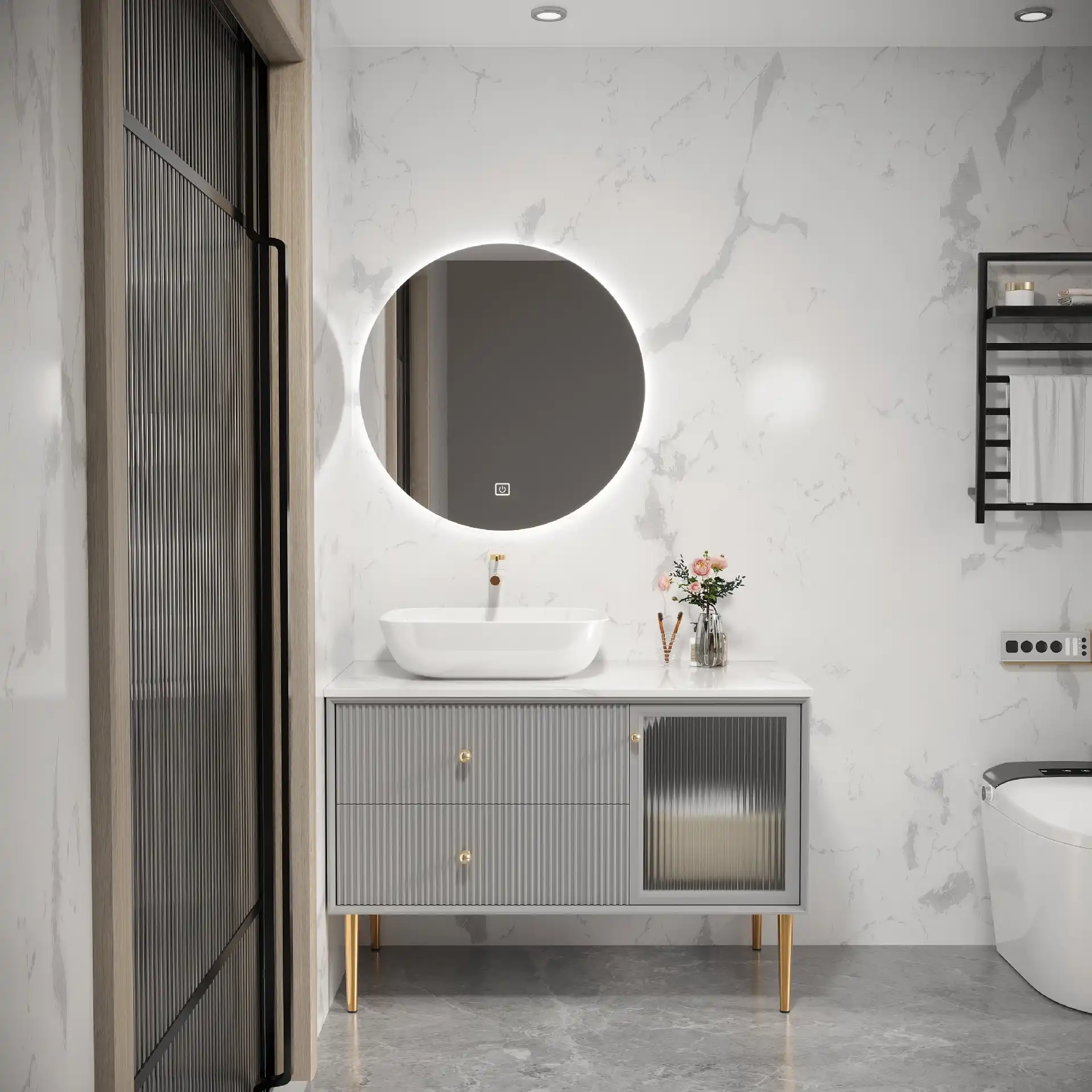
Our PVC line spans 24 to 60 inches in width with more than 1,000 standard finishes. The range covers compact apartments and hotel suites alike, and the 100% waterproof construction removes the swelling failure mode common to wood-based boxes. Compact units matter in dense urban housing, where bathrooms measure in meters rather than feet.
Basins carry their own logic. Sintered stone basins score 7 to 8 on the Mohs hardness scale and resist heat up to 300°C. They are non-porous and stain-resistant, which suits rental and hotel cycles where abuse is routine. The antibacterial surface is a selling point with property managers.
Mirrors need a voltage conversation, not an assumption. Smart LED mirrors with dimmable brightness, color temperature, and anti-fog heating depend on the right power configuration. Confirm the mains voltage and plug standard for the destination country at specification stage, and lock the answer into the order before production.
Plywood and solid wood still have a place in drier inland markets. Plywood in standard, BWR, or marine grade handles lower humidity well, and solid oak or walnut with a multi-layer PU waterproof coating serves the premium segment. The factory supports more than 40,000 custom combinations, so the spec can be tuned to a specific country rather than taken off a shelf.
Specs alone do not close a deal; the product line must exist. Browse the full PVC, plywood, and mirror range on our product pages before you write the PO. Then match the climate logic to the actual units, and let the sample confirm the choice.
Container Math for First Orders
First orders from Africa should be containers, not pallets, and the math starts with the minimum order quantity (MOQ). Our MOQ is 15 sets per model, color, and size, and mixed container loading is allowed across the line. That combination lets a new buyer test three models in one box instead of committing to one.

A 20-foot container suits the smallest trials. A 40-foot high-cube roughly doubles the usable volume, which is where per-unit freight cost starts to fall. Production runs 20 to 30 days after sample approval, and samples leave the factory within 10 working days. The whole first cycle fits inside a quarter.
Freight timing is a lever, not a surprise. Pre-booking freight before peak season locks rates and protects the schedule, a strategy covered in our pre-booking freight guide. Route planning and cube planning belong to the same spreadsheet.
Samples are the low-cost safeguard in the process. Free sample support means the only cost is the courier, and a 10-working-day turnaround keeps the schedule honest. Approving the sample against the full spec sheet prevents the sample-versus-production drift that eats margins.
Loading discipline matters as much as volume. The protection rules differ by product family, and sintered stone tops need specific blocking and lashing inside the box, as our container loading protection guide explains. A structured plan keeps the cartons stable through the weather of a long voyage.
The takeaway is simple. Fifteen sets per model is the floor, and mixed loading is the tool. A planned container is cheaper than an improvised one, because the cube plan protects both the freight cost and the goods.
Vanities Built for Your Market
Browse this product, solution, or service page to explore relevant offerings.
Documentation and QC Before Shipment
Three documents carry a furniture shipment: the commercial invoice, the packing list, and the bill of lading. They must agree line by line, because customs agents on both ends compare them. The commercial invoice states values and HS codes, the packing list states carton counts and weights, and the bill of lading is the carrier’s receipt. Our commercial invoice guide walks through each field that customs staff actually check.
Wood-content rules follow the material. Plywood vanities are available in standard, BWR, and marine grades. The emission side is compliant with E1 limits at 0.1 ppm or below, with CARB Phase 2 and TSCA Title VI in the same file. FSC wood is optional for buyers who need the documented chain of custody.
Quality control is scheduled, not assumed. Every product passes five in-house checks before packing, and third-party inspection by SGS or TÜV can be arranged with advance notice. Ask for the inspection report before the container is released, not after it arrives.
Packaging and labeling close the loop. Custom packaging with your brand marks, logo printing, and private-label cartons is standard for OEM orders, and it saves re-boxing at the destination. Confirm the carton marking rules with the clearing agent, because unmarked or mismatched cartons slow identification at the terminal.
The factory behind the paperwork matters. MFBATH is certified under ISO 9001 for quality management and ISO 14001 for environmental management, with both certificates confirmed valid in 2025. The company also holds CE and UL certification on the electrical product lines, and full cabinets carry a 2-year warranty with a return rate below 1%.
Regional Patterns Beyond Nigeria
Buying patterns diverge once you leave Lagos. West African markets such as Ghana and Senegal often source through Lagos-based distributors, so the Nigerian entry point doubles as a regional hub. East Africa is more direct, with buyers in Kenya, Tanzania, and Uganda working their own corridors.
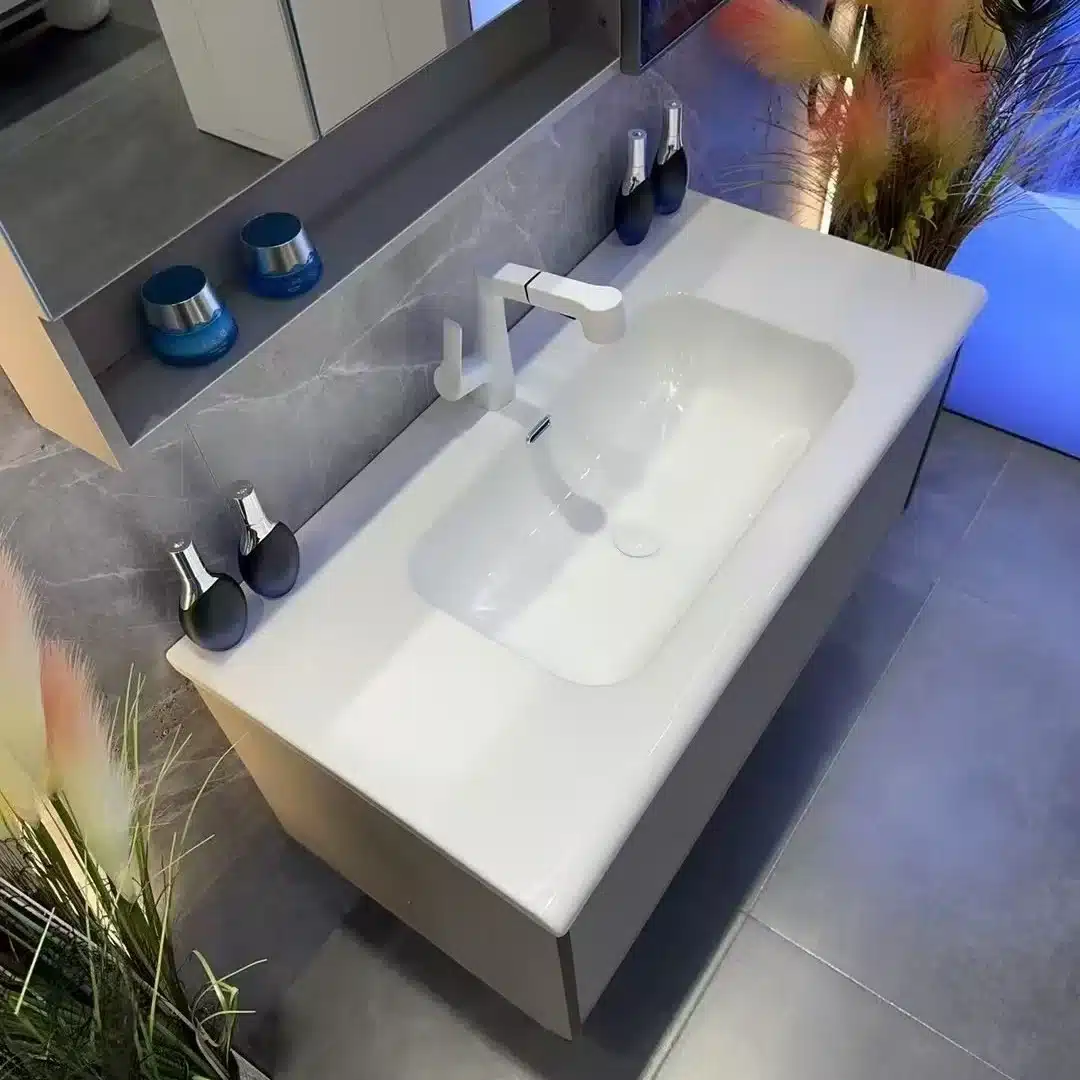
East African buyers lean price-sensitive and practical. Plywood vanities with clean, compact proportions sell well in Nairobi and Dar es Salaam, where apartments dominate and maintenance budgets are tight. The same units that serve Lagos rentals travel east without much re-engineering.
Southern Africa behaves like a developed market. South African importers ask for certification documentation, material specs, and warranty terms before they ask for price. ISO 9001 and ISO 14001 evidence, the E1 and CARB documentation, and a stated warranty answer the first round of questions.
Francophone West Africa adds its own rhythm. Cotonou and Lomé serve the corridors into Niger, Burkina Faso, and Mali, and Abidjan anchors the francophone coast. Volumes are smaller, but the buyer density is real, and many of those buyers already source through Lagos or Accra.
Trade policy is shifting underneath these patterns. The African Continental Free Trade Area is designed to boost intra-African trade and lower tariff barriers over time, which may reroute some distribution chains. Treat it as a trend to watch, not a reason to delay a first order.
The Mexico analogy helps frame the differences. Mexico’s vanity market runs through one dominant gateway with local standards and layered distribution, much like the African pattern. Our Mexico distribution playbook exposes the same questions worth asking before you commit to a market.
Your Africa Sourcing Decision Checklist
Run this list in order before you send a purchase order. Each step removes one known failure mode from the process. Done together, they turn the first Africa container from a gamble into a measured bet.
- Pick one gateway, whether Apapa, Tin Can, Mombasa, or Durban, and confirm the route with a licensed clearing agent before the PO.
- Verify the HS classification and duty treatment for bathroom cabinets before you quote landed cost to your customer.
- Lock the payment structure at 30% deposit, with the balance due within one week of the draft bill of lading.
- Match the material to the climate: PVC for high-humidity coastal bathrooms, plywood for price-sensitive inland markets.
- Size the first order at 15 sets per model with mixed container loading, and pre-book freight ahead of peak season.
- Schedule SGS or TÜV inspection with advance notice, and review the report before release.
- Approve the sample first; samples take 10 working days, and production runs 20 to 30 days after approval.
Frequently Asked Questions
What is the minimum order for a first shipment to Africa?
The MOQ is 15 sets per model, color, and size. Mixed container loading means you can combine several models in one box, so a first order can test the market without over-committing. Samples take 10 working days, and bulk production runs 20 to 30 days after approval.
How does payment work with a Chinese vanity factory?
The standard structure is a 30% deposit at order placement, with the balance due within one week of the draft bill of lading. That way the factory funds materials and you confirm loading before final payment. For larger programs, a letter of credit adds a bank layer, along with fees and document requirements.
Which material suits high-humidity African bathrooms?
A 100% waterproof PVC vanity is the direct answer for coastal and tropical bathrooms. The line spans 24 to 60 inches with more than 1,000 standard finishes. Full cabinets carry a 2-year warranty, and the factory return rate is below 1%.
Is third-party inspection necessary for my first order?
Not mandatory, but recommended. Every unit passes five in-house checks, and SGS or TÜV inspection can be arranged with advance notice. The factory is ISO 9001 and ISO 14001 certified, and it holds CE and UL certification on the electrical product lines.
The Bottom Line
Africa’s vanity market rewards importers who enter through one port, one climate-matched spec, and one controlled first order. Start with 15 sets, confirm the duty path, and let the draft bill of lading gate the final payment. The region’s urbanization does the scaling work from there. For africa bathroom vanity sourcing, the practical move is to run the checklist above before you send a single PO.




0 Comments