
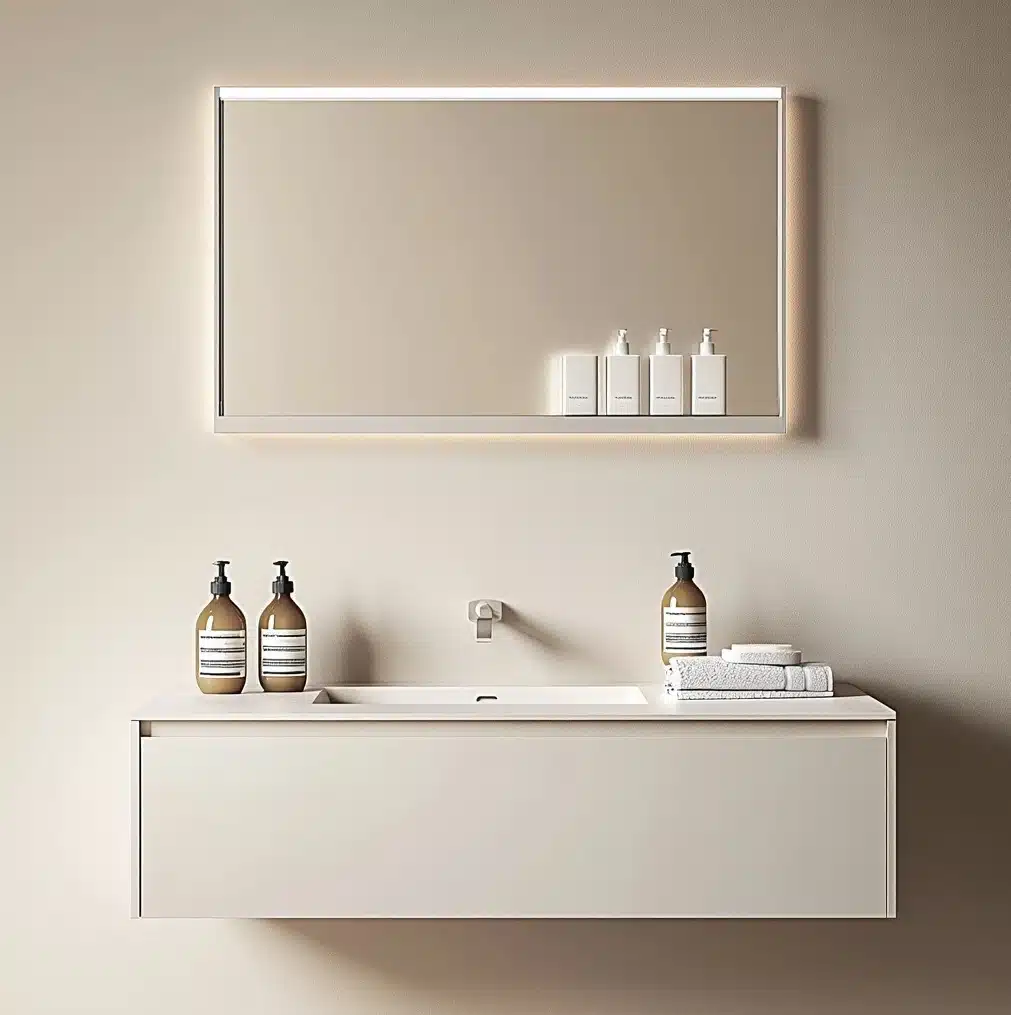
Every time a short-term rental (STR) checks in a new guest, the bathroom takes another round of abuse a family bathroom never sees: wet towels dropped on cabinet doors, luggage wheels scraping the toe kick, cleaning chemicals hitting the finish weekly. Property managers who furnish 15, 30, or 60 units cannot afford to learn which materials fail after the fact. This guide walks through the decisions behind Airbnb bathroom vanity furnishing for multi-unit operators: which materials survive guest turnover, how 24–60-inch widths fit small bathrooms, how the 15-set MOQ (Minimum Order Quantity) and mixed-container shipping work, and how to sequence samples, production, and reorders so units stay rentable.
Key Takeaways
- STR bathrooms face repeated moisture, impacts, and chemical cleaning across 15–60-unit portfolios — spec waterproof, scratch-resistant cabinets instead of decorative ones.
- Standard widths span 24–60 inches with depths of 18–24 inches, covering studio powder rooms through three-bedroom condos.
- PVC (polyvinyl chloride) cabinets are 100% waterproof, do not absorb water or warp, and wipe down in minutes between guests.
- The MOQ (Minimum Order Quantity) is 15 sets per model, color, and size, and mixed containers let small operators combine models in one shipment.
- Samples take 10 working days; production runs 20–30 days; total delivery to the US, Canada, or Mexico is 4–6 weeks.
- Every cabinet passes 5 QC (quality control) checks, carries a 2-year full-cabinet warranty, and the factory holds returns under 1%.
- Smart LED mirrors with adjustable brightness, color temperature, anti-fog heating, and touch control add guest-visible value to every unit.
In This Guide
- Why STR Furnishing Is Different from Home Renovation
- Sizing and Layout: Matching Vanities to Small Bathrooms
- Materials That Survive Guest Turnover
- Buying in Volume: MOQ, Mixed Containers, Reorder Cycles
- A Supplier Checklist for Property Managers
- Frequently Asked Questions
Why STR Furnishing Is Different from Home Renovation
A homeowner buys a vanity once, installs it, and lives with the result for a decade. An STR operator makes the same decision across a portfolio, then watches the product take a different kind of abuse: back-to-back bookings, wet luggage, cleaning crews, and the occasional door slammed at 2 a.m. The buying logic shifts from aesthetics-first to replacement-cost-first, because every failed cabinet means a maintenance call, a review ding, or a unit sitting offline. None of that shows up in a showroom photo, which is why STR furnishing needs its own set of rules before any model gets quoted.
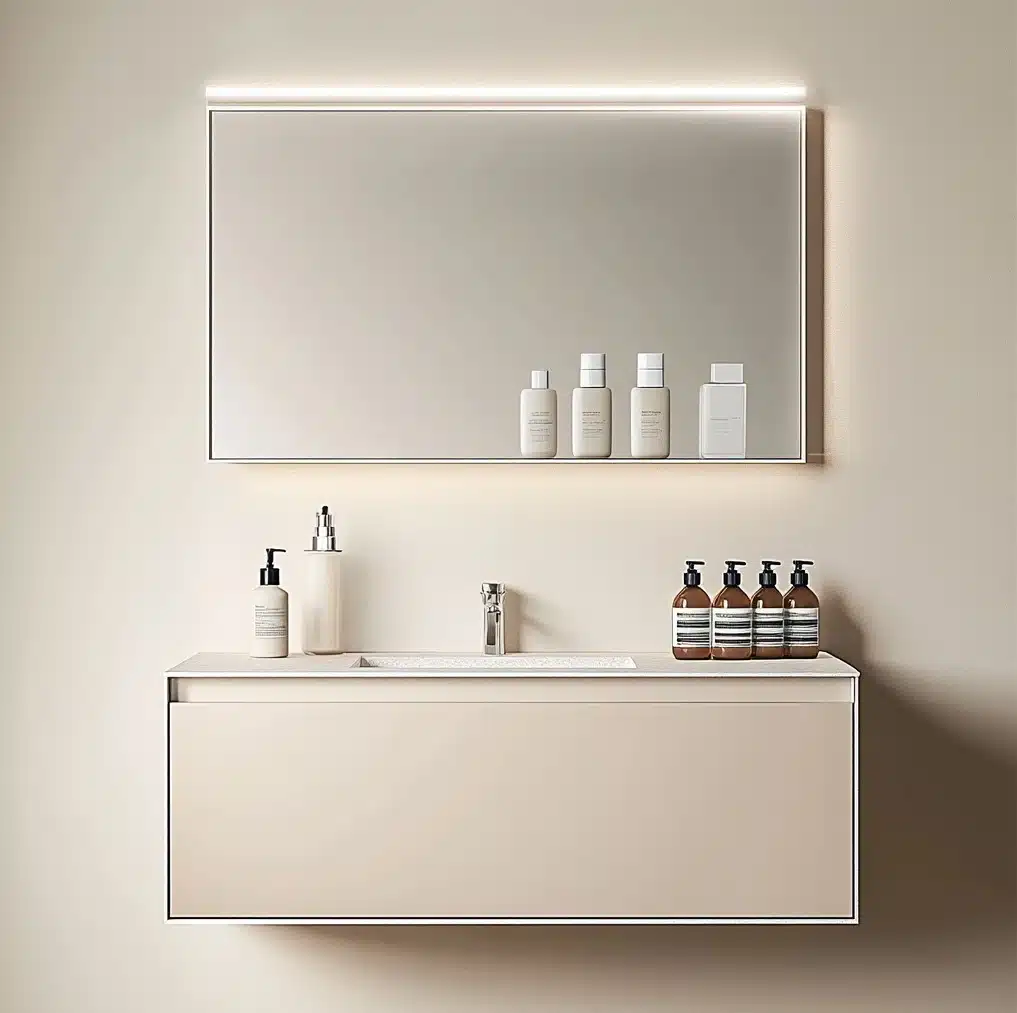
The failure list repeats itself across properties: water wicking into particleboard edges, chipped corners on cabinet doors, scratched countertops, and hinges that sag after a year of hard use. In a home, each failure is a weekend project. In a portfolio, it multiplies by the number of doors and lands on the operations calendar, where the costliest mistake is a cabinet specified for the wrong duty cycle. Operators who treat guest bathrooms as light-commercial spaces rather than upgraded rentals avoid most of that backlog before it starts.
STR buying sits between residential and hotel procurement. Hotels replace vanities on an FF&E cycle with contracted installers and a design team; homeowners buy once and forget. Property managers need hotel-grade durability with homeowner-scale decision speed — which is why the mistakes that keep recurring in the hotel and multifamily vanity sourcing guide are the same ones that show up in short-term rental fit-outs: the wrong material for the moisture load, hardware rated for dry conditions, and lead times treated as an afterthought.
| Buying factor | Home renovation | STR / Airbnb furnishing | Hotel project |
|---|---|---|---|
| Purchase cadence | Once, every 8–15 years | Initial fit-out plus rolling reorders every 12–24 months | FF&E cycles of 5–10 years |
| Durability bar | Decorative, moderate use | Waterproof body, scratch-resistant top, cycle-tested hardware | Institutional, commercial spec |
| Sizing | Custom to one bathroom | Standard widths 24–60 inches across many small rooms | Fixed spec sheets with contractor install |
| Order structure | Single unit from a retailer | MOQ 15 sets per model, color, size; mixed containers | Hundreds of units, containerized shipments |
| Service level | DIY install, local store | Sample-first ordering, 20–30-day production, 2-year cabinet warranty | Project-managed delivery and install |
Run the numbers the way operators do: a cabinet that survives its second year costs less than one replacement plus one refund plus one unoccupied weekend. That is why the rest of this article concentrates on three levers a property manager controls before the first unit ships — materials, sizing, and order structure. New hosts checking current expectations can read the Airbnb host platform, which publishes listing and quality guidance for each market, before defining the fit-out standard.
The bathroom also drives the perception of cleanliness harder than any other room. In listing photography, a warped door or a water-stained cabinet edge reads as neglect even when the unit is spotless, and that impression carries into reviews. That is why experienced operators set a refresh threshold — 18 to 24 months is a common planning interval for high-turnover units — and budget the vanity replacement as a line item, not an emergency. When the refresh arrives, the same 15-set order that refurnishes a block also resets the spare-parts pool, which keeps the replacement math predictable across the portfolio.
Sizing and Layout: Matching Vanities to Small Bathrooms
Bathrooms in short-term rentals tend to be compact — the 40-square-foot layouts common in condos, duplexes, and converted cabins. The factory standard range covers nearly all of them: widths of 24–60 inches with depths of 18–24 inches. A 24-inch cabinet suits a half bath; 30–36-inch single-bowl units handle most studio and one-bedroom plans; 42–48-inch cabinets fit two-bedroom condos; and 60-inch models with double bowls serve the master bath of a larger house. Keep the depth consistent, and width becomes the only variable left in the buying decision.
Two layout rules simplify multi-unit purchasing. First, standardize one depth across the portfolio so plumbing rough-ins, mirror mounting, and lighting placement stay identical from unit to unit. Second, treat width as the variable: the same 36-inch model installed in ten units creates one spare-parts pool and one installation template — worth more than the design variety it sacrifices. For the sub-30-inch configurations that recur in hospitality layouts, the compact vanity specs for boutique hotels page covers the narrow dimensions and wall-mount options worth considering.
| Vanity width | Typical STR property | Layout notes |
|---|---|---|
| 24 inches | Studio units, powder rooms | Single bowl, wall-mount or floor-mount; keep the toe kick low |
| 30–36 inches | One-bedroom units, compact condos | Most common STR spec; single bowl with counter storage |
| 42–48 inches | Two-bedroom condos, duplexes | Single or double bowl; more counter space for guest toiletries |
| 60 inches | Three-bedroom houses, cabins | Double bowl optional; confirm drain centers match rough-in |
Volume ordering changes the spares math too. A workable rule for a 15-unit block is one spare cabinet plus two spare doors and a set of soft-close hinges kept at a central location; with free samples in 10 working days and a 20–30-day production window, a stocked spare pool covers a failure without taking a unit offline for a month. Operators who have waited six weeks on a single custom door tend to adopt this rule quickly.
Visual consistency is an operational lever, not just branding. Ordering one model in one finish across all units means any spare cabinet matches any room. Operators who want differentiation can run the same series in two colors — the 1,000+ standard finishes include matte white, gloss black, and wood grains, and custom Pantone colors start at 15 sets per color. Either way, you keep one supply line instead of six. If floor plans vary, the factory builds 40,000+ custom combinations, so a 27-inch or 54-inch cabinet exists when a standard width leaves a gap; just remember each custom color or size carries its own 15-set minimum.
Sink and top selections follow the same logic. The sintered stone used for countertops is also available as an integrated basin with the same properties — hardness of 7–8 on the Mohs scale, heat resistance to 300°C, a non-porous stain-resistant surface, and antibacterial performance — which removes the seam where a glued-in sink most often fails. For wall-mount layouts, confirm the cabinet’s fixing points are rated for the wall type in each unit; plaster, tile, and drywall each need different anchors, and a retrofit anchor failure in a rental bathroom is a repair call you cannot schedule.
Materials That Survive Guest Turnover
Guest turnover exposes cabinetry to conditions that accelerate failure: steam after every shower, standing water on counters, harsh cleaners, and impact loading a homeowner’s routine never produces. The materials decision — not the style decision — determines whether a cabinet reaches year two. Look at the cabinet body first, then hardware, then the surfaces guests actually touch.
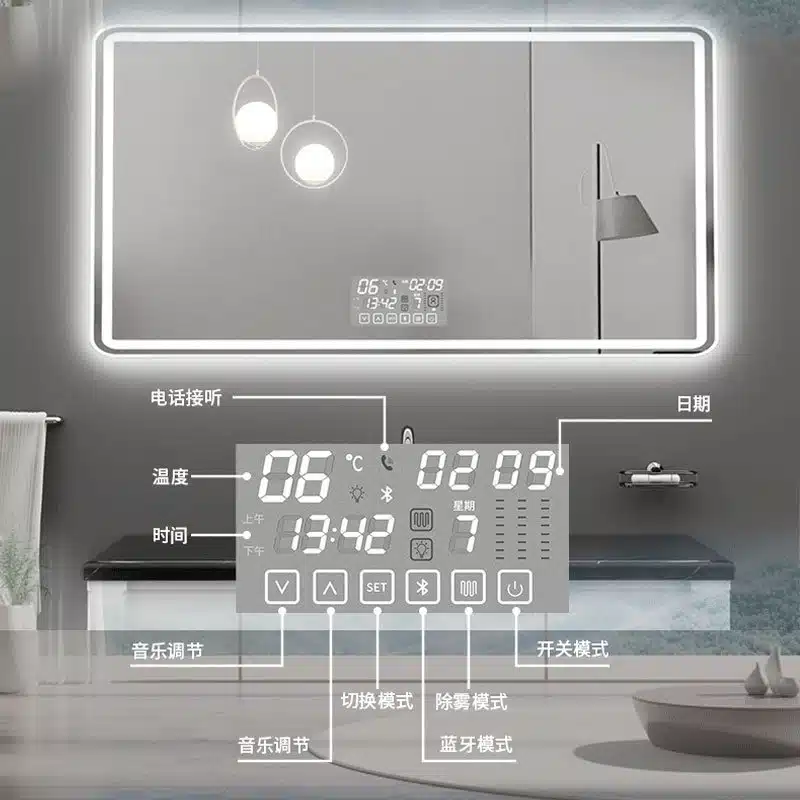
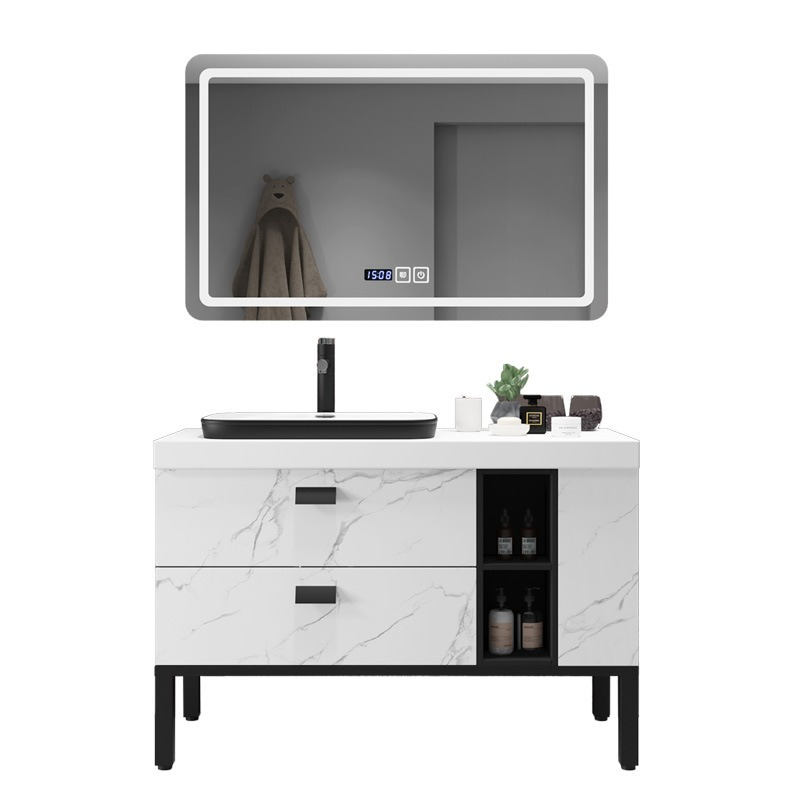
The smart LED mirror is the one upgrade guests notice within minutes of check-in. Adjustable brightness and color temperature answer the two most common bathroom complaints — harsh lighting and a mirror that fogs after a hot shower — because anti-fog heating is built in. Touch control, digital display, and optional Bluetooth or voice features are configurable rather than forced. At portfolio scale, smart mirror OEM integration means the mirror is produced to your spec and ships in the same container as the vanities. Airbnb’s hosting resources spell out the guest-experience standards that make an upgrade like this a defensible line item.
On the cabinet body, PVC (polyvinyl chloride) is the STR workhorse for a simple reason: it is 100% waterproof, does not absorb water, and will not warp in a humid bathroom. It resists scratches and wipes clean between guests, which matters when a cleaning crew has thirty minutes to reset a unit. Buyers who prefer wood grain can get the look in PVC foil finishes, or move up to plywood — standard, BWR (boil-water-resistant), or marine grade — when a client insists on real wood.
Countertops deserve the same scrutiny. Sintered stone tops rate 7–8 on the Mohs hardness scale, withstand heat to 300°C, and their non-porous surface shrugs off stains — relevant when a curling iron lands on the counter or makeup sits out overnight. The surface resists UV fading and is antibacterial, so the counter still reads clean in listing photos after two years of bookings.
Hardware carries half the durability story. The factory’s own cycle testing found that cabinet-door hinges rated for 100,000 cycles failed at 45,000 cycles under humid conditions — exactly the environment an STR bathroom lives in. That result is why soft-close hinges and drawers are standard here rather than an upsell, and why operators should ask any supplier for humidity-conditioned cycle data before signing.
Edge sealing is where waterproof claims live or die. Ask the supplier how the sink cutout and plumbing penetrations are sealed; an unsealed cutout turns a 100% waterproof body into a wicking sponge at exactly the point where water sits. The same logic applies to back panels and drawer bottoms — the surfaces guests never see but moisture always finds. Add a seam and edge inspection to the QC (quality control) checklist you send the factory, and request close-up photos of the cutouts on your sample before approving the run.
Finish chemistry matters in a closed unit with back-to-back bookings. Cabinets built to E1 emission limits (≤0.1ppm), CARB Phase 2, and TSCA Title VI keep formaldehyde levels low between guests, and the factory’s ISO 9001 and ISO 14001 certifications cover the quality and environmental systems behind the build. For an operator these are spec items to verify in writing, not marketing lines.
Vanities and Smart Mirrors Built for STR Turnover
Browse this product, solution, or service page to explore relevant offerings.
Buying in Volume: MOQ, Mixed Containers, Reorder Cycles
Volume ordering in a 15–60-unit portfolio follows one of two rhythms: an initial fit-out for new units, or a rolling renovation wave that replaces a block of vanities every year or two. Both start with samples, because the cost of a wrong finish multiplies by the number of doors. The factory provides free samples, and they ship within 10 working days, so the product is in your hands before any production commitment.
The MOQ (Minimum Order Quantity) is 15 sets per model, per color, and per size. Read that structure before counting units: two colors means two minimums of 15, and a custom size adds its own 15-set minimum on top. Mixed-container shipping is what makes this workable for small operators — you combine different models, colors, and sizes into one container and still land on each minimum. A 30-unit operator can take 15 of one model and 15 of another in a single order; a 60-unit operator can run four models. The 15-unit MOQ trial order guide walks through structuring that first order without over-committing.
Lead times matter because empty units do not generate revenue. Samples take 10 working days; bulk production runs 20–30 days; and total delivery to the US, Canada, or Mexico is 4–6 weeks from order confirmation. Terms are standard export terms: FOB (Free On Board) Qingdao, a 30% deposit to start production, and the balance due within a week of the draft BL (draft bill of lading). Work backward from the unit’s first bookable night and add a customs buffer.
On reorder cycles, treat the 20–30-day production window as a rolling constraint rather than a one-off event. Most operators renovate in waves — replacing the worst-condition units first — which keeps demand predictable and avoids a full-portfolio order landing in peak season. Monthly capacity of 5,000 sets means a 15–45-unit reorder slots in without stretching lead time, and the same mixed-container rule lets a later wave add a new model or color without waiting for a full container of a single item.
Quality terms belong in the purchase contract, not the wish list. Every cabinet passes 5 QC (quality control) checks before packing, third-party inspection by SGS or TÜV can be arranged with advance notice, and the full-cabinet warranty runs 2 years. The factory’s return rate is under 1% — the number to compare when suppliers quote different quality programs.
Packing and branding belong in the same conversation. White-label or private-label options, logo printing or laser engraving, and custom packaging let a management company present a uniform product across all its units, and the factory builds these into the order rather than treating them as afterthoughts. For a multi-property operator, that uniformity extends to service: one purchase order, one set of lead times, and one warranty to track instead of a dozen retail receipts.
A Supplier Checklist for Property Managers
Before signing a purchase order, run the same checklist against every supplier on your shortlist. The items below separate a container of usable cabinets from a maintenance backlog; most take one email to verify, and none require guessing.
- Cabinet body and edges: confirm 100% waterproof PVC construction, or specify the plywood grade (standard, BWR, or marine) and ask how joints and cutouts are sealed.
- Hardware: soft-close hinges and drawers rated for humid environments, backed by cycle-test data — ask whether the test ran under humidity, not a dry lab.
- Dimensions and rough-in: widths 24–60 inches, depths 18–24 inches, with drain centers that match existing plumbing so install does not become a replumb.
- Compliance documents: ISO 9001 and ISO 14001, plus E1 (≤0.1ppm), CARB Phase 2, and TSCA Title VI emission compliance; where a unit must be accessible, confirm the vanity is designed to meet ADA clearance requirements.
- QC and inspection: 5-point QC on every cabinet, and a third-party inspection option (SGS, TÜV) arranged before production starts.
- Commercial terms: free samples in 10 working days, 30% deposit with the balance after draft BL, FOB Qingdao, and 4–6 weeks total delivery to the US, Canada, or Mexico.
- Warranty and after-sales: 2-year full-cabinet warranty, a documented return rate below 1%, and a written process for replacement parts on later reorders.
Two extra checks pay for themselves. Ask whether the supplier has executed hotel LED mirror projects — hospitality mirror experience transfers directly to STR units where mirror failures become guest complaints. And look at the factory behind the quote: MFBATH has built PVC cabinetry since 2015, runs 95 employees in a 10,000-square-meter plant, and distributes through 1,000+ dealers across 20+ countries. The wholesale bathroom vanity sourcing guide lays out how to compare factory terms, inspection programs, and finish options across suppliers before committing a portfolio to one line.
When you send the RFQ, attach a unit count and a floor plan of the typical bathroom. Suppliers quote faster and more accurately when the request states quantities per model, color, and size — the three axes of the 15-set MOQ — plus the destination port and the target completion date. Include the checklist above as an appendix and ask for written answers; the supplier’s response quality is itself a data point about how they will handle your order.
Frequently Asked Questions
What is the MOQ for short-term rental vanity orders?
The MOQ (Minimum Order Quantity) is 15 sets per model, color, and size. Mixed-container shipping lets you combine multiple models, colors, or sizes in one container, so you hit the 15-set minimum for each selected model without filling a full container of a single item.
How long does a vanity order take to reach the US, Canada, or Mexico?
Samples ship in 10 working days. Bulk production takes 20–30 days, and total delivery to the US, Canada, or Mexico is 4–6 weeks from order confirmation, shipped FOB (Free On Board) Qingdao.
Can I get custom colors and compact sizes for small STR bathrooms?
Yes. Standard widths run 24–60 inches with depths of 18–24 inches, and the factory offers 1,000+ standard finishes. Custom Pantone colors start at 15 sets per color, which fits the standard MOQ structure.
The Bottom Line
Airbnb bathroom vanity furnishing comes down to three numbers: 15 sets as the MOQ, 10 working days for samples, and 4–6 weeks for delivery. Put a waterproof PVC body, humidity-tested soft-close hardware, and a smart LED mirror in front of those numbers, and the bathroom becomes a durable asset instead of a recurring work order. Order the free samples, run the supplier checklist, and structure the first batch around the 15-set minimum.




0 Comments