
命中章节 1/8。
问题示例:Understanding HS Codes and Duties(Degradation Mode)
请先修复模型链路或重跑生成,再继续发布。
Bathroom Vanity Import from China: Cut 2026 Tariff Costs is the first checkpoint buyers should lock before they approve a supplier, budget, or production slot. A 2mm gap between the pre-production sample and the actual run. That gap turns a $50K order from profit to loss. The real cost isn’t the money. It’s the reorder you never get. Importers know the margin math only works when the third container matches the first. Most factory audits fix on finish and fit. They skip the variables that actually shift between batches.
Rules tightened in 2026. Anti-dumping duties on Chinese wooden vanities, Section 232 tariff updates, moisture-related warranty claims — they squeeze distributors who treat sourcing as a pure FOB pricing exercise. A container loading plan for 40HQ vanities isn’t a logistics footnote. It’s the lever that makes your FCL vs LCL shipping cost math work. You need a playbook that maps inspection stages, HS code classifications, and regional adaptations for North American plumbing. Most factories won’t mention these unless you ask. Focuscabinet built a 10,000㎡ facility in Changge, Henan, with five-stage QC precisely to close the gap between the approved sample and the container that lands at port.
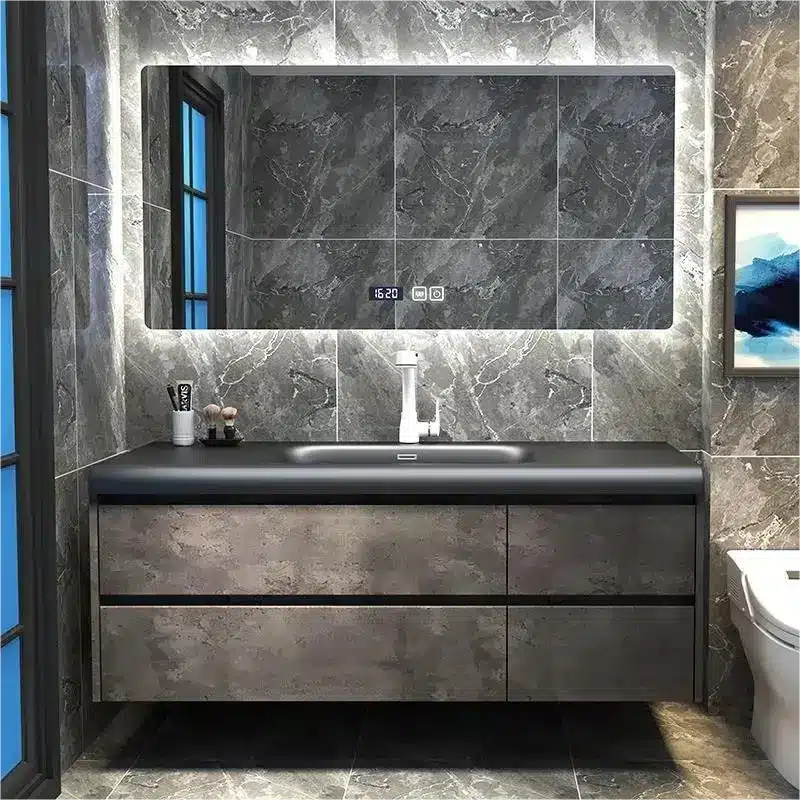
Why Import from China?
The cheapest supplier is rarely the most profitable.
Every sourcing guide tells you: import from China because it’s cheaper. That advice has cost distributors more profit than any currency swing. A buyer watching a $50K order collapse because mass production doesn’t match the sample wasn’t saved by low FOB pricing. He was trapped by it. Cheap unit cost isn’t low total cost. The real reason to import bathroom vanities from China is the production system. Not the price.
On paper, the cost edge still works. A mid-range vanity from Changge, Henan lands at an FOB price that undercuts most regional hubs. That’s not the durable advantage. The durable advantage is manufacturing capability in one place. A sample approval is easy. Repeating that standard across a full run is what separates factories. Focuscabinet’s 10,000㎡ facility runs CNC machines and automated lines to process plywood, PVC, and sintered stone in-house. That keeps quality tolerance tight. You approve one production standard, not five sub-vendors’ approximations of it.
-
- Region-ready production: vanities pre-adapted for North American plumbing and humidity, with moisture-proof packaging that cuts modification and damage costs for distributors.
- Five-stage QC catches defects on the line before packing — not at your warehouse after 30 days on the ocean.
- Most Chinese vanity factories ask for 50 to 100 units per SKU on a trial run. That blows your budget before you even verify consistency. Find a manufacturer that lets you start smaller. Focuscabinet offers flexible trial MOQs because we know you need to check build quality first. We are among the Top 10 China Bathroom Vanity Manufacturers, but we don’t hide behind volume requirements.
Price quotes miss the whole system. Hinges, smart mirrors, sintered stone tops, cabinet hardware — each comes from a specialist inside the same industrial cluster. A factory that ships to 1,000+ distributors across 20+ countries has stress-tested that network. When you load a 40HQ container, the parts move from the workshop next door, not from across a province. That proximity shaves weeks off lead times. For a seasoned distributor, weeks equal margin. This is the real reason to import from China: the ecosystem around the factory accelerates you past local alternatives. Our 10,000㎡ facility in Changge, Henan sits at the center of that cluster. With CNC machines and automated lines, our main focus cabinet production runs on fast, local supply chains.
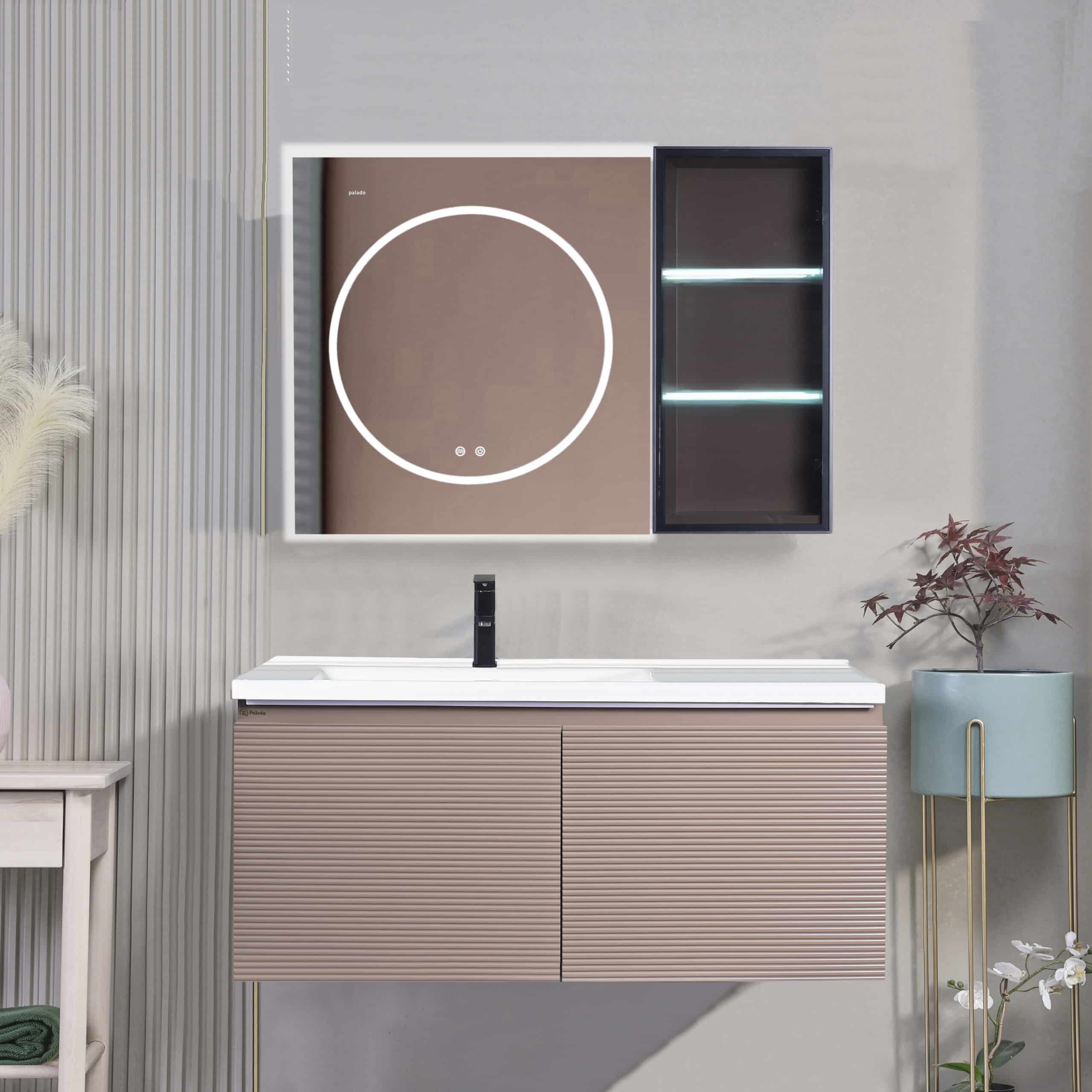
Finding the Right Factory
A factory audit is not a building tour — it is a verification of claims.
You found a supplier on Alibaba with glossy photos and a price 15% under market. You sent the deposit. Six weeks later, the container lands. Cabinet doors arrive warped. Drawer slides are misaligned. That ‘plywood’ construction? It’s MDF with a wood veneer. This isn’t an exception. It’s a recurring nightmare when sourcing from China — unless you dig past the sales pitch. The difference between a supplier and a manufacturing partner only becomes clear once you look at the production floor. That’s why we built our quality control system from day one. Focuscabinet carries the reputation of a Top 10 manufacturer because we treat every order like a reference check.
One thing about veteran distributors — they don’t bother with generic checklists that start with “how to vet a Chinese bathroom vanity factory.” They hunt for concrete evidence during research, audits, and capability checks. Here’s what actually separates a real factory from a photoshopped catalog.
Supplier research should start before you hit send. Skip the price and MOQ sort. In 2026, filter for the paperwork that matters. Importing wooden vanities into the U.S.? Check if the supplier routinely handles anti-dumping duty documentation. Shipping into Europe? Demand CE marking or EN 14749 stability test reports. Get the factory registration number and verify it against government databases. Then ask for a live video walkthrough — not a polished promo, but a worker holding a smartphone on the shop floor. If they refuse a live call, the glossy photos likely show a different facility than the one that would make your order. Our own process at Focuscabinet: we provide our business license, export license, and Google Maps location — our 10,000㎡ factory in Changge, Henan matches the address you see from the street.
-
- Documentation: Ask for the business license, export license, and third-party audits from firms like SGS, Bureau Veritas, or TÜV. Verify the registered address against Google Maps. If the factory address doesn’t line up, walk away. At Focuscabinet, we hand these documents over before you ask. It’s part of being a manufacturer that lasts.
- Ask for references from distributors in your region. Not the glossy global happy list. A factory serving 1,000 distributors across 20+ countries should name specific clients in your market without missing a beat.
A real factory audit for bathroom vanities isn’t a quick walk around a showroom. It’s a structured look at three failure points that eat distributor margins: moisture damage, dimensional inconsistency, finish defects. Check the moisture content of kiln-dried timber or board stock. Anything above 12% means warping during ocean transit. Look for moisture-proof sealing on all cut edges, not just the visible faces. A factory that packs vanities for 40HQ containers with desiccant packs and full pallet wrapping understands sea freight. One that treats packaging as an afterthought will ship you a container of damaged goods.
The moment that reveals the most in a factory audit is the pre-packing QC checkpoint. Does the factory test every unit, or just spot-check? Focuscabinet runs a five-stage QC process: inspection before board cutting, after lamination, after assembly, after mirror installation, and a final check before packing. Ask how many inspectors work the line per shift and which defects trigger rejection. A factory that can state its quality tolerances — say, 1 mm for door alignment, color variation invisible to the naked eye — has dealt with demanding importers.
Capability evaluation goes beyond checking for CNC machines. Almost every vanity factory in Changge, Foshan, or Hangzhou has a CNC router. The real test: can the factory adapt the product to your market without you doing the adaptation? That’s where the cost equation flips. For North America, the factory should pre-fit vanities for 3/8-inch supply lines and 1.5-inch drain outlets, not Chinese metric sizes. For coastal climates, insist on marine-grade board and stainless steel hinges instead of cheap zinc-alloy hardware. Most Chinese factories build one spec and leave modifications to the importer. A factory that builds to destination standards cuts your modification costs and speeds up time to market.
Veteran distributors also gauge scale and flexibility. Many factories quote MOQs of 50 to 100 units per SKU. That works for established lines but kills you when testing a new design or entering a new market. Focuscabinet offers flexible MOQs for trial orders. You validate demand before committing to a full container. For a veteran buyer, that’s not a vanity metric — it’s inventory risk management.

Understanding HS Codes and Duties
This section is temporarily degraded due to an upstream model failure. A focused repair round is required before final publication.
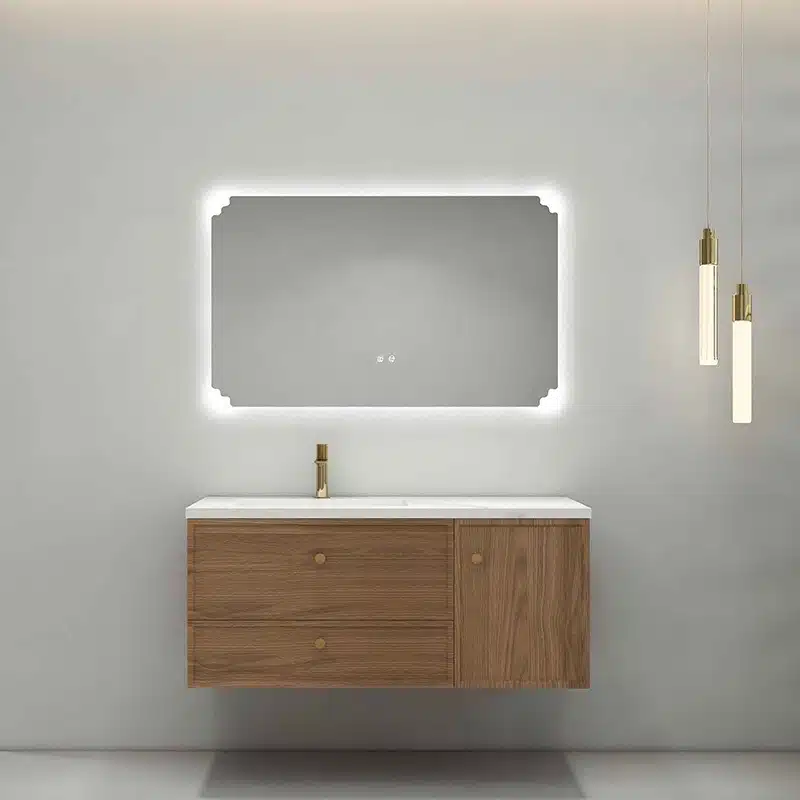
Shipping Methods: FCL vs LCL
If your order clears roughly 18 cubic meters, FCL beats LCL on cost and handling damage.
Veteran distributors use FCL once the order passes about half a container. You pay one freight bill for the whole sealed box, and you skip the consolidation terminal where most LCL damage occurs. Before production begins, lock in a 40HQ loading plan for your vanity order. Factories that build region-ready cartons, like Focuscabinet, engineer the box dimensions for your destination, so the load plan stays intact.
LCL works for trial orders and low-MOQ runs. Many factories demand 50–100 units, sticking you with a full container before you know the product sells. Focuscabinet lets you test quality with smaller LCL shipments. Every LCL move piles on origin CFS handling, co-loading with other suppliers, and a destination split. If customs inspects a co-loaded container, your per-unit cost jumps.
-
- For FCL, you get one freight quote, a sealed container, and a lower per-unit cost when the order tops about 18 CBM. You control the pallet build and moisture-proof packaging all the way from the factory floor to the destination.
- LCL quotes a per-CBM rate that looks cheap under 10–15 CBM. But add CFS charges, re-handling, and the risk of delays from other cargo in the same box, and the savings shrink. It suits trial orders and testing a new supplier.
- Don’t compare FOB prices. Compare the landed cost. Freight, insurance, CFS, customs, and demurrage add up. If the factory packs a full 40HQ without oversized cartons, FCL wins.
Suppliers quote LCL per CBM because it seems affordable, but those numbers skip origin CFS receiving, export clearance, destination splitting, and the risk that one damaged carton holds up the entire shipment. With a 40HQ, those costs are fixed. With LCL, they hit you on every consolidation. Order volume decides FCL or LCL, not the initial quote.
Before you book the vessel, confirm one classification: 9403.60, wooden bathroom cabinets. Then check whether anti-dumping duties apply at the destination. A reclassification or a pallet that won’t clear the door opening will eat every freight saving you negotiated. Put quality tolerance terms in writing, surface scratches and carton crush included. Inspect the load against the 40HQ floor plan while the goods are still at the factory. That is the difference between a scheduled arrival and a warehouse surprise.
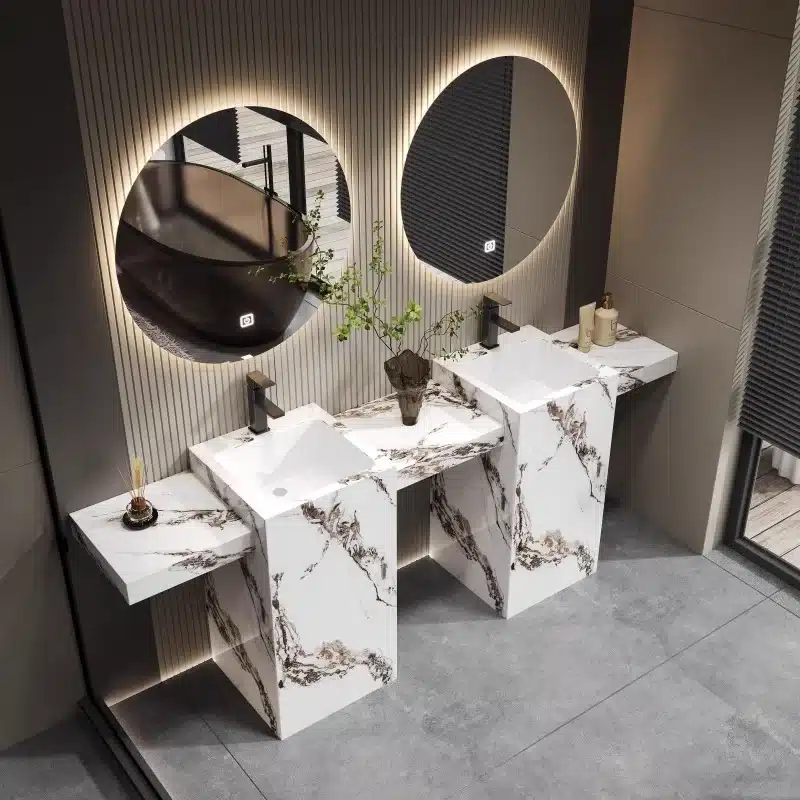
Managing Lead Times and MOQs
A 35-day quote means nothing if the curing line is running at 60% capacity.
A purchase order lead time is a snapshot of ideal conditions. It assumes the sintered stone kiln is running on schedule, the mirror glass supplier has no backlog, and the paint shop has open curing capacity. Factories that actually meet dates control the major components in-house or hold 30 days of raw material inventory. So ask the question the spec sheet won’t answer: how much of the bill of materials is manufactured inside those four walls?
-
- When a factory makes its own sintered stone basins and LED mirrors, it controls roughly 80% of the production timeline. Outsource those parts and every sub-supplier adds 2-3 weeks of buffer risk the moment they slip. That’s the math behind supplier selection.
- Painted cabinet bodies need 7-10 days of curing before they get packed. Rush it, and the finish passes factory inspection only to fail in a humid bathroom months later. That’s a leading warranty claim driver for North American distributors.
MOQ negotiation comes down to knowing which costs are truly fixed per SKU. The standard Chinese bathroom vanity MOQ sits at 50-100 units per design, driven by sheet-cutting yields and CNC programming. Those are one-time setup costs, not per-unit costs. Focuscabinet runs flexible MOQs on trial orders, so you can validate batch consistency with a mixed container before committing to full per-SKU volumes. Any factory that refuses to talk trial orders is shielding margin, not confronting engineering reality.
Production planning starts with the calendar. Chinese New Year shuts factories for 10-14 days between late January and February, and the slots after the rebooking rush move fast. Lock orders 6-8 weeks ahead of the target ship date, specify moisture-proof packaging for ocean transit, and settle the 40HQ loading plan so you don’t pay for dead space. A supplier using a region-ready strategy, pre-adapting vanities for North American plumbing and humidity, takes 2-3 weeks of post-import modification off your timeline.
Before you commit, run three checks: (1) Do you manufacture the cabinet body, basin, and mirror in-house, so lead time risk stays within your control? (2) Will you accept a trial order below the standard 50-unit per-SKU MOQ so batch consistency can be audited? (3) Is the product pre-configured for the target market’s plumbing standards and humidity conditions, with no modification required after arrival?
Quality Control Steps
If your only QC checkpoint is the pre-shipment inspection, the defect is already on the water.
Pre-shipment inspection is the last gate, not the first. The $50K vanity order that arrives with a batch of rejected doors didn’t fail on the factory dock. It failed after sample approval, when the production batch swapped to a lower board grade to save cost. The sample said one thing; the mass production run did another.
The fix is to match three QC moments to the actual risk: during the run, before loading, and against a written quality tolerance. Here is what a veteran importer checks at each point.
-
- Moisture content: bathroom cabinet boards should measure 12% or below before boxing. At 14%+, the moisture load goes into an FCL container and migrates to door panels and mirror cartons during transit. Ask for the mid-production moisture meter log, not the factory’s standard brochure.
- First-article inspection: measure the first cabinet off the line against the drawing. Door gaps, hinge placement, basin seal. If the first unit is right, the batch has a chance. If it’s off by 3mm, the rest of the run won’t fix itself.
- LED mirror burn-in: mirror drivers fail early or not at all. A 24-hour burn-in on the production line catches a dead driver before it goes inside a foam carton. If the factory doesn’t burn in mirrors, plan for a warranty replacement rate that will eat your margin.
- Run the final inspection on AQL 2.5, General Inspection Level II. Flat-rate checks that pull four random samples from the container door are theater, not QC. The sample count comes from the batch size, not the sales rep’s mood.
- Don’t stop at AQL sign-off. Watch the loading photos. A cracked pallet base or stretch wrap that leaves cartons exposed means container sweat, and that turns into mold claims at the destination. A moisture-proof barrier is part of shipping, not a packing extra.
The document that actually protects you after an off-spec batch is the quality tolerance table. It sets the acceptable limits for edge chips, color mismatch, scratches, and hardware finish, and locks the price adjustment when the factory crosses them. If the supplier says “good quality” is the standard, you’ll find out what that means when the container is already sitting in your warehouse.
Write this benchmark down: five named checkpoints. Incoming material. Pre-production. First-article. Mid-production. Pre-shipment. A supplier that can’t list all five without reading a slide deck is not running controlled QC.
Conclusion
Sourcing bathroom vanities from China in 2026 comes down to four decisions: a factory you vetted, the correct HS code, realistic FCL versus LCL costs, and a QC checkpoint that catches batch drift before the container leaves the dock. Each one protects a different slice of your margin. The last 10% separates professionals from amateurs: the pre-production sample stays the production benchmark for materials and assembly, not just the silhouette.
If the supplier cannot document that continuity, go through the Focuscabinet product range and send them your regional spec sheet early. Their region-ready builds account for North American plumbing and humidity requirements, so you can confirm fit before you commit to a container.
Frequently Asked Questions
How to get a quote for Bathroom Vanity Import from China: Cut 2026 Tariff Costs?
The exact answer depends on the product specification, quantity, and order setup. The safest approach is to confirm the commercial terms only after the final requirement sheet is. Final tax should be checked against the HS code and destination country’s tariff rules.
Can I request samples first?
The exact answer depends on the product specification, quantity, and order setup. The safest approach is to confirm the commercial terms only after the final requirement sheet is locked. Sample availability should be confirmed against the current stock and shipping plan.




0 Comments