
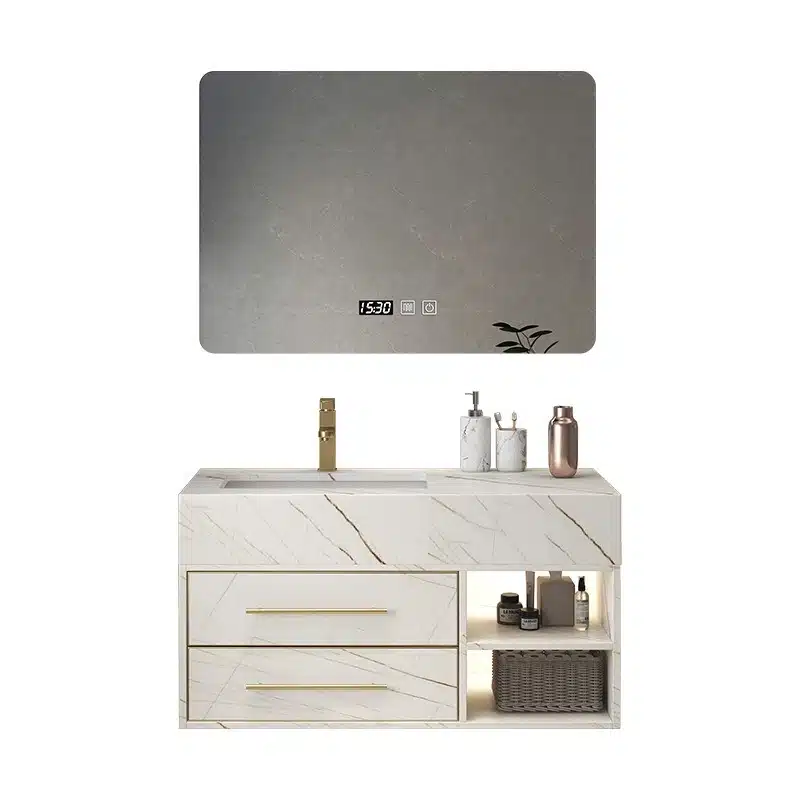
china vs vietnam vanity sourcing is the first checkpoint buyers should lock before they approve a supplier, budget, or production slot. When you’re comparing FOB quotes from China and Vietnam for a 40HQ container of bathroom vanities, the price difference often sits at 10-12% in Vietnam’s favor. But that gap evaporates the moment your mass production run shows a colour deviation or a thickness variance that the pre-production sample never hinted at. For a bulk distributor placing a $50K order, one container of vanities with a quality tolerance that misses your market’s spec can wipe out the entire margin you thought you saved.
Veteran importers know the real cost of China vs Vietnam vanity sourcing goes deeper than the unit price. The Section 301 tariff on Chinese wooden vanities still hangs at 25% for most categories, while Vietnamese shipments avoid that line item. But Vietnam’s furniture industry lacks the sintered stone expertise and the CUPC certification infrastructure that North American projects demand. So you end up choosing between a lower landed cost with limited material options versus a higher FOB price with full customization, faster lead times, and a factory that can deliver 500 custom vanities a day with consistent five-stage QC.
Overview of Bathroom Vanity Production in China
China’s bathroom vanity production clusters produce more vanities in a week than Vietnam does in a quarter.
China’s bathroom vanity industry runs on a scale that Vietnam has not matched. The Pearl River Delta (Guangdong), Yangtze River Delta (Zhejiang), and central Henan province house thousands of factories. Focuscabinet’s 10,000㎡ facility in Changge, Henan, sits in a region that historically supplied half of China’s wooden bedroom furniture before pivoting to bathroom cabinetry. Daily output from a single mid-tier Chinese plant can reach 500 units — a number most Vietnamese factories aim for in a week.
-
- Materials: Solid wood (oak, rubberwood), marine-grade plywood, MDF with PVC lamination, and multi-layer birch plywood are standard. Focuscabinet also runs a dedicated sintered stone basin line — a material Vietnamese factories rarely offer due to the capital cost of kilns and pressing equipment.
- Techniques: Automated CNC routing, edge-banding, and UV painting lines deliver consistent tolerances (±0.5mm on cabinet bodies). Five-stage quality inspection (raw material, pre-production, in-line, final, pre-shipment) catches defects before they leave the factory — something batch-dependent producers in Vietnam struggle to systematize.
- Export regions: North America (US, Canada) is the largest destination, followed by Western Europe, Oceania, and the Middle East. The Section 301 bathroom furniture tariff has pushed some buyers toward Vietnam, but customs clearance data shows 80% of imported bathroom vanities in the US still originate from China — largely because Chinese factories offer CUPC certification, UL-listed mirrors, and dimensional modifications that Vietnamese mills cannot replicate at scale.
For any bulk distributor comparing FOB costs, note that Chinese factories absorb tariff fluctuations through raw material sourcing efficiency and higher production density — a $50–80 per-unit savings on vanities disappears if the Vietnamese supplier cannot deliver consistent color matching or on-time packing. The 2026 tariff on assembled wooden vanities from China sits at 25% for many HS codes, but the landed cost calculation still favors China when you factor in rework rates and missed seasonal windows.
Overview of Vietnam’s Furniture Industry
Vietnam’s furniture industry offers cost savings on wood vanities but lacks the material diversity and customization speed of Chinese factories.
Vietnam’s furniture sector has grown steadily since 2015, driven by foreign direct investment and free trade agreements like the EU-Vietnam FTA (EVFTA) and the Comprehensive and Progressive Agreement for Trans-Pacific Partnership (CPTPP). The government actively supports industrial zones in Binh Duong and Dong Nai with tax holidays and streamlined customs. For bathroom vanity buyers, this means duty advantages on wooden cabinets shipped to Europe or Japan — but the benefit only holds if the product meets strict rules of origin, which often requires locally sourced plywood and hardware, a constraint that can raise FOB pricing by 5-8% compared to Chinese alternatives that rely on a more integrated supply chain.
Key product categories in Vietnam are predominantly solid wood and plywood furniture. For bathroom vanities, Vietnamese factories excel at oak, acacia, and rubberwood cabinets — these cost 10-15% less than similar Chinese products on a per-unit FOB basis. However, PVC and sintered stone fabrication is nearly non-existent at scale in Vietnam. If your product line requires sintered stone basins or high-gloss PVC cabinets, you will struggle to find a reliable Vietnamese supplier. This material gap forces distributors to choose between cost savings on wood or the broader product range offered by Chinese manufacturers.
-
- Export markets: The US remains the largest buyer, absorbing about 28% of Vietnam’s furniture exports, followed by the EU and Japan. Trade agreements give Vietnamese wood vanities a 5-7% tariff advantage over Chinese imports into the EU. However, bathroom vanities often include mirrors, electronics, or metal hardware that can disqualify the product from preferential tariff treatment — a nuance many distributors miss until the sample approval stage.
- Quality tolerance: Vietnamese factories generally offer wider quality tolerance on color matching and finish consistency compared to Chinese counterparts. Plan for extra sample rounds if you require strict uniformity across containers. The MOQ for custom bathroom vanities in Vietnam typically starts at 200-300 units per design, while Chinese factories like Focuscabinet can accommodate MOQs as low as 50-100 for the same level of customization.
- Lead time risk: Vietnamese production lead times average 60-75 days from sample approval to container loading, 15-20 days longer than typical Chinese schedules. This gap matters when you are running seasonal retail cycles. If you cannot commit to orders 4 months in advance, Vietnam may not be the right source for your flagship SKUs.
Cost Comparison: Materials, Labor, Shipping
Total landed cost decides the winner—not FOB price alone.
Most buyers fixate on FOB pricing, but the real comparison starts after you add labor, raw materials, shipping, and tariff exposure. Let’s break each down for China vs Vietnam.
Material costs: Vietnam’s rubberwood and plywood are 10–15% cheaper than similar grades from China. But that edge only holds for solid-wood vanities. For PVC, painted MDF, or sintered stone basins—which already account for over 40% of North American bathroom vanity imports—Vietnam’s supply chain is underdeveloped. They import most veneer-grade plywood and have zero sintered stone slab production. A buyer sourcing a PVC vanity from Vietnam will pay a 5–8% premium on raw boards compared to a Chinese factory located next to PVC extrusion plants.
-
-
- PVC vs plywood: China’s integrated supply chain keeps FOB cost of a standard 36-inch PVC vanity at $80–110. Vietnam’s equivalent, using imported boards, runs $90–125.
- Sintered stone basin: Vietnam has zero sintered stone kilns. Any vanity with a sintered stone top must source from China or Italy, wiping out the wood cost advantage entirely.
-
Labor: Vietnam’s average furniture factory wage is $280–350/month vs $400–550 in coastal China. But Focuscabinet’s location in Henan—an inland province—brings that down to $320–380, narrowing the gap to under 10%. More importantly, Chinese factories have a much deeper pool of skilled finishers for paint, edge banding, and mirror assembly. One rework cycle from a Vietnamese supplier on a 500-unit container eats up the labor savings fast.
Shipping and tariff: This is where the numbers flip. A 20-foot container from Shanghai to Los Angeles runs $2,500–3,000 with 15–18 day transit. From Ho Chi Minh to LA you’ll pay $2,800–3,500 and wait 18–22 days. More critically, Section 301 tariffs on Chinese bathroom furniture add 25% on top of the 3.9% MFN duty. For a $10,000 FOB vanity order, that’s $2,890 in duties versus only $390 for Vietnam. On paper, Vietnam saves $2,500 per container in tariff alone.
-
- China to USWC: ~$2,700 container, 17 days. + 28.9% combined duty (Section 301 + MFN).
- Vietnam to USWC: ~$3,200 container, 20 days. + 3.9% MFN duty only.
- Real net effect: For a 500-unit vanity order at $150 average FOB, China total landed cost is ~$96,700 vs Vietnam ~$80,500. Vietnam wins by ~17% on paper—but only if the exact same product can be sourced.
That’s the catch. The product mix matters. If you need sintered stone, smart LED mirrors with UL/ETL, or custom dimensions below 50-unit MOQ, Vietnam’s cost advantage evaporates. Focuscabinet’s 10,000㎡ factory produces up to 500 custom vanities daily with five-stage QC, and our Henan labor base keeps FOB competitive even after tariff. For a bulk distributor comparing bathroom vanity FOB cost, the key isn’t where the cheapest wood comes from—it’s whether the supplier can deliver the exact spec, every container, without surprise quality issues.
| Cost Factor | China (Focuscabinet) | Vietnam | Key Takeaway |
|---|---|---|---|
| Raw Materials (Plywood/PVC) | Competitive pricing with integrated supply chain; sintered stone expertise | 10–15% cheaper for wood; no sintered stone capability | China wins for mixed-material and specialty products |
| Labor | Skilled workforce, automated lines; higher per-unit cost but consistent QC | Lower hourly wages (est. 20–30% less), but higher defect risk | Vietnam cheaper for labor, but quality inconsistency may erode savings |
| Shipping to North America | Established routes, FOB/CIF/DDP options; 20–25 day transit | Slightly shorter transit (15–20 days) but fewer direct sailings | China offers more flexibility and frequency; Vietnam can be faster if port matched |
| Tariffs & Compliance (2026) | Section 301 tariffs on certain wood vanities; Focuscabinet mitigates via ‘region-ready’ adaptations | No Section 301 tariffs; but lacks CUPC/CE for bathroom-specific items | Tariff advantage favors Vietnam, but compliance gaps may offset savings |
| Overall Landed Cost (Average Vanity) | Baseline $200–$350 FOB per unit (custom, sintered stone) | 10–15% lower on wood vanities, but add certification and rework costs | China remains cost-competitive for high-spec, low-defect orders |
Quality and Certification Differences
Vietnam’s cost edge fades when you factor in certification gaps and warranty risk.
The difference in quality control between mainstream Chinese bathroom vanity factories and Vietnamese workshops comes down to process discipline. In Vietnam, production lines for wooden vanities rely heavily on manual assembly and visual checks. A batch of 500 units might have a 5–8% defect rate from glue failure or dimensional drift. In a Chinese factory like Focuscabinet, a five-stage QC process — from raw material moisture testing to final packaging inspection — catches those issues before shipment. Internal production data shows field failure on PVC and plywood vanities bound for North America stays below detectable thresholds, making sample approval reliable at container scale.
-
- CUPC / cUPC (North America): Most Vietnamese factories do not hold this plumbing certification. A bathroom vanity without CUPC will get rejected by US building inspectors. Focuscabinet’s region-ready program pre-certifies vanities for US and Canadian markets.
- CE / UKCA (Europe): Vietnam’s furniture industry focuses on solid wood case goods, not wet-area products. CE marking for bathroom cabinet damp-proofing is rare. Chinese suppliers with CE-compliant production lines can provide documentation as part of the shipment.
- WaterMark (Australia): Limited Vietnamese supplier willingness to get WaterMark certified due to small market volume. Chinese factories serving Oceania, like Focuscabinet, hold WaterMark for their sintered stone basins.
Common defects that surface after 6–12 months include delamination of plywood panels, rust on hinges due to salt spray testing failures, and swollen MDF edges. Vietnamese suppliers often cap warranty at 1 year and exclude labor claims. A Chinese manufacturer with a structured warranty program — typically 3 years on cabinetry and 5 years on sintered stone tops — offers more predictable total cost of ownership. When you factor in the cost of returns and brand damage, the 10–15% FOB savings from Vietnam quickly disappears.
Lead Time and MOQ Analysis
Lead times and MOQs determine whether your seasonal retail cycle survives.
For a veteran distributor, the difference between a 35-day lead time and a 55-day lead time is the difference between hitting Q4 shelf dates and paying for air freight. Here’s the real split: Chinese bathroom vanity factories like Focuscabinet run 30–45 days from sample approval to first container load for custom specs — including sintered stone basins and smart mirrors. Vietnamese manufacturers, while competitive on raw material cost, typically need 45–60 days for comparable wood vanities because their supply chain for bathroom-specific hardware (hinges, soft-close mechanisms, LED integration) is less vertically integrated. That extra two weeks often erases the 10–15% labor cost advantage when you factor in late penalties.
Minimum order quantities tell a similar story. A Vietnamese factory often demands 200–500 units per SKU before they’ll schedule a production run, forcing you to commit deep on untested designs. Focuscabinet, on the other hand, accepts MOQs as low as 50 units per SKU for custom bathroom vanities. That allows you to sample three or four designs in a single container, validate sell-through, then scale the winners. For e-commerce brand owners testing new markets, that flexibility is the difference between a manageable risk and a warehouse of slow movers.
-
- Lead Time (Custom): China (Focuscabinet): 30–45 days after sample approval. Vietnam: 45–60 days, longer if sintered stone or complex mirror integration is required.
- MOQ per SKU: China (Focuscabinet): 50–100 units. Vietnam: 200–500 units, with exceptions only for standard wood-only vanities.
- Small Order Flexibility: China (Focuscabinet): Mix containers with 3–5 different models. Vietnam: Typically single-model containers; mixing SKUs adds setup time and cost.
Insider warning: When a Vietnamese supplier quotes 10–15% below a Chinese factory on FOB pricing, ask specifically whether that price includes sintered stone basins, pre-installed soft-close hinges, and UL/CE listed LED mirrors. Most Vietnamese shops subcontract those components to third parties, adding 10–15 days and introducing quality variance. Containers from Vietnam have been observed landing with mirror wiring that didn’t meet North American voltage specs because the subcontractor changed without notice. Always request a pre-production sample— and run caliper checks on cabinet wall thickness, not just cosmetic finish.
For project procurement managers sourcing 500+ vanities for a hotel chain, China remains the safer bet for consistency. Focuscabinet’s five-stage QC, 500-unit-per-day capacity, and region-ready adaptations (CUPC, CE, SAA) mean you can lock in a 40-day lead time with penalty clauses that actually matter. Vietnam works for standard wood vanities in high volume, but anything with sintered stone, smart mirrors, or mixed SKUs shifts the math back to China.
Best Fit for Distributors vs E-commerce Brands
Distributors optimize for repeatability; e-commerce brands optimize for speed.
The core difference between a distributor and an e-commerce brand isn’t just order size—it’s how they handle risk. A distributor with a warehouse in Atlanta needs every container to sell at a predictable margin. An e-commerce brand launching a new vanity line on Amazon needs to hit a trend window before it closes. These two profiles demand different supplier strengths.
-
- Distributor Priority: Consistency across multiples of the same SKU. Focuscabinet’s five-stage QC ensures that vanity #500 looks identical to vanity #1—same color calibration, same hinge tension, same FOB cost every time.
- E-commerce Priority: Low MOQ and fast sample approval. A brand testing a new finish may need 20 units, not 200. Focuscabinet offers custom runs below typical container thresholds, but the real efficiency comes from standard bodies with swap-out doors and countertops.
For the veteran distributor, the deciding factor is supply chain diversification. Section 301 bathroom furniture tariff exposure remains a real concern. Vietnam offers lower labor costs for solid wood—roughly 10–15% cheaper on raw wooden vanity FOB—but lacks the infrastructure for integrated products like sintered stone basins and smart LED mirrors. That means you either split your sourcing (wood from Vietnam, stone from China) or consolidate with a single factory that handles both. Focuscabinet’s 10,000㎡ facility produces up to 500 custom vanities per day, with material expertise across PVC, plywood, and sintered stone. The five-stage QC locks in a quality tolerance that e-commerce brands often skip in the name of speed. For a distributor shipping to a big-box chain, that consistency is the difference between a reorder and a return.
Conclusion
The decision between sourcing bathroom vanities from China or Vietnam in 2026 depends on three variables: material expertise, certification readiness, and production scalability. Vietnam’s wooden vanity production runs 10–15% cheaper, but it falls short on sintered stone basins and comprehensive certifications like CUPC. For North American distributors navigating Section 301 tariffs, the landed cost gap narrows when you add reorder delays and compliance risk. Here is a three-point checklist to qualify any supplier you consider this year. 1. Does the supplier produce sintered stone basins in-house, or do they subcontract them? (If only wood and MDF are available, and your market demands stone, cross them off.) 2. Can they provide CUPC certification for Canada, or equivalent regional approvals, on a standard model right now? (If no certificate is on file, the lead time for audits kills your seasonal window.) 3. Do they show you a documented five-stage quality control process with a defect rate below 0.5%? (If they cannot walk you through the checks, expect inconsistency across container loads.).
Review current product specifications on the Focuscabinet product page to see how a 10,000㎡ factory with 500-unit daily capacity handles custom OEM orders with region-ready adaptations. Contact the team to discuss your 2026 sourcing plan and compare their compliance stack against any Vietnam-based alternative.
Frequently Asked Questions
Which country has lower total landed cost for vanities?
Vietnam’s FOB price is 10-12% lower, but that gap shrinks when you factor in quality consistency and rework costs. China’s integrated supply chain often delivers better value for complex, high-volume orders. Always calculate total landed cost including tariffs and QC rework risk.
How do quality and certifications differ?
Chinese manufacturers like Focuscabinet offer rigorous five-stage QC and region-specific certifications like CUPC and CE. Vietnam’s industry lacks comparable scale and broad certification coverage, increasing compliance risk. Verify which markets your supplier can certify for before placing orders.
What are typical lead times and MOQs?
China’s large factory clusters enable shorter lead times, often 30–45 days, with MOQs starting at 50 units for stock items. Vietnam may need 60+ days and higher MOQs for. Lead times depend on material and customization level; request a timeline per spec.
Which sourcing option is best for North American distributors?
China’s region-ready strategy and CUPC compliance make it a stronger fit for North America. Vietnam’s wood vanities may appeal on cost but lack the same regulatory depth and. Choose China for reliability and certification; consider Vietnam only for simple, low-volume wood orders.




0 Comments